
Converted Flexible Packaging Market Outlook: Size, Share, Trends, Growth Analysis, Competitive Landscape & Forecast, 2026-2033

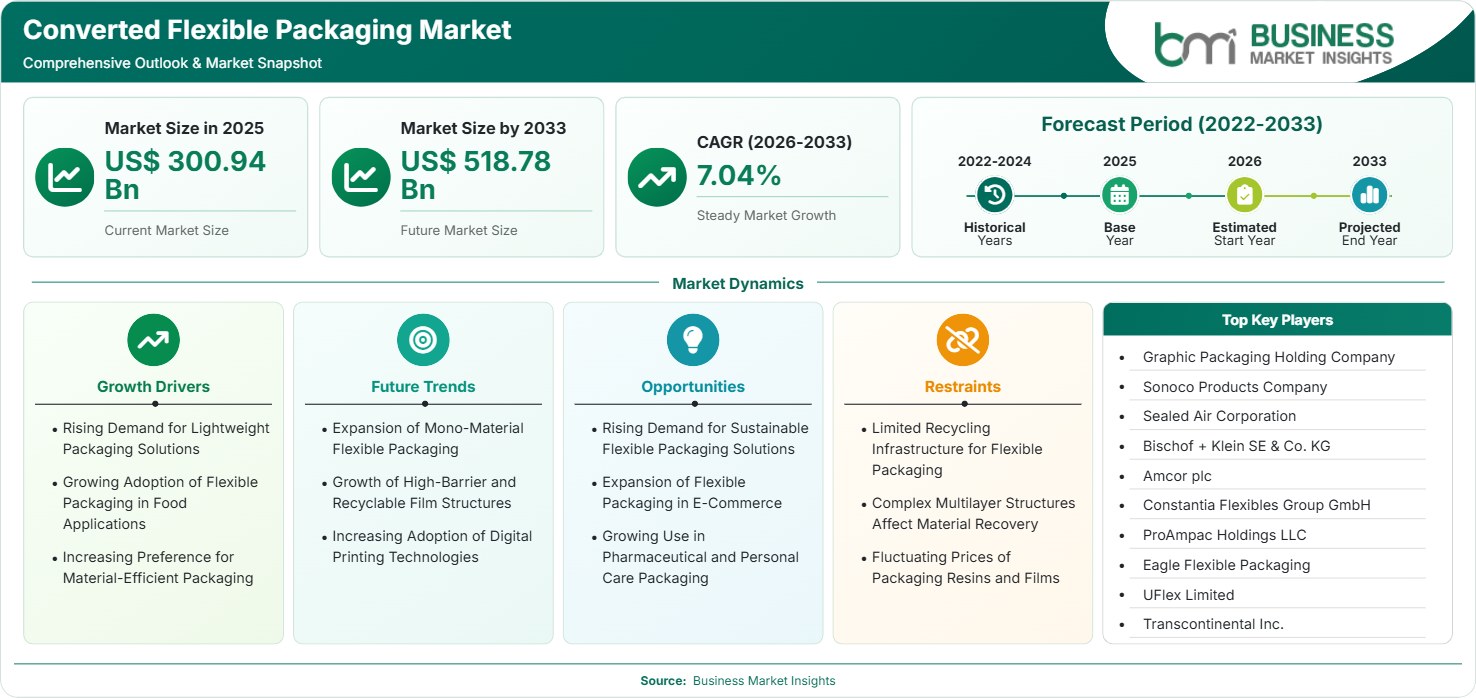
The Converted Flexible Packaging Market size was valued at US$ 300.94 Billion in 2025 and is projected to reach US$ 518.78 Billion by 2033, growing at a CAGR of 7.04% during 2026–2033, supported by sustainable packaging adoption, lightweight material demand, e-commerce expansion, advanced barrier technologies, and increasing packaged food consumption across developed and emerging economies.

Report Coverage
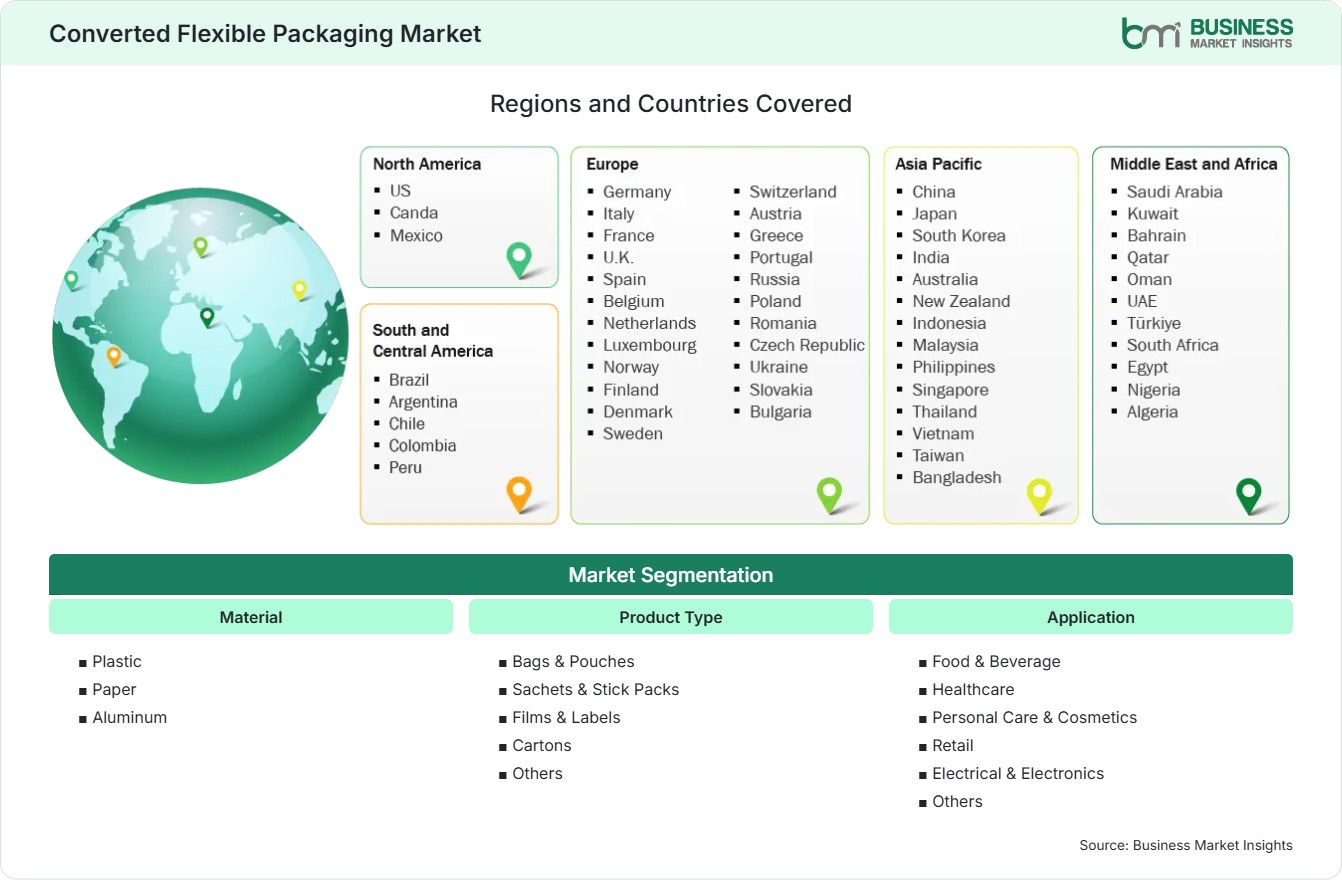
  • Material: Plastic, Paper, Aluminum
  • Product Type: Bags & Pouches, Sachets & Stick Packs, Films & Labels, Cartons, Others
  • Application: Food & Beverage, Healthcare, Personal Care & Cosmetics, Retail, Electrical & Electronics, Others
US$ 300.94 Bn Market size in 2025
US$ 518.78 Bn Market Size by 2033
7.04% CAGR, 2026 - 2033
2026-2033 Forecast Period

AI Overview

Converted Flexible Packaging Market Summary

  • North America Region: North America holds a converted flexible packaging market share of 34%–37% in 2025, growing with a CAGR of 5.8%–6.4% during 2026–2033. Growth is supported by packaged food demand, healthcare packaging innovation, sustainability initiatives, recycling infrastructure expansion, digital printing adoption, lightweight packaging preferences, advanced barrier technologies, supply chain efficiency improvements, brand differentiation strategies, and growing online retail activities.
  • Fastest Growing Region: Asia Pacific holds a market share of 28%–31% in 2025, growing with a CAGR of 8.5%–9.2% during 2026–2033. Growth is driven by manufacturing expansion, urbanization, rising disposable incomes, packaged food consumption growth, healthcare sector investments, sustainability programs, retail modernization, industrial development, technological advancements in converting processes, and increasing regional exports.
  • Leading Segment: Plastic accounts for 58%–61% of the market in 2025 and is expected to grow at a CAGR of 6.5%–7.1% during 2026–2033. Demand is supported by excellent barrier performance, lightweight characteristics, cost efficiency, design flexibility, product protection capabilities, extended shelf life requirements, transportation savings, compatibility with advanced printing technologies, and broad industrial applications.
  • High Growth Segment: Healthcare represents 13%–16% of the market in 2025 and is projected to expand at a CAGR of 8.4%–9.0% during 2026–2033. Growth is fueled by pharmaceutical production expansion, stringent safety requirements, medical device packaging demand, tamper-evident solutions, regulatory compliance standards, sterile packaging adoption, aging populations, and increasing healthcare expenditures globally.
  • Key Market Opportunity: Growing investment in recyclable mono-material structures, high-performance barrier films, digital printing technologies, and circular economy initiatives is creating substantial opportunities for converters serving food, healthcare, personal care, and retail packaging applications worldwide.
  • Major Market Players: Graphic Packaging Holding Company, Sonoco Products Company, Sealed Air Corporation, Bischof + Klein SE & Co. KG, Amcor plc, Constantia Flexibles Group GmbH, ProAmpac Holdings LLC, Eagle Flexible Packaging, UFlex Limited, and Transcontinental Inc.
Strategic Insights

Converted Flexible Packaging Market: Strategic Insights

Converted Flexible Packaging Market Strategic Framework
FREE PDF
Request your free sample
Request free sample
Stakeholder View

Key Takeaways

  • The converted flexible packaging market value chain is becoming increasingly integrated, with raw material suppliers, converters, printers, and brand owners collaborating to improve packaging functionality, sustainability, and operational efficiency.
  • The food and beverages sector accounts for the highest amount of revenue, whereas healthcare packaging holds potential for long-term growth on account of its safety and regulatory standards.
  • The trends in innovation are toward recyclable mono-material systems, barrier technologies, digital printing, and smart packaging.
  • Asia-Pacific has emerged as an ideal investment location owing to growing manufacturing output, increasing consumer expenditure, and growth in demand for packaged products.
  • Sustainability has shifted from being a competitive advantage to a strategic priority affecting product development, capital allocation, and long-term customer relations in the packaging industry.
Geographic Outlook

Converted Flexible Packaging Market Regional Highlights

North America Converted Flexible Packaging Market

North America accounted for 34%–37% of global revenue in 2025 and is projected to expand at a CAGR of 5.8%–6.4% during 2026–2033. The region benefits from strong demand across food processing, healthcare, and consumer goods industries. The Converted Flexible Packaging Market share remains significant due to advanced manufacturing capabilities, extensive recycling investments, and strong adoption of innovative barrier materials.

  • Manufacturers of food and beverages are increasingly switching from stiff to flexible packagings in order to cut down transportation costs, increase aesthetic value, and ensure environmental performance without sacrificing product integrity.
  • Digital printing usage is growing fast amongst converters as a result of the need for smaller batch sizes, more creative packaging design, quicker response times, and adaptation to shifting customer preferences.
  • The rise in e-commerce is driving the demand for durable, lightweight, and protective packaging which can sustain the quality of the products.

US Converted Flexible Packaging Market

The United States represents approximately 72%–76% of North American revenue and is anticipated to grow at a CAGR of 5.9%–6.5% through 2033. Strong packaged food consumption, advanced retail networks, healthcare sector expansion, and continuous packaging innovation support long-term converted flexible packaging market development.

  • The use of recyclable packaging by major consumer packaged goods corporations is becoming popular due to their focus on being sustainable and meeting consumer needs on environmental issues.
  • The purchase of modern converting machines has helped increase production efficiency, minimized waste creation, and developed high-value flexible packaging for premium uses.
  • Increased growth in the pharmaceutical industry has resulted in demand for flexible packaging that would provide security for the product quality and compliance.
  • The rise in the use of e-commerce sales channels has contributed to the need for lightweight and durable packaging.

Europe Converted Flexible Packaging Market

Europe accounted for 24%–27% of global revenue in 2025 and is expected to register a CAGR of 6.3%–6.9% during 2026–2033. Stringent environmental regulations, circular economy initiatives, and strong consumer awareness regarding sustainability continue influencing converted flexible packaging market development.

  • Germany is a market leader in terms of regional demand because of its well-developed manufacturing sector, advanced packaging solutions, and sustainable materials innovation.
  • Poland is one of the rapidly growing markets driven by industrial growth, export-based manufacturing, and investment in modern manufacturing facilities for packaging.
  • The market demand for healthcare packaging continues to be stable owing to production capacities, compliance regulations, and patient safety initiatives.
  • Flexible premium food packaging solutions continue driving the demand in the market because of their high-barrier properties.

Asia Pacific Converted Flexible Packaging Market

Asia Pacific represented 28%–31% of global revenue in 2025 and is projected to record the highest CAGR of 8.5%–9.2% during 2026–2033. Rapid industrialization, urbanization, and rising consumer spending are strengthening packaging demand across multiple sectors. China remains the largest regional market, while India demonstrates some of the fastest growth rates.

  • China ensures its leadership in the region by having large manufacturing facilities, healthy domestic consumption levels, and substantial investment in state-of-the-art packaging technology.
  • India represents one of the rapidly growing markets because of the need for packaged foods, development of the healthcare industry, modernization of retail channels, and increasing disposable incomes.
  • The increasing export of consumer goods necessitates effective packaging that can safeguard goods throughout long distances and time periods.
  • Governments of the regions encourage sustainable manufacturing and energy-efficient production technologies.
  • Expansion of organized retail and e-commerce platforms continues creating demand for visually appealing, durable, and cost-effective flexible packaging solutions.

Rest of World Converted Flexible Packaging Market

The Rest of World region accounted for 10%–13% of global revenue in 2025 and is expected to expand at a CAGR of 6.8%–7.5% through 2033. South & Central America benefits from food processing growth and rising packaged product consumption.

  • Brazil drives regional demand owing to its sizable consumer base, existing food processing industry, and investment in the development of packaging manufacturing facilities.
  • Saudi Arabia is one of the fastest growing markets because of industrial diversification initiatives, increasing manufacturing of consumer goods, and investments in sophisticated manufacturing facilities.
  • F&B packaging applications are key demand drivers in the developing countries driven by urbanization and changing lifestyles of consumers.
  • Moderation of retail sector and growth of distribution networks is increasing the demand for aesthetically pleasing and practical packaging solutions.
  • Investments in healthcare sector of several nations are encouraging the use of flexible packaging products catering to the needs of pharmaceutical and medical applications.
Global Market Geography
FREE PDF
Request your free sample
Request free sample
Segment Analysis

Converted Flexible Packaging Market Segmentation

Material

The material segment forms the foundation of industry performance, with plastic remaining the dominant category. This segment accounted for 58%–61% market share in 2025 and is projected to expand at a CAGR of 6.5%–7.1% during 2026–2033. The Converted Flexible Packaging Market scope continues expanding as manufacturers develop innovative material combinations that balance environmental performance with product protection and operational efficiency.

  • Plastic: Plastic materials remain widely adopted because of their lightweight properties, excellent barrier performance, design flexibility, and compatibility with advanced printing and converting technologies across diverse industrial applications.
  • Paper: Paper-based solutions are gaining traction as sustainability initiatives accelerate. Growing consumer preference for renewable materials and regulatory support for recyclable packaging continue encouraging adoption across end-use industries.
  • Aluminum: Aluminum materials are valued for superior barrier protection against moisture, oxygen, and light. Their use remains particularly important in pharmaceutical, food preservation, and high-performance packaging applications.

Product Type

Product innovation continues to shape demand patterns across the packaging industry. Bags & pouches represented approximately 36%–39% of market revenue in 2025 and are expected to register a CAGR of 7.4%–8.0% through 2033. The Converted Flexible Packaging Market trends indicate increasing adoption of convenience-oriented formats that improve storage, transportation efficiency, shelf visibility, and product differentiation while supporting sustainability and consumer convenience objectives.

  • Bags & Pouches: Bags and pouches remain highly preferred due to convenience, portability, resealability, and efficient material utilization. Their versatility supports applications ranging from food products to healthcare and personal care packaging.
  • Sachets & Stick Packs: Sachets and stick packs continue gaining popularity in single-use and portion-controlled applications, particularly within food, pharmaceutical, and cosmetic sectors where convenience and affordability are critical.
  • Films & Labels: Films and labels play a crucial role in branding, product protection, and information delivery. Demand is supported by technological advancements in printing quality and functional barrier capabilities.
  • Cartons: Flexible carton formats are increasingly utilized for lightweight packaging solutions that combine structural integrity with enhanced visual appeal and improved logistics efficiency.

Application

Application diversity remains a key growth characteristic of the market. Food & Beverage accounted for approximately 42%–46% of global revenue in 2025 and is expected to grow at a CAGR of 6.8%–7.4% through 2033. The Converted Flexible Packaging Market share remains heavily influenced by food industry purchasing patterns and evolving consumer preferences.

  • Food & Beverage: Food and beverage applications dominate demand due to high consumption volumes, shelf-life requirements, product safety considerations, and ongoing innovation in convenience-oriented packaging formats.
  • Healthcare: Healthcare applications are experiencing strong momentum supported by pharmaceutical production growth, stringent compliance standards, tamper-evident requirements, and increasing demand for sterile packaging solutions.
  • Personal Care & Cosmetics: Personal care and cosmetic brands increasingly utilize premium flexible packaging formats to improve product presentation, convenience, and sustainability while supporting brand differentiation strategies.
  • Retail: Retail applications benefit from demand for visually appealing packaging that enhances consumer engagement, supports branding objectives, and optimizes transportation and inventory management efficiency.
  • Electrical & Electronics: Electronics packaging requires protective solutions capable of preventing contamination, moisture exposure, and physical damage while supporting efficient transportation and storage requirements.
Market Forces

Converted Flexible Packaging Market Dynamics

Key Market Drivers

Expansion of Global Packaged Food Consumption

The rising trend in the consumption of packaged and processed foods remains a primary factor driving the industry. The food producers are now opting for flexible packaging since it helps in minimizing materials used, making transport easier, and increasing the shelf-life due to its superior barrier properties. The Converted Flexible Packaging Market growth will largely be driven by the requirements of packaging that keeps the food fresh, minimizes food wastage, and enables better distribution. Rapid growth in the market of ready-to-eat food, snack foods, frozen foods, and high-end packaging is leading to investments in advanced converting technologies and material structures.

Growing Sustainability and Circular Economy Initiatives

Sustainability has become a primary strategic priority across the packaging value chain. Governments, brand owners, retailers, and consumers are increasingly demanding solutions that reduce environmental impact while maintaining product performance. Regulatory frameworks in North America, Europe, and Asia are encouraging recyclable, reusable, and resource-efficient packaging formats. Manufacturers are investing heavily in mono-material structures, recycled-content solutions, and advanced recovery systems to address evolving requirements. Converted Flexible Packaging Market trends increasingly reflect the industry's transition toward circular economy principles. Lightweight packaging formats also contribute to lower transportation emissions compared with many rigid alternatives. As sustainability commitments become integrated into corporate procurement strategies, converters capable of delivering environmentally responsible solutions are expected to strengthen their competitive positioning and customer relationships.

Advancements in Printing and Converting Technologies

Advancements in technology continue to revolutionize the ability of packaging manufacturing. With modern printing, lamination, automatic inspection technology, and converting equipment, packaging manufacturers are in a better position to customize, increase quality consistency, and decrease production time. In addition, brand owners continue to demand customized packaging designs according to target consumer groups and promotions. Advancing converting technologies ensure that there is more flexibility in production without increasing wastage and cost.

Key Market Opportunities

Development of Recyclable Mono-Material Packaging Solutions

Demand for recyclable packaging structures presents one of the most significant long-term opportunities for industry participants. As regulatory requirements become stricter and sustainability goals intensify, converters are accelerating development of mono-material solutions capable of delivering comparable barrier performance. Investment in recyclable polyethylene and polypropylene structures is expanding rapidly across food, healthcare, and personal care applications. Converted Flexible Packaging Market Forecasts indicate increasing adoption of these solutions as global consumer brands seek scalable pathways toward circular packaging objectives. Companies that successfully balance functionality, cost competitiveness, and recyclability are expected to secure stronger customer relationships and gain access to premium growth opportunities across multiple end-use sectors.

Healthcare Packaging Expansion Across Emerging Markets

Healthcare infrastructure development across emerging economies is creating substantial opportunities for flexible packaging suppliers. Pharmaceutical manufacturing investments, expanding medical device production, and rising healthcare expenditures are increasing demand for high-performance packaging solutions. Sterility requirements, product safety considerations, and regulatory compliance standards necessitate sophisticated packaging formats capable of protecting sensitive products throughout supply chains. Countries across Asia Pacific, Latin America, and the Middle East are strengthening domestic pharmaceutical capabilities, creating new demand centers for converters. Companies with expertise in barrier materials, tamper-evident technologies, and specialized healthcare packaging formats are well positioned to capitalize on these developments while benefiting from long-term demographic and healthcare trends.

Growth of Digital Printing and Personalized Packaging

New ways of differentiation and consumer involvement are being created through digital printing technologies. Brand owners are more interested in the creation of customized packaging designs to be used in their marketing strategies. Unlike conventional printing technologies, digital printing enables the creation of limited production runs as well as modifications to the designs easily without incurring huge set up costs. The advantage of flexibility makes it a good choice for consumer goods firms working in volatile environments. Customized packaging also increases consumer involvement in addition to reinforcing their brand loyalty. The adoption of digital printing technologies will increase as the technology becomes more efficient in terms of quality and speed.

Market Restraints and Challenges

Volatility in Raw Material Pricing

Factor: The industry remains highly dependent on petroleum-derived resins, specialty films, aluminum, and paper-based materials whose prices are influenced by energy markets, geopolitical developments, and supply-demand fluctuations. Impact: Raw material volatility creates uncertainty in production planning, procurement strategies, and profit margins. Manufacturers frequently face challenges in passing cost increases to customers, particularly under long-term supply agreements. As sustainability requirements increase demand for specialized materials, supply constraints may further intensify cost pressures throughout the value chain, affecting operational performance and long-term profitability.

Increasing Regulatory Complexity and Compliance Costs

Factor: Packaging regulations are becoming more comprehensive, covering recyclability, material composition, labeling requirements, extended producer responsibility obligations, and environmental performance standards across multiple jurisdictions. Impact: Compliance with evolving regulations often requires significant investments in research, testing, certification, and product redesign. Frequent regulatory changes can also shorten product development cycles and increase administrative burdens. These challenges require continuous monitoring and adaptation, potentially affecting profitability while creating barriers for smaller organizations with limited technical and regulatory resources.

Company Analysis

Competitive Landscape

The competitive environment remains characterized by continuous product innovation, sustainability-focused investments, strategic partnerships, and capacity expansions. Converted Flexible Packaging Market analysis indicates that leading companies are prioritizing recyclable material development, advanced barrier technologies, digital printing capabilities, and geographic expansion to strengthen their market positions and address evolving customer requirements.

Company Name

Overview

Products and Services Relevant to this Market

Graphic Packaging Holding Company

Global packaging manufacturer serving food, beverage, consumer products, and healthcare industries through extensive production and innovation capabilities.

Flexible packaging solutions, sustainable packaging formats, barrier materials, printed packaging products, and customized packaging systems.

Sonoco Products Company

Diversified packaging company with a strong presence across consumer, industrial, healthcare, and protective packaging markets worldwide.

Flexible packaging, laminated structures, pouches, films, healthcare packaging, and packaging design services.

Sealed Air Corporation

Leading provider of packaging and protective solutions focused on food safety, sustainability, and operational efficiency.

Flexible food packaging, barrier films, protective materials, vacuum packaging, and automation-related solutions.

Bischof + Klein SE & Co. KG

European packaging specialist recognized for innovation in flexible materials and sustainable packaging technologies.

Printed films, industrial packaging, food packaging materials, recyclable structures, and customized flexible packaging solutions.

Amcor plc

One of the world's largest packaging companies with extensive global manufacturing and research capabilities.

Flexible packaging, healthcare packaging, barrier films, recyclable materials, and advanced packaging technologies.

Constantia Flexibles Group GmbH

International packaging company serving food, pharmaceutical, and consumer goods industries through innovative solutions.

Flexible laminates, pharmaceutical packaging, aluminum-based solutions, recyclable packaging, and customized packaging formats.

ProAmpac Holdings LLC

Flexible packaging manufacturer focused on innovation, sustainability, and performance-driven packaging products.

Pouches, films, rollstock, sustainable packaging products, specialty materials, and printing services.

Eagle Flexible Packaging

Specialized packaging provider serving food, industrial, and consumer product manufacturers with customized solutions.

Flexible packaging materials, pouches, printed films, barrier packaging, and specialty packaging applications.

UFlex Limited

Integrated packaging solutions provider with significant manufacturing capabilities across multiple international markets.

Flexible films, laminates, aseptic packaging, printing solutions, and sustainable packaging products.

Transcontinental Inc.

Packaging and printing company with strong expertise in flexible packaging technologies and customer-focused innovation.

Flexible packaging, shrink films, pouches, printed packaging, and specialty packaging solutions.

Trust & Transparency

Research Methodology

The market analysis combines proprietary research with secondary data from government agencies, company disclosures, regulatory filings, industry databases and expert interviews. Market estimates are validated through data triangulation, cross-market benchmarking and analyst review.

View Full Research Methodology

Questions Answered

Frequently Asked Questions

What insights are included in a Converted Flexible Packaging Market Report?

The report typically includes market sizing, segmentation analysis, regional outlooks, competitive benchmarking, technology developments, sustainability trends, growth opportunities, regulatory impacts, and strategic recommendations for stakeholders.

What are the most important technology trends shaping the industry?

Key trends include digital printing, recyclable mono-material structures, advanced barrier coatings, smart packaging integration, automation in converting processes, and enhanced quality-control technologies that improve manufacturing efficiency.

Which application segment generates the highest revenue?

Food and beverage applications account for the largest revenue contribution because of high packaging consumption volumes, shelf-life requirements, convenience trends, and continuous innovation in product packaging formats.

How does flexible packaging support sustainability objectives?

Flexible packaging generally uses less material than many rigid alternatives, reduces transportation-related emissions through lower weight, and increasingly incorporates recyclable structures and recycled content to support circular economy goals.

What factors are driving demand for converted flexible packaging?

Demand is primarily driven by packaged food consumption, sustainability initiatives, e-commerce growth, lightweight packaging requirements, healthcare sector expansion, and advancements in barrier material technologies that improve product protection and shelf life.

Access the Full Converted Flexible Packaging Market Report

Get segment-level forecasts, regional estimates, competitive benchmarking, company profiles and downloadable Excel datasets.

Access the full Converted Flexible Packaging Market Report
350 pages PDF & Excel | 2026-09-15
Similar Research

Related Market Reports