Market Summary
Executive Summary and Global Market Analysis
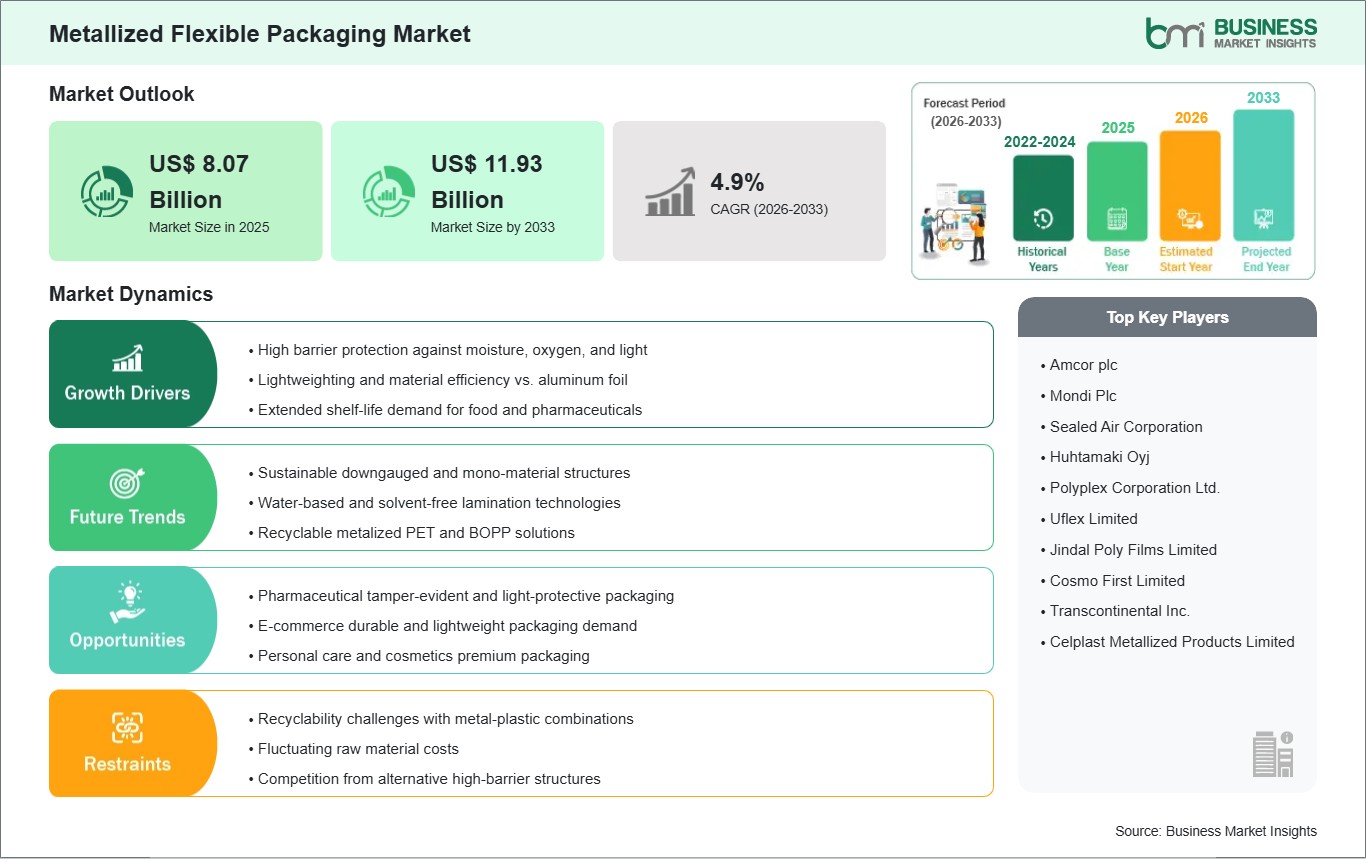
Metallized flexible packaging consists of pliable substrates coated or laminated with a thin metallic layer to improve barrier performance, surface appearance, and converting efficiency. These materials are designed to protect products from moisture, oxygen, light, and aroma migration while supporting lightweight pack formats. Their use spans food packs, healthcare wraps, decorative applications, and printed laminates where shelf stability and visual differentiation must be balanced within compact packaging structures.
Market momentum reflects the shift toward pack designs that combine barrier protection with material efficiency. Brand owners are selecting metallized formats to maintain product integrity without relying solely on rigid alternatives. Format flexibility, print compatibility, and improved machinability support broader use across snack foods, beverages, personal care items, and pharmaceutical unit packs. This operating profile aligns with procurement priorities centered on shelf life, transport efficiency, and differentiated on-shelf presentation.
Segmentation patterns indicate clear variation by material and format. Aluminum Foil Based structures remain relevant where barrier intensity and product sensitivity are central purchasing criteria, while Metalized Film supports lighter constructions and broader converting flexibility. Pouches and roll stock hold strong relevance because they integrate well with high-speed filling lines and diverse pack sizes. Across applications, packaging and printing & lamination represent core demand centers due to their direct influence on product protection and visual execution.
Technical development is refining metallization quality, downgauging strategies, and film-layer compatibility. Producers are improving coating uniformity, seal behavior, and substrate performance to support more efficient conversion across end-use industries. The competitive environment remains shaped by material specialization, application breadth, and the ability to align performance with sustainability expectations. Suppliers that can deliver reliable barrier outcomes, visual consistency, and portfolio breadth across food, healthcare, and consumer applications are better positioned within this sector.
Segment Analysis
Metallized Flexible Packaging Market Segmentation
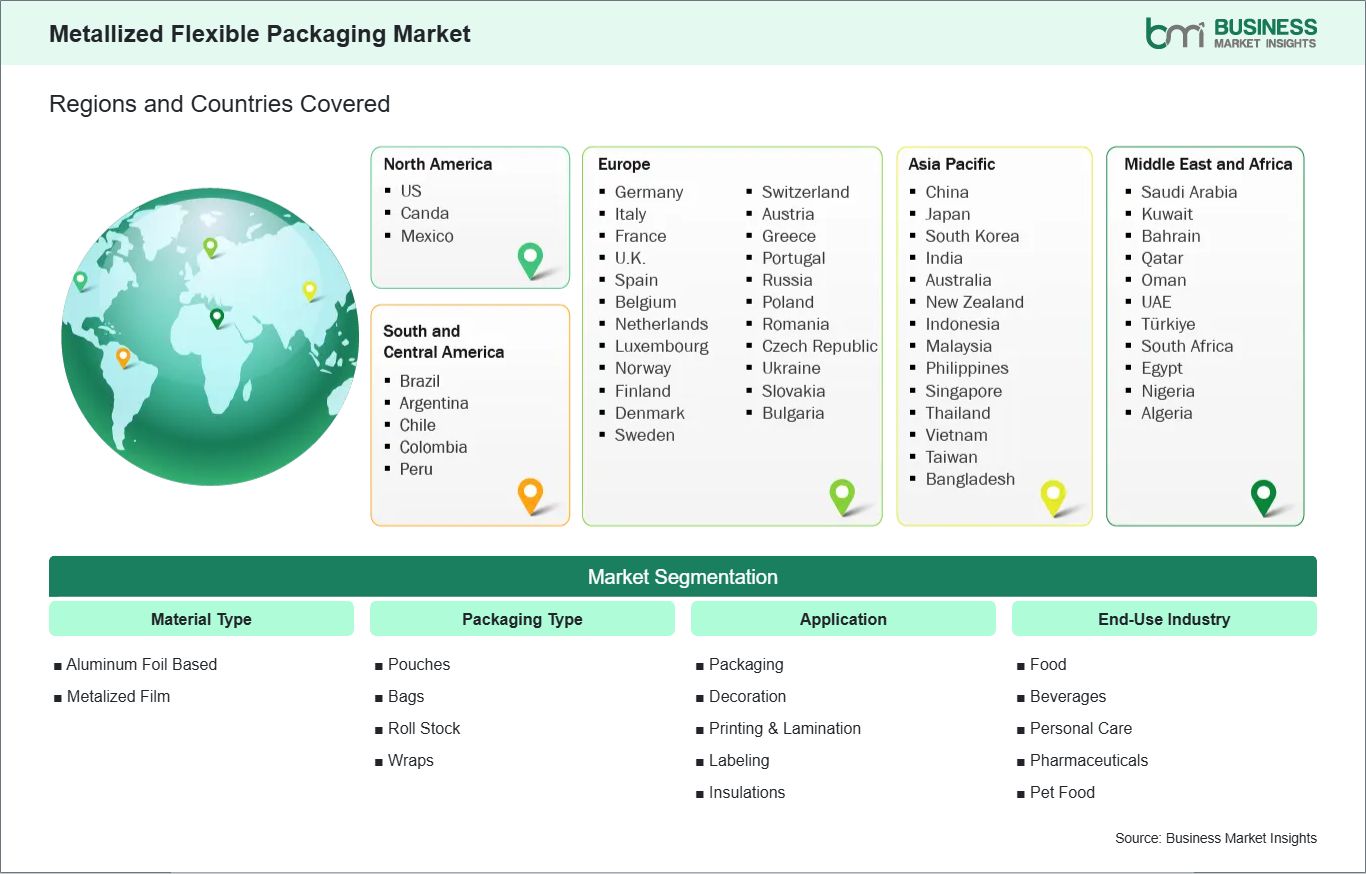
The market is segmented by Material Type, Packaging Type, Application, and End-Use Industry to reflect performance requirements and conversion priorities across supply chains.
By Material Type
- Aluminum Foil Based: Selected for strong barrier control in sensitive product packaging.
- Metalized Film: Preferred for lightweight construction, printability, and converting versatility.
By Packaging Type
- Pouches: Support convenience formats, efficient sealing, and strong shelf presence.
- Bags: Used for bulk and retail packs requiring durable flexible protection.
- Roll Stock: Enables high-throughput packaging operations across standardized production lines.
- Wraps: Applied where surface coverage and presentation quality are equally important.
By Application
- Packaging: Represents the core use case for barrier protection and pack efficiency.
- Decoration: Adds metallic finish and visual distinction for consumer-facing products.
- Printing & Lamination: Supports multilayer structures and enhanced graphics performance.
- Labeling: Used where reflective appearance and product differentiation matter.
- Insulations: Applied in structures requiring reflective and protective material functions.
By End-Use Industry
- Food: Requires barrier packaging to preserve taste, texture, and freshness.
- Beverages: Uses metallized formats for portion packs and specialty drink applications.
- Personal Care: Leverages premium appearance and product protection in flexible formats.
- Pharmaceuticals: Depends on protective layers that support product stability and compliance.
- Pet Food: Adopts durable barrier packs for aroma retention and shelf handling.
Market Forces
Metallized Flexible Packaging Market Drivers and Opportunities
Need for High-Barrier, Lightweight Packaging Formats
Product categories sensitive to oxygen, moisture, aroma loss, and light exposure require packaging layers that preserve contents without adding structural bulk. Metallized flexible formats address this need by combining protective performance with lower material intensity than many rigid alternatives. Their compatibility with pouches, bags, and roll stock makes them suitable for large production runs across food, beverages, pharmaceuticals, and pet food, where package efficiency directly affects operational decisions.
The result is a material category that supports shelf-life protection, transport practicality, and stronger print execution within a single pack system. This relevance becomes more pronounced where brand owners need premium appearance alongside functional containment. As end-use industries refine pack design for convenience, differentiation, and inventory efficiency, metallized flexible packaging remains closely aligned with those commercial and technical requirements.
Advancement in Sustainable Film Structures and Converting Design
Innovation opportunities are emerging through thinner film constructions, improved coating consistency, and structure designs that better align with recycling expectations. Manufacturers are refining metallized film solutions that maintain barrier performance while supporting downgauging and broader converting adaptability. These improvements open room for new pouch, wrap, and label concepts where visual appeal, seal performance, and product protection must coexist within streamlined material architectures.
Future scope extends across premium food formats, healthcare packs, personal care sachets, and specialized laminates where material balance influences supplier selection. Expansion potential is strongest for solutions that reduce structural complexity without compromising performance. Suppliers that translate coating innovation into scalable commercial formats can improve pack efficiency, widen application reach, and strengthen their position as sustainability and functionality become more tightly linked.
Size and Share Analysis
Metallized Flexible Packaging Market Size and Share Analysis
The Metallized Flexible Packaging market size is expected to reach US$ 11.93 Billion by 2033 from US$ 8.07 Billion in 2025. The market is estimated to record a CAGR of 4.9% from 2026 to 2033. This trajectory reflects steady expansion supported by durable demand for protective, lightweight, and visually differentiated pack formats across consumer and industrial applications.
By material type, Aluminum Foil Based packaging retains a strong position where barrier intensity and product sensitivity shape procurement choices. By packaging type, Pouches hold a leading role because they combine efficient storage, strong shelf presentation, and operational compatibility across filling lines. Metalized Film and Roll Stock continue to gain relevance where material efficiency and converting flexibility influence pack development.
By application, Packaging represents the principal demand center due to its direct connection to shelf life, transport resilience, and merchandising needs. Printing & Lamination also maintains notable relevance as converters seek structures that combine barrier behavior with visual consistency. Across end-use industries, Food remains the most established outlet, while pharmaceuticals and personal care sustain broader specification requirements for performance-oriented flexible materials.
Report Coverage
Metallized Flexible Packaging Market Report Coverage and Deliverables
The "Metallized Flexible Packaging Market Size and Forecast (2022-2033)" report provides a detailed analysis of the market covering the areas below:
- Market size and forecast at global, regional, and country levels for all the key market segments covered under the scope
- Market trends, as well as market dynamics such as drivers, restraints, and key opportunities
- Market analysis covering key market trends, global and regional framework, major players, regulations, and recent market developments
- Industry landscape and competition analysis covering market concentration, heat map analysis, prominent players, and recent developments for the market
- Detailed company profiles, including SWOT analysis
Geographic Insights
Metallized Flexible Packaging Market Geographic Insights
The Metallized Flexible Packaging market shows diverse regional adoption patterns influenced by end-use mix, converting capabilities, retail packaging formats, and regulatory direction on material performance. At a global level, demand reflects the need for barrier-oriented flexible structures that can protect contents while supporting efficient distribution and attractive presentation. Regional priorities differ according to manufacturing depth, consumer packaging preferences, and the maturity of downstream food, healthcare, and personal care industries.
North America benefits from established converting infrastructure and strong specification standards across packaged foods, pharmaceuticals, and premium consumer goods. Demand in the region is closely tied to performance consistency, convenience packaging, and design quality. Buyers often prioritize structures that deliver stable barrier behavior and support efficient filling operations, which reinforces the role of metallized pouches, bags, and laminated formats across mainstream retail channels.
Asia Pacific represents a broad manufacturing and consumption base where metallized flexible packaging aligns with expanding packaged food distribution, personal care demand, and industrial converting activity. The region supports high-volume production across films, laminates, and printed flexible materials, creating favorable conditions for scale deployment. Application diversity and cost-performance balancing remain central themes as suppliers address both domestic consumption and export-oriented packaging requirements.
Europe emphasizes technical compliance, material optimization, and premium pack execution across food, healthcare, and labeling applications. Emerging markets in the Middle East and Africa and South and Central America are progressing through wider packaged goods penetration, local conversion investment, and evolving retail presentation standards. Together, these regions extend the industry’s opportunity base by increasing the use of flexible structures that combine protection, shelf visibility, and handling efficiency.
Industry Activity
Recent Developments
Recent activity in the market highlights product refinement and capacity alignment across metallized film and flexible packaging applications.
- In February 2026, S-OneLP is excited to announce the launch of our 3.5mil Metallized PCR 36% Stand Up Pouch Web. Engineered with advanced chemical recycling, this film eliminates common post-consumer recycled (PCR) challenges like gels’ surface inconsistency and poor curl control. During trials on HP Indigo 20K, 25K, and 200K Digital Presses, the film ran flawlessly and proved to be a true drop in replacement for conventional 4mil metallized (MET) structures.
- In July 2025, Dai Nippon Printing Co., Ltd. (DNP) has developed Vacuum Metalized High Barrier PP Film, suitable for mono-material packaging’s base material. The new film has high barrier property against oxygen and water vapor, as well as a high lightproof property. Mono-material packaging using this product exhibits almost double the barrier performance compared to the DNP’s conventional mono-material packaging2.
Trust & Transparency
Research Methodology
The market analysis combines proprietary research with secondary data from government agencies, company disclosures, regulatory filings, industry databases and expert interviews. Market estimates are validated through data triangulation, cross-market benchmarking and analyst
review.
View Full Research Methodology
Key Sources Referred:
Industry reports on metallized films and flexible packagingGovernment trade and manufacturing dataPackaging and materials science journalsCompany annual reports and investor filingsCorporate product announcements and technical notesAcademic studies on barrier materials and coatingsIndustry association publications