
Polyethylene Foams Market Outlook: Size, Share, Trends, Growth Analysis, Competitive Landscape & Forecast, 2026-2033

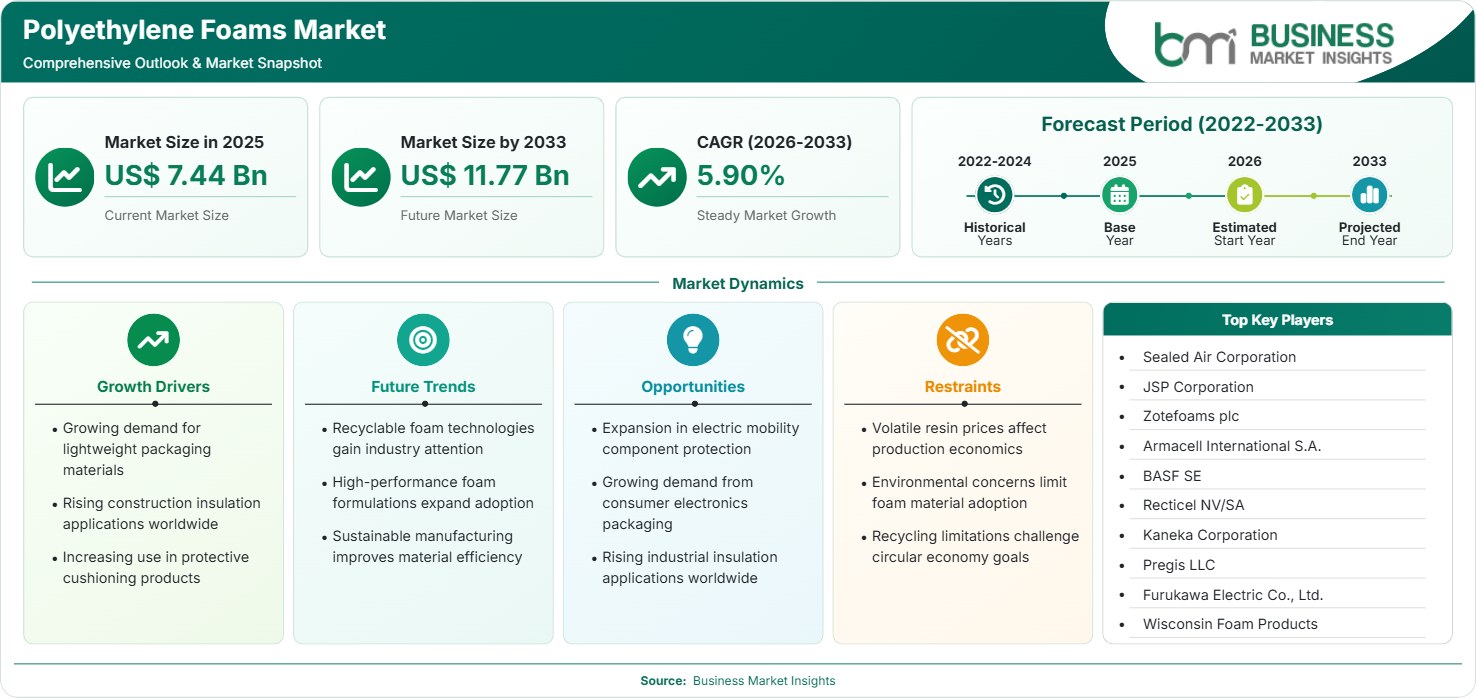
The Polyethylene Foams Market size was valued at US$ 7.44 billion in 2025 and is projected to reach US$ 11.77 billion by 2033, growing at a CAGR of 5.90% during 2026–2033. Growing demand for lightweight packaging materials, increasing insulation applications, and rising adoption of protective cushioning solutions continue supporting market expansion across industries.

Report Coverage
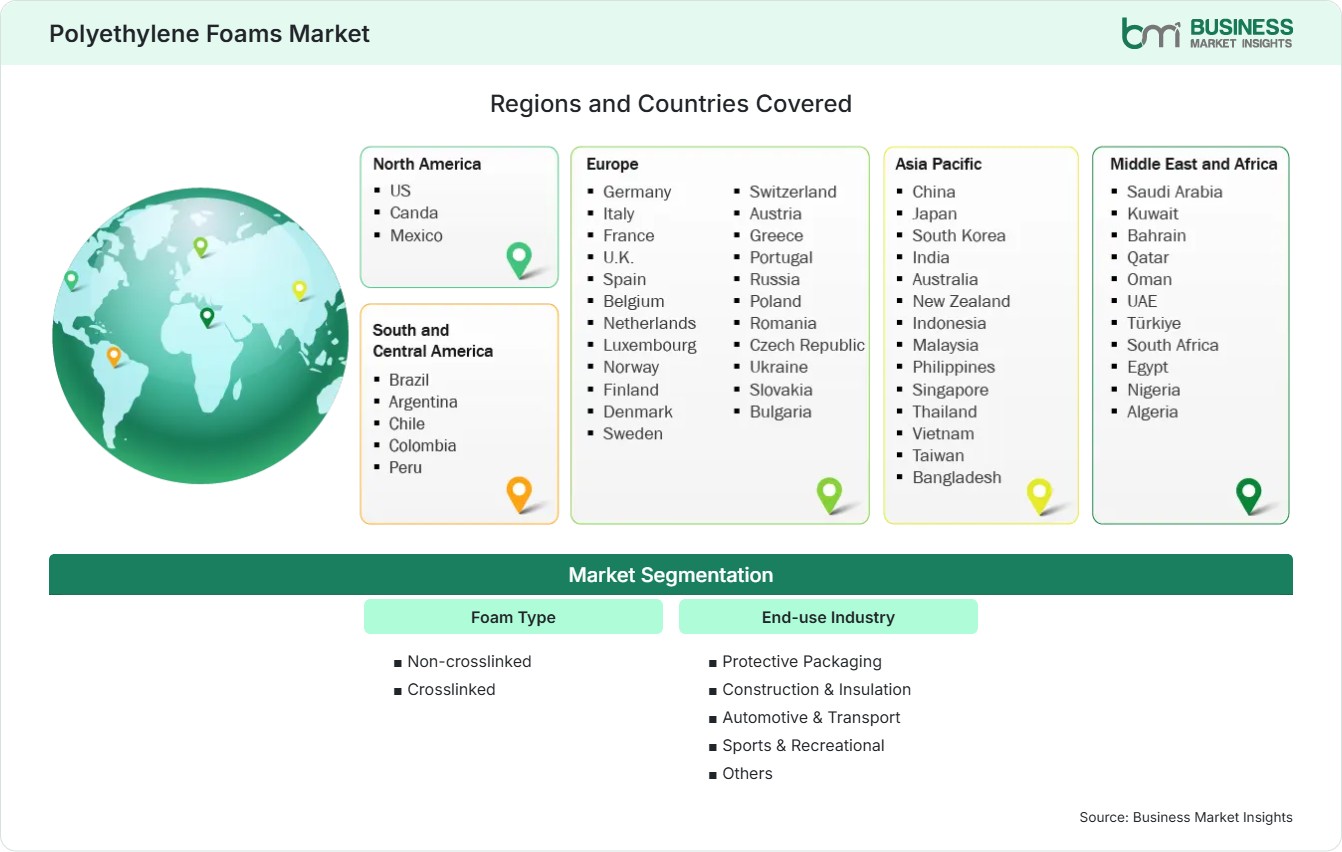
  • Foam Type: Non-crosslinked, Crosslinked
  • End-use Industry: Protective Packaging, Construction & Insulation, Automotive & Transport, Sports & Recreational, Others
US$ 7.44 Bn Market size in 2025
US$ 11.77 Bn Market Size by 2033
5.90% CAGR, 2026 - 2033
2026-2033 Forecast Period

01 AI Overview

Polyethylene Foams Market Summary

  • North America Region: North America holds 31%–34% market share in 2025 and is projected to grow at a CAGR of 5.4%–5.9% during 2026–2033. Strong packaging demand, automotive production, and construction insulation activities support regional growth. The U.S. represents the largest contributor with a CAGR of 5.5%–6.0%, driven by industrial packaging demand and infrastructure renovation activities.
  • Fastest Growing Region: Asia Pacific accounts for 38%–41% market share in 2025 and is expected to register a CAGR of 6.3%–6.8%, supported by expanding manufacturing activities, electronics production, construction development, and increasing demand for protective packaging materials.
  • Leading Segment: Non-crosslinked (EPE) represents 57%–60% market share in 2025 and is anticipated to grow at a CAGR of 5.5%–6.0%, supported by lightweight packaging applications, cost efficiency, and widespread adoption across transportation and consumer goods industries.
  • High Growth Segment: Automotive & Transport captures 22%–25% market share in 2025 and is projected to expand at a CAGR of 6.4%–6.9%, driven by lightweight component protection requirements, electric vehicle production, and improved impact absorption needs.
  • Key Market Opportunity: Increasing electric vehicle adoption, electronics shipment growth, and demand for advanced insulation solutions are creating opportunities for manufacturers developing sustainable and high-performance polyethylene foam products.
  • Major Market Players: Sealed Air Corporation, JSP Corporation, Zotefoams plc, Armacell International S.A., BASF SE, Recticel NV/SA, Kaneka Corporation, Pregis LLC, Furukawa Electric Co., Ltd., and Wisconsin Foam Products.
02 Strategic Insights

Polyethylene Foams Market: Strategic Insights

Polyethylene Foams Market Strategic Framework
FREE PDF
Request your free sample
Request free sample
03 Stakeholder View

Key Takeaways

  • Packaging remains the primary demand contributor as manufacturers increasingly replace heavier protective materials with lightweight foam solutions that reduce transportation costs and improve product safety.
  • Electric mobility represents a major opportunity area as battery systems, vehicle interiors, and electronic components require reliable cushioning and insulation materials.
  • Material innovation is becoming a competitive priority, with companies focusing on recyclable foam structures, improved thermal performance, and advanced manufacturing techniques.
  • Asia Pacific provides strong investment potential due to expanding industrial production, electronics manufacturing, construction activities, and increasing regional packaging consumption.
  • Strategic collaborations between foam manufacturers and end-use industries are increasing product customization and accelerating adoption across specialized applications.
  • Sustainability initiatives are encouraging companies to develop environmentally responsible foam alternatives while maintaining performance and cost efficiency.
04 Geographic Outlook

Polyethylene Foams Market Regional Highlights

North America Polyethylene Foams Market

North America accounts for 31%–34% Polyethylene Foams Market share in 2025 and is expected to expand at a CAGR of 5.4%–5.9% during 2026–2033. Regional demand is supported by advanced manufacturing, strong packaging industries, automotive production, and infrastructure renovation activities. Companies are increasingly adopting polyethylene foams for protective packaging, insulation, and transportation applications due to their lightweight characteristics and impact resistance.

  • E-commerce expansion continues increasing demand for protective packaging solutions across consumer goods and industrial shipments.
  • Automotive manufacturers utilize polyethylene foams for lightweight protection and improved vehicle component durability.
  • Construction renovation activities support adoption of insulation materials with improved energy efficiency.
  • Sustainable packaging initiatives encourage development of recyclable and efficient foam solutions.

US Polyethylene Foams Market

The United States contributes 82%–85% of North American revenue and is projected to grow at a CAGR of 5.5%–6.0% through 2026–2033. Strong industrial production, packaging demand, and automotive manufacturing continue supporting market development. Companies are focusing on high-performance foam solutions for transportation, electronics protection, and construction insulation applications.

  • Advanced manufacturing industries continue driving demand for engineered foam materials.
  • Logistics and e-commerce sectors increase requirements for protective cushioning products.
  • Automotive suppliers adopt lightweight foam materials for component protection.
  • Energy-efficient construction practices encourage insulation material adoption.

Europe Polyethylene Foams Market

Europe represents 24%–27% market share in 2025 and is forecast to grow at a CAGR of 5.2%–5.7% during the forecast period. Demand is influenced by automotive manufacturing, sustainable packaging initiatives, and energy-efficient building requirements. Germany remains the leading market, while Poland and Spain demonstrate higher growth potential due to expanding industrial production and construction activities.

  • Strict energy efficiency standards support increased use of insulation materials in buildings.
  • Automotive manufacturing continues generating demand for protective foam components.
  • Sustainable packaging regulations encourage recyclable material development.
  • Industrial applications continue expanding through manufacturing modernization initiatives.

Asia Pacific Polyethylene Foams Market

Asia Pacific holds 38%–41% market share in 2025 and is projected to record the fastest 6.3%–6.8% CAGR through 2026–2033. Rapid industrialization, electronics manufacturing growth, construction expansion, and rising packaging consumption support regional dominance. China leads regional demand, while India records strong growth due to manufacturing investments and infrastructure development.

  • Electronics manufacturing expansion increases demand for protective packaging materials.
  • Construction growth supports insulation foam adoption across residential and commercial projects.
  • Automotive production increases usage of lightweight protective materials.
  • Growing export activities strengthen demand for transportation packaging solutions.

Rest of World Polyethylene Foams Market

The Rest of World region accounts for 6%–9% market share in 2025 and is expected to grow at a CAGR of 5.5%–6.1% during 2026–2033. Growth across Latin America, the Middle East, and Africa is supported by industrial development, construction activities, and expanding packaging requirements.

  • Brazil remains a key market due to manufacturing growth and packaging demand.
  • Middle Eastern construction projects support insulation material adoption.
  • Industrial expansion in Africa increases demand for protective packaging solutions.
  • Growing trade activities encourage use of lightweight transportation materials.
Global Market Geography
FREE PDF
Request your free sample
Request free sample
05 Segment Analysis

Polyethylene Foams Market Segmentation

Foam Type

The foam type segment plays a crucial role in determining product performance, cost efficiency, and application suitability across packaging, automotive, and construction industries. The segment accounted for 57%–60% market share in 2025 and is projected to expand at a CAGR of 5.5%–6.0% during 2026–2033. Demand is influenced by lightweight material requirements, impact protection needs, and increasing adoption of customized foam structures. Manufacturers are focusing on improving durability, recyclability, and thermal properties to address evolving customer requirements across multiple industries.

  • Non-crosslinked (EPE): Non-crosslinked polyethylene foam remains widely adopted due to its flexibility, lightweight structure, cost-effectiveness, and excellent cushioning properties. It is extensively used in packaging, consumer goods, and industrial protection applications.
  • Crosslinked (XLPE/IXPE): Crosslinked polyethylene foams are gaining demand due to enhanced durability, chemical resistance, thermal stability, and superior surface quality. They are preferred in automotive, electronics, insulation, and specialized industrial applications.

End-use Industry

The end-use industry segment reflects increasing adoption across packaging, transportation, construction, and recreational applications requiring lightweight and protective materials. The segment accounted for 36%–39% market share in 2025 and is expected to register a CAGR of 6.0%–6.5% during 2026–2033. Rising Polyethylene Foams Market trends indicate greater utilization of advanced foam solutions that provide impact resistance, insulation performance, and material efficiency across diverse industrial environments.

  • Protective Packaging: Represents a major application area as businesses increasingly require cushioning materials for electronics, consumer goods, industrial equipment, and fragile products during transportation and storage.
  • Construction & Insulation: Demand continues increasing as builders adopt lightweight insulation materials that improve thermal efficiency, moisture resistance, and overall building energy performance.
  • Automotive & Transport: Growth is supported by increasing vehicle production, electric mobility expansion, and rising demand for lightweight protective materials used in interiors, components, and transportation systems.
  • Sports & Recreational: Polyethylene foams are utilized in sports equipment, fitness products, and recreational goods due to their flexibility, shock absorption, buoyancy, and user safety benefits.
  • Others: Additional applications include healthcare, marine, industrial products, and specialty manufacturing sectors where lightweight protection, insulation, and durability are required.
06 Market Forces

Polyethylene Foams Market Dynamics

Key Market Drivers

Growing demand for lightweight packaging materials

The increasing focus on reducing transportation costs, improving handling efficiency, and minimizing packaging weight is accelerating the adoption of lightweight protective materials across industries. Polyethylene foam is ideal for use in electronics, consumer goods, industrial equipment, and online product delivery due to its cushioning, shock-absorption, and high elasticity. With increased global shipping, manufacturers are looking for ways to ship their products safely while using less material. According to packaging industry trends, companies are increasingly shifting toward efficient protective materials that balance performance and sustainability. These developments are supporting Polyethylene Foams Market growth as businesses prioritize cost-effective packaging solutions with improved protection capabilities.

Rising construction insulation applications worldwide

Growing investments in energy-efficient buildings and infrastructure modernization are increasing demand for advanced insulation materials. Polyethylene foam is moisture resistant, offers good insulation properties, is durable and has a lightweight nature, which makes it suitable for use in construction as wall, floor, roofing and HVAC insulations. There is increasing emphasis on building efficiency from governments around the world, favoring the use of products that increase energy efficiency and minimize operating costs. There is increasing use by construction companies of flexible insulations that are easy to install and perform well.

Increasing use in protective cushioning products

The expansion of e-commerce, consumer electronics shipments, and industrial transportation is increasing the requirement for reliable cushioning materials. Polyethylene foams play an important role in minimizing product damage when being handled and shipped by absorbing shock and vibrations. Packaging companies in various sectors such as electronics, auto parts, medical instruments, and consumer goods have taken up foam packaging as a means of protecting their products. Polyethylene foams have the benefit of being light and chemically resistant.These factors are influencing Polyethylene Foams Market trends, encouraging suppliers to develop application-specific cushioning solutions for diverse industrial requirements.

Key Market Opportunities

Expansion in electric mobility component protection

The rapid growth of electric vehicles is creating new opportunities for polyethylene foam manufacturers as automotive companies require advanced protection materials for batteries, electronic systems, and sensitive components. Electric mobility systems demand lightweight materials capable of absorbing impact, preventing vibration damage, and providing insulation support. Battery packs and electrical components require specialized packaging solutions during manufacturing, transportation, and assembly processes. Polyethylene Foams Market Forecasts indicate that increasing electric vehicle production and battery supply chain expansion will generate additional demand for engineered foam solutions designed for next-generation mobility applications.

Growing demand from consumer electronics packaging

Increasing production and global distribution of smartphones, computers, appliances, and electronic devices are creating opportunities for protective foam suppliers. Electronics manufacturers require packaging materials that provide reliable shock absorption, moisture protection, and lightweight handling during transportation. Polyethylene foams are increasingly preferred because they can be customized into precise shapes while protecting sensitive components from damage. Growth in online electronics sales is further increasing demand for durable packaging solutions capable of supporting long-distance shipments. Companies developing recyclable and high-performance foam packaging solutions are positioned to benefit from expanding electronics supply chains.

Rising industrial insulation applications worldwide

Industrial facilities are increasingly investing in insulation solutions to improve energy efficiency, reduce heat loss, and maintain operational performance. Polyethylene foams play an important role in minimizing product damage when being handled and shipped by absorbing shock and vibrations. Packaging companies in various sectors such as electronics, auto parts, medical instruments, and consumer goods have taken up foam packaging as a means of protecting their products. Polyethylene foams have the benefit of being light and chemically resistant.

Market Restraints and Challenges

Volatile resin prices affect production economics

Polyethylene foam production relies heavily on polymer resins, making manufacturers vulnerable to fluctuations in raw material pricing. Factor: Fluctuations in crude oil prices, disparity in supply and demand, and disruption in the petrochemical supply chain cause resin purchasing costs to go up. Impact: Increased material costs may lower company profits, raise product prices, and have an effect on competitiveness in markets where price is a sensitive factor, such as packaging. The solution to this problem lies in supplier diversification, efficient production, and material formulation optimization.

Environmental concerns limit foam material adoption

Growing environmental awareness and regulatory pressure around plastic waste are influencing customer preferences and material selection decisions. Factor: Environmental concerns related to the recyclability and disposal problems of polymer-based foams exert pressure on producers to seek greener alternatives. Impact: Unfavorable views and regulatory changes can limit usage in cases where consumers look for eco-friendly packaging materials. The industry players are exploring ways to make polyethylene foams recyclable, adding recycled material content, and improving the recycling process.

07 Company Analysis

Competitive Landscape

The competitive landscape is influenced by factors such as innovation in material, application-specific product development, sustainability efforts, and geographical extension into packaging, automotive, and construction sectors. Polyethylene Foams Market analysis reveals that the top players are concentrating on innovative lightweight foam materials, recyclable products, specialized product design, and association with end-use industries for improved market standing. In addition to this, processing methods are also being improved by manufacturers.

Company Name

Overview

Products and Services Relevant to this Market

Sealed Air Corporation

Global packaging solutions provider offering protective materials and advanced packaging technologies for industrial and consumer applications.

Protective polyethylene foam packaging, cushioning materials, transit protection solutions, and customized packaging systems for multiple industries.

JSP Corporation

Japan-based manufacturer specializing in expanded plastics and foam materials for packaging, automotive, and industrial applications.

EPE foam products, automotive foam components, packaging materials, insulation solutions, and lightweight protective materials.

Zotefoams plc

UK-based specialist manufacturer producing high-performance cellular materials for demanding industrial applications.

Crosslinked polyethylene foams, closed-cell foam solutions, aerospace materials, sports products, and advanced insulation materials.

Armacell International S.A.

Global provider of flexible foam-based insulation solutions serving construction, energy, and industrial markets.

Polyethylene insulation foams, thermal insulation products, acoustic solutions, and energy-efficient building materials.

BASF SE

Diversified chemical company developing advanced polymer materials and foam technologies for various industries.

Polyethylene-based foam solutions, polymer additives, insulation materials, and specialty foam technologies for industrial applications.

Recticel NV/SA

European foam technology company focused on sustainable and high-performance foam solutions.

Flexible foam materials, insulation products, technical foam solutions, and customized applications for industrial markets.

Kaneka Corporation

Japanese chemical manufacturer producing specialty polymers and advanced material solutions.

Crosslinked foam products, insulation materials, packaging foam solutions, and high-performance polymer-based applications.

Pregis LLC

Global protective packaging manufacturer providing customized solutions for shipping and product protection requirements.

Foam packaging materials, cushioning systems, protective packaging solutions, and sustainable packaging technologies.

Furukawa Electric Co., Ltd.

Japanese technology company developing advanced materials for automotive, electronics, and industrial applications.

Foam-based protective materials, insulation components, automotive solutions, and specialty material technologies.

Wisconsin Foam Products

U.S.-based foam converter specializing in custom foam fabrication and engineered protective solutions.

Polyethylene foam fabrication, custom cushioning products, packaging inserts, insulation components, and industrial foam solutions.

10 Trust & Transparency

Research Methodology

The market analysis combines proprietary research with secondary data from government agencies, company disclosures, regulatory filings, industry databases and expert interviews. Market estimates are validated through data triangulation, cross-market benchmarking and analyst review.

View Full Research Methodology

11 Questions Answered

Frequently Asked Questions

What does the Polyethylene Foams Market Report include?

The Market Report provides insights into market size, segmentation, regional analysis, competitive developments, technology trends, growth opportunities, industry challenges, and strategic factors influencing future market expansion.

Which region offers the strongest growth potential?

Asia Pacific provides significant growth opportunities due to expanding manufacturing activities, electronics production, construction development, automotive manufacturing, and increasing demand for protective packaging solutions.

Why are polyethylene foams used in automotive applications?

Polyethylene foams provide impact protection, vibration reduction, lightweight performance, and insulation properties, making them suitable for vehicle interiors, component protection, and electric mobility-related applications.

Which foam type dominates the market?

Non-crosslinked polyethylene foam holds the leading position due to its cost efficiency, flexibility, lightweight characteristics, and extensive use in packaging, transportation protection, and consumer product applications.

What factors are driving the Polyethylene Foams Market?

The market is driven by increasing demand for lightweight packaging materials, expanding construction insulation applications, rising electric vehicle production, and growing adoption of protective cushioning solutions across multiple industries.

Access the Full Polyethylene Foams Market Report

Get segment-level forecasts, regional estimates, competitive benchmarking, company profiles and downloadable Excel datasets.

Access the full Polyethylene Foams Market Report
350 pages PDF & Excel | 2026-08-12