
Polyethylene (PE) Market Outlook: Size, Share, Trends, Growth Analysis, Competitive Landscape & Forecast, 2026-2033

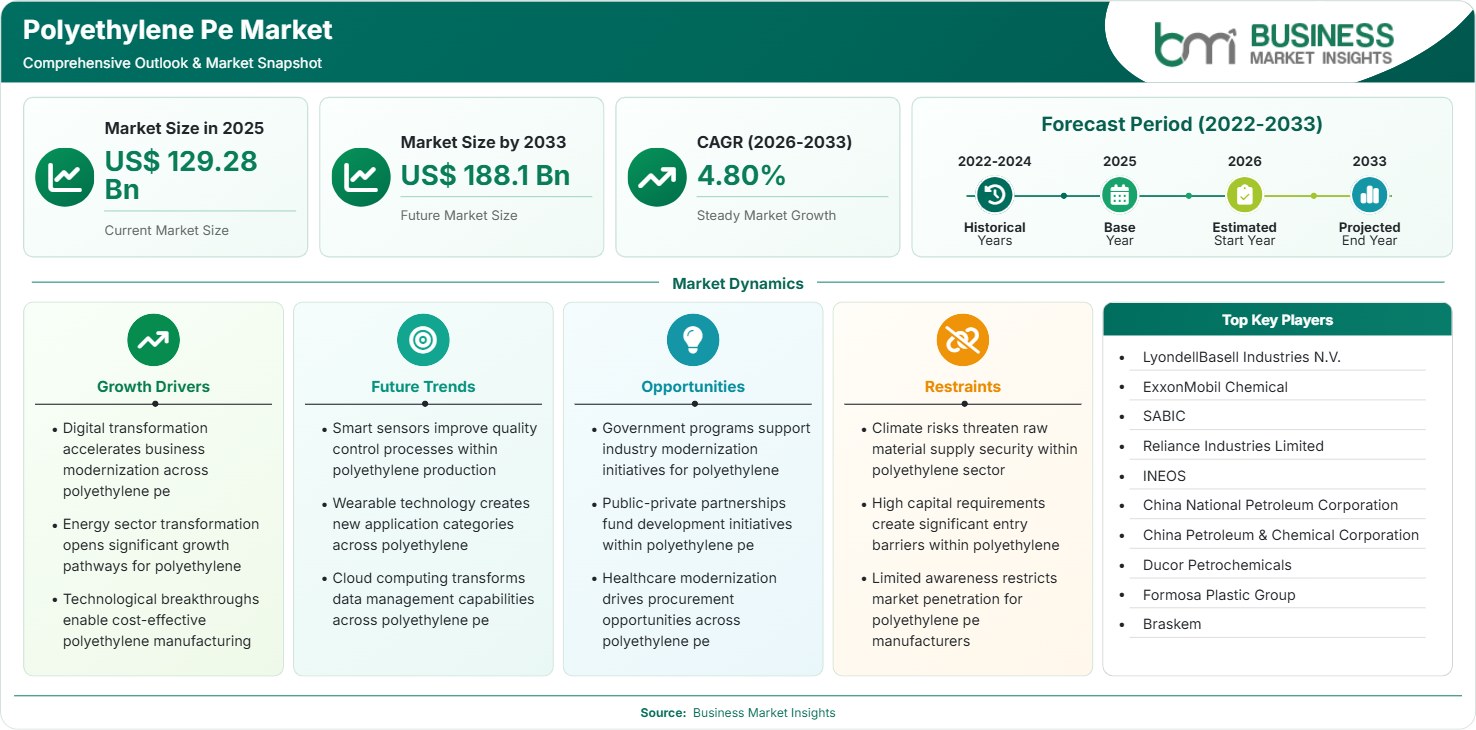
The Polyethylene (PE) Market size was valued at US$ 129.28 Billion in 2025 and is projected to reach US$ 188.1 Billion by 2033, growing at a CAGR of 4.80% during 2026–2033. Demand from packaging, infrastructure modernization, healthcare applications, recyclable polymer innovations, circular economy investments, and rising consumption across emerging economies continue to support industry expansion.

Report Coverage
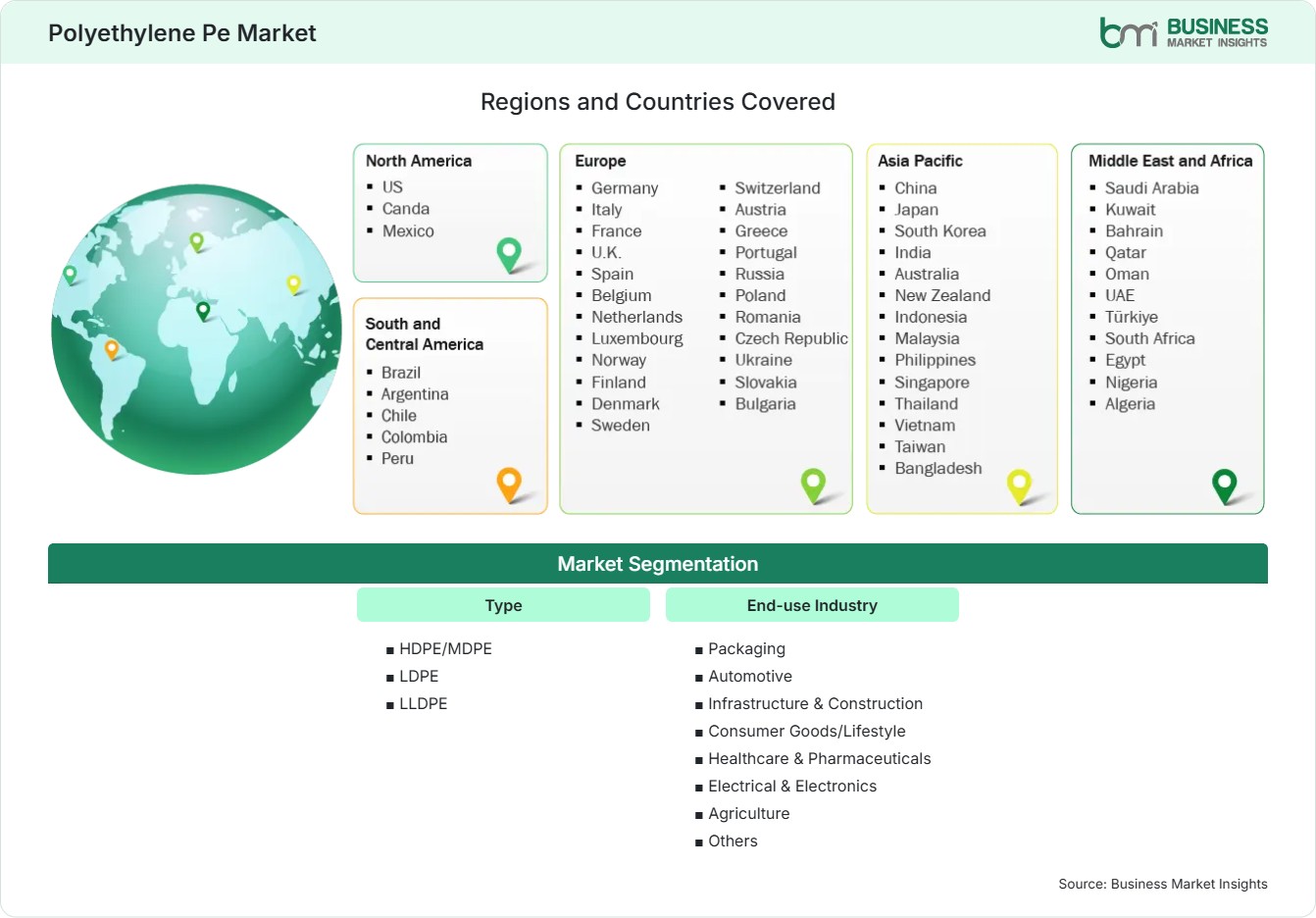
  • Type: HDPE/MDPE, LDPE, LLDPE
  • End-use Industry: Packaging, Automotive, Infrastructure & Construction, Consumer Goods/Lifestyle, Healthcare & Pharmaceuticals, Electrical & Electronics, Agriculture, Others
US$ 129.28 Bn Market size in 2025
US$ 188.1 Bn Market Size by 2033
4.80% CAGR, 2026 - 2033
2026-2033 Forecast Period

AI Overview

Polyethylene (PE) Market Summary

  • North America Region: North America holds market share of 24%–27% in 2025, growing with a CAGR of 4.1%–4.5% during 2026–2033. Abundant shale-gas feedstock, export-oriented resin production, sustainable packaging investments, advanced recycling capacity, healthcare demand, and infrastructure upgrades strengthen regional competitiveness while supporting capacity utilization and material innovation. US represents most regional demand, supported by packaging, pipe systems, healthcare, and export-led resin production, growing near 4.2%–4.6%.
  • Fastest Growing Region: Asia Pacific holds market share of 42%–45% in 2025 and advances at a CAGR of 5.5%–5.9%. Industrialization, e-commerce packaging expansion, automotive manufacturing growth, urban construction spending, electronics production, rising consumer purchasing power, and petrochemical investments support accelerating consumption across developing economies.
  • Leading Segment: Packaging accounts for 41%–44% of demand in 2025 and expands at 4.7%–5.1% CAGR. Flexible films, food preservation requirements, logistics expansion, retail distribution modernization, lightweight material preferences, recyclability initiatives, and cost-efficient processing sustain high volume consumption globally.
  • High Growth Segment: Healthcare & Pharmaceuticals represents 7%–9% market share in 2025 and records 6.0%–6.5% CAGR. Medical packaging adoption, pharmaceutical transportation requirements, stringent hygiene standards, sterilizable materials, diagnostic device demand, healthcare infrastructure investments, and regulatory compliance drive consumption.
  • Key Market Opportunity: Advanced recycling technologies, bio-attributed feedstocks, circular packaging commitments, consumer sustainability expectations, regulatory incentives, brand-owner partnerships, traceable material certification, and closed-loop collection systems create long-term value opportunities globally.
  • Major Market Players: Exxon Mobil Corporation, Dow Inc., LyondellBasell Industries N.V., Saudi Basic Industries Corporation (SABIC), INEOS Group Holdings S.A., Chevron Phillips Chemical Company LLC, Borealis AG, Formosa Plastics Corporation, Braskem S.A., Reliance Industries Limited.
Strategic Insights

Polyethylene (PE) Market: Strategic Insights

Polyethylene (PE) Market Strategic Framework
FREE PDF
Request your free sample
Request free sample
Stakeholder View

Key Takeaways

  • Integrated producers with direct access to ethane, naphtha, logistics infrastructure, and downstream conversion capabilities maintain stronger margin flexibility across the value chain.
  • Healthcare packaging, pressure pipes, and specialty films present attractive upside due to regulatory-driven quality requirements and long asset replacement cycles.
  • Product innovation is shifting toward recyclable mono-material structures, high-performance film grades, and certified circular polymers supporting sustainability commitments.
  • Asia Pacific offers the strongest investment case, particularly in India, Vietnam, Indonesia, and China, where industrial output and packaging demand continue rising.
  • Industry consolidation increasingly focuses on recycling technologies, sustainability partnerships, and regional capacity optimization rather than conventional volume expansion alone.
  • Digital quality monitoring, predictive maintenance, and AI-enabled production systems are improving plant efficiency and enabling higher-performance resin development.
Geographic Outlook

Polyethylene (PE) Market Regional Highlights

North America Polyethylene Market

North America accounted for approximately 24%–27% of global demand in 2025 and is projected to grow at 4.1%–4.5% CAGR through 2033. The region benefits from cost-competitive shale-gas feedstocks, strong export capacity, and significant investments in advanced recycling. Packaging, industrial films, healthcare products, and utility pipe applications remain major consumption centers. The Polyethylene Market share in North America remains supported by integrated petrochemical infrastructure, while sustainability initiatives increasingly influence purchasing decisions across consumer and industrial value chains.

  • Large-scale ethane-based production provides feedstock advantages and improves export competitiveness across international polymer markets.
  • Advanced recycling investments accelerate circular polymer commercialization and support corporate sustainability commitments.
  • Infrastructure replacement programs increase demand for durable pipe-grade materials used in water and gas distribution.
  • Healthcare manufacturing expansion sustains consumption of medical packaging and sterilizable polymer solutions.
  • Producer focus on low-carbon operations strengthens competitiveness amid tightening environmental expectations.

US Polyethylene Market

The US represents approximately 78%–82% of North American Polyethylene Market demand and records an estimated 4.2%–4.6% CAGR through 2033. Strong petrochemical integration, extensive export networks, and packaging leadership support domestic consumption. Manufacturing investment and circular-economy initiatives continue shaping procurement strategies. Growing healthcare applications and infrastructure projects contribute steady demand while technological improvements enhance production efficiency and quality consistency.

  • Gulf Coast assets remain global production centers benefiting from competitive feedstock availability and export infrastructure.
  • Circular polymer partnerships between producers and brand owners accelerate commercialization opportunities.
  • Packaging applications dominate consumption due to food, beverage, and e-commerce distribution growth.
  • Water-system modernization encourages long-term utilization of durable pressure-pipe materials.

Europe Polyethylene Market

Europe held 18%–21% market share in 2025 and is expected to expand at 3.6%–4.0% CAGR. Strong sustainability regulations, recycled-content targets, and circular economy initiatives influence product development and procurement decisions. Germany remains the leading country, while Poland and Eastern European economies display comparatively higher growth potential at approximately 4.5%–5.0% CAGR. Regional producers increasingly focus on certified circular products and low-emission production pathways.

  • Packaging redesign initiatives encourage demand for recyclable mono-material solutions.
  • Regulatory frameworks support investments in mechanical and chemical recycling infrastructure.
  • Germany leads regional consumption through diversified industrial and manufacturing activity.
  • Poland demonstrates stronger expansion supported by industrial investments and packaging demand.
  • Low-carbon material certification is becoming an important competitive differentiator.

Asia Pacific Polyethylene Market

Asia Pacific accounted for 42%–45% of global demand in 2025 and remains the fastest-growing region with a CAGR of 5.5%–5.9%. China leads regional consumption, while India represents the strongest growth opportunity with estimated expansion above 6.0%. Manufacturing growth, urbanization, e-commerce activity, electronics production, and construction investments support robust consumption. Regional capacity additions continue improving supply availability and market competitiveness.

  • China remains the largest consumer due to packaging, manufacturing, and infrastructure requirements.
  • India benefits from rising consumer demand, industrialization, and expanding conversion capacity.
  • Southeast Asian economies attract investments in petrochemical integration and packaging production.
  • Electronics manufacturing increases demand for insulation and specialty polymer applications.
  • Urban infrastructure projects support consumption of pipe systems and construction products.

Rest of World Polyethylene Market

Rest of World represented approximately 11%–14% of Polyethylene Market demand in 2025 and is forecast to grow at 4.8%–5.2% CAGR. South and Central America benefit from packaging and agricultural applications, while the Middle East and Africa gain support from expanding petrochemical investments and infrastructure development.

Brazil remains the leading market in Latin America, whereas Saudi Arabia and the UAE maintain strong production influence. Several African economies are increasing packaging consumption through urbanization and retail modernization trends.

  • Brazil supports regional demand through food packaging and industrial manufacturing activity.
  • Saudi Arabia benefits from feedstock availability and export-oriented petrochemical operations.
  • Agricultural film adoption contributes stable demand across Latin American economies.
  • Infrastructure investments encourage utilization of durable pipe-grade materials.
  • Consumer-goods expansion increases flexible packaging requirements in emerging markets.
Global Market Geography
FREE PDF
Request your free sample
Request free sample
Segment Analysis

Polyethylene (PE) Market Segmentation

Type

Type segment represented the foundation of industry demand. HDPE/MDPE accounted for the largest share at approximately 45%–48% in 2025 and expanded at 4.6%–5.0% CAGR. Material selection depends on durability, flexibility, processing characteristics, and end-use performance requirements. Growing infrastructure and packaging demand continue supporting volume expansion. The Polyethylene Market scope increasingly includes circular and specialty resin development.

  • HDPE/MDPE: Widely used in pipes, rigid containers, caps, closures, industrial products, and infrastructure systems due to durability, chemical resistance, and cost-efficient processing characteristics.
  • LDPE: Strong demand from films, coatings, flexible packaging, and consumer applications where softness, transparency, and sealing characteristics are critical performance requirements.
  • LLDPE: Increasing adoption in stretch films, industrial packaging, agricultural applications, and high-strength flexible structures requiring enhanced puncture resistance and mechanical performance.

End-use Industry

End-use industries determine consumption dynamics across global value chains. Packaging remained dominant with 41%–44% share in 2025 and CAGR of 4.7%–5.1% through the forecast period. The Polyethylene Market trends indicate rising emphasis on recyclable packaging, infrastructure durability, healthcare safety, and lightweight transportation applications supporting diversified demand growth.

  • Packaging: Largest application segment driven by food protection, logistics efficiency, retail distribution, shelf-life enhancement, and increasing flexible packaging adoption across consumer industries.
  • Automotive: Lightweight components support fuel-efficiency goals while durable polymeric materials improve design flexibility, corrosion resistance, and manufacturing efficiency.
  • Infrastructure & Construction: Demand stems from water distribution systems, gas networks, geomembranes, insulation materials, and long-life construction products.
  • Consumer Goods/Lifestyle: Household products, toys, storage containers, and lifestyle accessories contribute stable resin consumption across mature and emerging economies.
  • Healthcare & Pharmaceuticals: Sterile packaging, medical devices, diagnostic equipment, and pharmaceutical transport applications create high-value demand opportunities.
  • Electrical & Electronics: Wire insulation, cable protection, component housing, and electronic packaging support specialized consumption requirements.
  • Agriculture: Greenhouse films, irrigation systems, mulch films, and crop-protection applications sustain demand in agricultural value chains.
Market Forces

Polyethylene (PE) Market Dynamics

Key Market Drivers

Expansion of Global Packaging Consumption

Packaging remains the largest demand generator as e-commerce activity, food distribution networks, and consumer-product shipments continue expanding worldwide. United Nations population growth projections and rising urbanization levels support greater packaged-goods consumption. Processability, impermeability, strength, and cost-effectiveness make polyethylene an ideal choice for flexible and rigid packagers. The expansion in organized retailing, home delivery of groceries online, and pharmaceuticals adds to the demand for film, containers, wrappers, and other protective materials. Packaging design by brand owners towards recycling also makes the use of material viable. The emerging markets also present volume growth potential due to consumption trends being in line with organized retail.

Infrastructure Modernization and Utility Investments

Water infrastructure renewal, gas-distribution network upgrades, and industrial development projects are expanding demand for durable pipe-grade materials. Systems that use polyethylene pipes exhibit the ability to resist corrosion, longevity of service, reduced maintenance needs, and ease of installation when compared to traditional counterparts. Infrastructure investments by government institutions in the Asia Pacific, North America, and the Middle East generate uniform purchasing needs. Urbanization leads to increased stress on the water management systems and drives the need for modern pipeline construction. The focus of municipal bodies on lifecycle efficiency and reduced leakages further enhances the trend. All these aspects help in generating demand in industries other than packaging.

Advances in Recycling and Circular Economy Solutions

Consumer brands, retailers, and regulatory bodies focus more on recycled content incorporation and packaging circularity. There is an increase in business prospects through the use of chemical recycling, mechanical recycling advances, and mass balance certification. The producers have started forming partnerships with waste management companies to ensure that their raw material is acquired and to enhance the quality of the recycled resins. The sustainability pledges made by multinational consumer goods companies are creating a sustained need for circular polymers. With tighter regulations and advancements in recyclable-grade plastics and circular materials, innovation is being supported to meet industry requirements.

Key Market Opportunities

Commercialization of Bio-Attributed Polyethylene

Bio-attributed resins from renewable sources represent a key path to commercializing such technologies for companies implementing a decarbonization strategy. Market segments targeting the consumer end are now demanding materials with lower carbon footprints but still offering the same properties and ease of process. Certified programs allow for verification of renewable material claims without interfering with existing production systems. There is growing dedication to sustainability among the international brands. Polyethylene Market Forecasts are increasingly taking into account premium-value circular and renewable material streams, providing the potential for differentiation, margin improvement, and collaboration across the larger packaging ecosystem and industrial value chain.

Healthcare Supply Chain Expansion

Healthcare infrastructure development, pharmaceutical manufacturing growth, and rising diagnostic activity are creating new material requirements globally. The applications for sterile packaging, medical parts, laboratory disposables, and drug delivery require reliable polymer solutions that will be able to satisfy stringent quality requirements. The aging population and rising healthcare access in emerging markets will provide consistent demand. Companies that decide to produce specific grades of polymers through quality-conscious manufacturing processes will be able to capitalize on value-added opportunities. Quality, compliance, and traceability are increasingly becoming critical competitive advantages.

Emerging Manufacturing Hubs in Asia and Africa

Industrial diversification strategies across India, Vietnam, Indonesia, and selected African economies are encouraging growth in downstream conversion industries. A boost in domestic manufacturing will reduce dependence on imported goods and help create a value chain in the region. The manufacturing of consumer goods, the upgrading of logistics facilities, and industrial activities that favor exports will improve the outlook for the consumption of materials. Foreign firms will continue to assess opportunities for joint ventures in manufacturing and capacity building across the regions. Higher income and urbanization will increase the demand for packaged goods.

Market Restraints and Challenges

Feedstock Price Volatility and Margin Pressure

Factor: Polyethylene production remains closely linked to hydrocarbon feedstocks including ethane and naphtha. Fluctuations in crude oil and natural gas markets create unpredictable raw-material costs across production regions.

Impact: Rapidly changing costs put pressure on profit margins, create difficulty in purchasing planning, and impact regional competitiveness. Firms that have been working in a non-integrated framework may face greater pressure on profitability during commodity cycles. Volatility can also affect converter purchases and contracts. There is increasing emphasis by firms on diversifying feedstock sources and improving operational efficiency. Yet the continued uncertainty in the energy market remains a major issue.

Environmental Regulations and Plastic Waste Concerns

Factor: Increasing scrutiny surrounding plastic waste generation has accelerated regulatory intervention, recycling targets, producer-responsibility frameworks, and sustainability reporting obligations.

Impact: Costs increase with regard to production, package design, collection and recycling infrastructure investment. Firms that are unable to change their portfolios may face access and reputation issues. Even though circular strategies provide new possibilities, the deployment involves investment and cooperation within the ecosystem. The demand profile might also move towards better-performing, recyclable packages. Companies should find a way to reconcile their ambitions with the evolving environmental context to achieve sustainability.

Company Analysis

Competitive Landscape

The competitive environment reflects continuous capacity expansion, sustainability investments, and global supply-chain integration. Current Polyethylene Market analysis highlights competition across commodity volumes, circular materials, specialty grades, and regional distribution networks.

Company Name

Overview

Products and Services relevant to this market

Exxon Mobil Corporation

Global energy and petrochemical leader with extensive polymer manufacturing and integrated feedstock advantages.

HDPE, LLDPE, specialty film resins, packaging materials, industrial polymer solutions.

Dow Inc.

Major materials science company serving packaging, infrastructure, mobility, and consumer applications.

Polyethylene grades, circular plastics, flexible packaging solutions, industrial materials.

LyondellBasell Industries N.V.

One of the world's largest polyolefin producers with broad geographic presence.

HDPE, LDPE, LLDPE, recycled polymers, advanced plastic solutions.

Saudi Basic Industries Corporation (SABIC)

Leading petrochemical producer with global manufacturing and sustainability initiatives.

Polyethylene resins, circular polymers, packaging and industrial material solutions.

INEOS Group Holdings S.A.

Significant global polyolefin manufacturer with diversified production assets.

HDPE, LDPE, specialty polyethylene grades, industrial applications.

Chevron Phillips Chemical Company LLC

Integrated chemical producer focused on polyolefin technology and capacity growth.

Marlex polyethylene products, packaging resins, pipe materials.

Borealis AG

European leader emphasizing innovation and circular economy development.

Polyethylene solutions, infrastructure materials, recyclable polymer offerings.

Formosa Plastics Corporation

Large-scale petrochemical manufacturer serving diversified industrial sectors.

Polyethylene resins, packaging materials, extrusion and molding grades.

Braskem S.A.

Major Latin American polymer producer with renewable-material expertise.

Bio-based polyethylene, packaging polymers, industrial-grade resins.

Reliance Industries Limited

Integrated petrochemical and refining group with substantial polymer capacity.

HDPE, LDPE, LLDPE, packaging and infrastructure-focused materials.

Trust & Transparency

Research Methodology

The market analysis combines proprietary research with secondary data from government agencies, company disclosures, regulatory filings, industry databases and expert interviews. Market estimates are validated through data triangulation, cross-market benchmarking and analyst review.

View Full Research Methodology

Questions Answered

Frequently Asked Questions

Why is the Polyethylene Market Report important for investors?

It helps investors assess regional demand patterns, growth segments, sustainability opportunities, competitive positioning, and long-term value creation trends influencing capital allocation decisions.

What role does recycling play in future industry development?

Advanced mechanical and chemical recycling technologies support circularity goals, regulatory compliance, and consumer sustainability expectations while creating premium-value material streams.

Why is packaging the leading application segment?

Packaging requires cost-effective, durable, moisture-resistant materials capable of supporting food safety, logistics efficiency, and product protection. These performance advantages sustain large-scale resin consumption.

Which region offers the strongest long-term expansion potential?

Asia Pacific presents the most attractive expansion outlook due to industrialization, urbanization, rising consumer spending, manufacturing investments, and growing packaging consumption across developing economies.

What is driving demand across end-use industries?

Packaging, infrastructure, healthcare, agriculture, and consumer-products manufacturing are the primary demand centers. Lightweight properties, chemical resistance, durability, and processing flexibility support broad application adoption.

Access the Full Polyethylene (PE) Market Report

Get segment-level forecasts, regional estimates, competitive benchmarking, company profiles and downloadable Excel datasets.

Access the full Polyethylene (PE) Market Report
350 pages PDF & Excel | 2026-08-21