
BOPP Films Market Outlook: Size, Share, Trends, Growth Analysis, Competitive Landscape & Forecast, 2026-2033

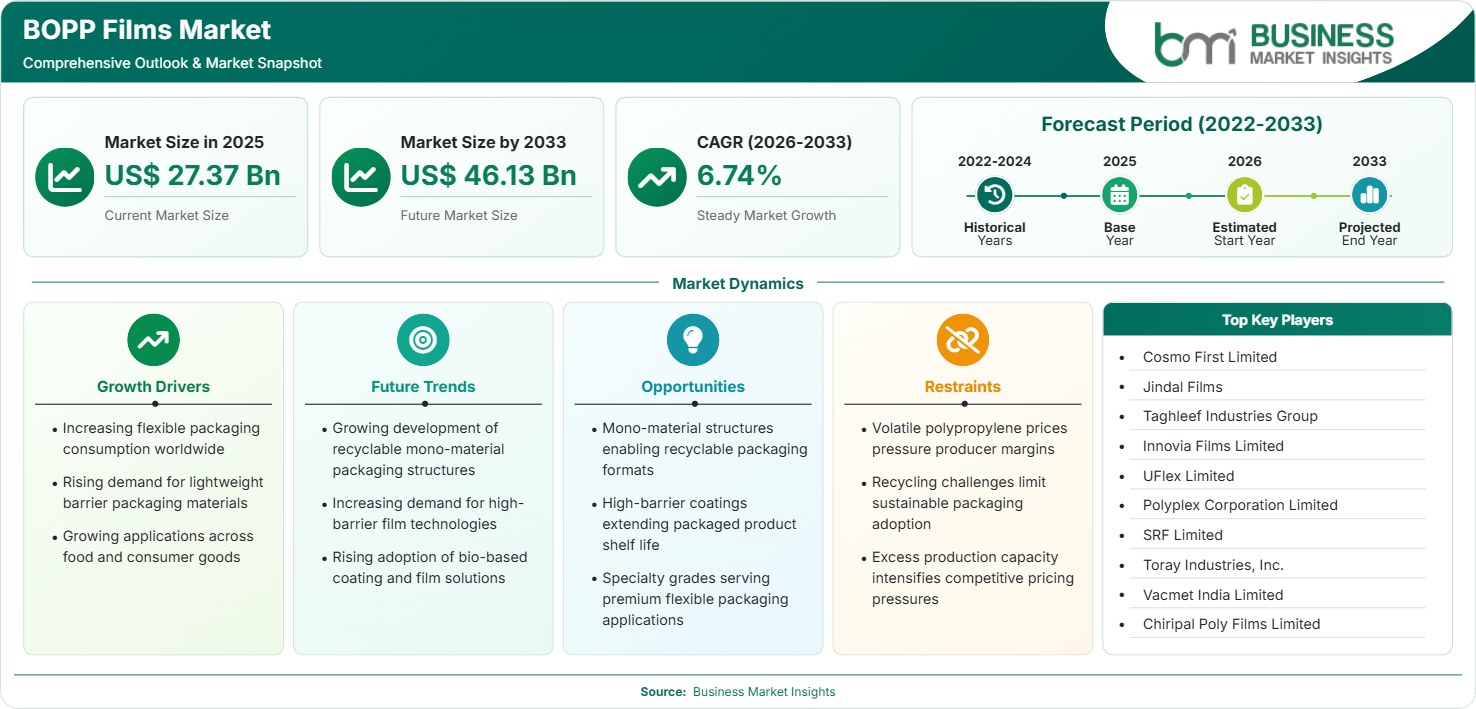
The BOPP Films Market size was valued at US$ 27.37 Billion in 2025 and is projected to reach US$ 46.13 Billion by 2033, growing at a CAGR of 6.74% during 2026–2033. Rising flexible packaging demand, food shelf-life requirements, recyclable mono-material packaging adoption, premium labeling applications, and capacity expansions across Asia create strong growth opportunities.

Report Coverage
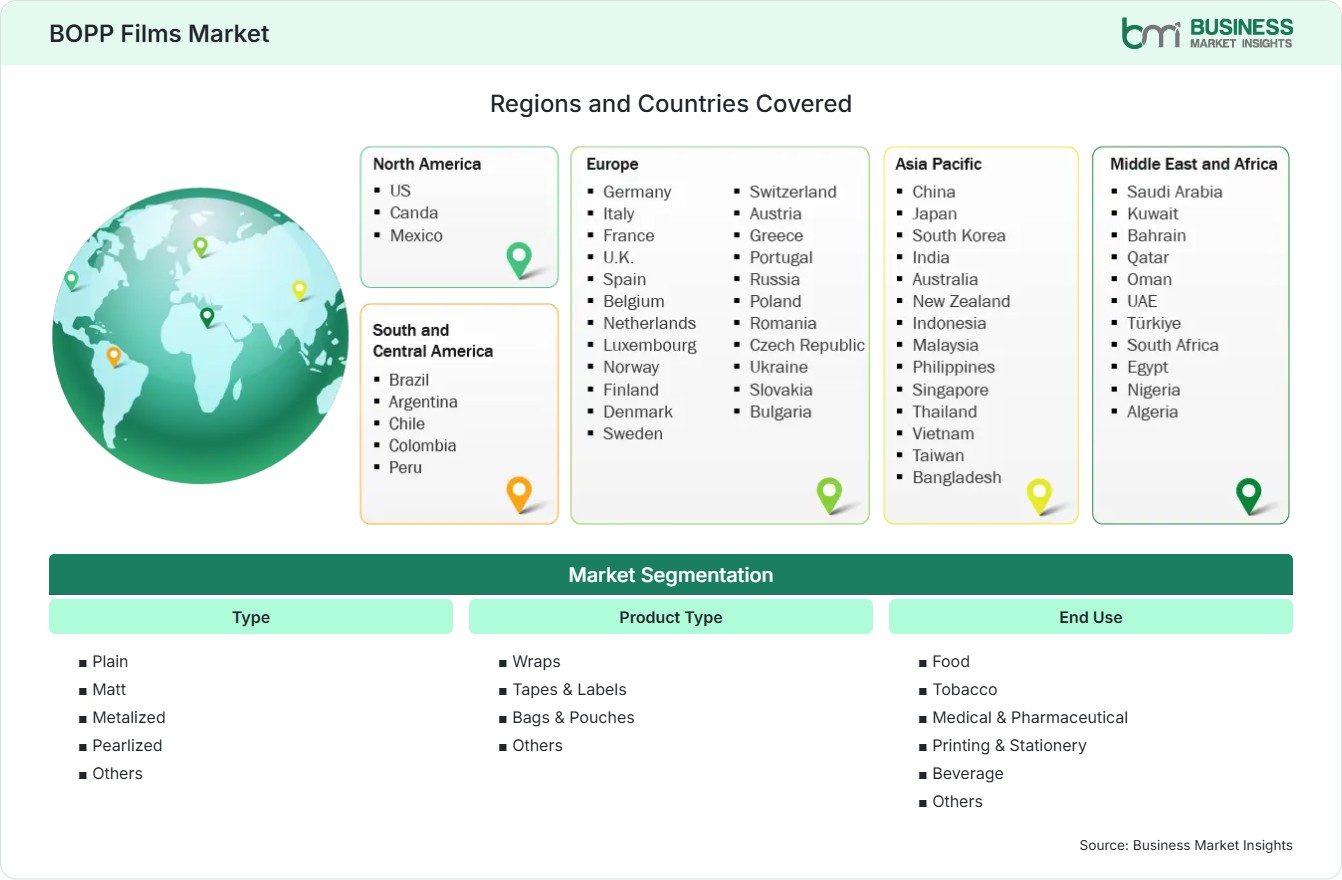
  • Type: Plain, Matt, Metalized, Pearlized, Others
  • Product Type: Wraps, Tapes & Labels, Bags & Pouches, Others
  • End Use: Food [Bakery & Confectionary, Dairy, Meat, Poultry & Sea Food, Fruits & Vegetables, Others], Tobacco, Medical & Pharmaceutical, Printing & Stationery, Beverage, Others
US$ 27.37 Bn Market size in 2025
US$ 46.13 Bn Market Size by 2033
6.74% CAGR, 2026 - 2033
2026-2033 Forecast Period

AI Overview

BOPP Films Market Summary

  • North America Region: North America holds a market share of 24%–27% in 2025, growing at a CAGR of 5.8%–6.3% during 2026–2033. Demand is supported by packaged food consumption, sustainable packaging transition, premium labeling requirements, advanced converting infrastructure, recycling initiatives, e-commerce distribution growth, and investment in higher-barrier film technologies. The U.S. accounts for 78%–82% of regional demand and is expected to grow at 5.9%–6.4% CAGR through 2033.
  • Fastest Growing Region: Asia Pacific holds a market share of 39%–42% in 2025, growing at a CAGR of 7.8%–8.4% during 2026–2033. Expansion is driven by manufacturing investments, rising packaged food demand, export-oriented production, retail modernization, pharmaceutical packaging growth, consumer goods consumption, and increasing adoption of recyclable film structures.
  • Leading Segment: Food end use accounts for 42%–46% of the BOPP Films Market share in 2025 and advances at 6.8%–7.3% CAGR. Growth stems from moisture-barrier performance, shelf-life enhancement, lightweight packaging preferences, growing processed food volumes, regulatory compliance requirements, cost-efficient packaging formats, and expanding cold-chain distribution.
  • High Growth Segment: Bags & Pouches represent 28%–32% share in 2025 and expand at 7.4%–8.0% CAGR. Demand benefits from convenience packaging, stand-up pouch penetration, reduced material consumption, strong branding potential, transportation efficiency, e-commerce packaging suitability, and improved barrier performance.
  • Key Market Opportunity: Development of recyclable mono-material packaging solutions enables brand owners to meet circular-economy targets while improving packaging performance, creating new investment opportunities across food, personal care, pharmaceutical, and industrial packaging applications.
  • Major Market Players: Cosmo First Limited, Jindal Films, Taghleef Industries Group, Innovia Films Limited, UFlex Limited, Polyplex Corporation Limited, SRF Limited, Toray Industries, Inc., Vacmet India Limited, Chiripal Poly Films Limited.
Strategic Insights

BOPP Films Market: Strategic Insights

BOPP Films Market Strategic Framework
FREE PDF
Request your free sample
Request free sample
Stakeholder View

Key Takeaways

  • The value chain is becoming increasingly integrated as film manufacturers strengthen relationships with resin suppliers, converters, printers, and consumer-goods companies to improve margins and product customization.
  • Food packaging and pouch applications provide the strongest long-term upside due to expanding packaged food consumption, rising urbanization, and increasing preference for lightweight packaging formats.
  • Innovation is moving toward ultra-thin structures, high-barrier coatings, recyclable mono-material packaging, digital-print compatible surfaces, and specialty films designed for premium branding applications.
  • Asia Pacific presents the most compelling investment opportunity because of manufacturing scale advantages, growing domestic demand, export competitiveness, and supportive industrial policies.
  • Strategic acquisitions and production expansions continue enhancing global capacity, enabling suppliers to improve regional supply reliability and strengthen customer relationships.
  • Sustainability metrics are becoming critical purchasing criteria, encouraging development of circular packaging solutions and greater use of recyclable polypropylene-based structures.
Geographic Outlook

BOPP Films Market Regional Highlights

North America BOPP Films Market

North America accounts for approximately 24%–27% of the BOPP Films Market share in 2025 and is projected to expand at 5.8%–6.3% CAGR through 2033. Demand is supported by packaged food, beverage, healthcare, and labeling applications. Strong recycling initiatives and brand-owner sustainability commitments encourage adoption of recyclable film structures. Manufacturers continue investing in specialty grades with enhanced barrier performance and premium appearance characteristics. The region benefits from advanced converting infrastructure, strong retail networks, and growing demand for value-added packaging solutions.

  • Packaged food manufacturers increasingly use barrier films that improve shelf life while supporting sustainability objectives.
  • Growth in pressure-sensitive labeling applications supports premium film demand across consumer goods sectors.
  • E-commerce shipping requirements stimulate demand for lightweight and durable flexible packaging solutions.
  • Recycling infrastructure development encourages adoption of polypropylene-based mono-material packaging formats.

US BOPP Films Market

The United States represents 78%–82% of North American demand and is expected to advance at 5.9%–6.4% CAGR through 2033. Food packaging, healthcare products, personal care goods, and labeling remain primary consumption areas. Investments in sustainable packaging and domestic manufacturing strengthen market economics. High packaged-food penetration and extensive retail distribution networks support stable consumption while brand owners continue transitioning toward recyclable structures and improved packaging efficiency.

  • Sustainability commitments from major consumer brands accelerate procurement of recyclable flexible packaging materials.
  • Premium beverage and food categories increasingly utilize specialty films for shelf differentiation and product protection.
  • Domestic converting capacity expansion improves supply-chain resilience and service responsiveness.
  • Healthcare packaging applications create demand for consistent quality and regulatory-compliant film solutions.

Europe BOPP Films Market

Europe holds a 22%–25% share in 2025 and is forecast to grow at 5.6%–6.1% CAGR in the BOPP Films Market. Circular-economy regulations, packaging waste directives, and recyclability targets strongly influence purchasing decisions. Germany remains the leading national market, while Poland exhibits one of the fastest growth rates at approximately 6.5%–7.0% CAGR. Demand continues increasing in food, labeling, personal care, and industrial applications. Advanced converting industries and sustainability-focused innovation support long-term competitiveness across the region.

  • Recyclable mono-material packaging development aligns with European sustainability mandates.
  • Germany leads consumption through its strong food-processing and packaging industries.
  • Poland benefits from manufacturing expansion and export-oriented packaging production.
  • Premium labeling applications drive demand for matte, pearlized, and specialty-grade films.

Asia Pacific BOPP Films Market

The Asia Pacific region holds a market share of 39% to 42% and is witnessing the highest growth rate, with a 7.8% to 8.4% CAGR in 2025. The Chinese market is the largest, and India is showing higher growth, with a CAGR of 8.5%-9%. The growth is driven by rapid industrialization, consumption of packaged foods, urbanization, and manufacturing investments. There are production capacity additions that will help in exports. The region benefits from scale advantages, lower conversion costs, and increasing adoption of convenience packaging across multiple end-use segments.

  • China dominates regional consumption through extensive food, beverage, and consumer-goods production.
  • India records strong demand from packaged foods, pharmaceuticals, and retail modernization.
  • Southeast Asia attracts investments seeking diversified manufacturing locations.
  • Export-focused film producers continue expanding capacity to serve global packaging converters.
  • Rising incomes support greater utilization of premium packaged products.

Rest of World BOPP Films Market

Rest of World accounts for 10%–13% of the BOPP Films Market share and is projected to grow at 6.4%–7.0% CAGR. South and Central America benefit from packaged-food growth and retail expansion. Brazil remains the largest regional contributor.

Middle East and Africa markets are supported by food security initiatives, manufacturing diversification, and consumer goods demand. Saudi Arabia demonstrates strong investment activity while South Africa maintains a significant converting base. Increasing packaging localization supports long-term growth prospects across both regions.

  • Brazil benefits from expanding flexible packaging consumption and food-processing investments.
  • Saudi Arabia supports petrochemical integration and downstream packaging development.
  • Regional retail modernization encourages adoption of packaged consumer products.
  • Investment in local conversion capabilities reduces dependence on imports.
  • Food and beverage industries remain the principal demand generators.
Global Market Geography
FREE PDF
Request your free sample
Request free sample
Segment Analysis

BOPP Films Market Segmentation

Type

This particular market segment accounts for the largest share of the film difference and performance positioning. This category has 100% market coverage, and high-end versions deliver value. The demand is driven by packaging customization needs, with a CAGR of 6.5%–7.2%. The BOPP Films Market Scope continues to expand, driven by high-end specialty films.

  • Plain: Widely used across flexible packaging and lamination applications because of transparency, mechanical strength, printability, and cost efficiency.
  • Matt: Preferred for premium branding applications requiring sophisticated appearance, excellent tactile properties, and enhanced shelf differentiation.
  • Metalized: Used extensively where improved barrier protection and decorative appearance are required in food packaging.
  • Pearlized: Supports lightweight packaging solutions with opacity, aesthetics, and packaging performance benefits across multiple industries.

Product Type

The types of products demanded will depend on packaging format development and consumer demand for convenience. Opportunities arise from the increasing use of flexible packaging and efforts toward sustainable development. CAGR estimates range from 6.6% to 7.4%, while packaging modernization continues to create opportunities for innovation and product differentiation.

  • Wraps: Commonly utilized for snacks, confectionery products, bakery items, and overwrap applications requiring excellent clarity and protection.
  • Tapes & Labels: Supported by growing logistics activity, branding requirements, and premium labeling applications across consumer products.
  • Bags & Pouches: High-growth category benefiting from convenience packaging formats, transportation efficiency, and material reduction advantages.

End Use

The end-user industry drives demand intensity and specifications. In the food industry, the market takes first place with a share of 42%-46% and a CAGR of 6.8%-7.3%. The BOPP Films Market trends focus on sustainability, barriers, and lightweight packaging across diverse consumption sectors.

Food:

    • Bakery & Confectionery: Utilizes films for freshness retention, attractive product presentation, and efficient distribution across retail channels.
    • Dairy: Requires reliable moisture resistance and secure packaging performance for extended product quality maintenance.
    • Meat, Poultry & Seafood: Increasing demand for protective packaging supporting shelf-life extension and food safety objectives.
    • Fruits & Vegetables: Supports freshness preservation while enabling efficient retail merchandising and transportation.
  • Tobacco: Important application segment requiring high-quality overwrap solutions and aesthetic packaging characteristics.
  • Medical & Pharmaceutical: Growing adoption driven by packaging integrity, regulatory requirements, and product protection needs.
  • Printing & Stationery: Utilized in lamination, graphic protection, and value-added print applications.
  • Beverage: Demand supported by labeling applications, shrink formats, and product branding requirements.
Market Forces

BOPP Films Market Dynamics

Key Market Drivers

Expansion of Flexible Food Packaging Demand

Packaged food consumption worldwide is increasing due to urbanization, convenience, and growth in organized retail. Food processors have increasingly been using BOPP packaging due to its barrier properties, printing capability, and low-cost protection. Trade groups report continuous growth in the use of flexible packaging, especially for snacks, baked goods, confectionery, and prepared foods. Shelf-life performance reduces product wastage in distribution channels. The increased demand for aesthetic packaging also promotes its usage. These factors collectively support stable volume growth and encourage investment in advanced film production technologies worldwide.

Shift Toward Recyclable Mono-Material Structures

Sustainable packaging has now emerged as a key focus area for multinational consumer goods corporations. The use of polypropylene-based, recyclable materials allows companies to increase their sustainability quotient without compromising packaging performance. Developments in regulations across Europe and other regions have begun to emphasize material recovery and recyclability. Manufacturers of film are reacting to these changes by innovating in sealable structures, coatings, and downgauging. Brand companies look for material blends that make the recycling process easy and environmentally friendly. Consequently, the rising demand for film formulations continues to increase across food, personal care, healthcare, and industrial packaging applications.

Growth of Premium Labeling and Branding Applications

Increasing competition in retail is driving greater focus on developing differentiated packaging. Quality graphics, clarity, opacity, metalization, and surface treatments increase visibility and engage consumers. High-end labels are driving the requirement for matte, pearlescent, and specialty films. Manufacturers of consumer products have become increasingly reliant on differentiated packaging to build brand awareness and convey quality cues. Printing technology developments continue to open up new possibilities. Such trends create opportunities to realize value for those who can manufacture custom products for special needs and performance requirements.

Key Market Opportunities

Development of Circular Packaging Ecosystems

With the increasing investment in recycling infrastructure, there could be an opportunity for suppliers, converters, and brand owners to work together to develop closed-loop packaging. The demand for mono-material packages that are easily recyclable will increase as sustainability ambitions grow. Packaging in BOPP is ready to take advantage of it since polypropylene material makes it easy to recycle. According to Long-term BOPP Films Market Forecasts, there are good chances for BOPP films in food, pharmaceutical, and personal care packaging applications. Companies investing in material innovation, recycling partnerships, and circular design solutions can strengthen their competitiveness while addressing evolving regulatory requirements and customer expectations.

Emerging Market Consumption Expansion

Due to rising disposable incomes and increased modernization of retail trade operations in Asia, Africa, and Latin America, there is an ever-growing demand for packaged products. Due to the growth of the middle class, there has been an increase in purchases of branded food, beverages, household products, and healthcare products. Investments in local converting plants have created even more opportunities to develop regional supply chains. At the same time, there is increased governmental support for manufacturing and value-added production in several emerging markets. These dynamics increase the potential for consumption while supporting diversified geographic expansion strategies for film producers and packaging solution providers.

Specialty High-Barrier Product Innovation

In addition, there is a continuous drive for longer shelf life, reduced food waste, and improved performance of packaging materials themselves. Innovative technologies for coatings, metallization, and functional films could provide solutions that will meet the increasingly stringent requirements for product performance. Companies that have succeeded in providing outstanding barrier protection without jeopardizing recyclability will gain access to lucrative market applications. Potential markets include pharmaceuticals, industrial products, and high-end consumer products. Investment in research and development remains essential for differentiation and sustainable margin expansion.

Market Restraints and Challenges

Polypropylene Resin Price Volatility

Factor: The price of polypropylene resin continues to be affected by oil prices, refinery issues, raw material supply, and geopolitical events. Impact: Fluctuations in the cost of raw materials could result in narrower margins and difficulties negotiating purchasing terms for converters and film makers. Fluctuations affect negotiations and inventory policies across the packaging industry value chain. The smaller companies will probably be under more pressure since they have less buying power. Even though the long-term trend looks good, fluctuations can delay investment decision-making and create uncertainty regarding production economics and profitability.

Increasing Regulatory and Sustainability Compliance Costs

Factor: The regulations regarding packaging are becoming increasingly complex due to improvements in waste reduction, recycling, labeling, and overall environmental performance implemented by government authorities. Impact: Compliance will entail additional expenses for certification, testing, product design, and other operational changes. It calls for ongoing improvements to the product line for film manufacturers as standards continue to rise. Regional differences in regulatory standards add another level of complexity to the situation. Sustainable initiatives could create new opportunities, but compliance costs could undermine profitability.

Company Analysis

Competitive Landscape

The competitive environment reflects ongoing capacity expansion, sustainability initiatives, and product innovation. BOPP Films Market analysis indicates that large integrated manufacturers are strengthening positions through specialty film portfolios and global production networks.

Company Name

Overview

Products and Services relevant to this market

Cosmo First Limited

Global specialty film producer with extensive packaging and labeling expertise.

BOPP films, labeling films, lamination films, metallized films, packaging solutions.

Jindal Films

Leading manufacturer serving packaging and labeling industries globally.

BOPP films, recyclable packaging films, mono-material packaging solutions.

Taghleef Industries Group

International flexible packaging specialist with diversified film portfolio.

Specialty BOPP films, decorative films, barrier packaging materials.

Innovia Films Limited

Producer of high-performance packaging and label films worldwide.

Packaging films, label films, tobacco overwrap films, specialty products.

UFlex Limited

Integrated packaging company with global film manufacturing operations.

BOPP, BOPET, CPP, metallized films, flexible packaging solutions.

Polyplex Corporation Limited

Global film manufacturer focused on packaging applications.

Packaging films, specialty films, coated and performance materials.

SRF Limited

Diversified materials company with significant packaging film business.

BOPP films, packaging substrates, industrial film products.

Toray Industries, Inc.

Major advanced materials producer serving global packaging markets.

Functional films, specialty packaging materials, barrier solutions.

Vacmet India Limited

Large producer of coated and metallized flexible packaging films.

Metallized BOPP films, coated films, flexible packaging solutions.

Chiripal Poly Films Limited

Film manufacturer serving packaging converters and industrial users.

BOPP films, packaging substrates, specialty film products.

Trust & Transparency

Research Methodology

The market analysis combines proprietary research with secondary data from government agencies, company disclosures, regulatory filings, industry databases and expert interviews. Market estimates are validated through data triangulation, cross-market benchmarking and analyst review.

View Full Research Methodology

Questions Answered

Frequently Asked Questions

Why is a BOPP Films Market Report useful for investors?

It helps investors evaluate demand patterns, regional opportunities, competitive positioning, technological developments, regulatory impacts, and long-term growth potential across packaging-related industries.

What are the major factors influencing profitability?

Raw-material costs, energy prices, capacity utilization rates, product mix, specialty-film adoption, and the ability to develop higher-value sustainable solutions significantly influence profitability.

What makes Asia Pacific the fastest-growing region?

Rapid urbanization, higher packaged-food consumption, manufacturing investments, retail expansion, and growing exports collectively support stronger regional demand than mature markets.

Why are BOPP films important for sustainable packaging?

They support lightweight packaging designs and are increasingly used in recyclable mono-material structures, helping brands align with circular economy objectives while maintaining barrier and visual performance.

Which industry generates the highest demand for BOPP films?

Food packaging remains the leading consumer because of shelf-life protection, moisture resistance, strong printability, and cost-effective packaging performance across snacks, bakery, dairy, and processed food categories.

Access the Full BOPP Films Market Report

Get segment-level forecasts, regional estimates, competitive benchmarking, company profiles and downloadable Excel datasets.

Access the full BOPP Films Market Report
350 pages PDF & Excel | 2026-09-10
Similar Research

Related Market Reports