
Breathable Films Market Outlook: Size, Share, Trends, Growth Analysis, Competitive Landscape & Forecast, 2026-2033

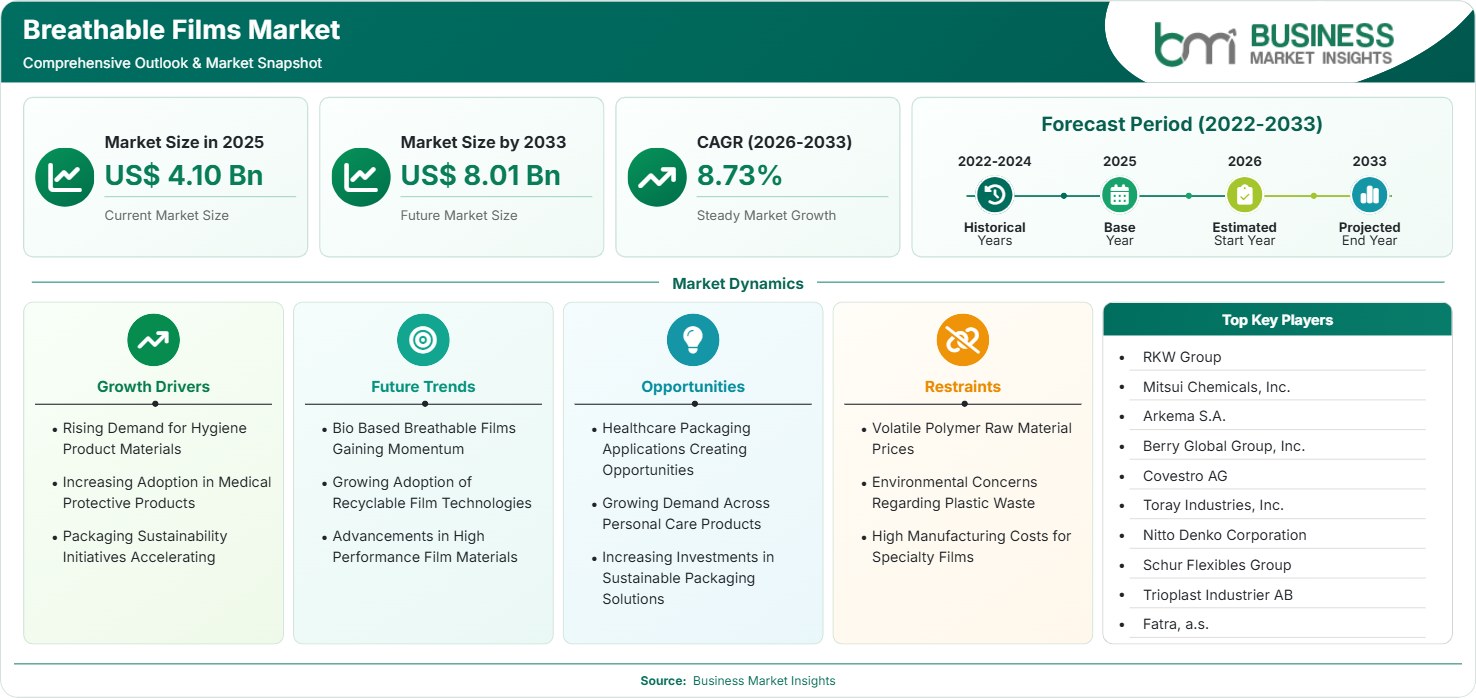
The Breathable Films Market size was valued at US$ 4.10 Billion in 2025 and is projected to reach US$ 8.01 Billion by 2033, growing at a CAGR of 8.73% during 2026–2033. Rising demand for sustainable packaging, expanding hygiene product consumption, advanced polymer processing technologies, and increasing medical applications are strengthening production capacity while creating new commercialization opportunities across global manufacturing ecosystems.

Report Coverage
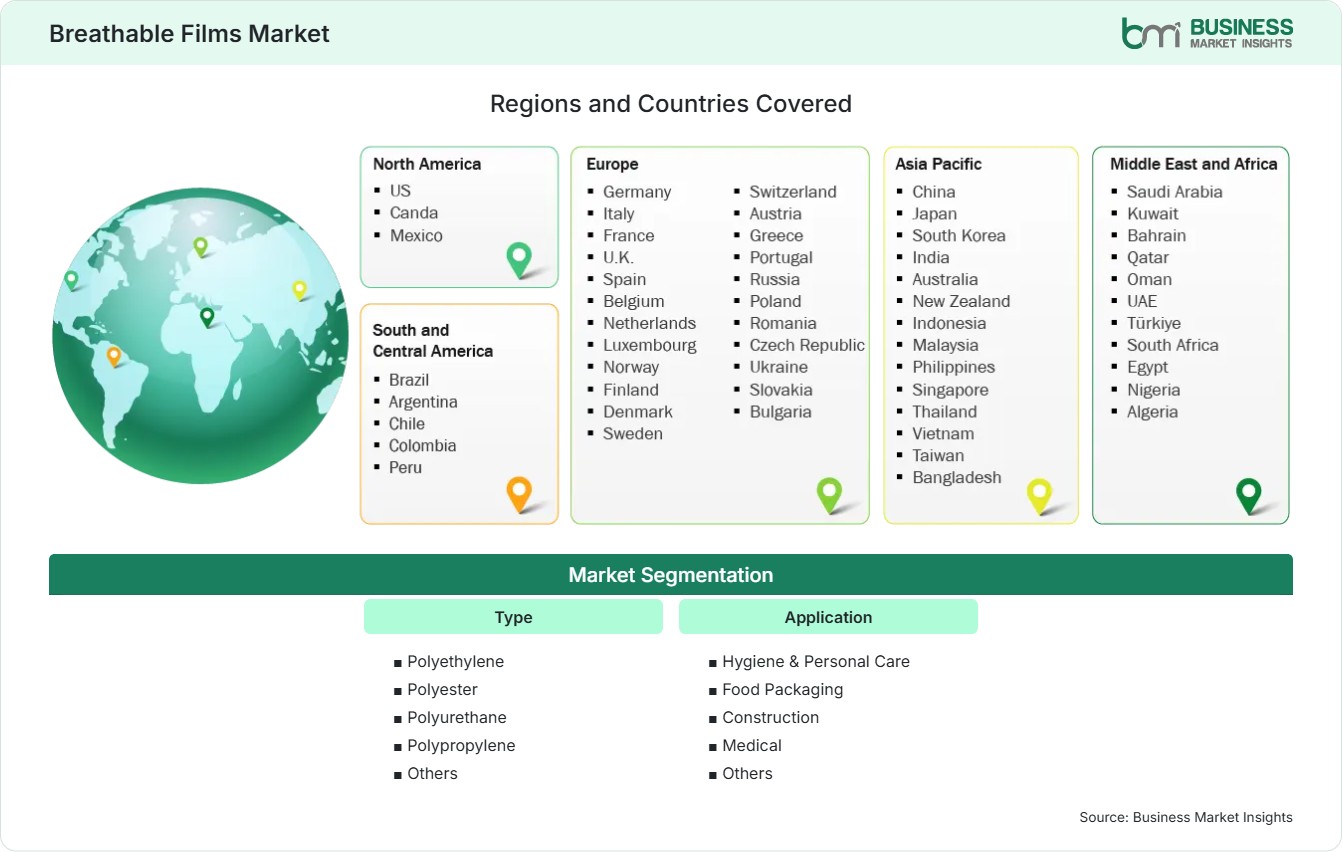
  • Type: Polyethylene, Polyester, Polyurethane, Polypropylene, Others
  • Application: Hygiene & Personal Care, Food Packaging, Construction, Medical, Others
US$ 4.10 Bn Market size in 2025
US$ 8.01 Bn Market Size by 2033
8.73% CAGR, 2026 - 2033
2026-2033 Forecast Period

AI Overview

Breathable Films Market Summary

  • North America: North America holds 34%–37% market share in 2025 and is projected to expand at a 7.8%–8.4% CAGR during 2026–2033. Strong hygiene manufacturing, advanced healthcare packaging demand, and sustainability initiatives continue driving investment and innovation. The U.S. market benefits from expanding medical packaging production, advanced polymer innovation, and domestic manufacturing investments, supporting an estimated 8.0%–8.5% CAGR through 2033.
  • Fastest Growing Region: Asia Pacific accounts for 28%–31% market share in 2025 and is forecast to register a 10.0%–10.8% CAGR during 2026–2033. Expanding hygiene manufacturing, growing packaged food demand, rising healthcare expenditure, rapid industrialization, and increasing investments in recyclable polymer technologies continue accelerating regional capacity expansion.
  • Leading Segment: Hygiene & Personal Care represents 40%–43% market share in 2025 and is expected to expand at a 9.0%–9.6% CAGR through 2033. Rising infant care demand, aging populations, premium hygiene products, sustainable materials, and continuous product innovation continue supporting long-term commercial expansion across global markets.
  • High Growth Segment: Polyurethane accounts for 17%–20% market share in 2025 while advancing at a 10.2%–10.9% CAGR during 2026–2033. Superior moisture vapor transmission, flexibility, lightweight construction, medical compatibility, and premium apparel applications continue expanding adoption across high-performance industrial and healthcare sectors.
  • Key Market Opportunity: Increasing investment in recyclable breathable polymer structures, mono-material packaging, advanced medical protective products, and sustainable hygiene applications creates long-term revenue opportunities while supporting circular economy initiatives and regulatory compliance worldwide.
  • Major Market Players: RKW Group, Mitsui Chemicals, Inc., Arkema S.A., Berry Global Group, Inc., Covestro AG, Toray Industries, Inc., Nitto Denko Corporation, Schur Flexibles Group, Trioplast Industrier AB, and Fatra, a.s.
Strategic Insights

Breathable Films Market: Strategic Insights

Breathable Films Market Strategic Framework
FREE PDF
Request your free sample
Request free sample
Stakeholder View

Key Takeaways

  • Manufacturers are benefiting from vertically integrated polymer supply chains, improved extrusion processes, and strategic partnerships, allowing for greater production flexibility while minimizing risks associated with sourcing throughout hygiene, packaging, and medical value chains.
  • Hygiene products, high-end medical applications, and eco-friendly food packaging are the most viable areas of business because the trend favors breathable materials with sustainable environmental and functional properties
  • Innovation in microporous systems, calcium carbonate films, mono-material packaging, and recycling multilayer technology is transforming the market dynamics and helping meet more stringent sustainability criteria.
  • The Asia Pacific region shows the best prospects for investment due to improved manufacturing facilities, supportive government policies, rising disposable income, and increased usage of hygiene products in China, India, and Southeast Asian markets.
  • Collaboration between polymer producers, packaging companies, healthcare producers and research institutes has increased in an effort to commercialize new breathable materials that can meet emerging regulations and requirements.
Geographic Outlook

Breathable Films Market Regional Highlights

North America Breathable Films Market

North America accounted for 34%–37% of global revenue in 2025 and is projected to register a 7.8%–8.4% CAGR during 2026–2033. The region maintains leadership through advanced polymer manufacturing, strong healthcare infrastructure, and mature hygiene product demand. The Breathable Films Market share remains highest across developed economies where sustainability targets and premium consumer products encourage continuous product innovation and manufacturing modernization.

  • Growing adoption of recyclable hygiene product materials is encouraging manufacturers to develop mono-material breathable structures with improved moisture vapor transmission, enabling compliance with sustainability regulations while reducing dependence on conventional multilayer packaging systems.
  • Medical protective apparel production continues expanding due to rising healthcare expenditure, infection prevention standards, and increased domestic manufacturing capacity, strengthening demand for breathable polymer films with superior barrier protection and wearer comfort.
  • Food packaging companies increasingly utilize breathable films to improve product freshness, reduce food waste, and optimize modified atmosphere packaging performance while meeting consumer demand for sustainable and lightweight packaging solutions.
  • Research investments across specialty polymers, advanced fillers, and high-speed extrusion technologies continue improving manufacturing efficiency, product consistency, and commercial scalability throughout North America's industrial ecosystem.

US Breathable Films Market

The United States represented 79%–82% of North American revenue in 2025 and is expected to expand at a 8.0%–8.5% CAGR through 2033. Investments in sustainable packaging technologies, automation, and specialty polymer research further strengthen the country's competitive manufacturing position across global value chains while supporting high-value export opportunities.

  • Increasing production of infant diapers, adult incontinence products, and feminine hygiene solutions continues strengthening domestic demand for advanced breathable polyethylene and polyurethane films with enhanced durability and comfort.
  • Federal sustainability initiatives and corporate environmental commitments encourage manufacturers to introduce recyclable packaging structures, renewable raw materials, and energy-efficient production technologies across industrial facilities.
  • Healthcare manufacturers continue expanding domestic production of surgical gowns, drapes, wound care materials, and protective apparel utilizing breathable membranes for enhanced patient safety and clinical performance.
  • Continuous automation, digital quality monitoring, and process optimization enable U.S. manufacturers to improve production efficiency while maintaining consistent product quality across high-volume industrial operations.

Europe Breathable Films Market

Europe held 25%–28% Breathable Films Market share during 2025 and is forecast to grow at a 7.5%–8.2% CAGR through 2033. Circular economy legislation, advanced packaging innovation, and strong medical manufacturing continue supporting regional demand. Germany remains the leading national market, while Poland demonstrates the fastest expansion with an estimated 8.8%–9.4% CAGR, driven by manufacturing investments and growing hygiene product exports across European markets.

  • European Union packaging regulations continue encouraging recyclable mono-material structures, driving investments in innovative breathable polymer technologies and advanced film manufacturing processes across regional production facilities.
  • Healthcare manufacturers increasingly adopt breathable membranes in wound care products, surgical protection, and pharmaceutical packaging requiring controlled moisture management and dependable barrier performance.
  • Food packaging companies prioritize breathable films supporting extended shelf life, freshness preservation, and reduced environmental impact while meeting increasingly stringent regulatory compliance requirements.
  • Industrial construction applications continue expanding demand for breathable roofing membranes and building wraps capable of improving energy efficiency and moisture management across residential and commercial infrastructure.

Asia Pacific Breathable Films Market

Asia Pacific represented 28%–31% of global demand in 2025 and is projected to record the fastest 10.0%–10.8% CAGR through 2033. China leads regional production and consumption, while India records the highest national growth at approximately 11.2%–11.8% CAGR owing to expanding hygiene product manufacturing, rapid urbanization, healthcare investments, and rising packaged food consumption across developing economies.

  • Rapid industrialization continues expanding polymer processing capacity, enabling manufacturers to increase production of breathable films serving hygiene, healthcare, construction, and packaging industries throughout the region.
  • Rising disposable income and changing consumer lifestyles accelerate demand for premium baby diapers, feminine hygiene products, and adult care solutions utilizing advanced breathable materials.
  • Increasing healthcare infrastructure investments create substantial opportunities for breathable medical apparel, wound care products, and infection prevention materials across emerging Asian economies.
  • Continuous expansion of food processing industries encourages adoption of breathable packaging technologies supporting freshness preservation and reduced product losses throughout regional distribution networks.

Rest of World Breathable Films Market

The Rest of World region accounted for 9%–11% market share in 2025 and is anticipated to expand at a 8.4%–9.1% CAGR during 2026–2033. South & Central America benefit from expanding packaged food manufacturing and hygiene product demand, while Middle East & Africa experience increasing healthcare investments, construction activity, and industrial diversification supporting breathable material adoption.

  • Expanding local packaging industries encourage investments in high-performance breathable materials that improve food preservation, product quality, and transportation efficiency across developing consumer markets.
  • Healthcare modernization programs increase procurement of breathable medical protective products, surgical apparel, and advanced wound care materials across hospitals and healthcare facilities.
  • Construction growth supports rising demand for breathable roofing membranes, waterproof building wraps, and moisture management materials improving structural durability under varying climate conditions.
  • International manufacturers increasingly establish regional partnerships and distribution networks to strengthen product availability while supporting local converting and polymer processing capabilities.
  • Government industrial diversification policies continue attracting investments in polymer manufacturing, sustainable packaging, and specialty material production across emerging economies.
Global Market Geography
FREE PDF
Request your free sample
Request free sample
Segment Analysis

Breathable Films Market Segmentation

Type

The Type segment accounted for the complete market and remains the foundation of product differentiation across hygiene, medical, packaging, and construction applications. Polyethylene continues leading with an estimated 43%–46% market share in 2025, while Polyurethane records the highest projected 10.2%–10.9% CAGR through 2033 due to its superior breathability and flexibility. Expanding product innovation and sustainability initiatives continue broadening the Breathable Films Market scope across multiple end-use industries.

  • Polyethylene: Polyethylene remains the largest material category owing to excellent processability, cost efficiency, lightweight characteristics, and broad adoption across hygiene products, food packaging, and construction membranes requiring balanced moisture management and mechanical performance.
  • Polyester: Polyester breathable films are increasingly selected for premium industrial textiles, protective apparel, and specialty packaging because they provide superior dimensional stability, chemical resistance, durability, and long-term mechanical reliability under demanding operating conditions.
  • Polyurethane: Polyurethane films experience the fastest adoption across healthcare, sportswear, technical textiles, and advanced protective applications where superior elasticity, moisture vapor transmission, softness, and wearer comfort provide significant commercial advantages over conventional alternatives.
  • Polypropylene: Polypropylene films continue gaining traction across medical packaging, hygiene products, and industrial applications due to their lightweight construction, chemical resistance, excellent processability, and compatibility with recyclable packaging initiatives.

Application

Application diversity continues expanding as breathable films address evolving requirements across healthcare, packaging, and industrial sectors. Hygiene & Personal Care represents the largest application with 40%–43% market share during 2025 and is expected to grow at a 9.0%–9.6% CAGR through 2033. Rising consumer awareness, premium hygiene product adoption, and expanding medical applications continue strengthening the Breathable Films Market trends across developed and emerging economies.

  • Hygiene & Personal Care: Infant diapers, feminine hygiene products, and adult incontinence solutions remain primary demand generators, supported by increasing healthcare awareness, aging populations, premium product preferences, and continuous innovation in breathable multilayer material technologies.
  • Food Packaging: Food manufacturers increasingly adopt breathable films to optimize moisture regulation, preserve freshness, extend shelf life, reduce food waste, and improve packaging sustainability while maintaining product safety throughout distribution and storage operations.
  • Construction: Construction applications continue expanding through breathable roofing membranes, wall wraps, insulation barriers, and moisture management systems that improve building durability, indoor air quality, and long-term structural energy efficiency.
  • Medical: Medical applications continue recording robust adoption through surgical drapes, protective gowns, wound dressings, sterilization packaging, and infection prevention products requiring dependable barrier protection combined with controlled moisture vapor transmission.
Market Forces

Breathable Films Market Dynamics

Key Market Drivers

Rising Demand for Hygiene Product Materials

The global Breathable Films Market growth for infant nappies, female hygiene and incontinence products keeps growing due to an increase in elderly population and improved health consciousness. There is an increasing need for breathable polymer films that offer moisture permeability, softness, durability, and skin comfort at the same time while being economical. The differentiation through light weight construction and recyclability has increased the pace of procurement among multi-national hygiene product companies.

Increasing Adoption in Medical Protective Products

The healthcare sector remains committed to developing protective apparel, wound care products, drapes, and sterilization packs using more advanced breathable membrane technology. Hospitals are becoming conscious of the importance of preventing infections and ensuring the comfort of the patients. The building of the healthcare industry in Asia Pacific, the Middle East, and Latin America regions is facilitating the purchase of quality medical devices. The advancements in the technology of polyurethane and polyethylene films have led to better microbial barrier properties and moisture management.

Packaging Sustainability Initiatives Accelerating

Governments, brand owners, and packaging manufacturers continue pursuing circular economy objectives through recyclable materials and reduced plastic consumption. Breathable mono-material films technology can help to enhance the recyclability of materials without compromising on their ability to perform their packaging and preservation role. Increased investments in equipment for specialty extrusion, renewable polymer, and lightweight packaging can lead to successful commercialization of environmentally friendly breathable products.

Key Market Opportunities

Healthcare Packaging Applications Creating Opportunities

Healthcare packaging continues presenting attractive long-term investment opportunities as pharmaceutical manufacturers require breathable sterilization packaging, advanced medical pouches, and infection-control solutions. With growth in production of biologicals, fabrication of medical devices, and expansion in healthcare infrastructure investments, there is increased need for specialty breathable films with enhanced barrier properties. Innovations in polymer science and coating technology ensure that manufacturers can supply top-notch products that satisfy ever-growing standards for regulations and performance.

Growing Demand Across Personal Care Products

High-end personal care segments continue to grow quickly as consumers emphasize their preference for comfort, skincare, and superior hygiene products. Innovations in product design are being made with manufacturers adopting thinner and lighter designs through polymer innovations. Increased disposable income levels within developing nations have increased the demand for high-end hygiene products, thereby making it necessary for the industry to increase manufacturing capabilities and breathable film facilities for the Breathable Films Market Forecasts.

Increasing Investments in Sustainable Packaging Solutions

Global packaging companies invest in recyclable packaging structures, renewable plastics, and sustainable technologies. Investments in monomaterial packaging solutions, high-tech extrusion machinery, and joint development programs open up opportunities for producers of specialty breathable films. Food packaging, healthcare packaging, and protective materials for industries are projected to stay in focus of investments as regulatory requirements and environmental awareness of consumers keep rising globally.

Market Restraints and Challenges

Volatile Polymer Raw Material Prices

Factor: Prices of polyethylene, polypropylene, polyurethane feedstocks, and specialty additives remain closely linked to fluctuations in crude oil and petrochemical markets.

Impact: Manufacturing costs become increasingly unpredictable, reducing margin stability for converters and finished product manufacturers. Frequent raw material price volatility also complicates long-term procurement planning, customer pricing agreements, inventory management, and capital investment decisions, particularly for small and medium-sized producers.

Environmental Concerns Regarding Plastic Waste

Factor: Increasing regulatory scrutiny regarding plastic waste generation, recycling performance, and extended producer responsibility requirements continues reshaping packaging and polymer industries.

Impact: Manufacturers face growing compliance costs while accelerating investments in recyclable materials, renewable polymers, and circular economy technologies. Companies unable to rapidly transition toward environmentally responsible product portfolios risk reduced competitiveness, delayed customer adoption, and increased regulatory exposure.

Company Analysis

Competitive Landscape

The competitive environment is characterized by investments in sustainable polymers, high-performance extrusion technologies, and regional manufacturing expansion. The Breathable Films Market analysis indicates that companies are focusing on recyclable mono-material structures, medical-grade breathable membranes, lightweight packaging films, and strategic partnerships to strengthen their positions across hygiene, healthcare, construction, and food packaging applications.

Company Name

Overview

Products and Services Relevant to this Market

RKW Group

Global manufacturer specializing in polyolefin-based films for hygiene, industrial, agricultural, and packaging applications with strong European and international manufacturing capabilities.

Breathable hygiene backsheet films, construction membranes, packaging films, specialty polyethylene films, and customized multilayer extrusion solutions.

Mitsui Chemicals, Inc.

Japanese chemical company with diversified polymer technologies, advanced materials, and specialty resins supporting healthcare, packaging, and industrial markets worldwide.

Functional polymers, breathable film materials, elastomers, packaging resins, medical materials, and specialty chemical solutions.

Arkema S.A.

Global specialty materials producer focused on advanced polymers and sustainable material innovation serving industrial, healthcare, and packaging industries.

High-performance polymers, specialty resins, bio-based materials, coating solutions, and polymer technologies supporting breathable film manufacturing.

Berry Global Group, Inc.

Leading producer of engineered materials and packaging products with extensive expertise in hygiene, healthcare, and specialty film manufacturing.

Breathable backsheet films, medical films, packaging materials, nonwoven solutions, engineered polymer films, and sustainable packaging technologies.

Covestro AG

International supplier of high-performance polymer materials emphasizing circular economy initiatives and advanced material innovation.

Polyurethane raw materials, specialty films, sustainable polymers, coating technologies, and healthcare material solutions.

Toray Industries, Inc.

Diversified advanced materials company with strong capabilities in films, fibers, chemicals, and performance materials serving global industrial markets.

Functional films, breathable membranes, industrial polymers, medical materials, textile solutions, and advanced packaging films.

Nitto Denko Corporation

Technology-driven materials manufacturer specializing in functional films, industrial materials, and advanced membrane technologies.

Functional breathable membranes, industrial films, medical materials, adhesive technologies, and specialty polymer products.

Schur Flexibles Group

European flexible packaging company focused on high-performance and sustainable packaging innovations across food, healthcare, and industrial sectors.

Flexible packaging films, breathable packaging structures, recyclable packaging systems, barrier films, and customized converting solutions.

Trioplast Industrier AB

Manufacturer of polyethylene film solutions emphasizing circular plastics, recycled materials, and industrial packaging innovations.

Polyethylene films, industrial packaging materials, sustainable plastic films, specialty extrusion products, and recyclable film solutions.

Fatra, a.s.

European producer of plastic processing solutions with expertise in technical films, membranes, flooring, and specialty polymer products.

Breathable construction membranes, technical polymer films, waterproofing systems, industrial plastic sheets, and specialty extrusion products.

Trust & Transparency

Research Methodology

The market analysis combines proprietary research with secondary data from government agencies, company disclosures, regulatory filings, industry databases and expert interviews. Market estimates are validated through data triangulation, cross-market benchmarking and analyst review.

View Full Research Methodology

Questions Answered

Frequently Asked Questions

Why should businesses refer to a market report before investing?

A comprehensive Breathable Films Market Report helps investors evaluate regional demand patterns, competitive positioning, technology developments, regulatory changes, supply chain dynamics, and future commercial opportunities, enabling informed strategic planning and long-term capital allocation decisions.

How are sustainability regulations influencing Breathable Films Market development?

Environmental regulations are accelerating investments in recyclable polymer structures, mono-material packaging, renewable raw materials, and lightweight product designs.

Which region offers the strongest future investment potential?

Asia Pacific presents the strongest long-term investment opportunity because of expanding manufacturing infrastructure, increasing hygiene product consumption, healthcare investments, favorable industrial policies, and rapidly growing packaged food industries across major developing economies.

Which material type is expected to experience the fastest expansion?

Polyurethane is projected to register the fastest growth owing to its excellent flexibility, moisture management, durability, and compatibility with advanced healthcare, sportswear, technical textile, and premium protective applications requiring high-performance breathable materials.

What are the primary applications of breathable films?

Breathable films are extensively used in hygiene products, food packaging, construction membranes, medical protective products, and industrial applications requiring moisture vapor transmission combined with liquid barrier performance. Their versatility continues expanding as sustainability and product performance requirements evolve.

Access the Full Breathable Films Market Report

Get segment-level forecasts, regional estimates, competitive benchmarking, company profiles and downloadable Excel datasets.

Access the full Breathable Films Market Report
350 pages PDF & Excel | 2026-08-21
Similar Research

Related Market Reports