
Sustainable Materials Market Outlook: Size, Share, Trends, Growth Analysis, Competitive Landscape & Forecast, 2026-2033

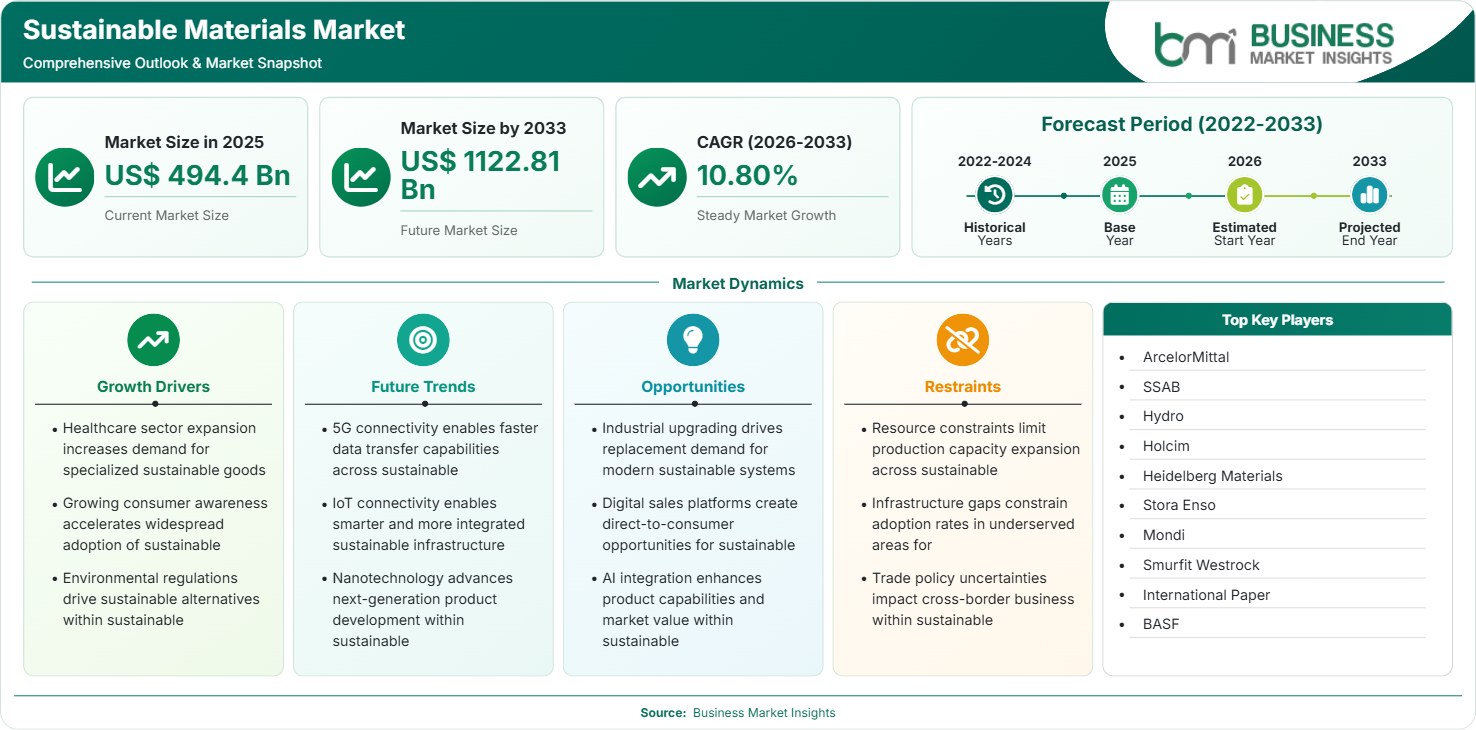
The Sustainable Materials Market size was valued at US$ 494.4 Billion in 2025 and is projected to reach US$ 1122.81 Billion by 2033, growing at a CAGR of 10.80% during 2026–2033. Rising decarbonization initiatives, circular economy adoption, green building investments, sustainable packaging demand, and industrial innovation are creating long-term opportunities across manufacturing, construction, transportation, and consumer industries.

Report Coverage
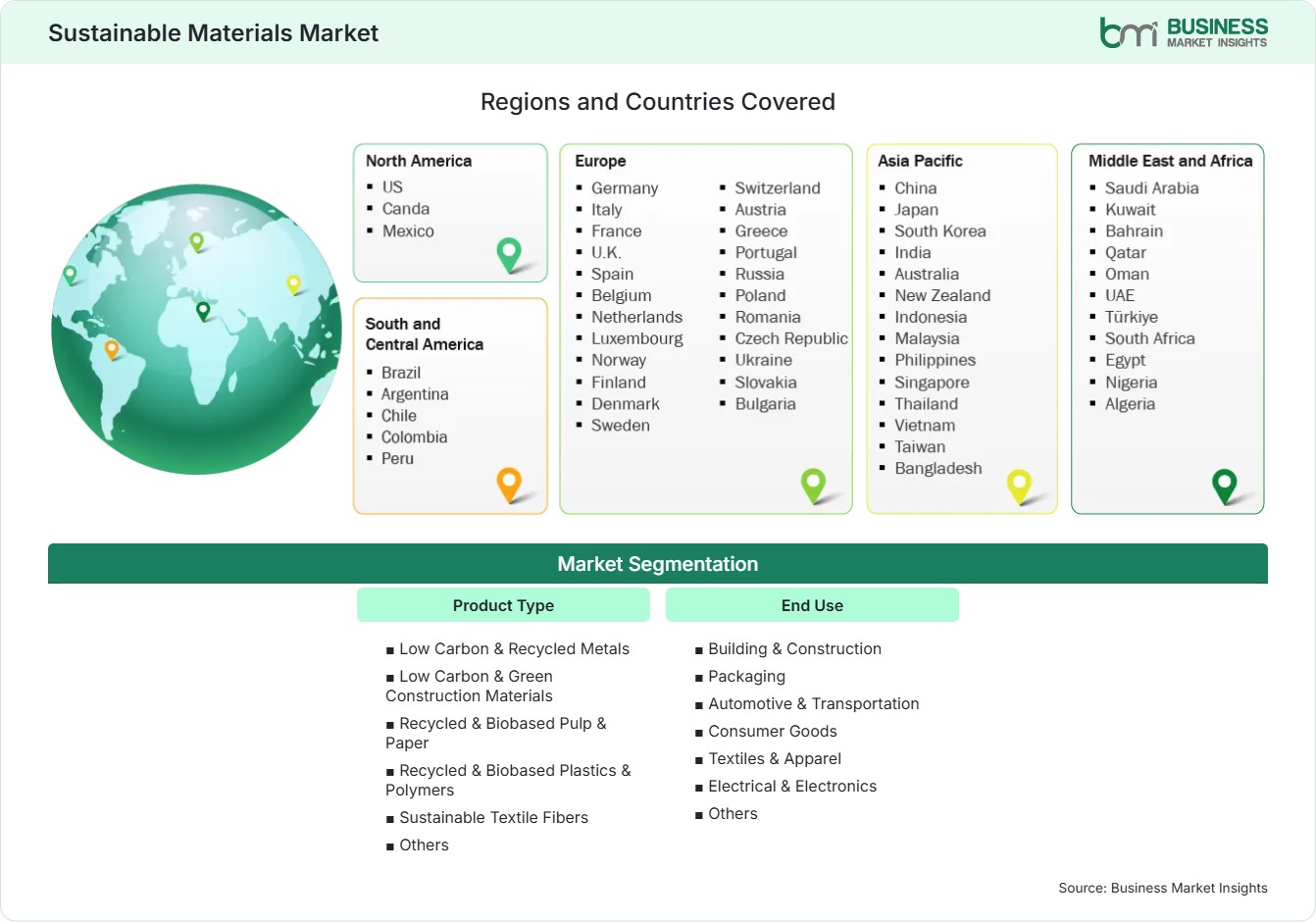
  • Product Type: Low Carbon & Recycled Metals, Low Carbon & Green Construction Materials, Recycled & Biobased Pulp & Paper, Recycled & Biobased Plastics & Polymers, Sustainable Textile Fibers, Others
  • End Use: Building & Construction, Packaging, Automotive & Transportation, Consumer Goods, Textiles & Apparel, Electrical & Electronics, Others
US$ 494.4 Bn Market size in 2025
US$ 1122.81 Bn Market Size by 2033
10.80% CAGR, 2026 - 2033
2026-2033 Forecast Period

AI Overview

Sustainable Materials Market Summary

  • North America Region: North America holds 34%–37% market share in 2025, expanding at a 9.2%–9.8% CAGR during 2026–2033. Strong sustainability regulations, corporate ESG commitments, advanced recycling technologies, and green infrastructure investments continue supporting material innovation and commercialization across industries. The U.S. market benefits from large-scale industrial decarbonization investments, federal clean manufacturing incentives, and growing private-sector adoption, advancing at an estimated CAGR of 9.3%–9.9% through 2033.
  • Fastest Growing Region: Asia Pacific accounts for 27%–30% market share in 2025 and is projected to register a 12.3%–13.1% CAGR during 2026–2033. Manufacturing expansion, government sustainability mandates, renewable energy investments, and increasing demand for environmentally responsible products accelerate regional capacity expansion and innovation.
  • Leading Segment: Building & Construction represents 30%–33% market share in 2025 while advancing at a 10.2%–10.8% CAGR through 2033. Green infrastructure projects, low-carbon cement adoption, recycled metals, and stricter building efficiency standards continue strengthening long-term material demand across commercial and residential developments.
  • High Growth Segment: Recycled & Biobased Plastics & Polymers contributes 15%–18% market share in 2025 and is expected to expand at a 13.4%–14.2% CAGR. Circular packaging initiatives, plastic reduction targets, advanced recycling technologies, and consumer sustainability preferences are accelerating commercial adoption worldwide.
  • Key Market Opportunity: Increasing investments in circular manufacturing ecosystems, carbon-neutral production technologies, advanced recycling infrastructure, and bio-based material innovation enable manufacturers to reduce emissions while improving supply chain resilience and long-term profitability.
  • Major Market Players: ArcelorMittal, SSAB AB, Norsk Hydro ASA, Holcim Ltd., Heidelberg Materials AG, Stora Enso Oyj, Mondi plc, Smurfit Westrock plc, International Paper Company, BASF SE.
Strategic Insights

Sustainable Materials Market: Strategic Insights

Sustainable Materials Market Strategic Framework
FREE PDF
Request your free sample
Request free sample
Stakeholder View

Key Takeaways

  • The industry value chain is evolving from linear resource consumption toward circular manufacturing, integrating recycled feedstocks, renewable raw materials, digital traceability, and closed-loop recovery systems to improve operational efficiency and environmental performance.
  • Building materials, sustainable packaging, transportation components, and bio-based polymers represent the strongest commercial opportunities as governments and multinational corporations accelerate carbon reduction initiatives across industrial supply chains.
  • Material innovation increasingly focuses on lightweight composites, green steel, low-carbon cement, bio-based polymers, engineered wood products, and advanced recycling technologies capable of delivering measurable lifecycle emission reductions.
  • Asia Pacific offers the most attractive long-term investment environment owing to expanding manufacturing capacity, supportive industrial policies, renewable energy deployment, and rapidly increasing domestic demand for environmentally responsible products.
  • Strategic acquisitions, technology partnerships, and joint ventures continue strengthening competitive positioning as leading manufacturers expand recycling capabilities, low-carbon production technologies, and sustainable product portfolios across multiple industries.
  • Digital product passports, lifecycle carbon accounting, AI-enabled production optimization, and supply-chain transparency solutions are expected to become key competitive differentiators throughout the forecast period.
Geographic Outlook

Sustainable Materials Market Regional Highlights

North America Sustainable Materials Market

North America accounted for 34%–37% of the global Sustainable Materials Market share in 2025 and is projected to expand at a CAGR of 9.2%–9.8% during 2026–2033. The region benefits from stringent climate policies, widespread corporate ESG adoption, advanced recycling infrastructure, and increasing investments in green manufacturing. The United States and Canada continue expanding low-carbon industrial production, while public procurement programs and sustainable construction initiatives stimulate demand for recycled metals, engineered wood, bio-based polymers, and environmentally responsible packaging materials.

  • Federal clean manufacturing incentives and industrial decarbonization programs encourage steel, cement, chemicals, and packaging manufacturers to invest in low-carbon technologies, renewable energy integration, and recycled feedstock utilization across large-scale production facilities.
  • Major consumer brands increasingly establish circular procurement strategies requiring recycled, recyclable, and bio-based materials throughout their supply chains, strengthening long-term commercial demand while accelerating innovation among material producers and technology providers.
  • Construction companies continue adopting low-carbon concrete, recycled steel, engineered timber, and sustainable insulation materials to comply with evolving building regulations and green certification programs across commercial and residential developments.
  • Growing investments in advanced chemical recycling, carbon capture technologies, and AI-driven manufacturing optimization improve production efficiency while supporting emission reduction targets across multiple industrial sectors.
  • Collaboration among governments, universities, manufacturers, and technology providers accelerates commercialization of innovative sustainable materials while strengthening regional competitiveness in global industrial value chains.

US Sustainable Materials Market

The United States represented approximately 78%–81% of North American revenue in 2025 and is anticipated to register a CAGR of 9.3%–9.9% through 2033. Large-scale infrastructure modernization, clean energy investments, and federal manufacturing incentives continue supporting sustainable industrial production. Strong research capabilities, corporate sustainability commitments, and increasing private investment in circular economy technologies further reinforce long-term Sustainable Materials Market expansion across construction, automotive, packaging, and advanced manufacturing industries.

  • Federal funding under clean manufacturing and infrastructure programs continues supporting commercialization of low-carbon steel, cement, engineered wood, recycled polymers, and sustainable packaging technologies throughout domestic industrial supply chains.
  • Automotive manufacturers increasingly integrate lightweight recycled metals, bio-based plastics, and renewable composites to improve vehicle efficiency while supporting national carbon reduction objectives and electrification initiatives.
  • Consumer packaged goods companies continue increasing recycled content requirements while expanding investments in recyclable packaging, advanced material recovery systems, and closed-loop manufacturing operations.
  • Venture capital funding for advanced material technologies, carbon utilization solutions, and industrial biotechnology strengthens innovation ecosystems while accelerating commercialization of environmentally responsible products.

Europe Sustainable Materials Market

Europe held approximately 28%–31% market share during 2025 and is forecast to grow at a CAGR of 10.1%–10.7% through 2033. Comprehensive climate regulations, circular economy legislation, and carbon pricing mechanisms continue accelerating adoption across industrial sectors. Germany remains the leading regional Sustainable Materials Market, while Nordic countries demonstrate the fastest expansion through investments in green steel, renewable materials, sustainable forestry, and advanced recycling technologies supported by ambitious national sustainability strategies.

  • The European Green Deal and Circular Economy Action Plan continue encouraging manufacturers to increase recycled content, reduce lifecycle emissions, and improve resource efficiency across industrial production.
  • Germany maintains regional leadership through advanced manufacturing capabilities, strong automotive production, and significant investments in low-carbon industrial technologies supporting sustainable material commercialization.
  • Sweden, Finland, and Norway experience some of the fastest regional expansion through green steel production, renewable energy integration, engineered wood innovation, and sustainable mining developments.
  • Packaging regulations requiring higher recycled content encourage rapid investments in fiber-based packaging, recyclable plastics, and advanced recycling infrastructure throughout the European Union.
  • Growing collaboration between research institutes and industrial manufacturers accelerates development of innovative bio-based materials capable of replacing conventional fossil-derived alternatives.

Asia Pacific Sustainable Materials Market

Asia Pacific accounted for 27%–30% of global revenue in 2025 and is projected to register the fastest CAGR of 12.3%–13.1% during the forecast period. Rapid industrialization, expanding manufacturing capacity, and government sustainability initiatives continue driving regional demand. China remains the largest Sustainable Materials Market, while India records the fastest growth due to infrastructure expansion, renewable energy investments, supportive environmental policies, and increasing adoption of circular manufacturing practices.

  • China continues investing heavily in green manufacturing, renewable energy integration, advanced recycling facilities, and low-carbon construction materials supporting industrial transformation.
  • India records the strongest regional expansion as infrastructure development, sustainable urbanization, and government production incentives encourage environmentally responsible manufacturing across multiple sectors.
  • Japan and South Korea focus on high-performance recycled materials, advanced composites, and bio-based polymers supporting automotive, electronics, and precision manufacturing industries.
  • Rapid expansion of sustainable packaging production responds to increasing consumer awareness, export requirements, and regulatory initiatives targeting single-use plastic reduction.
  • International manufacturers continue expanding production facilities across Southeast Asia to strengthen resilient supply chains while improving access to renewable raw materials and regional markets.

Rest of World Sustainable Materials Market

The Rest of World region represented approximately 8%–11% of global revenue in 2025 and is expected to expand at a CAGR of 10.8%–11.5% through 2033.

South and Central America continue benefiting from abundant renewable resources, expanding forestry industries, and growing investments in bio-based manufacturing. Brazil remains the leading regional Sustainable Materials Market supported by sustainable pulp, paper, and bio-based chemical production.

The Middle East and Africa increasingly invest in green construction, renewable energy infrastructure, and industrial diversification initiatives. The United Arab Emirates leads regional sustainable construction adoption, while Saudi Arabia demonstrates the fastest growth through large-scale green infrastructure projects and circular economy investments.

  • Brazil continues expanding sustainable forestry management and fiber-based product manufacturing while increasing exports of certified renewable materials to global industrial markets.
  • Governments across the Gulf region prioritize sustainable construction materials for smart city developments, renewable energy projects, and carbon-neutral infrastructure initiatives.
  • South Africa invests in recycled materials, resource-efficient mining, and industrial modernization supporting environmentally responsible manufacturing across multiple sectors.
  • International development organizations continue supporting circular economy initiatives, waste management infrastructure, and recycling capacity expansion throughout emerging economies.
  • Increasing foreign direct investment strengthens regional manufacturing capabilities while improving technology transfer, sustainable production standards, and long-term industrial competitiveness.
Global Market Geography
FREE PDF
Request your free sample
Request free sample
Segment Analysis

Sustainable Materials Market Segmentation

Product Type

Product Type accounted for approximately 56%–59% of the overall market in 2025 and is projected to expand at a CAGR of 11.1%–11.8% during 2026–2033. Increasing industrial decarbonization, circular manufacturing initiatives, and regulatory emphasis on resource efficiency continue strengthening adoption across multiple industries. The Sustainable Materials Market scope is expanding as manufacturers commercialize innovative low-carbon alternatives capable of improving lifecycle sustainability while maintaining high mechanical and performance characteristics.

  • Low Carbon & Recycled Metals: Growing utilization across automotive, construction, renewable energy, and industrial equipment manufacturing is driven by carbon reduction targets, improved recycling technologies, and increasing availability of secondary raw materials supporting circular production.
  • Low Carbon & Green Construction Materials: Demand continues accelerating through green building certifications, infrastructure modernization projects, and stricter building energy regulations encouraging adoption of low-carbon cement, engineered timber, recycled aggregates, and environmentally responsible insulation materials.
  • Recycled & Biobased Pulp & Paper: Sustainable packaging expansion, plastic substitution initiatives, certified forestry practices, and rising consumer preference for recyclable fiber products continue supporting steady commercial adoption across packaging and consumer goods industries.
  • Recycled & Biobased Plastics & Polymers: Rapid innovation in mechanical and chemical recycling technologies, bio-based resin development, and circular packaging investments continue strengthening commercialization across food packaging, automotive, healthcare, and consumer products.
  • Sustainable Textile Fibers: Fashion brands increasingly integrate recycled polyester, regenerated cellulose fibers, organic natural fibers, and bio-based alternatives to improve supply-chain sustainability while complying with evolving environmental regulations and consumer expectations.

End Use

By End Use represented approximately 41%–44% Sustainable Materials Market share in 2025 and is anticipated to register a CAGR of 10.5%–11.2% through 2033. Demand continues expanding as industries prioritize lifecycle carbon reduction, recycled material integration, and environmentally responsible sourcing strategies. Increasing regulatory compliance requirements, sustainability reporting obligations, and investment in green manufacturing continue accelerating adoption across diversified industrial applications.

  • Building & Construction: The largest application segment benefits from increasing adoption of green buildings, energy-efficient infrastructure, recycled metals, engineered wood, and low-carbon cement supporting sustainable urban development and infrastructure modernization initiatives.
  • Packaging: Brand owners continue replacing conventional materials with recyclable paper, fiber-based packaging, recycled plastics, and compostable alternatives to comply with sustainability commitments and evolving environmental regulations worldwide.
  • Automotive & Transportation: Manufacturers increasingly utilize lightweight recycled metals, renewable composites, and bio-based polymers to improve fuel efficiency, electric vehicle performance, and lifecycle environmental performance across passenger and commercial vehicles.
  • Consumer Goods: Consumer product manufacturers continue integrating recycled content and renewable raw materials into household products, personal care packaging, furniture, and durable goods to satisfy sustainability commitments and changing customer preferences.
  • Textiles & Apparel: Apparel producers invest in recycled fibers, renewable textiles, closed-loop manufacturing systems, and traceable supply chains to reduce environmental impacts while strengthening sustainable product differentiation.
  • Electrical & Electronics: Electronics manufacturers adopt recycled engineering plastics, lightweight aluminum, sustainable packaging, and environmentally responsible materials supporting product stewardship, regulatory compliance, and circular economy objectives.
Market Forces

Sustainable Materials Market Dynamics

Key Market Drivers

Global Decarbonization Policies Accelerating Industrial Material Transformation

Governments across the globe are increasingly focusing on their climate commitments via carbon pricing, carbon market, green procurement and decarbonization programs for industries. Programs like Carbon Border Adjustment Mechanism (CBAM) in the European Union, Inflation Reduction Act in the U.S., and analogous programs in Asia, are pushing industrial companies to use low carbon content materials in their production processes. As per the International Energy Agency (IEA), industrial sector is responsible for around 25% of all energy related CO₂ emissions. Thus, development of new materials is an important decarbonization goal. Consequently, Sustainable Materials Market growth is increasingly supported by policy-driven demand, technology commercialization, and long-term sustainability commitments from both public and private sectors.

Rapid Expansion of Circular Economy and Advanced Recycling Infrastructure

The circular economy is transforming global manufacturing, with the focus being on efficient use of resources, minimizing waste, and using recycled materials. Investment in mechanical recycling, chemical recycling, industrial waste recycling, and tracking of materials increases the supply of feedstock while decreasing reliance on virgin materials. Organizations such as the United Nations Environment Programme (UNEP) continue promoting circular production models that minimize environmental impacts while improving economic resilience. More manufacturers have started adopting closed-loop production processes which can recycle precious materials from the industrial and consumer waste. This helps ensure the availability of the raw materials for production, decrease costs and speed up the process of producing environmentally friendly products.

Corporate ESG Commitments Driving Sustainable Procurement Strategies

Environmental, Social, and Governance (ESG) objectives have become central to procurement strategies among multinational corporations. Manufacturing firms across the world are setting scientifically informed emission reduction goals that entail their suppliers providing certified low-emission material inputs through lifecycle analysis and environmental declarations. The finance industry has been incorporating sustainable performance within their loans, thereby prompting industries to adopt renewables and sustainable production techniques and recycled inputs. Digital systems that monitor the supply chain can help firms trace where and how much emissions come from concerning input sourcing. Working together with manufacturers, technologists, certifiers, and users has led to the increasing adoption of sustainable materials.

Key Market Opportunities

Large-Scale Green Infrastructure Investments Creating New Revenue Streams

The use of sustainable transport, renewable energy, intelligent cities, and resilient infrastructure is taking place not only in North America, Europe, Asia-Pacific region, but also in the Middle East region, with substantial investments from the governments in these areas. The use of these initiatives requires huge quantities of low carbon steel, green concrete, engineered wood, recycled aggregates, as well as eco-friendly insulating material. The infrastructure upgrades serve as a stable source of demand for the development of innovative materials. Sustainable Materials Market Forecasts indicate that firms able to provide certified low-carbon products with transparent data about lifecycle emissions will benefit from competitive advantages as sustainability performance becomes an important criterion for supplier selection within the procurement process.

Bio-Based Material Innovation Expanding High-Value Commercial Applications

Continual studies on renewable feedstocks, industrial biotechnology, and biomaterials have resulted in possibilities other than those in packaging sectors. There is more commercial potential for bio-polymers, engineered cellulose material, algae-based materials, and agricultural waste material. Improvements in mechanical performance, durability, moisture resistance, and process compatibility enable broader industrial adoption while reducing dependence on fossil-derived raw materials. Strategic alliances of chemical firms, biotech firms, universities, and manufacturers will continue to accelerate the development of next-generation sustainable materials that can meet the tough requirements of industries.

Digital Material Traceability Supporting Premium Sustainable Products

Emerging Sustainable Materials Market Trends indicate that the growing demand for supply-chain transparency encourages adoption of blockchain platforms, AI-powered lifecycle assessment tools, digital product passports, and automated carbon accounting solutions. Manufacturers can now distinguish their products based on environmental certifications, recycling certifications, and traceability documents. In addition, digital traceability makes regulatory compliance easy, boosts consumer confidence, and helps in pricing environmentally friendly products at higher rates. With the expansion of sustainability reporting requirements internationally, companies that invest in digital verification technology are expected to foster stronger customer relations in the global industrial value chain.

Market Restraints and Challenges

High Production Costs and Limited Commercial Scale

Factor: Many low-carbon materials, advanced bio-based products, and innovative recycling technologies remain more expensive than conventional alternatives because of higher capital investment requirements, limited economies of scale, and evolving production technologies.

Impact: High production costs discourage the uptake in industries that are price conscious and developing economies where decision-making is based on first-cost considerations, not the environment benefits throughout the lifecycle of the product. The payback periods are also very long in setting up recycling plants, renewable energy systems, and production plants with reduced carbon emissions. While the production costs keep reducing as a result of advancement in technology, commercialization will depend on increasing the production capacity, government assistance, and sustainable feedstocks.

Inconsistent Global Standards and Raw Material Supply Constraints

Factor: Sustainability certifications, recycled content requirements, lifecycle assessment methodologies, and environmental reporting frameworks continue to vary across countries, while reliable supplies of high-quality recycled and renewable feedstocks remain constrained.

Impact: The manufacturer may be faced with challenges such as higher compliance difficulty, higher certification cost, and disparate international market needs that make the commercialization of products difficult. The availability of the required recycled material may also be challenging. Harmonization of international sustainability standards, expansion of collection infrastructure, and stronger investment in circular supply chains will be essential to improve long-term Sustainable Materials Market stability and support broader industrial adoption of sustainable materials.

Company Analysis

Competitive Landscape

The competitive environment is characterized by strategic investments in decarbonization technologies, circular manufacturing, renewable feedstocks, and advanced recycling capabilities. The Sustainable Materials Market analysis indicates that leading companies are strengthening their positions through capacity expansions, technology partnerships, sustainable product innovation, and acquisitions that enhance low-carbon production and resource efficiency across global value chains.

Company Name

Overview

Products and Services Relevant to this Market

ArcelorMittal

Global steel producer focusing on industrial decarbonization, circular steel production, and low-carbon manufacturing technologies across multiple international markets.

Low-carbon steel, recycled steel products, green steel solutions, automotive steel, construction steel, and carbon reduction technologies.

SSAB AB

Swedish steel manufacturer recognized for fossil-free steel innovation and advanced sustainable manufacturing initiatives supporting industrial decarbonization.

Fossil-free steel, high-strength steel, recycled steel products, construction materials, automotive steel, and sustainable manufacturing solutions.

Norsk Hydro ASA

Leading aluminum producer emphasizing renewable energy-powered production, recycling, and circular aluminum value chains across global industries.

Recycled aluminum, low-carbon aluminum, extrusion solutions, rolled products, building systems, and sustainable industrial materials.

Holcim Ltd.

Global building materials company investing heavily in low-carbon cement, circular construction solutions, and sustainable infrastructure materials.

Low-carbon cement, green concrete, recycled aggregates, roofing systems, construction solutions, and circular building materials.

Heidelberg Materials AG

International producer advancing carbon capture technologies and environmentally responsible construction materials through continuous innovation.

Sustainable cement, ready-mix concrete, recycled aggregates, carbon capture solutions, and infrastructure construction materials.

Stora Enso Oyj

Renewable materials company utilizing sustainably managed forests to develop bio-based alternatives for packaging and construction industries.

Engineered wood, renewable packaging materials, biomaterials, pulp products, sustainable packaging, and wood construction solutions.

Mondi plc

Global packaging and paper manufacturer focused on circular economy innovation and recyclable packaging technologies.

Sustainable packaging, kraft paper, containerboard, flexible packaging, recycled paper products, and fiber-based material solutions.

Smurfit Westrock plc

Leading provider of paper-based packaging solutions with extensive recycling operations supporting circular packaging systems worldwide.

Corrugated packaging, containerboard, recycled paper products, fiber packaging, packaging design, and recycling services.

International Paper Company

Major producer of renewable fiber-based packaging and pulp products emphasizing responsible forestry and circular resource management.

Fiber packaging, pulp products, containerboard, recycled paper, industrial packaging, and renewable fiber solutions.

BASF SE

Global chemical company developing bio-based polymers, recyclable materials, sustainable additives, and circular economy technologies.

Bio-based plastics, engineering polymers, sustainable chemicals, performance materials, recycling technologies, and industrial solutions.

Trust & Transparency

Research Methodology

The market analysis combines proprietary research with secondary data from government agencies, company disclosures, regulatory filings, industry databases and expert interviews. Market estimates are validated through data triangulation, cross-market benchmarking and analyst review.

View Full Research Methodology

Questions Answered

Frequently Asked Questions

Why is the Sustainable Materials Market Report valuable for business decision-makers?

The report provides detailed insights into competitive positioning, regional opportunities, evolving regulations, technology trends, investment priorities, and future demand patterns, enabling organizations to develop informed long-term growth and sustainability strategies.

How are technological innovations influencing this industry?

Advanced recycling technologies, bio-based polymers, AI-enabled manufacturing optimization, digital product passports, lifecycle carbon assessment, and carbon capture technologies are improving material performance, transparency, and environmental sustainability across industrial applications.

Which region is expected to experience the fastest expansion during the forecast period?

Asia Pacific is projected to register the highest growth rate through 2033, supported by expanding manufacturing capacity, industrial modernization, renewable energy investments, and strong government initiatives promoting sustainable production.

Which end-use industry generates the largest demand for sustainable materials?

Building and construction remains the leading end-use industry due to growing adoption of low-carbon cement, recycled steel, engineered wood, and green building certifications supporting sustainable infrastructure development worldwide.

What factors are accelerating demand for the Sustainable Materials Market?

Demand is increasing because governments, manufacturers, and consumers prioritize carbon reduction, circular economy practices, renewable feedstocks, and environmentally responsible supply chains. Investments in green infrastructure and sustainable packaging further strengthen long-term adoption.

Access the Full Sustainable Materials Market Report

Get segment-level forecasts, regional estimates, competitive benchmarking, company profiles and downloadable Excel datasets.

Access the full Sustainable Materials Market Report
350 pages PDF & Excel | 2026-08-17
Similar Research

Related Market Reports