
Sustainable Packaging Materials Market Outlook: Size, Share, Trends, Growth Analysis, Competitive Landscape & Forecast, 2026-2033

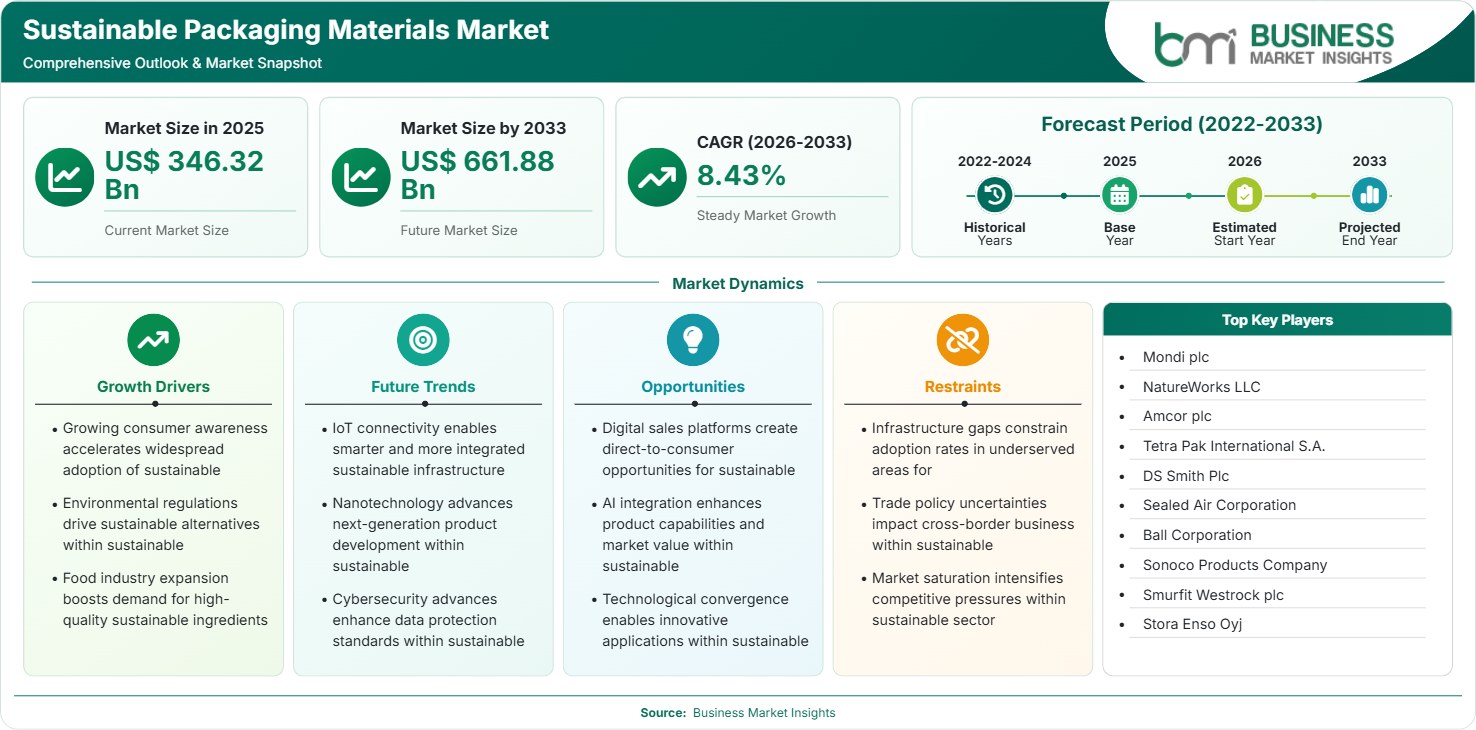
The Sustainable Packaging Materials Market size was valued at US$ 346.32 Billion in 2025 and is projected to reach US$ 661.88 Billion by 2033, growing at a CAGR of 8.43% during 2026–2033, driven by rising circular economy initiatives, regulatory pressure on plastic waste, corporate sustainability commitments, recyclable material adoption, bio-based innovation, and expanding eco-conscious consumer demand.

Report Coverage
  • Material Type: Biodegradable & Compostable Materials, Recyclable Materials, Reusable / Refillable Materials, Others
  • Packaging Type: Rigid Packaging, Flexible Packaging
  • End-Use Industry: Food & Beverage, Pharmaceuticals & Healthcare, Electronics, E-commerce & Retail, Others
US$ 346.32 Bn Market size in 2025
US$ 661.88 Bn Market Size by 2033
8.43% CAGR, 2026 - 2033
2026-2033 Forecast Period

AI Overview

Sustainable Packaging Materials Market Summary

  • North America Region: North America holds a sustainable packaging materials market share of 31%–34% in 2025, growing with a CAGR of 7.5%–8.2% during 2026–2033, influenced by recycling infrastructure expansion, corporate ESG targets, sustainable material innovation, food packaging modernization, regulatory support, consumer awareness, e-commerce growth, circular economy investments, advanced manufacturing capabilities, and brand sustainability commitments. The U.S. market benefits from robust consumer goods demand, recycling investments, and sustainability regulations, advancing at approximately 7.8%–8.5% CAGR.
  • Fastest Growing Region: Asia Pacific accounts for 25%–28% share in 2025 and is projected to expand at a CAGR of 9.5%–10.3%, supported by urbanization, manufacturing expansion, government sustainability programs, growing packaged food demand, retail modernization, investment in bio-based materials, recycling infrastructure upgrades, increasing environmental awareness, export-oriented production, and corporate decarbonization strategies.
  • Leading Segment: Recyclable Materials represent 42%–46% share in 2025 and are expected to grow at a CAGR of 8.0%–8.8%, supported by mature collection systems, lower compliance costs, circular economy alignment, retailer adoption, packaging redesign initiatives, material recovery advancements, brand sustainability goals, regulatory acceptance, industrial scalability, and established supply chains.
  • High Growth Segment: Biodegradable & Compostable Materials account for 22%–26% share in 2025 and are anticipated to register a CAGR of 10.2%–11.1%, driven by single-use plastic restrictions, innovation in bio-polymers, composting ecosystem development, foodservice adoption, regulatory incentives, renewable feedstocks, consumer preference shifts, investment in green materials, carbon reduction initiatives, and sustainable product differentiation.
  • Key Market Opportunity: Significant opportunities are emerging from advanced bio-based packaging solutions, closed-loop recycling systems, sustainable e-commerce packaging formats, reusable packaging networks, digital traceability integration, and industrial composting infrastructure investments worldwide.
  • Major Market Players: Mondi plc; NatureWorks LLC; Amcor plc; Tetra Pak International S.A.; DS Smith Plc; Sealed Air Corporation; Ball Corporation; Sonoco Products Company; Smurfit Westrock plc; Stora Enso Oyj.
Strategic Insights

Sustainable Packaging Materials Market: Strategic Insights

Sustainable Packaging Materials Market Strategic Framework
FREE PDF
Request your free sample
Request free sample
Stakeholder View

Key Takeaways

  • The sustainable packaging materials market ecosystem is increasingly integrated, with resin producers, converters, recyclers, brand owners, and waste management companies collaborating to establish circular packaging supply chains.
  • The food and beverage sector remains the most promising area from a commercial perspective owing to the high volume of packaging involved, environmental considerations, and changing material regulation.
  • Novation trends involve mono-material solutions, fiber-based packaging solutions, biodegradable plastics, and digital traceability systems for better recovery and recycling.
  • Asia Pacific has emerged as an interesting location for investments considering its manufacturing activities, stringent environmental regulations, increased consumer awareness, and greater consumption of packaged products.
  • Mergers and acquisitions by packaging companies are leading to portfolio diversification and availability of sustainable materials technology.
Geographic Outlook

Sustainable Packaging Materials Market Regional Highlights

North America Sustainable Packaging Materials Market

North America accounts for approximately 31%–34% Sustainable Packaging Materials Market share in 2025 and is projected to expand at a CAGR of 7.5%–8.2% through 2033. Investments in circular economy infrastructure, packaging innovation, and material recovery systems are reinforcing regional competitiveness while strengthening adoption across food, healthcare, retail, and industrial sectors.

  • The leading companies have been ramping up their efforts to redesign their packages to become more recyclable, use less virgin plastic, and meet sustainability commitments made by the company.
  • The rising popularity of e-commerce transactions is causing an increase in the need for environmentally friendly yet light and sturdy packaging options.
  • The improvements made to recycling systems are allowing packaging producers to recycle more materials and incorporate them into their packaging products.
  • The ongoing sustainability initiatives from both the public and private sector are continuing to promote the development of low-carbon packaging systems.

US Sustainable Packaging Materials Market

The United States represents approximately 72%–76% sustainable packaging materials market share within North America and is forecast to grow at a CAGR of 7.8%–8.5% through 2033. Federal and state-level sustainability initiatives, combined with corporate ESG strategies, are increasing investments in recyclable, reusable, and renewable packaging materials. Technology innovation and consumer preference for environmentally responsible products continue strengthening adoption across major packaging applications.

  • The major consumer packaged goods brands are increasingly adopting more recycled content and recyclable packagings, thus increasing the demand for sustainable materials.
  • The increased use of paper-based products is facilitating the replacement of plastic materials in various sectors such as retail, food services and shipping.
  • Chemical recycling and sorting innovations are enhancing the circular economy performance throughout the entire packaging supply chain.
  • Growth in e-commerce is continuously providing packaging innovations that are lightweight and recyclable.

Europe Sustainable Packaging Materials Market

Europe holds approximately 28%–31% sustainable packaging materials market share in 2025 and is expected to expand at a CAGR of 7.8%–8.6% through 2033. Germany remains the leading regional market, while Eastern European economies are demonstrating stronger expansion rates as packaging investments and environmental regulations continue strengthening across industrial sectors.

  • Regulatory frameworks focusing on waste reduction and circular systems are motivating the quick uptake of sustainable materials in the packaging sector.
  • The high level of awareness among consumers with regards to sustainability is affecting the buying decisions made by customers.
  • The development of fiber-based packaging technology is facilitating the advancement in food, beverages, and consumer goods.
  • The retailers have started demanding sustainable packaging formats from their suppliers.
  • Industry-wide collaboration is enhancing the efficiency of recycling and promoting sustainable packaging materials.

Asia Pacific Sustainable Packaging Materials Market

Asia Pacific accounts for approximately 25%–28% share in 2025 and is projected to register the fastest expansion, with a CAGR of 9.5%–10.3% through 2033. China remains the largest regional sustainable packaging materials market due to its manufacturing scale and sustainability initiatives, while India demonstrates the strongest growth momentum supported by regulatory reforms, investments in recycling infrastructure, and rising consumer awareness regarding sustainable consumption practices.

  • The government’s banning of single-use plastics is pressurizing packaging suppliers into using recyclable, biodegradable and renewable packaging materials.
  • The booming sectors of food delivery, retail and e-commerce are creating a huge demand for sustainable packaging that can provide environmental performance and efficiency.
  • The regional capacity to manufacture these materials and their cost-effectiveness is creating investments in bio-based polymers, paper packaging and recycling technologies.
  • Increased consumer consciousness about the environment is motivating brands to use more environmentally friendly packaging options.
  • Global packaging suppliers are increasing their production capacity and making strategic alliances to enhance their presence in the region and innovation capabilities.

Rest of World Sustainable Packaging Materials Market

Rest of World represents approximately 11%–14% share in 2025 and is forecast to expand at a CAGR of 8.3%–9.0% through 2033. Middle East and Africa markets are gradually advancing through sustainability initiatives, industrial diversification, and waste-management modernization programs. Growing participation from multinational consumer brands is supporting demand for environmentally responsible packaging solutions throughout emerging economies.

  • Brazil remains the leading sustainable packaging materials market in South and Central America due to strong agricultural exports and increasing adoption of recyclable packaging systems.
  • Mexico is witnessing rising investments in sustainable manufacturing and packaging conversion technologies driven by export-oriented industries.
  • Gulf Cooperation Council countries are supporting circular economy projects and waste reduction initiatives that encourage sustainable packaging adoption.
  • South Africa continues expanding recycling infrastructure and environmental awareness programs supporting long-term market development.
  • International brand sustainability commitments are driving adoption of renewable and recyclable packaging formats across emerging regional markets.
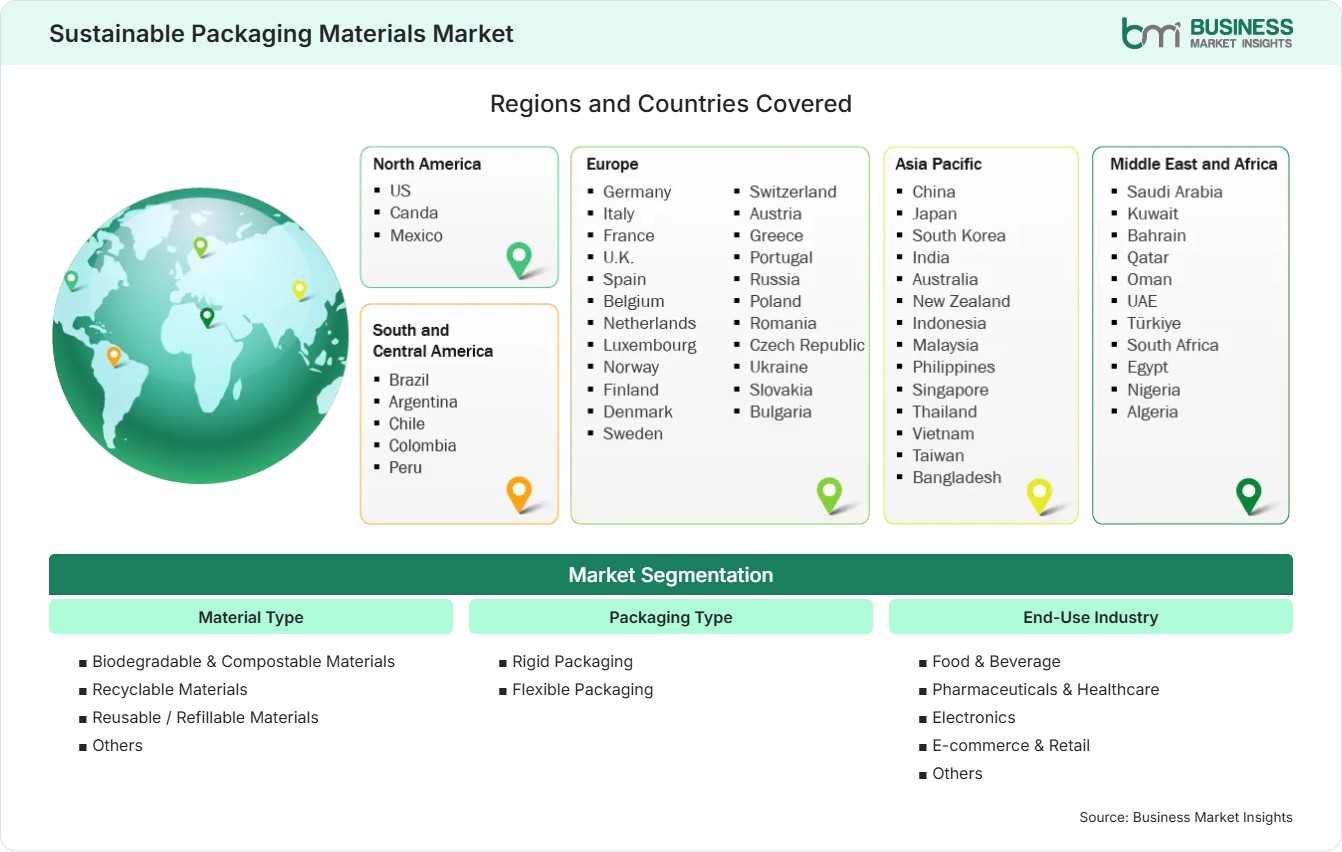
Global Market Geography
FREE PDF
Request your free sample
Request free sample
Segment Analysis

Sustainable Packaging Materials Market Segmentation

Material Type

Material Type remains the most influential segmentation category, with Recyclable Materials accounting for 42%–46% market share in 2025 and advancing at a CAGR of 8.0%–8.8% through 2033. Demand is supported by established collection systems, favorable regulations, and corporate circular economy goals. The Sustainable Packaging Materials Market scope continues expanding as packaging producers prioritize material recovery, carbon reduction, and compliance with increasingly stringent environmental standards across major end-use industries.

  • Biodegradable & Compostable Materials: Adoption is accelerating in foodservice, consumer goods, and specialty packaging applications where environmental performance and disposal flexibility provide competitive advantages amid tightening regulations.
  • Recyclable Materials: Strong demand stems from mature recovery infrastructure, compatibility with circular economy objectives, and increasing incorporation of recycled content within packaging portfolios.
  • Reusable / Refillable Materials: Growing interest in closed-loop packaging systems and waste-reduction initiatives is encouraging deployment across retail, personal care, and commercial distribution channels.

Packaging Type

Packaging Type segmentation is shaped by functionality, product protection requirements, and sustainability targets. Flexible Packaging holds approximately 54%–58% share in 2025 and is expected to expand at a CAGR of 8.7%–9.4% through 2033. Manufacturers increasingly prefer lightweight designs that reduce transportation emissions and material usage while maintaining product integrity. Technological improvements are enhancing recyclability and performance characteristics, strengthening long-term adoption across multiple industries.

  • Rigid Packaging: Widely used for beverages, pharmaceuticals, and industrial products where durability, structural strength, and extended product protection remain essential requirements.
  • Flexible Packaging: Gains momentum through lightweight construction, reduced material consumption, logistics efficiency, and ongoing innovations in recyclable and renewable material structures.

End-Use Industry

End-use demand remains highly diversified, with Food & Beverage accounting for 38%–42% share in 2025 and recording a CAGR of 8.5%–9.2% through 2033. Increasing demand for packaged foods, sustainability-focused consumer preferences, and stricter packaging regulations continue supporting adoption. Sustainable Packaging Materials Market trends indicate rising investments in recyclable, compostable, and reusable packaging formats designed to improve environmental performance while preserving product quality and shelf life.

  • Food & Beverage: High packaging consumption volumes and sustainability commitments continue driving adoption of recyclable, compostable, and renewable material solutions across product categories.
  • Pharmaceuticals & Healthcare: Growing emphasis on safety, traceability, and environmental compliance supports increasing use of sustainable packaging technologies.
  • Electronics: Manufacturers are reducing plastic dependence through fiber-based protective packaging and recyclable transportation solutions designed for product safety.
  • E-commerce & Retail: Rapid parcel shipment growth is increasing demand for lightweight, protective, recyclable, and reusable packaging systems across distribution networks.
Market Forces

Sustainable Packaging Materials Market Dynamics

Key Market Drivers

Expansion of Circular Economy Policies Worldwide

Globally, circular economy models are being established within the major economies in such a way that prioritizes waste reduction, recycling, and efficient resource use. Government policies, such as extended producer responsibility systems, recycled content targets, and packaging waste reduction targets, are changing the purchase patterns along the packaging value chain. Sustainable packaging materials market growth will be more influenced by the need for compliance in finding materials that can meet the goals of circularity. Sustainability programs for packaging from the EU, recycling investments in North America, and waste reduction programs in the Asia Pacific region are pushing for large scale use of recyclable and renewable packaging materials.

Corporate Sustainability Commitments and ESG Targets

Big multi-national corporations have created goals to measure their environmental impact through reduction of packaging waste, recycling, and reduction of carbon footprint during the product lifecycle. There is a call from the owners of the brands for sustainable packaging products as expected by investors and consumers. Performance criteria based on environmental, social, and governance have become a critical factor during procurement processes and capital investments. The companies providing packaging that can be recycled, renewable, or compostable are becoming more competitive than others. There are large scale commitments from companies in the food, beverages, personal care, and retail sectors to innovate materials.

Technological Advancements in Sustainable Material Development

Technological advancements in material science are making it more profitable to use eco-friendly packaging solutions. Innovations in bio-based polymers, fiber-based packaging, mono-material construction, barrier coatings, and recycling techniques are making the materials more efficient and environmentally friendly. The companies are spending large amounts of money on R&D to produce materials that would be durable, safe, and recyclable at the same time. Innovations in processing are decreasing costs and scaling up production. Technology solutions for traceability and life cycle assessment are increasing transparency within the packaging ecosystem. Innovations are helping packaging companies meet the changing needs of consumers while overcoming environmental obstacles.

Key Market Opportunities

Commercialization of Advanced Bio-Based Packaging Solutions

Advanced bio-based materials represent one of the most attractive investment opportunities across the industry. Innovations involving polylactic acid, cellulose-based packaging, agricultural waste fibers, and renewable feedstocks are expanding the range of commercially viable alternatives to fossil-based plastics. Sustainable Packaging Materials Market Forecasts increasingly highlight bio-based solutions as a key growth avenue due to rising environmental regulations and consumer demand for renewable products. Manufacturers investing in scalable production capabilities and feedstock diversification can strengthen competitive positioning. Strategic partnerships between material developers, converters, and brand owners are accelerating commercialization timelines. As production efficiencies improve and costs decline, bio-based packaging is expected to capture a larger share of global packaging demand.

Expansion of Reusable Packaging Networks

There are rising trends of reuse packaging initiatives in response to the demand for sustainable long-term waste management practices from businesses. Retailers, food-service providers, logistics firms, and consumer goods firms are testing reuse and returnable packaging programs that allow them to operate in a circular economy framework. The advancement in digital technologies for tracing and smart labelling makes such business initiatives easier to implement. Consumer acceptance of reuse packages is driving the adoption of such packaging solutions in various industries. Investors are showing increasing interest in companies that have developed reuse packaging platforms. With growing sustainability goals, there is a need for reusable packaging networks.

Growth of Sustainable E-commerce Packaging Solutions

The continued expansion of online retail creates substantial opportunities for environmentally responsible packaging innovation. E-commerce companies are seeking solutions that reduce material usage, improve recyclability, and maintain product protection during transportation. Packaging manufacturers are developing lightweight corrugated formats, recyclable cushioning systems, and reusable shipping containers tailored to digital commerce requirements. Demand is particularly strong among retailers seeking to enhance sustainability credentials while lowering logistics costs. Investments in automation-compatible packaging designs and right-sizing technologies are further strengthening market potential. The convergence of e-commerce growth, sustainability expectations, and supply chain optimization creates a favorable environment for continued innovation and commercialization.

Market Restraints and Challenges

Higher Production Costs Compared with Conventional Materials

Factor: Sustainable materials often require specialized feedstocks, advanced processing technologies, and smaller-scale production systems than conventional packaging materials. Impact: Higher manufacturing costs can limit adoption, particularly among cost-sensitive industries and small enterprises. While economies of scale are improving, many biodegradable and bio-based materials remain more expensive than traditional plastic alternatives. Fluctuations in renewable feedstock availability and processing costs can further affect profitability. Organizations must balance sustainability objectives with financial performance and pricing pressures. This challenge is especially pronounced in highly competitive sectors where packaging costs significantly influence margins. Continued investment in production efficiency and material innovation remains necessary to improve cost competitiveness.

Inconsistent Recycling and Waste Management Infrastructure

Factor: Collection, sorting, recycling, and composting capabilities vary significantly across countries and regions. Impact: Limited infrastructure can reduce the practical environmental benefits of sustainable packaging materials and hinder widespread adoption. Many advanced materials require specialized recovery systems that are not universally available. Inconsistent labeling standards and consumer understanding may further complicate disposal processes. Companies operating across multiple markets face challenges in designing packaging solutions compatible with diverse waste-management systems. Infrastructure gaps can also affect recycled material availability and circularity performance. Addressing these limitations will require collaboration among governments, industry participants, waste-management providers, and technology developers.

Company Analysis

Competitive Landscape

The competitive environment remains highly dynamic, with manufacturers focusing on innovation, circular economy initiatives, material diversification, and global production expansion. Sustainable Packaging Materials Market analysis indicates that strategic partnerships, acquisitions, and investments in recyclable and renewable materials are shaping long-term competitive positioning.

Company Name

Overview

Products and Services relevant to this market

Mondi plc

Global packaging and paper leader focused on sustainable packaging innovation, circular economy solutions, and integrated manufacturing capabilities across multiple regions.

Recyclable paper packaging, flexible packaging solutions, corrugated products, fiber-based materials, and packaging design services supporting sustainability goals.

NatureWorks LLC

Pioneer in bio-based polymer production with extensive expertise in renewable material technologies and environmentally responsible packaging applications.

PLA biopolymers, compostable packaging materials, sustainable resin solutions, and renewable feedstock-based packaging technologies.

Amcor plc

International packaging company emphasizing recyclable, reusable, and lower-carbon packaging solutions for consumer and industrial markets.

Flexible packaging, rigid containers, recyclable packaging formats, healthcare packaging, and sustainability-focused product development services.

Tetra Pak International S.A.

Leading food processing and packaging solutions provider with strong emphasis on renewable and recyclable material innovation.

Carton packaging systems, paper-based packaging, recycling initiatives, processing equipment, and sustainable packaging technologies.

DS Smith Plc

Packaging manufacturer specializing in circular economy-driven packaging design and fiber-based material solutions.

Corrugated packaging, recycling services, sustainable transportation packaging, and customized circular packaging solutions.

Sealed Air Corporation

Global provider of protective and food packaging technologies focused on sustainability and operational efficiency.

Protective packaging, food packaging systems, recyclable packaging formats, automation technologies, and material optimization services.

Ball Corporation

Major producer of sustainable metal packaging solutions serving beverage, personal care, and household product sectors.

Aluminum beverage cans, recyclable metal containers, packaging innovation services, and sustainability-focused packaging solutions.

Sonoco Products Company

Diversified packaging manufacturer with extensive expertise across industrial, consumer, and healthcare packaging markets.

Paper-based packaging, rigid containers, flexible packaging, protective solutions, and recycling-related packaging services.

Smurfit Westrock plc

Global leader in paper-based packaging and circular packaging systems with extensive manufacturing and recycling capabilities.

Corrugated packaging, containerboard products, renewable packaging materials, and sustainable supply-chain packaging solutions.

Stora Enso Oyj

Renewable materials company focused on replacing fossil-based materials with fiber-based packaging alternatives.

Fiber packaging, renewable materials, paperboard products, biomaterials, and sustainable packaging innovation solutions.

Trust & Transparency

Research Methodology

The market analysis combines proprietary research with secondary data from government agencies, company disclosures, regulatory filings, industry databases and expert interviews. Market estimates are validated through data triangulation, cross-market benchmarking and analyst review.

View Full Research Methodology

Questions Answered

Frequently Asked Questions

Why are reusable packaging systems gaining importance?

Reusable systems help reduce packaging waste, improve resource efficiency, support circular business models, and align with corporate sustainability strategies seeking long-term environmental and economic benefits.

What does the Sustainable Packaging Materials Market Report typically cover?

The report generally includes market sizing, segmentation, regional performance, competitive landscape assessment, technological developments, regulatory influences, and future opportunity analysis.

How do bio-based materials differ from conventional packaging materials?

Bio-based materials are derived from renewable resources such as plant feedstocks and agricultural byproducts, helping reduce dependence on fossil resources while supporting carbon reduction and circular economy objectives.

Which end-use industry generates the highest demand?

Food and beverage applications generate the largest demand due to high packaging consumption volumes, increasing sustainability targets, regulatory requirements, and continuous innovation in environmentally responsible packaging formats.

What factors are accelerating adoption of sustainable packaging materials?

Growing environmental regulations, consumer preference for eco-friendly products, corporate sustainability commitments, and advancements in recyclable and renewable materials are collectively supporting broader adoption across multiple industries worldwide.

Access the Full Sustainable Packaging Materials Market Report

Get segment-level forecasts, regional estimates, competitive benchmarking, company profiles and downloadable Excel datasets.

Access the full Sustainable Packaging Materials Market Report
350 pages PDF & Excel | 2026-09-02
Similar Research

Related Market Reports