
PFAS-Free Food Packaging Market Outlook: Size, Share, Trends, Growth Analysis, Competitive Landscape & Forecast, 2026-2033

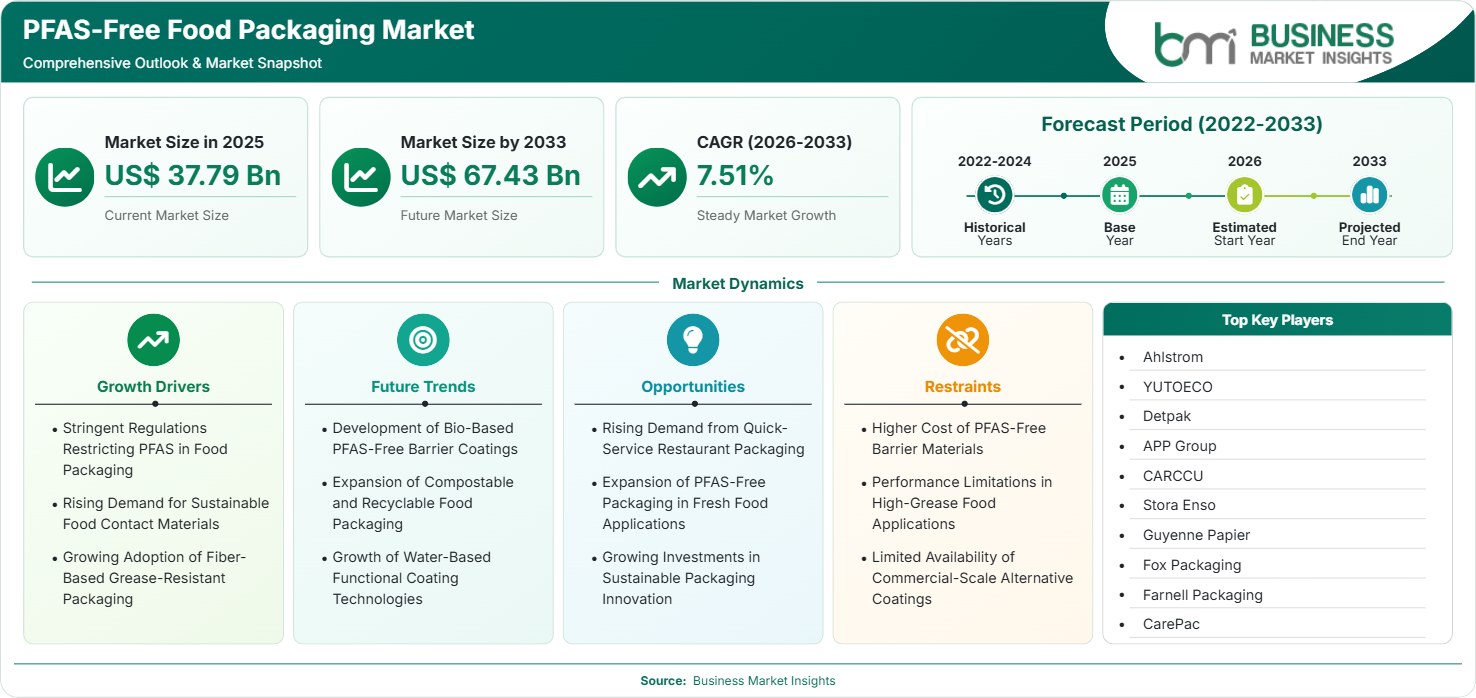
The PFAS-free Food Packaging Market size was valued at US$ 37.79 Billion in 2025 and is projected to reach US$ 67.43 Billion by 2033, growing at a CAGR of 7.51% during 2026–2033. Rising regulatory scrutiny of PFAS substances, growing consumer preference for sustainable packaging, increasing adoption of eco-friendly food contact materials, and expanding investments in circular packaging solutions are supporting market growth globally.

Report Coverage
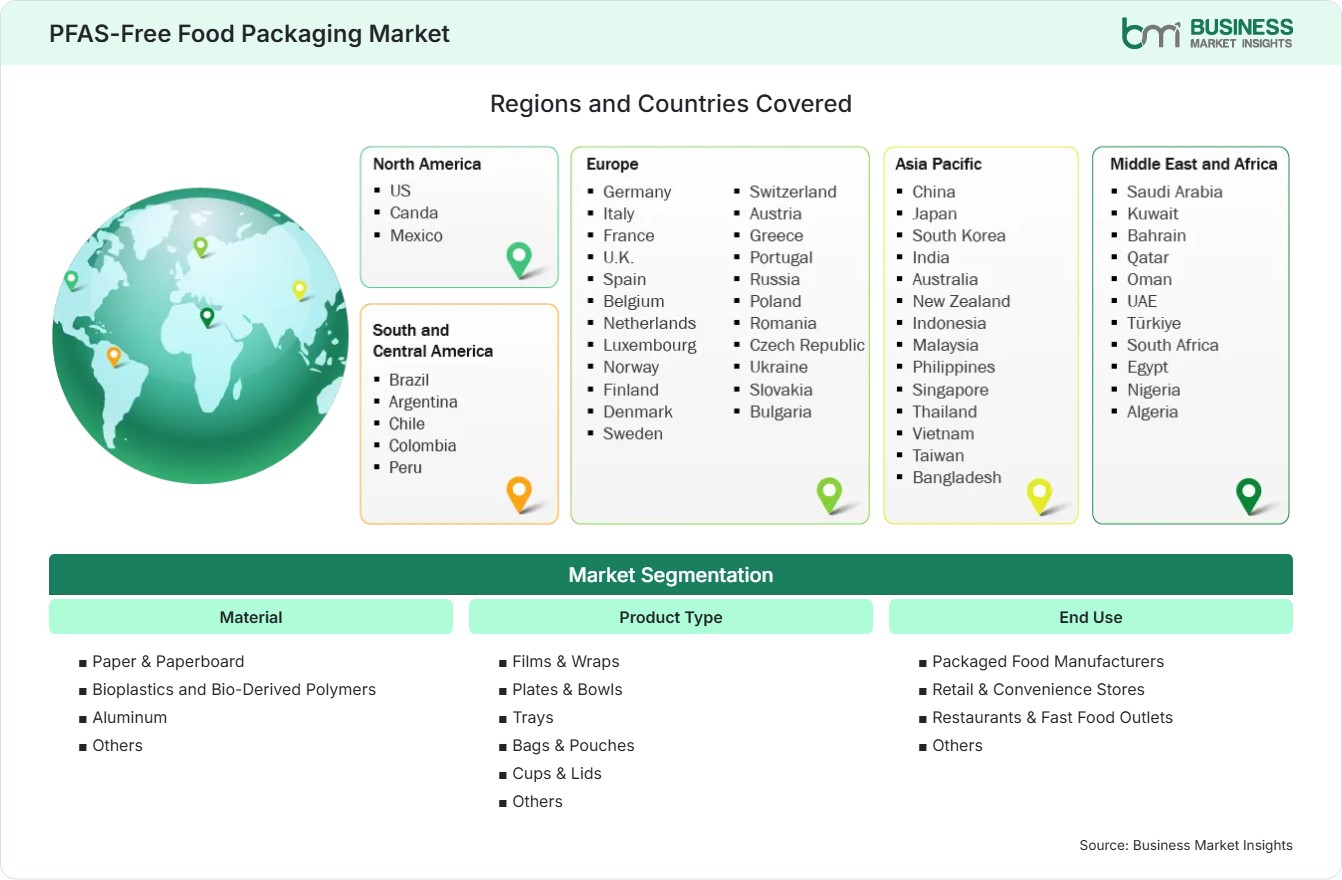
  • Material: Paper & Paperboard, Bioplastics and Bio-Derived Polymers, Aluminum, Others
  • Product Type: Films & Wraps, Plates & Bowls, Trays, Bags & Pouches, Cups & Lids, Others
  • End Use: Packaged Food Manufacturers, Retail & Convenience Stores, Restaurants & Fast Food Outlets, Others
US$ 37.79 Bn Market size in 2025
US$ 67.43 Bn Market Size by 2033
7.51% CAGR, 2026 - 2033
2026-2033 Forecast Period

01 AI Overview

PFAS-Free Food Packaging Market Summary

  • North America Region: North America holds a market share of 35%–38% in 2025, growing with a CAGR of 7.0%–7.6% during 2026–2033. Increasing regulatory restrictions on PFAS materials, growing demand for sustainable packaging, strong foodservice sector adoption, and rising investments in fiber-based packaging innovations continue supporting regional leadership. The U.S. market is expected to register a CAGR of 7.1%–7.7%.
  • Fastest Growing Region: Asia Pacific accounts for 24%–27% share in 2025 and is projected to grow at a CAGR of 8.4%–9.0% through 2033. Expanding packaged food consumption, rising environmental awareness, increasing regulatory focus on chemical safety, and growing demand for sustainable packaging alternatives continue supporting regional growth.
  • Leading Segment: Paper & Paperboard represents 46%–49% share in 2025 and is expected to grow at a CAGR of 7.5%–8.1% through 2033. Strong recyclability, renewable material sourcing, regulatory acceptance, and consumer preference for fiber-based solutions continue supporting segment dominance.
  • High Growth Segment: Bioplastics and Bio-Derived Polymers account for 18%–21% share in 2025 and are forecast to grow at a CAGR of 9.2%–9.8% during 2026–2033. Growing sustainability initiatives, compostability benefits, and advancements in bio-based barrier technologies continue accelerating adoption.
  • Key Market Opportunity: Increasing commercialization of innovative PFAS-free barrier coatings and next-generation sustainable food packaging materials is creating substantial opportunities across foodservice and retail packaging sectors.
  • Major Market Players: Ahlstrom, YUTOECO, Detpak, APP Group, CARCCU, Stora Enso, Guyenne Papier, Fox Packaging, Farnell Packaging, CarePac.
02 Strategic Insights

PFAS-Free Food Packaging Market: Strategic Insights

PFAS-Free Food Packaging Market Strategic Framework
FREE PDF
Request your free sample
Request free sample
03 Stakeholder View

Key Takeaways

  • Regulatory restrictions on PFAS substances continue accelerating demand for alternative food packaging materials.
  • Paper and paperboard remain the dominant material segment due to strong sustainability credentials and broad food packaging compatibility.
  • Bioplastics and bio-derived polymers represent one of the fastest-growing categories within the PFAS-free food packaging market.
  • Food brands are increasingly prioritizing PFAS-free packaging within sustainability and ESG initiatives.
  • Innovation in barrier coatings and functional materials remains a major factor shaping competitive differentiation.
  • Asia Pacific offers substantial growth opportunities due to expanding food processing and packaging industries.
04 Geographic Outlook

PFAS-Free Food Packaging Market Regional Highlights

North America PFAS-free Food Packaging Market

North America accounts for 35%–38% PFAS-free Food Packaging Market share in 2025 and is projected to grow at a CAGR of 7.0%–7.6% through 2033. Growing regulatory scrutiny, increasing sustainability initiatives, rising foodservice demand, and growing adoption of recyclable packaging materials continue supporting regional leadership.

  • Food manufacturers and restaurant chains are actively transitioning from PFAS-containing products to compliant packaging alternatives.
  • Retailers increasingly prioritize sustainable packaging solutions to meet environmental commitments and consumer expectations.
  • Strong innovation activity is supporting the commercialization of grease-resistant fiber-based packaging materials.
  • Packaging suppliers continue investing in advanced barrier technologies to improve functionality and regulatory compliance.
  • Consumer demand for environmentally responsible food packaging remains a key adoption driver.
  • Growing adoption of circular economy principles continues supporting market development.

US PFAS-free Food Packaging Market

The United States contributes approximately 84%–88% of North American revenue and is expected to register a CAGR of 7.1%–7.7% through 2033. Increasing sustainability commitments, product innovation activities, and foodservice packaging demand continue supporting market leadership.

  • Food packaging manufacturers are expanding PFAS-free product portfolios across multiple application categories.
  • Restaurant operators increasingly seek compliant alternatives that maintain performance and food safety standards.
  • Demand for fiber-based packaging continues growing across quick-service restaurant and takeaway segments.
  • Retail brands are increasingly incorporating sustainable packaging targets into procurement strategies.
  • Growing consumer awareness regarding packaging sustainability is strengthening PFAS-free food packaging market growth.

Europe PFAS-free Food Packaging Market

Europe represents 27%–30% of global revenue in 2025 and is anticipated to expand at a CAGR of 7.4%–8.0% through 2033. Strong environmental regulations, circular economy initiatives, and sustainable packaging policies continue driving regional growth. Germany remains the leading market while Poland demonstrates stronger growth momentum.

  • Germany continues leading regional adoption through strong packaging innovation and sustainability initiatives.
  • Poland is among the fastest-growing markets and is estimated to register a CAGR of 8.3%–8.9% during the forecast period.
  • Food producers increasingly seek recyclable and compostable packaging alternatives.
  • Regulatory emphasis on sustainable materials is encouraging investment in PFAS-free technologies.
  • Advanced fiber packaging development continues strengthening market expansion.
  • Growing consumer preference for environmentally friendly packaging supports demand growth.

Asia Pacific PFAS-free Food Packaging Market

Asia Pacific accounts for 24%–27% of global revenue in 2025 and is expected to achieve the fastest CAGR of 8.4%–9.0% through 2033. Expanding food processing activities, increasing urbanization, regulatory developments, and growing environmental awareness continue supporting strong regional growth.

  • China remains the largest regional market due to substantial food packaging production capacity and sustainability initiatives.
  • India is projected to achieve approximately 9.1%–9.8% CAGR, supported by increasing demand for sustainable packaging and expansion of food retail sectors.
  • Food manufacturers are increasingly exploring eco-friendly packaging solutions.
  • Rising packaged food consumption continues generating demand for functional packaging materials.
  • Investments in biodegradable and recyclable packaging technologies are increasing across the region.
  • Government initiatives promoting sustainable manufacturing practices continue supporting market development.

Rest of World PFAS-free Food Packaging Market

Rest of World accounts for 8%–11% of global revenue in 2025 and is projected to expand at a CAGR of 7.6%–8.2% through 2033. Growing sustainability awareness, increasing food packaging demand, and expanding environmental initiatives continue supporting market growth.

  • Brazil continues generating demand through growth in packaged food consumption and sustainable packaging adoption.
  • The UAE is witnessing increased interest in environmentally responsible food packaging solutions.
  • Saudi Arabia is expected to achieve approximately 8.2%–8.8% CAGR through 2033, supported by retail expansion and sustainability initiatives.
  • Foodservice operators are increasingly adopting PFAS-free packaging products.
  • Packaging manufacturers continue expanding sustainable material offerings.
  • Growing awareness regarding environmental impact is encouraging adoption of alternative packaging technologies.
Global Market Geography
FREE PDF
Request your free sample
Request free sample
05 Segment Analysis

PFAS-Free Food Packaging Market Segmentation

Material

Material selection remains the most critical factor within the PFAS-free food packaging industry, directly influencing grease resistance, moisture protection, recyclability, compostability, food safety compliance, and sustainability performance. The segment accounts for approximately 46%–49% share in 2025 and is projected to grow at a CAGR of 7.7%–8.3% through 2033. The expanding PFAS-free Food Packaging Market scope is being driven by increasing regulatory restrictions on fluorinated chemicals, growing consumer demand for environmentally responsible packaging solutions, and rising investments in renewable and recyclable materials capable of replacing conventional PFAS-based barriers.

  • Paper & Paperboard: Paper and paperboard remain the dominant material category due to excellent recyclability, wide regulatory acceptance, renewable sourcing potential, and compatibility with foodservice packaging applications. Manufacturers continue enhancing fiber-based materials through innovative barrier coatings and functional treatments.
  • Bioplastics and Bio-Derived Polymers: This segment is witnessing rapid growth because of rising demand for compostable, bio-based, and lower-carbon packaging alternatives. Innovations in material performance are expanding usage across food packaging applications.
  • Aluminum: Aluminum packaging remains important for applications requiring strong barrier properties, durability, heat resistance, and extended product protection. Its recyclability also supports sustainability initiatives.
  • Others: Additional materials include molded fiber, cellulose-based materials, specialty coatings, hybrid material systems, and emerging sustainable packaging substrates designed to deliver PFAS-free performance.

Product Type

Product innovation continues playing a central role in market development as manufacturers seek to replace PFAS-containing products across a wide range of food packaging formats. This segment accounts for approximately 35%–38% share in 2025 and is expected to register a CAGR of 7.8%–8.4% through 2033. Current PFAS-free Food Packaging Market trends indicate strong demand for sustainable alternatives across foodservice, takeaway, retail, and packaged food applications.

  • Films & Wraps: Films and wraps continue gaining adoption for food preservation, transportation, and retail packaging applications requiring flexible barrier properties.
  • Plates & Bowls: PFAS-free plates and bowls are increasingly utilized by foodservice operators seeking compliant and environmentally responsible packaging solutions.
  • Trays: Trays remain widely used in fresh food packaging, ready-to-eat meals, bakery products, and food processing applications.
  • Bags & Pouches: Sustainable bags and pouches are witnessing increasing demand due to growth in packaged foods, snacks, bakery products, and takeaway services.
  • Cups & Lids: Foodservice operators continue transitioning toward PFAS-free cups and lids for beverages and takeaway applications.
  • Others: Additional products include cartons, clamshells, containers, wraps, specialty foodservice packaging products, and customized retail packaging formats.

End Use

End-use demand continues expanding as regulatory pressures and sustainability commitments influence packaging procurement decisions across the food value chain. This segment accounts for approximately 39%–42% share in 2025 and is projected to grow at a CAGR of 7.9%–8.5% through 2033.

  • Packaged Food Manufacturers: Packaged food companies represent the largest end-user segment due to increasing replacement of traditional packaging materials and growing sustainability commitments.
  • Retail & Convenience Stores: Retailers are increasingly adopting PFAS-free packaging solutions to strengthen environmental credentials and align with consumer expectations.
  • Restaurants & Fast Food Outlets: Restaurants, cafés, and quick-service chains are actively transitioning to PFAS-free packaging as regulations tighten and sustainability goals become more important.
  • Others: Additional end users include institutional foodservice providers, catering companies, educational facilities, healthcare food providers, and specialty food operators.
06 Market Forces

PFAS-Free Food Packaging Market Dynamics

Key Market Drivers

Stringent Regulations Restricting PFAS in Food Packaging

Increasing regulatory scrutiny of per- and polyfluoroalkyl substances remains one of the strongest drivers supporting the PFAS-free food packaging market. Governments and regulatory agencies across numerous regions are implementing restrictions and guidance aimed at reducing the use of PFAS chemicals in food contact materials due to environmental persistence concerns and growing public awareness. Food manufacturers and packaging suppliers are proactively transitioning toward alternative materials to ensure compliance and minimize regulatory risk. These developments are accelerating investment in next-generation packaging technologies that maintain required functionality while eliminating fluorinated compounds. As regulations continue evolving globally, demand for PFAS-free packaging solutions is expected to increase significantly across multiple food packaging categories.

Rising Demand for Sustainable Food Contact Materials

The consumers have now started preferring the products that are sustainable, thus, pushing the brands to adopt sustainable packaging techniques. The sustainable packaging materials for food will assist organizations in reducing their ecological footprints, improving their brand image, and contributing towards circular economies. The packaging industry players have started widening their range of recyclable, renewable, biodegradable, and bio-based packaging materials that can substitute for the conventional packaging materials. Apart from this, there are many more factors such as investors' interests, sustainability programs of companies, and procurement practices of retailers driving the adoption of eco-friendly packaging solutions.

Growing Adoption of Fiber-Based Grease-Resistant Packaging

Fiber-based packaging has emerged as one of the most attractive alternatives to traditional PFAS-containing materials due to sustainability benefits and strong acceptance among consumers and regulators. Manufacturers are increasingly developing innovative grease-resistant paper and paperboard solutions that utilize alternative barrier technologies rather than fluorinated compounds. These products are being adopted across foodservice applications including takeaway packaging, bakery products, fast food containers, trays, and prepared food packaging. Ongoing advancements in coating technologies and material engineering are improving functionality while maintaining recyclability and environmental performance. The continuing transition toward fiber-based packaging solutions is expected to remain a significant contributor to market growth.

Key Market Opportunities

Rising Demand from Quick-Service Restaurant Packaging

Quick-service restaurant operators are increasingly transitioning toward PFAS-free packaging to address regulatory changes, meet sustainability commitments, and respond to changing consumer expectations. The sector utilizes substantial volumes of food wrappers, containers, bowls, plates, trays, cups, and other packaging formats that traditionally relied on grease-resistant materials. As restaurant chains seek scalable and compliant alternatives, demand for PFAS-free solutions continues expanding rapidly. Packaging suppliers capable of delivering performance, cost efficiency, and environmental benefits are well positioned to capitalize on these opportunities.

Expansion of PFAS-Free Packaging in Fresh Food Applications

Fresh food categories including produce, meat, seafood, bakery products, and ready-to-eat meals represent a significant growth opportunity for PFAS-free packaging manufacturers. Retailers and food processors are increasingly seeking packaging formats that provide effective protection while supporting sustainability goals. Advancements in fiber-based materials, biodegradable coatings, and moisture-resistant technologies are enabling broader application across fresh food supply chains. As demand for environmentally responsible packaging grows, adoption within fresh food applications is expected to accelerate significantly.

Growing Investments in Sustainable Packaging Innovation

Packaging companies, material developers, food brands, and research organizations are investing heavily in sustainable packaging innovation. Efforts are focused on developing renewable materials, alternative barrier technologies, recyclable packaging systems, and next-generation bio-based solutions capable of matching or exceeding the performance of conventional products. These investments are accelerating commercialization of advanced PFAS-free technologies across multiple packaging segments. Long-term PFAS-free Food Packaging Market Forecasts remain favorable as innovation continues creating new opportunities for performance improvement, cost optimization, and sustainability enhancement.

Market Restraints and Challenges

Higher Cost of PFAS-Free Barrier Materials

Factor: Many PFAS-free materials and barrier technologies currently involve higher production costs than conventional alternatives due to raw material expenses, manufacturing complexity, ongoing product development efforts, and limited economies of scale. Companies transitioning to alternative materials often encounter increased procurement and implementation costs.

Impact: Higher costs can create challenges for food manufacturers, foodservice operators, and packaging suppliers seeking to balance sustainability objectives with profitability requirements. Cost considerations may slow adoption in price-sensitive markets and encourage gradual transition strategies rather than rapid implementation.

Performance Limitations in High-Grease Food Applications

Factor: Certain PFAS-free alternatives may face challenges in matching the grease resistance, moisture protection, and durability characteristics traditionally provided by fluorinated materials, particularly in demanding foodservice applications involving oily or high-temperature foods.

Impact: Performance limitations can affect product suitability for specific packaging applications and may require additional material innovation or multilayer design approaches. Manufacturers must continue investing in research and development to improve barrier performance while maintaining sustainability benefits, recyclability, and regulatory compliance.

07 Company Analysis

Competitive Landscape

The PFAS-free Food Packaging Market analysis is characterized by increasing competition among sustainable packaging manufacturers, fiber-based material producers, foodservice packaging suppliers, and innovative barrier technology developers. Companies are focusing on recyclable materials, renewable feedstocks, compostable solutions, PFAS-free barrier coatings, and circular economy initiatives to strengthen their market positions. Growing regulatory restrictions on fluorinated chemicals, rising consumer awareness regarding sustainable packaging, and increasing food industry commitments toward environmentally responsible materials continue accelerating innovation across the market. Strategic investments in material science, bio-derived barriers, and advanced fiber technologies are reshaping the competitive landscape globally.

Company Name

Overview

Products and Services relevant to this market

Ahlstrom

Specialty materials company focused on fiber-based and sustainable packaging solutions.

PFAS-free food packaging materials, fiber-based foodservice papers, specialty barrier solutions, and sustainable packaging substrates.

YUTOECO

Sustainable packaging provider focused on environmentally responsible food-contact packaging solutions.

PFAS-free packaging products, biodegradable packaging materials, foodservice packaging solutions, and eco-friendly packaging alternatives.

Detpak

Food packaging manufacturer supplying sustainable solutions for foodservice and retail applications.

Paper food containers, PFAS-free packaging products, takeaway packaging, cups, trays, and sustainable foodservice solutions.

APP Group

Paper and packaging manufacturer serving food packaging, retail, and industrial markets.

Paperboard packaging, fiber-based food packaging, recyclable packaging materials, and sustainable packaging solutions.

CARCCU

Packaging company engaged in sustainable food-contact material development and packaging innovation.

PFAS-free food packaging products, fiber-based packaging materials, foodservice packaging solutions, and specialty food containers.

Stora Enso

Renewable materials company focused on fiber-based packaging and circular economy solutions.

Food-grade paperboard, renewable packaging materials, sustainable barrier technologies, and PFAS-free food packaging solutions.

Guyenne Papier

Paper packaging manufacturer specializing in food-contact paper products and sustainable packaging.

Food wrapping papers, PFAS-free paper packaging, specialty foodservice materials, and sustainable paper solutions.

Fox Packaging

Flexible packaging company serving food packaging applications.

Sustainable food packaging, bags, pouches, PFAS-free packaging formats, and retail food packaging products.

Farnell Packaging

Packaging producer focused on recyclable and environmentally responsible food packaging solutions.

PFAS-free foodservice packaging, paper packaging products, sustainable trays, wraps, and food-contact packaging materials.

CarePac

Packaging supplier providing foodservice, retail, and environmentally conscious packaging solutions.

PFAS-free packaging products, food containers, paper packaging formats, sustainable takeaway packaging, and custom packaging solutions.

10 Trust & Transparency

Research Methodology

The market analysis combines proprietary research with secondary data from government agencies, company disclosures, regulatory filings, industry databases and expert interviews. Market estimates are validated through data triangulation, cross-market benchmarking and analyst review.

View Full Research Methodology

11 Questions Answered

Frequently Asked Questions

How are regulations influencing PFAS-free packaging adoption?

Governments and regulatory agencies are increasingly restricting the use of PFAS substances in food-contact applications, encouraging food manufacturers, retailers, and foodservice operators to transition toward safer and more sustainable packaging alternatives.

What does this PFAS-free Food Packaging Market Report cover?

This report covers material analysis, product type segmentation, end-use assessment, regional trends, competitive landscape evaluation, market dynamics, growth opportunities, restraints, and future market prospects through 2033.

Why are bioplastics and bio-derived polymers growing rapidly?

Bioplastics and bio-derived polymers are experiencing strong growth because they provide renewable, compostable, and lower-environmental-impact alternatives while benefiting from ongoing advancements in barrier performance technologies.

Which material segment dominates the market?

Paper & Paperboard represents the leading material segment due to its recyclability, renewable sourcing advantages, strong consumer acceptance, regulatory compliance, and widespread suitability for food packaging applications.

What is driving growth in the PFAS-free Food Packaging market?

Stringent regulations restricting PFAS use in food-contact materials, rising demand for sustainable packaging solutions, increasing consumer awareness regarding environmental safety, and growing adoption of fiber-based packaging alternatives are major factors supporting market growth.

Access the Full PFAS-Free Food Packaging Market Report

Get segment-level forecasts, regional estimates, competitive benchmarking, company profiles and downloadable Excel datasets.

Access the full PFAS-Free Food Packaging Market Report
350 pages PDF & Excel | 2026-08-12