Market Summary
Executive Summary and Global Market Analysis
The eco-friendly food packaging market refers to packaging solutions that seek to minimize environmental impacts through their lifecycle while ensuring food safety, product protection, and operational efficiencies. The solutions employ renewable, recyclable, reusable, or biodegradable materials in order to help meet sustainability objectives within the supply chain. The integration of environmentally friendly packaging solutions is growing amongst manufacturers, retailers, and foodservice operators in order to meet emerging customer preferences and their environmental commitments.
Environmental issues linked to traditional packaging materials remain an important factor influencing procurement practices as well as product design and development within the food industry. Companies are increasingly looking to incorporate packaging solutions that will help reduce waste generation and enhance recyclability efforts. Consumers' preferences for sustainable products further drive companies to consider more environmentally friendly packaging solutions. On the other hand, developments in material science have enhanced the effectiveness of such packaging solutions.
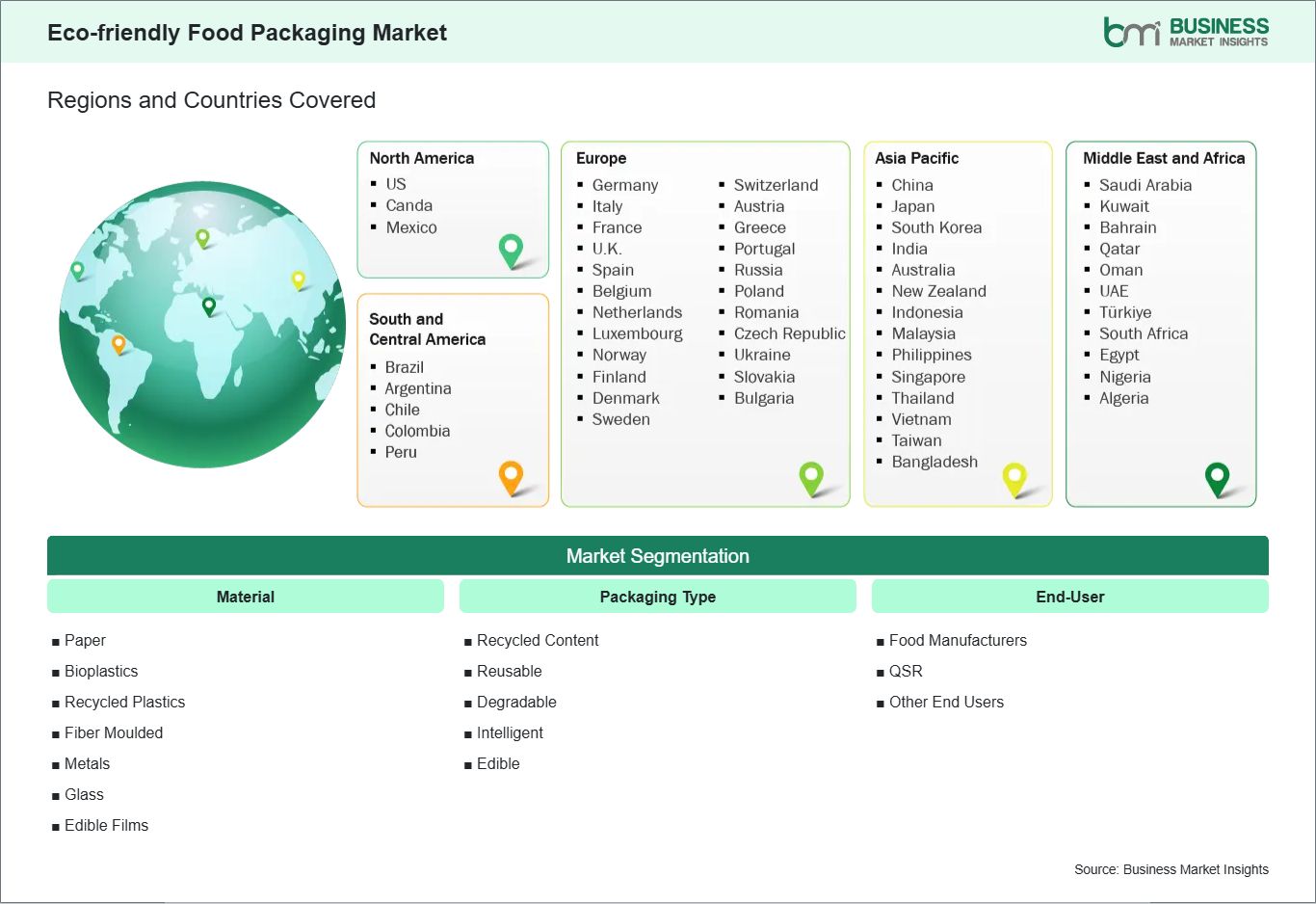
The segmentation is done on the basis of material, packaging type, and end user, as each segment requires different packaging for its respective use. Various types of packaging materials include paper, bioplastic, recycled plastic, fiber molding, metal, glass, and edible films, each fulfilling different requirements of preserving the food product. The various types of packaging include recycled packaging, intelligent packaging, and edible packaging, catering to different needs. Demand from end users comes from food producers, quick service restaurants, and other food industry players.
Technology developments play an important role in the product development process, where emphasis is laid upon recycling packaging structures and smart packaging technology. Advanced materials are being incorporated into the existing packaging products to increase effectiveness while minimizing adverse effects on the environment. Competition in this industry includes portfolio extension, material innovation, and packaging innovation.
Segment Analysis
Eco-friendly Food Packaging Market Segmentation
The eco-friendly food packaging market is segmented based on material, packaging type, and end-user, reflecting industry efforts to balance sustainability objectives, food protection requirements, and operational efficiency across packaging applications.
By Material
- Paper – Renewable packaging formats support recyclability and broad food industry acceptance.
- Bioplastics – Plant-derived materials reduce dependence on conventional petroleum-based packaging resources.
- Recycled Plastics – Circular material utilization supports waste reduction and resource conservation goals.
- Fiber Moulded – Compostable structures offer protective packaging with reduced environmental burden.
- Metals – Durable packaging formats provide extended product protection and material recovery potential.
- Glass – Reusable and recyclable containers maintain product quality and packaging sustainability.
- Edible Films – Consumable packaging solutions minimize packaging waste generation after use.
By Packaging Type
- Recycled Content – Recovered materials strengthen circular packaging systems and resource efficiency.
- Reusable – Multi-use packaging models reduce single-use packaging consumption over time.
- Degradable – Environmentally responsive materials support controlled breakdown after disposal.
- Intelligent – Embedded features enhance product monitoring and packaging functionality.
- Edible – Consumable packaging alternatives reduce dependence on conventional disposal pathways.
By End User
- Food Manufacturers – Sustainable packaging adoption supports product differentiation and compliance objectives.
- QSR – Foodservice operators prioritize packaging solutions aligned with environmental initiatives.
- Other End Users – Diverse food sectors seek packaging options supporting sustainability commitments.
Market Forces
Eco-friendly Food Packaging Market Drivers and Opportunities
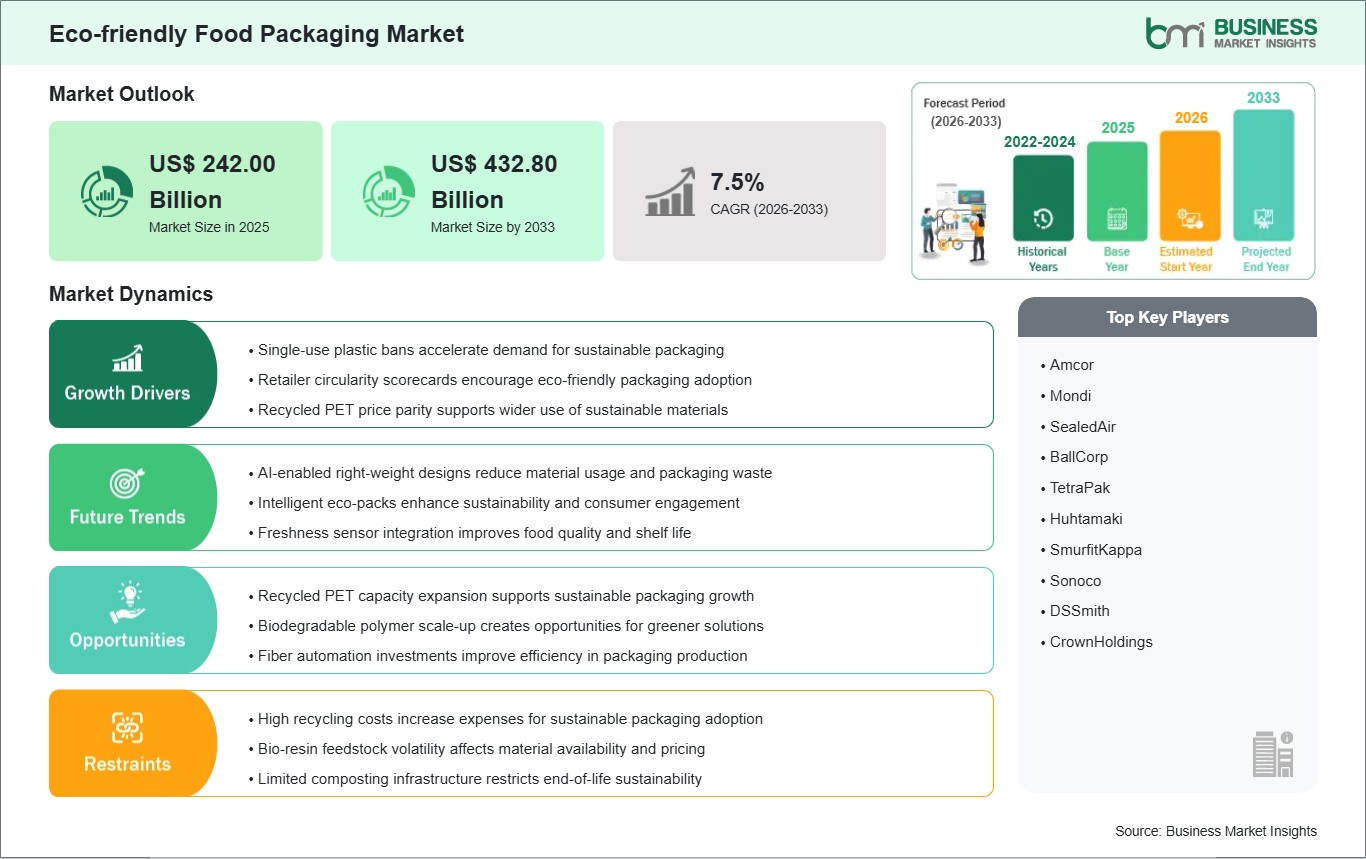
Regulatory bans on single-use plastics
Governments have begun to limit the usage of single-use plastic in food packaging to address these issues. Therefore, it is forcing companies to consider new material choices and packaging options. Companies are becoming increasingly inclined towards using eco-friendly packaging material to comply with regulations while fulfilling their environmental responsibilities. These regulations result in high demands for environmentally friendly packaging options that can meet operational demands by using materials other than those used traditionally in food packaging applications.
Regulatory bodies continue to introduce such policies based on waste reduction goals and circular economy principles. The need to innovate materials to comply with regulations while maintaining quality performance criteria is driving packaging material manufacturers. Given the growing importance of regulations in various locations, there is increasing emphasis on eco-friendly packaging materials in the food industry.
Expansion of recycled PET capacity
An increase in recycled PET production capabilities will present numerous opportunities to develop sustainable packaging options in the food industry. There have been increased investments in infrastructure that can improve the supply of food-grade recycled PET. Manufacturers will be in a better position to find sustainable packaging materials that help them realize their sustainability goals without compromising on the quality and functionality of packaging.
An increased supply of recycled materials may also motivate players to incorporate the material into various types of food packaging, such as containers and trays. A future increase in recycled PET supply will lead to improved resource efficiency and sustainability of the packaging process. Advances in technology will make it possible for manufacturers to get consistent quality material from the process. The increase in supply will motivate companies and packaging producers to adopt more sustainable packaging practices.
Size and Share Analysis
Eco-friendly Food Packaging Market Size and Share Analysis
The eco-friendly food packaging market is projected to grow from US$ 242.0 billion in 2025 to US$ 432.8 billion by 2033, registering a CAGR of 7.5% from 2026 to 2033.
By material, paper accounts for a significant share due to its high recyclability, biodegradability, and strong consumer acceptance as a sustainable alternative to conventional plastic packaging. It also benefits from well-established recycling infrastructure, regulatory support for reducing plastic waste, and its wide applicability across food service, takeaway, and packaged food products.
By packaging type, recycled content packaging dominates the market because it helps manufacturers reduce dependence on virgin raw materials while meeting sustainability targets and regulatory requirements. The segment is further supported by growing consumer preference for environmentally responsible packaging and increasing investments in circular economy initiatives that promote the use of recycled materials in food packaging.
By end user, food manufacturers lead the market as they represent the largest consumers of packaging materials across processed foods, beverages, dairy products, bakery items, and ready-to-eat meals. Their large-scale packaging requirements, combined with increasing commitments to sustainability, regulatory compliance, and brand differentiation through eco-friendly packaging solutions, continue to drive the adoption of sustainable food packaging.
Report Coverage
Eco-friendly Food Packaging Market Report Coverage and Deliverables
The "Eco-friendly Food Packaging Market Size and Forecast (2022–2033)" report provides a detailed analysis of the market covering below areas:
- Market size and forecast at global, regional, and country levels for all key market segments covered under the scope
- Market trends, along with market dynamics such as drivers, restraints, and key opportunities
- Market analysis covering key trends, global and regional frameworks, major players, regulations, and recent developments
- Industry landscape and competitive analysis covering market concentration, heat map analysis, prominent players, and recent developments
- Detailed company profiles, including SWOT analysis
Geographic Insights
Eco-friendly Food Packaging Market Geographic Insights
There is an uneven trend regarding the use of eco-friendly food packaging in various regions, depending on the needs and concerns of the industry as a whole in terms of environmental responsibility, technological development, regulations, and the special needs of each particular industry sector. Sustainability concerns have driven choices in packaging material and methods, even in developing countries.
North America continues to be an important player in this industry, thanks to rising awareness about environmental matters and changing regulations in the area of food packaging. Both the US and Canada show increasing interest in packaging options that allow recycling and reuse and support waste minimization efforts. In addition, corporate sustainability policies and consumers' desire for more environmentally-friendly products promote the development of eco-packaging alternatives in the region.
Asia-Pacific is another important market, driven by the rise in food processing operations and concern about waste management practices. Such countries as China, Japan, India, and South Korea are actively implementing new sustainable development strategies while investing in new technologies for packaging materials. Urbanization, shifting consumption trends, and rising demands for packaged foods drive the demand for eco-friendly food packaging solutions in Asia.
A strong position is maintained by Europe on account of its already existing environment-related policies, along with an inclination towards the concept of the circular economy. Nations like Germany, France, Italy, and the UK have continued to encourage the use of sustainable packaging materials as well. New entrants into the packaging sector from Latin America, the Middle East, and Africa are also being seen due to rising awareness about the environment and improvements in food packaging.
Industry Activity
Recent Developments
The eco-friendly food packaging market is evaluated by gathering qualitative and quantitative data post primary and secondary research, which includes important corporate publications, association data, and databases. Recent developments and news in the market include:
- In July 2025, Huhtamaki announced the launch of new compostable and recyclable ice cream cups made from certified paperboard with a bio-based coating. The product expands the company’s sustainable food packaging portfolio and helps food-service customers reduce reliance on fossil-based plastics.
- In May 2025, Amcor announced that it had partnered with Metsa Group to develop recyclable molded-fibre food packaging solutions combining Amcor’s high-barrier technologies with Metsa Group’s Muoto fibre platform to deliver sustainable packaging for perishable food applications.
Trust & Transparency
Research Methodology
The market analysis combines proprietary research with secondary data from government agencies, company disclosures, regulatory filings, industry databases and expert interviews. Market estimates are validated through data triangulation, cross-market benchmarking and analyst
review.
View Full Research Methodology
Key Sources Referred:
Food and Agriculture Organization (FAO) United Nations Environment Programme (UNEP) European Commission U.S. Environmental Protection Agency (EPA) U.S. Food and Drug Administration (FDA) European Food Safety Authority (EFSA) International Organization for Standardization (ISO) Company Websites Company Annual Reports Company Investor Presentations