
Food And Beverage Packaging Market Outlook: Size, Share, Trends, Growth Analysis, Competitive Landscape & Forecast, 2026-2033

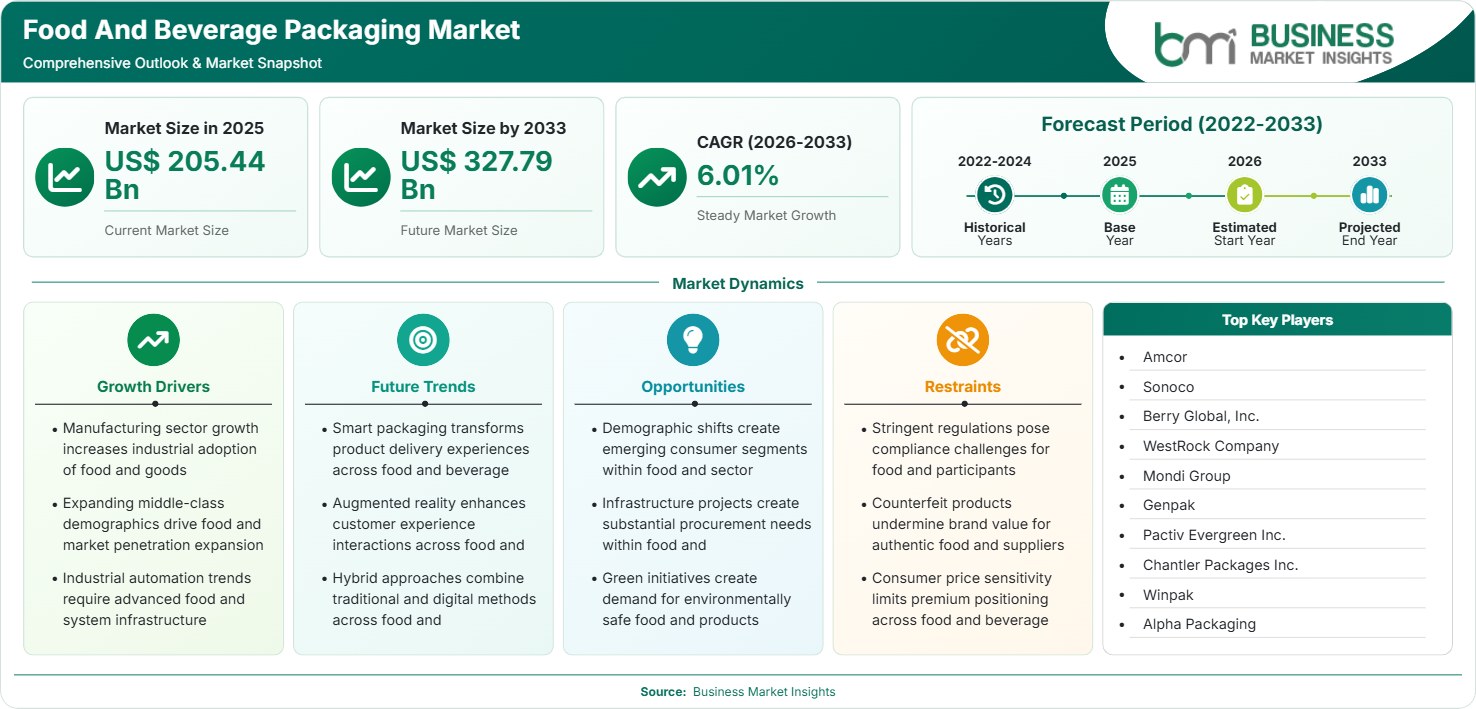
The Food and Beverage Packaging Market size was valued at US$ 205.44 Billion in 2025 and is projected to reach US$ 327.79 Billion by 2033, growing at a CAGR of 6.01% during 2026–2033, driven by sustainable packaging adoption, rising packaged food consumption, and opportunities in recyclable materials, smart packaging, and emerging markets.

Report Coverage
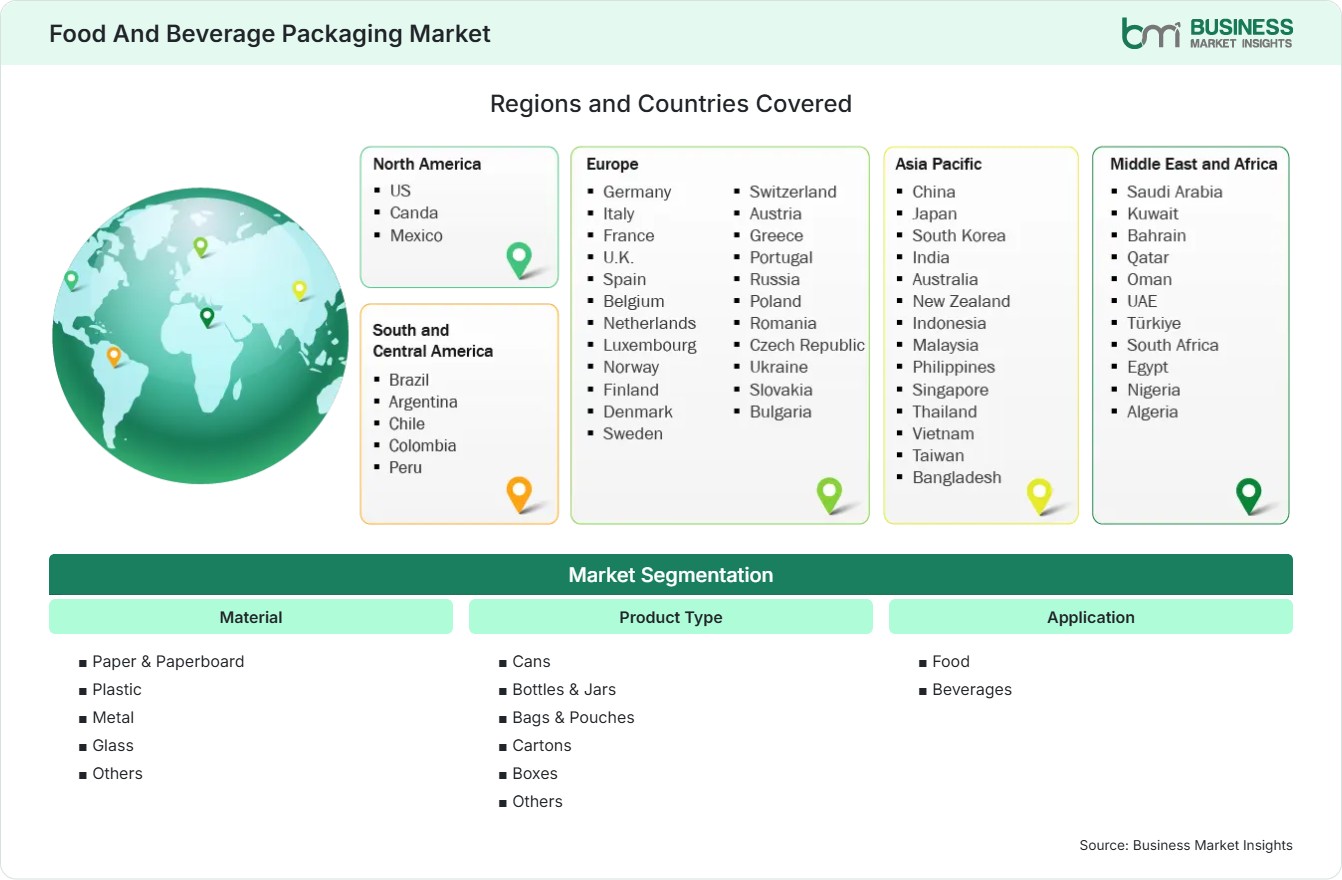
  • Material: Paper & Paperboard, Plastic, Metal, Glass, Others
  • Product Type: Cans, Bottles & Jars, Bags & Pouches, Cartons, Boxes, Others
  • Application: Food, Beverages
US$ 205.44 Bn Market size in 2025
US$ 327.79 Bn Market Size by 2033
6.01% CAGR, 2026 - 2033
2026-2033 Forecast Period

AI Overview

Food And Beverage Packaging Market Summary

  • North America Region: North America holds a market share of 30%–33% in 2025, growing with a CAGR of 5.20%–5.70% during 2026–2033, influenced by sustainable packaging mandates, convenience food demand, e-commerce expansion, and advanced recycling infrastructure development. The U.S. market demonstrates steady expansion with a CAGR of 5.30%–5.80% supported by food safety regulations, innovation investments, and premium beverage packaging adoption.
  • Fastest Growing Region: Asia Pacific accounts for a market share of 28%–31% in 2025, advancing with a CAGR of 6.80%–7.30% during 2026–2033, supported by urbanization, rising disposable incomes, expanding processed food industries, and increasing investments in flexible packaging technologies across developing economies.
  • Leading Segment: Plastic material holds a market share of 38%–42% in 2025, growing with a CAGR of 5.80%–6.30% during 2026–2033, driven by lightweight packaging demand, durability advantages, cost efficiency, and increasing development of recyclable and bio-based plastic solutions.
  • High Growth Segment: Bags & Pouches represent a market share of 22%–25% in 2025, expanding with a CAGR of 7.00%–7.50% during 2026–2033, supported by flexible designs, reduced material usage, extended shelf life, and increasing demand from convenience-oriented consumers.
  • Key Market Opportunity: Sustainable packaging transformation creates opportunities through recyclable polymers, fiber-based solutions, circular economy models, and smart packaging technologies that improve traceability, reduce waste, and support evolving environmental compliance requirements.
  • Major Market Players: Amcor, Sonoco, Berry Global, Inc., WestRock Company, Mondi Group, Genpak, Pactiv Evergreen Inc., Chantler Packages Inc., Winpak, Alpha Packaging, and PacMoore Products.
Strategic Insights

Food And Beverage Packaging Market: Strategic Insights

Food And Beverage Packaging Market Strategic Framework
FREE PDF
Request your free sample
Request free sample
Stakeholder View

Key Takeaways

  • The market ecosystem is shifting toward integrated packaging value chains where material suppliers, converters, food producers, and recycling companies collaborate to improve sustainability, efficiency, and compliance across global packaging operations.
  • Flexible packaging formats, recyclable materials, and portion-controlled solutions present strong growth opportunities as food manufacturers seek lightweight options with improved logistics efficiency and extended product shelf life.
  • Packaging innovation is increasingly focused on mono-material structures, intelligent labeling, digital tracking technologies, and advanced coatings that improve recyclability while maintaining protection against moisture, oxygen, and contamination.
  • Asia Pacific provides a compelling investment opportunity due to expanding processed food production, rising consumer spending, and increasing adoption of modern retail channels in countries such as India, China, and Southeast Asian economies.
  • Industry consolidation is accelerating through strategic acquisitions, capacity expansion programs, and sustainability-focused investments as leading packaging companies strengthen their positions across high-growth application segments.
  • Collaboration between packaging producers and food brands is becoming essential for developing circular economy solutions, meeting environmental targets, and adapting to changing consumer expectations regarding responsible packaging choices.
Geographic Outlook

Food And Beverage Packaging Market Regional Highlights

North America Food and Beverage Packaging Market

North America holds a share of 30%–33% in 2025 and is projected to grow at a CAGR of 5.20%–5.70% during 2026–2033. The region benefits from mature food processing industries, sustainability initiatives, and strong demand for convenient packaging formats. The Food and Beverage Packaging Market share in North America reflects established consumption patterns and advanced manufacturing capabilities. The United States and Canada remain important contributors through recyclable material adoption, automation investments, and regulatory-driven packaging improvements.

  • Sustainable packaging adoption is accelerating as companies invest in recyclable plastics, paper-based formats, and circular economy initiatives to address environmental regulations and changing consumer preferences across North American food industries.
  • Beverage manufacturers are increasing investments in lightweight bottles, cans, and flexible packaging solutions to improve transportation efficiency, reduce material usage, and support sustainability targets throughout regional supply chains.
  • Advanced manufacturing technologies, including automated production lines and digital printing systems, are improving operational efficiency while enabling customized packaging designs for diverse food and beverage categories.
  • Regulatory pressure related to packaging waste reduction is encouraging manufacturers to redesign products using recyclable structures, improved barrier technologies, and responsible material sourcing strategies.

US Food and Beverage Packaging Market

The U.S. accounts for a share of 24%–27% within North America in 2025 and is estimated to expand at a CAGR of 5.30%–5.80% during 2026–2033. The country maintains a strong position due to large-scale food production, beverage innovation, and established retail networks. The U.S. Food and Beverage Packaging Market continues developing through sustainable packaging investments, premium product launches, and increased demand for flexible and functional packaging formats.

  • Major food and beverage brands are adopting recyclable packaging solutions to align with corporate sustainability commitments and increasing consumer awareness regarding environmental impacts of packaging waste.
  • Growth in online grocery platforms is increasing demand for durable, lightweight, and protective packaging formats capable of supporting direct-to-consumer delivery models and extended distribution networks.
  • Beverage packaging innovation is expanding through aluminum cans, lightweight containers, and smart labeling technologies that enhance product differentiation and consumer engagement.
  • Domestic manufacturers are investing in automation and advanced processing equipment to improve production capacity, reduce operational costs, and maintain supply chain reliability.

Europe Food and Beverage Packaging Market

Europe represents a share of 25%–28% in 2025 and is expected to register a CAGR of 5.70%–6.20% during 2026–2033. The region is driven by strict environmental regulations, strong recycling infrastructure, and consumer preference for sustainable packaging. Germany, France, the United Kingdom, and Italy remain leading countries, while Poland and Spain demonstrate increasing adoption through food processing expansion and packaging modernization initiatives.

  • European packaging producers are prioritizing recyclable paperboard, bio-based materials, and lightweight solutions to comply with sustainability regulations and improve environmental performance.
  • Germany leads regional innovation through advanced manufacturing capabilities, recycling infrastructure development, and investments in high-performance packaging technologies for food and beverage applications.
  • France and the United Kingdom are witnessing increasing demand for sustainable packaging formats due to retailer commitments toward waste reduction and responsible sourcing practices.
  • Italy and Spain are expanding packaging demand through growing food exports, beverage production, and modernization of processing facilities supporting premium packaged products.

Asia Pacific Food and Beverage Packaging Market

Asia Pacific holds a share of 28%–31% in 2025 and is projected to grow at a CAGR of 6.80%–7.30% during 2026–2033. The region represents the fastest-growing market due to urbanization, increasing disposable incomes, expanding food processing industries, and retail transformation. China, India, Japan, and Southeast Asian countries are major contributors. The Food and Beverage Packaging Market growth in Asia Pacific is supported by rising packaged food consumption and manufacturing investments.

  • China remains a major packaging hub due to large food manufacturing capacity, increasing domestic consumption, and investments in recyclable and advanced packaging technologies.
  • India is experiencing strong packaging demand from expanding organized retail, processed food industries, and government initiatives supporting food processing sector development.
  • Japan continues focusing on high-quality packaging solutions, smart technologies, and sustainable materials to support premium food and beverage categories.
  • Southeast Asian economies are attracting packaging investments due to growing urban populations, increasing convenience food demand, and expansion of multinational food brands.

Rest of World Food and Beverage Packaging Market

Rest of World accounts for a share of 11%–14% in 2025 and is anticipated to grow at a CAGR of 5.50%–6.00% during Food and Beverage Packaging Market Forecasts. South and Central America are supported by agricultural exports, beverage production, and food processing expansion. Middle East and Africa markets are developing through retail modernization, population growth, and packaged food adoption. Regional investments focus on efficient packaging infrastructure and sustainable material solutions.

  • Brazil and Mexico are strengthening packaging demand through food exports, beverage manufacturing expansion, and increasing adoption of modern packaging formats across consumer markets.
  • Middle Eastern countries are investing in food security initiatives, local processing facilities, and packaging capabilities to reduce dependency on imported packaged products.
  • African markets are experiencing gradual packaging growth due to urbanization, retail development, and increasing demand for affordable packaged food products.
  • Regional manufacturers are exploring sustainable packaging alternatives to address waste management challenges and align with international environmental expectations.
Global Market Geography
FREE PDF
Request your free sample
Request free sample
Segment Analysis

Food And Beverage Packaging Market Segmentation

Material

Material segmentation remains a critical factor shaping packaging selection based on durability, recyclability, cost efficiency, and application requirements. The material segment accounted for a share of 100% in 2025 and is expected to grow at a CAGR of 6.01% during 2026–2033. The Food and Beverage Packaging Market scope is influenced by increasing demand for sustainable alternatives, lightweight structures, and advanced barrier materials across global food and beverage industries.

  • Paper & Paperboard: Paper and paperboard packaging demand is increasing due to renewable characteristics, recyclability advantages, and strong adoption in cartons, boxes, and food service applications requiring sustainable solutions.
  • Plastic: Plastic packaging maintains leadership due to lightweight properties, flexibility, durability, and cost advantages. Manufacturers are developing recyclable polymers and improved barrier solutions for diverse food applications.
  • Metal: Metal packaging continues gaining adoption in cans and containers due to durability, long shelf life, corrosion resistance, and strong suitability for beverages and preserved food products.
  • Glass: Glass packaging remains preferred for premium beverages and food products because of chemical stability, product visibility, and recyclability advantages supporting quality-focused brands.

Product Type

Product type segmentation reflects changing consumer preferences toward convenience, portability, and extended shelf life. The segment accounted for a share of 100% in 2025 and is projected to expand at a CAGR of 6.01% during 2026–2033. The Food and Beverage Packaging Market trends indicate rising adoption of flexible formats, innovative designs, and packaging solutions supporting e-commerce and modern retail channels.

  • Cans: Cans remain widely used for beverages and processed foods due to durability, recyclability, efficient transportation, and compatibility with high-volume manufacturing operations.
  • Bottles & Jars: Bottles and jars support beverages, sauces, dairy products, and premium food categories through product visibility, convenience, and strong consumer recognition.
  • Bags & Pouches: Bags and pouches are expanding rapidly due to lightweight structures, reduced material usage, resealable features, and increasing demand for convenient food packaging.
  • Cartons: Cartons are gaining adoption across dairy, beverages, and dry foods because of renewable material availability, printing capabilities, and sustainable packaging advantages.
  • Boxes: Boxes continue supporting bakery, confectionery, and processed food applications through structural strength, branding opportunities, and efficient storage characteristics.

Application

Application segmentation demonstrates diverse packaging requirements across food and beverage industries. The Food and Beverage Packaging Market segment represented a share of 100% in 2025 and is estimated to grow at a CAGR of 6.01% during 2026–2033. Food producers and beverage companies increasingly require packaging solutions that provide safety, convenience, sustainability, and product differentiation across global markets.

  • Food: Food applications represent a major demand area due to rising consumption of packaged products, increasing food safety standards, and expansion of processed food categories.
  • Bakery & Confectionery: Bakery and confectionery packaging demand is driven by attractive designs, freshness protection, portion formats, and premium product presentation requirements.
  • Dairy: Dairy packaging growth is supported by demand for hygienic containers, extended shelf life solutions, and efficient cold-chain compatibility.
  • Fruits & Vegetables: Fruits and vegetables packaging is expanding through modified atmosphere packaging, sustainable films, and solutions that reduce food waste.
  • Meat & Seafood: Meat and seafood packaging adoption is increasing due to contamination prevention, freshness preservation, and improved transportation requirements.
  • Sauces & Dressings: Sauces and dressings packaging demand is supported by convenient dispensing formats, durable containers, and increasing consumer preference for ready-to-use products.
  • Beverages: Beverage packaging demand continues growing through product diversification, premiumization, and increasing consumption of functional and ready-to-drink beverages.
  • Alcoholic: Alcoholic beverage packaging focuses on premium designs, brand differentiation, and sustainable bottles and cans for evolving consumer preferences.
  • Non-alcoholic: Non-alcoholic beverage packaging expands through bottled water, juices, energy drinks, and functional beverages requiring convenient and recyclable packaging formats.
Market Forces

Food And Beverage Packaging Market Dynamics

Key Market Drivers

Rising Demand for Sustainable Packaging Solutions

The transition toward sustainable materials is a major driver shaping the market growth as manufacturers respond to environmental regulations and consumer expectations. According to industry sustainability initiatives, companies are increasing investments in recyclable plastics, paper-based packaging, and circular economy models. The Food and Beverage Packaging Market trends indicate that brands are redesigning packaging structures to reduce material consumption and improve recyclability. Government policies targeting packaging waste reduction are encouraging innovation in mono-material solutions, bio-based materials, and improved recycling systems. Food producers are adopting sustainable formats to strengthen brand positioning while meeting evolving environmental commitments.

Expansion of Packaged Food and Beverage Consumption

Growing demand for convenient food products, ready-to-eat meals, and functional beverages is increasing packaging requirements across global markets. Urbanization, lifestyle changes, and growing participation in online grocery systems have led to an increase in demand for packaging that is portable, safe, and efficient. Countries with emerging economies have seen a surge in the consumption of processed food because of improved retail facilities. In response to this growing need for ensuring safety and shelf life, packaging companies have been producing light-weight and flexible packages. There is continued demand for innovation in packaging owing to the consumption trends mentioned above.

Advancements in Packaging Technology and Material Innovation

Technological advancements in barrier coatings, smart packaging, digital printing, and automation are improving packaging performance and production efficiency. Solutions are being made to extend shelf life, provide greater traceability, engage consumers and minimize environmental impact. The use of intelligent labels, QR coding on packaging, and advances in material engineering are being adopted by luxury food and beverage manufacturers. The incorporation of automation and advanced manufacturing technology allows companies to minimize production costs and enhance quality control. This innovation is increasing competition among packaging manufacturers and providing solutions tailored to the application.

Key Market Opportunities

Growth of Circular Economy and Recycling Infrastructure

Circular economy initiatives present significant opportunities for packaging manufacturers as governments and companies focus on improving recycling systems and reducing packaging waste. Investment in collection systems, recycling processes, and the availability of recycled material will create new business opportunities. This could be advantageous to packaging firms since they will be able to devise solutions that will work well within the current recycling process and use more post-consumer recycled materials. Many food and beverage firms are looking for suppliers that will provide them with sustainable packaging solutions without hindering their product protection.

Increasing Adoption of Flexible and Lightweight Packaging

Flexible packaging represents a high-potential opportunity due to its material efficiency, transportation advantages, and consumer convenience features. There is increased demand for resealable, lightweight, and portion-sized packaging for snacks, beverages, dairy, and prepared foods. Producers are focusing on innovative films and barriers, which will help in ensuring better protection with minimum weight packaging. The growing trend of online sales and food delivery channels further contributes to the demand. There are several firms that are producing flexible packaging, which can be recycled, and such firms are poised to gain from the growing need for sustainable packaging products.

Smart Packaging Integration Across Food Applications

Smart packaging technologies are creating new opportunities by improving product tracking, authenticity verification, and consumer interaction. Technological approaches like intelligent tags, sensors, and digital identification technologies are considered for the purpose of promoting food safety and traceability through the supply chain. Food producers are now more focused on packaging technologies that can deliver instant updates on freshness, storage conditions, and the history of food products. Connected packaging can help in achieving regulatory compliance and building consumer trust. With increasing digitalization in the food industry, packaging companies offering technological solutions are likely to get an edge in the premium and safety-oriented segments.

Market Restraints and Challenges

High Costs Associated with Sustainable Material Adoption

Factor: Sustainable packaging materials often involve higher production costs due to limited availability, advanced processing requirements, and investment needs for manufacturing adaptation.

Impact: Higher costs may prevent smaller and medium-sized food manufacturers with budget constraints from using eco-friendly packaging. While there is an increasing need for eco-friendly packaging, organizations will still have to find a way to balance sustainability and cost-effectiveness. It will be essential to come up with affordable recycling techniques to help reduce cost barriers. This will not be an easy task in areas where conventional plastic packaging is more cost-effective.

Complexity of Recycling and Waste Management Systems

Factor: Fragmented recycling infrastructure and inconsistent waste management capabilities create challenges for achieving large-scale packaging circularity.

Impact: Inadequate collection systems and recycling centers may affect the performance of such recyclable packaging projects. The variation in regulations and recycling practices across different regions adds to the complexity of operations for companies producing packaging material in several countries. Companies need to develop packaging solutions that will promote recycling while working together with the government and waste management authorities.

Company Analysis

Competitive Landscape

The Food and Beverage Packaging Market analysis highlights intense competition among global packaging manufacturers focusing on sustainability, material innovation, production efficiency, and customized packaging solutions. Leading companies are expanding capabilities through acquisitions, strategic partnerships, and investments in recyclable materials. The competitive environment is shaped by demand for lightweight packaging, circular economy solutions, and advanced formats supporting food safety and consumer convenience.

Company Name

Overview

Products and Services relevant to this market

Amcor

Global packaging company providing innovative solutions across food, beverage, healthcare, and consumer applications with strong sustainability focus.

Flexible packaging, rigid containers, recyclable solutions, films, pouches, and specialty packaging systems for food and beverage brands.

Sonoco

Diversified packaging manufacturer serving global consumer and industrial markets through sustainable and engineered packaging solutions.

Paperboard containers, rigid packaging, flexible packaging, composite cans, and food preservation packaging technologies.

Berry Global, Inc.

Major plastic packaging producer offering innovative and sustainable packaging solutions for multiple consumer industries worldwide.

Plastic containers, closures, films, flexible packaging, recyclable polymers, and food-grade packaging products.

WestRock Company

Packaging solutions provider specializing in fiber-based packaging, automation, and sustainable paperboard solutions.

Folding cartons, corrugated boxes, beverage packaging, paperboard containers, and retail-ready packaging solutions.

Mondi Group

International packaging and paper company focused on sustainable packaging innovation and renewable materials.

Flexible packaging, paper-based solutions, kraft paper bags, food pouches, and recyclable packaging materials.

Genpak

Food packaging manufacturer supplying disposable and sustainable packaging solutions for food service applications.

Trays, containers, lids, molded fiber packaging, and food-safe packaging products.

Pactiv Evergreen Inc.

Producer of food and beverage packaging solutions serving restaurants, retailers, and consumer brands.

Cartons, cups, containers, paperboard packaging, and beverage packaging systems.

Chantler Packages Inc.

Canadian packaging company specializing in flexible packaging and custom solutions for food applications.

Stand-up pouches, roll stock films, custom flexible packaging, and food-grade packaging solutions.

Winpak

Packaging manufacturer focused on high-quality packaging for food, beverage, and healthcare applications.

Flexible packaging, rigid containers, lidding materials, and aseptic packaging solutions.

Alpha Packaging

Packaging specialist providing rigid plastic containers and bottles for consumer products.

Plastic bottles, jars, closures, and custom packaging solutions for food and beverage applications.

PacMoore Products

Contract packaging company supporting food manufacturers with packaging and processing services.

Dry food packaging, contract packaging, blending services, and customized food packaging solutions.

Trust & Transparency

Research Methodology

The market analysis combines proprietary research with secondary data from government agencies, company disclosures, regulatory filings, industry databases and expert interviews. Market estimates are validated through data triangulation, cross-market benchmarking and analyst review.

View Full Research Methodology

Questions Answered

Frequently Asked Questions

How do companies compete in the Food and Beverage Packaging Market Report?

Companies compete through material innovation, sustainability performance, manufacturing efficiency, customization capabilities, and strategic partnerships. Leading packaging producers are expanding product portfolios to serve diverse food and beverage applications while addressing environmental requirements.

What role do regulations play in packaging innovation?

Regulations encourage companies to develop recyclable materials, reduce packaging waste, and improve recycling compatibility. Environmental policies are accelerating investment in sustainable packaging technologies and influencing product design decisions across global markets.

Why are flexible packaging formats gaining popularity?

Flexible packaging formats are gaining popularity due to lightweight construction, reduced material consumption, transportation efficiency, and convenience features such as resealable designs. These benefits support both manufacturers seeking cost optimization and consumers demanding portable products.

How is technology changing food packaging solutions?

Technology is improving packaging through smart labels, digital printing, automation, and advanced barrier materials. These innovations enhance traceability, quality control, product protection, and consumer engagement across food and beverage supply chains.

What factors are influencing the sustainable Food and Beverage Packaging Market?

Sustainable packaging adoption is influenced by environmental regulations, consumer awareness, recycling infrastructure development, and corporate sustainability targets. Food companies are increasingly selecting recyclable materials and lightweight formats to reduce waste while maintaining product safety and shelf-life performance.

Access the Full Food And Beverage Packaging Market Report

Get segment-level forecasts, regional estimates, competitive benchmarking, company profiles and downloadable Excel datasets.

Access the full Food And Beverage Packaging Market Report
350 pages PDF & Excel | 2026-08-17
Similar Research

Related Market Reports