
Beverage Packaging Market Outlook: Size, Share, Trends, Growth Analysis, Competitive Landscape & Forecast, 2022-2033

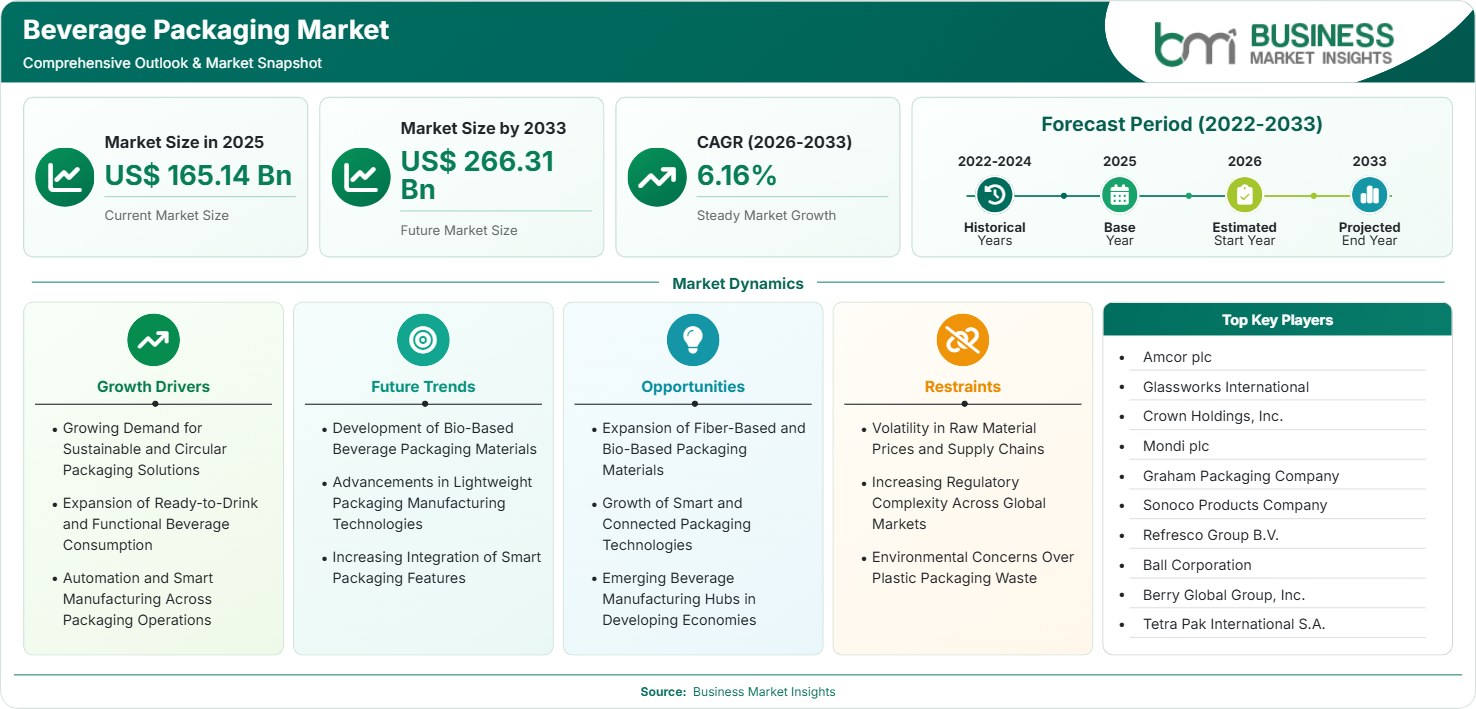
The Beverage Packaging Market size was valued at US$ 165.14 Billion in 2025 and is projected to reach US$ 266.31 Billion by 2033, growing at a CAGR of 6.16% during 2026–2033, driven by sustainable packaging innovation, premium beverage consumption, circular economy initiatives, lightweight materials, smart packaging adoption, and expanding beverage manufacturing investments across emerging economies.

Report Coverage
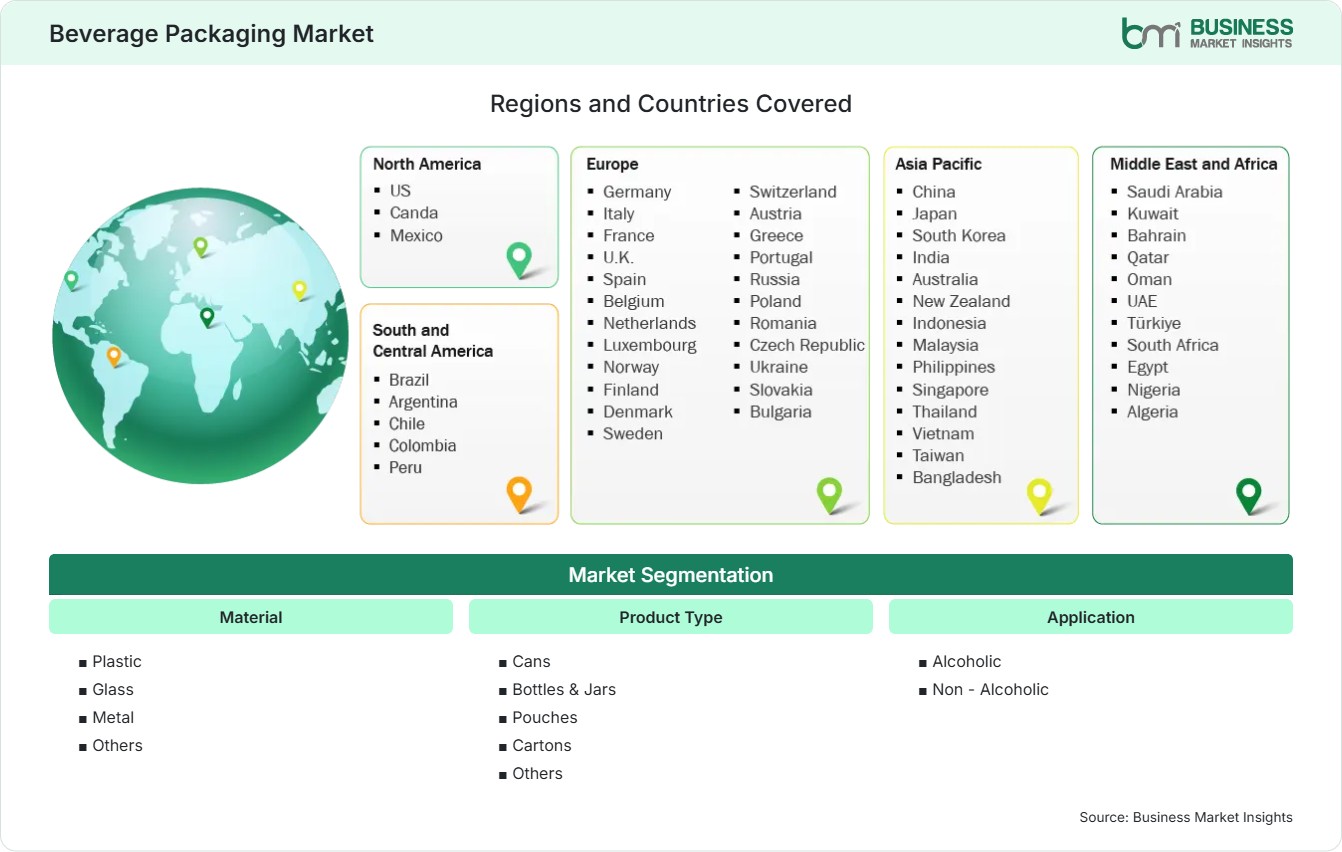
  • Material: Plastic, Glass, Metal, Others
  • Product Type: Cans, Bottles & Jars, Pouches, Cartons, Others
  • Application: Alcoholic, Non - Alcoholic
US$ 165.14 Bn Market size in 2025
US$ 266.31 Bn Market Size by 2033
6.16% CAGR, 2026 - 2033
2026-2033 Forecast Period

01 AI Overview

Beverage Packaging Market Summary

  • North America Region: North America holds 34%–37% market share in 2025 and is expected to grow at a 5.5%–6.0% CAGR during 2026–2033, supported by premium beverage demand, recycling infrastructure improvements, sustainable material innovation, regulatory compliance, smart packaging investments, and advanced manufacturing capabilities creating long-term opportunities. The U.S. remains the regional leader due to strong beverage production, sustainability investments, and packaging automation, expanding at an estimated 5.6%–6.1% CAGR.
  • Fastest Growing Region: Asia Pacific accounts for 27%–30% market share in 2025 and is projected to register a 7.2%–7.8% CAGR through 2033, supported by urbanization, packaged beverage consumption, manufacturing expansion, e-commerce distribution, rising disposable incomes, sustainable packaging investments, and favorable industrial development policies across emerging economies.
  • Leading Segment: Plastic holds 39%–42% market share in 2025 and is anticipated to expand at a 5.8%–6.3% CAGR through 2033 owing to lightweight characteristics, cost efficiency, design flexibility, transportation advantages, recyclability improvements, high-volume beverage production, and continuous innovations in resin technologies.
  • High Growth Segment: Cartons account for 16%–19% market share in 2025 while advancing at a 7.4%–8.0% CAGR through 2033 because of increasing aseptic beverage consumption, renewable material usage, extended shelf life, consumer preference for sustainable packaging, and expanding dairy and juice production worldwide.
  • Key Market Opportunity: Growing investments in recyclable, refillable, and fiber-based beverage packaging solutions, combined with digital printing, smart labeling, and closed-loop recycling infrastructure, are creating scalable opportunities for manufacturers serving premium beverage brands globally.
  • Major Market Players: Amcor plc, Glassworks International, Crown Holdings, Inc., Mondi plc, Graham Packaging Company, Sonoco Products Company, Refresco Group B.V., Ball Corporation, Berry Global Group, Inc., and Tetra Pak International S.A.
02 Strategic Insights

Beverage Packaging Market: Strategic Insights

Beverage Packaging Market Strategic Framework
FREE PDF
Request your free sample
Request free sample
03 Stakeholder View

Key Takeaways

  • Supply chains are rapidly transitioning toward circular packaging ecosystems, integrating recycled content, lightweight materials, advanced sorting technologies, and digital traceability to improve resource efficiency while reducing environmental impact across global beverage value chains.
  • The strongest commercial opportunities remain concentrated in premium bottled beverages, ready-to-drink coffee, functional beverages, dairy drinks, and aseptic beverage applications where innovative packaging delivers extended shelf life and stronger brand differentiation.
  • Smart packaging technologies, including QR-enabled labels, digital authentication, connected packaging, and intelligent printing, are becoming important competitive differentiators that enhance consumer engagement, regulatory compliance, and supply chain transparency.
  • Asia Pacific presents one of the most compelling long-term investment destinations as expanding beverage manufacturing, urban population growth, modern retail penetration, and sustainability initiatives accelerate demand for innovative packaging formats.
  • Strategic acquisitions, long-term supply agreements, and investments in recycled resin production, aluminum recycling, fiber packaging technologies, and packaging automation continue reshaping competitive positioning among global packaging manufacturers.
  • The Beverage Packaging Market analysis indicates that companies investing simultaneously in sustainability, digital manufacturing, premium product innovation, and regional production capacity are better positioned to strengthen profitability while addressing changing regulatory and consumer expectations.
04 Geographic Outlook

Beverage Packaging Market Regional Highlights

North America Beverage Packaging Market

North America accounts for 34%–37% of the Beverage Packaging Market share in 2025 and is expected to expand at a 5.5%–6.0% CAGR through 2033. Regional demand is supported by high packaged beverage consumption, mature recycling infrastructure, premium alcoholic beverage sales, and continued investments in lightweight packaging technologies.

  • Beverage companies continue expanding investments in recycled PET, aluminum recovery, and refillable packaging systems to comply with evolving sustainability regulations while lowering carbon emissions throughout manufacturing and distribution operations.
  • Premium bottled water, craft beer, energy drinks, and ready-to-drink beverages generate consistent demand for innovative packaging formats that improve convenience, product protection, shelf differentiation, and transportation efficiency across retail channels.
  • Automation technologies, AI-enabled inspection systems, and digital printing solutions improve packaging quality, production flexibility, and operational productivity while reducing manufacturing waste across large-scale packaging facilities.
  • Growing consumer preference for environmentally responsible products accelerates commercialization of recyclable polymers, lightweight containers, and renewable fiber packaging solutions throughout beverage manufacturing supply chains.
  • Strategic partnerships between beverage producers and packaging manufacturers strengthen recycling infrastructure while supporting circular economy initiatives across the United States, Canada, and Mexico.

US Beverage Packaging Market

The United States represents 72%–76% of North American demand and is projected to register a 5.6%–6.1% CAGR through 2033. Strong beverage manufacturing capacity, continuous investment in sustainable packaging technologies, advanced recycling capabilities, and rising consumption of premium beverages reinforce market expansion.

  • Investments in aluminum can manufacturing and PET bottle recycling expand domestic capacity while supporting sustainability and circular economy goals.
  • Rising demand for premium bottled water, functional beverages, sports drinks, and ready-to-drink coffee drives high-performance packaging with improved barriers and branding.
  • Federal and state sustainability initiatives promote recycled material use, plastic waste reduction, and reusable beverage packaging systems.
  • Advanced automation, robotics, and digital inspection improve efficiency, production consistency, and supply chain responsiveness while reducing manufacturing costs.

Europe Beverage Packaging Market

Europe captures 28%–31% Beverage Packaging Market share during 2025 while advancing at a 5.8%–6.4% CAGR through 2033. Strong environmental legislation, circular economy initiatives, and consumer preference for recyclable materials continue driving packaging innovation. Germany remains the leading regional market, while Poland demonstrates the fastest expansion supported by manufacturing investments and packaged beverage production.

  • Germany leads regional packaging production through advanced recycling infrastructure, premium beverage manufacturing, and investments in sustainable technologies.
  • Poland records rapid growth, supported by expanding beverage production, lower manufacturing costs, and rising foreign investment in packaging and automation.
  • EU recycling directives accelerate the adoption of recyclable materials, reusable containers, and higher recycled-content packaging across beverage manufacturing.
  • Rising demand for premium wines, bottled water, dairy beverages, and functional drinks drives innovation in lightweight glass, metal, and aseptic cartons.
  • Renewable energy investments in packaging plants improve sustainability while reducing manufacturing emissions across major European beverage packaging companies.

Asia Pacific Beverage Packaging Market

Asia Pacific represents 27%–30% of the global market during 2025 and is forecast to grow at a 7.2%–7.8% CAGR through 2033, making it the fastest-growing regional market. China leads regional demand owing to its extensive beverage manufacturing industry, while India records the highest growth supported by urbanization, rising disposable income, and expanding packaged beverage consumption.

  • China leads the region through large-scale beverage production, integrated manufacturing ecosystems, and investments in recyclable packaging and automated technologies.
  • India records the fastest growth as packaged beverages, bottled water, dairy drinks, and energy beverages gain demand through expanding organized retail networks.
  • Japan and South Korea invest in premium packaging, lightweight containers, and intelligent labeling to enhance product differentiation and sustainability.
  • E-commerce growth drives demand for durable beverage packaging that protects products during transit while reducing logistics costs and environmental impact.
  • Regional governments promote recycling infrastructure and sustainable packaging investments to advance circular economy practices across beverage industries.

Rest of World Beverage Packaging Market

The Rest of World region accounts for 9%–11% market share in 2025 and is anticipated to expand at a 6.3%–6.9% CAGR through 2033. South & Central America benefit from expanding soft drink and bottled water production, while the Middle East & Africa experience rising investments in beverage manufacturing and food processing industries. Increasing urban populations, tourism growth, and modernization of retail distribution continue supporting packaging demand across developing economies.

There are continuous developments in recyclable packaging and beverage production in South and Central America, while the Middle Eastern nations focus on high-quality packaging for bottled water and aluminum can production. South Africa and the UAE play significant roles as regional producers with regard to these industries.

  • Brazil leads South & Central America through strong beverage manufacturing, expanding packaged drink consumption, and growing investments in recyclable plastic and aluminum packaging production.
  • The United Arab Emirates demonstrates rapid development supported by premium beverage demand, tourism growth, and investments in advanced beverage filling and packaging facilities.
  • South Africa strengthens regional competitiveness through investments in food and beverage processing industries alongside improvements in recycling infrastructure and sustainable manufacturing initiatives.
  • Growing bottled water consumption across Middle Eastern countries supports higher demand for lightweight PET bottles, innovative closures, and environmentally responsible packaging technologies.
  • International packaging companies continue expanding regional manufacturing facilities to improve supply chain resilience while meeting increasing demand for sustainable beverage packaging solutions.
Global Market Geography
FREE PDF
Request your free sample
Request free sample
05 Segment Analysis

Beverage Packaging Market Segmentation

Material

Material remains the largest segment, accounting for 39%–42% market share in 2025 while advancing at a 5.9%–6.4% CAGR through 2033. The Beverage Packaging Market scope continues expanding as manufacturers prioritize lightweight, recyclable, and durable materials capable of supporting sustainability objectives, premium product presentation, regulatory compliance, and efficient transportation across global beverage supply chains.

  • Plastic: Lightweight construction, design flexibility, excellent barrier performance, and cost-effective manufacturing continue supporting extensive adoption across bottled water, carbonated drinks, juices, dairy beverages, and functional beverage packaging applications.
  • Glass: Premium appearance, excellent product preservation, and complete recyclability encourage strong demand across alcoholic beverages, premium juices, specialty drinks, and luxury beverage brands emphasizing sustainability and quality perception.
  • Metal: High recyclability, durability, extended shelf life, and excellent protection against light and oxygen make metal packaging increasingly preferred for carbonated beverages, beer, and energy drinks.

Product Type

Product type contributes significantly to market expansion, with Bottles & Jars maintaining 35%–38% market share during 2025 while registering a 5.8%–6.3% CAGR through 2033. The Beverage Packaging Market trends increasingly favor convenient, lightweight, recyclable, and visually differentiated packaging formats that improve product protection, transportation efficiency, shelf visibility, and consumer convenience.

  • Cans: Growing consumption of carbonated beverages, beer, and ready-to-drink products supports rising demand for lightweight, recyclable aluminum cans with enhanced branding and product preservation capabilities.
  • Bottles & Jars: Versatility, product visibility, excellent sealing performance, and compatibility with diverse beverage categories continue supporting dominant adoption across global beverage manufacturers.
  • Pouches: Flexible packaging solutions gain popularity because of reduced material consumption, lower transportation costs, convenience, and increasing applications within functional beverages and liquid concentrates.
  • Cartons: Aseptic technology, renewable paper content, and extended shelf life strengthen demand for cartons across dairy beverages, fruit juices, plant-based drinks, and nutritional beverages.

Application

Application demand is led by Non-Alcoholic beverages, representing 63%–66% Beverage Packaging Market share in 2025 while expanding at a 6.3%–6.8% CAGR through 2033. Increasing consumption of bottled water, dairy beverages, sports drinks, functional beverages, and ready-to-drink products continues supporting long-term packaging innovation, sustainable material adoption, and manufacturing capacity expansion worldwide.

  • Alcoholic: Premium branding, glass packaging demand, aluminum cans, and product differentiation continue driving packaging innovation across beer, wine, spirits, and ready-to-drink alcoholic beverages.
  • Non-Alcoholic: Rising health-conscious consumption, expanding bottled water demand, functional beverages, juices, dairy drinks, and premium soft beverages continue accelerating packaging innovation and sustainable material adoption.
06 Market Forces

Beverage Packaging Market Dynamics

Key Market Drivers

Growing Demand for Sustainable and Circular Packaging Solutions

Increasing environmental consciousness and tightening packaging policies are driving the use of recyclable, reusable, and renewable packaging materials for beverages. Regulatory bodies in Europe, North America, and the Asia Pacific are rolling out extended producer responsibility programs and recycled content standards that urge brands to revamp their packaging portfolio. Beverage companies are making more efforts towards using lightweight bottles, aluminum cans, paper-based cartons, and recycled plastics in order to cut down carbon emissions and ensure circularity. Further improvements in the recycling methods will boost the availability of raw materials for ensuring the sustained growth of the Beverage Packaging Market.

Expansion of Ready-to-Drink and Functional Beverage Consumption

The lifestyles of consumers have now started to gravitate towards convenience beverages that can be taken even when they are moving, thus resulting in a lot of demand for packaging that needs to be innovative. There is a demand for such packaging that will not only ensure the durability of the beverage but will also help it to last longer and remain portable as well. Beverages like ready-to-drink coffee, flavored water, energy drinks, sports beverages, kombucha, and nutritional drinks will need packaging that meets all such criteria. The growing retail sector and online groceries add to such demands for packaging.

Automation and Smart Manufacturing Across Packaging Operations

The digital transformation is still impacting the manufacturing of beverage packages through robotics, AI, machine vision inspection, predictive maintenance, and smart manufacturing. The current packaging plants are adopting automated filling, labeling, palletizing, and quality inspection technology to increase the speed of production, lower the cost of production, and reduce material waste. Smart manufacturing provides better traceability, faster product changeover, and more flexibility when dealing with different packagings that beverage companies produce. The adoption of Industry 4.0 technologies by manufacturers increases their efficiency and lowers downtime, and improves the utilization of resources while maintaining high-quality packaging.

Key Market Opportunities

Expansion of Fiber-Based and Bio-Based Packaging Materials

Increasing sustainability initiatives by beverage companies open new avenues for investment in renewable packaging materials. The continued efforts by the beverage companies to explore fiber cartons, molded pulp packages, plant-based plastics, and biodegradable packaging materials continue to attract investment. Governments’ commitment to promoting circular economy models as well as consumers' interest in eco-friendly products further drive the commercial adoption of these renewable packaging materials. Companies that invest in renewable raw materials, innovative manufacturing processes, and recycling programs will be well placed to reap maximum benefits.

Growth of Smart and Connected Packaging Technologies

Connected packaging solutions are gradually becoming a significant tool for beverage companies trying to develop stronger relationships with their customers and have better control of the supply chain. Barcode technologies, NFC, connected packaging solutions, and digital authentication can be used in order to guarantee product traceability, fight against counterfeiting, and improve the personalization of the consumer experience. The proliferation of smartphones and digital retail provides further opportunities for packaging providers who produce connected packaging solutions.

Emerging Beverage Manufacturing Hubs in Developing Economies

Industrialization at an incredible pace in countries of the Asia Pacific, Latin America, the Middle East, and selected countries of Africa results in the expansion of capacity in beverage production. It is becoming more common for international beverage brands to build manufacturing plants in regions with high growth in their consumer markets to reduce logistics costs. Regional production expansion by packaging production businesses will be a great benefit for them due to increasing packaged beverages consumption, demographics, disposable income, and government policies.

Market Restraints and Challenges

Volatility in Raw Material Prices and Supply Chains

Factor: The production of beverage packaging materials is highly dependent on plastic materials, aluminum, steel, paperboard, glass, and special resins, which can change their price levels owing to energy prices, political tensions, logistics disruption, and changes in global demand levels. Impact: Price fluctuations result in higher costs of production, difficult purchasing planning, and thinning profit margins for beverage packaging manufacturers who work according to long-term contracts for supplies. It becomes more common practice for companies to broaden the sourcing approach, establish closer relationships with suppliers, manage inventory better, and use recycled materials.

Increasing Regulatory Complexity Across Global Markets

Factor: Governments keep coming up with more stringent regulations related to recycled content, packaging waste management, labeling, food-contact materials, and extended producer responsibility. Impact: This adds more complexity to the process of compliance, which results in increased costs, frequent redesign of packaging material, and delayed product launches in different jurisdictions that have different environmental or safety regulations. The manufacturing of packaging material requires tracking regulation updates, updating the production process, ensuring compliance with the material used, and maintaining records.

07 Company Analysis

Competitive Landscape

The competitive environment is characterized by continuous investments in sustainable materials, lightweight packaging, digital printing, smart manufacturing, and circular economy initiatives. The Beverage Packaging Market analysis indicates that leading companies are strengthening their market positions through capacity expansion, strategic partnerships, acquisitions, and innovations in recyclable and renewable packaging solutions.

Company Name

Overview

Products and Services Relevant to this Market

Amcor plc

Global packaging leader focused on flexible and rigid packaging with extensive sustainability initiatives serving beverage manufacturers worldwide.

PET bottles, recyclable flexible packaging, closures, barrier packaging solutions, and lightweight beverage containers.

Glassworks International

UK-based manufacturer specializing in premium glass packaging solutions for beverage producers emphasizing quality, branding, and sustainability.

Glass bottles, customized beverage containers, decorative glass packaging, and specialty packaging solutions.

Crown Holdings, Inc.

Leading global manufacturer of metal packaging with strong presence in beverage can production and recycling technologies.

Aluminum beverage cans, metal closures, specialty cans, packaging design, and recycling solutions.

Mondi plc

International packaging and paper company delivering sustainable fiber-based packaging and innovative material technologies.

Cartons, paper packaging, sustainable barrier materials, flexible packaging, and industrial packaging solutions.

Graham Packaging Company

Major supplier of rigid plastic packaging serving beverage, food, household, and personal care industries globally.

PET bottles, HDPE containers, custom rigid packaging, closures, and lightweight plastic packaging.

Sonoco Products Company

Diversified global packaging manufacturer offering consumer packaging and industrial packaging with strong innovation capabilities.

Composite containers, rigid packaging, protective packaging, recyclable materials, and packaging services.

Refresco Group B.V.

Global beverage solutions company supporting beverage production through integrated packaging and filling operations.

Beverage filling, contract packaging, PET bottle production, can filling, and supply chain services.

Ball Corporation

Global leader in infinitely recyclable aluminum beverage packaging with strong sustainability and recycling capabilities.

Aluminum beverage cans, specialty cans, packaging innovation, and sustainable container solutions.

Berry Global Group, Inc.

International manufacturer of plastic packaging products serving beverage, healthcare, industrial, and consumer markets.

Plastic bottles, closures, sustainable polymers, rigid packaging, and recycled-content packaging solutions.

Tetra Pak International S.A.

Global leader in aseptic beverage packaging and processing technologies serving dairy and beverage manufacturers.

Carton packaging, aseptic processing equipment, filling systems, packaging materials, and recycling support solutions.

10 Trust & Transparency

Research Methodology

The market analysis combines proprietary research with secondary data from government agencies, company disclosures, regulatory filings, industry databases and expert interviews. Market estimates are validated through data triangulation, cross-market benchmarking and analyst review.

View Full Research Methodology

11 Questions Answered

Frequently Asked Questions

5. How is digital technology influencing beverage packaging?

Automation, AI-based quality inspection, digital printing, connected packaging, QR-enabled labels, and smart manufacturing technologies improve production efficiency, traceability, consumer engagement, operational flexibility, and supply chain visibility throughout beverage packaging operations.

4. Why are beverage manufacturers investing in sustainable packaging?

Manufacturers are adopting recyclable, renewable, and lightweight packaging materials to comply with environmental regulations, reduce carbon emissions, improve brand reputation, strengthen circular economy initiatives, and satisfy changing consumer purchasing preferences.

3. Which region is expected to grow the fastest during the forecast period?

Asia Pacific is projected to record the fastest growth owing to expanding beverage manufacturing, rapid urbanization, increasing disposable incomes, modern retail expansion, government support for sustainable manufacturing, and rising demand for packaged beverages.

2. Which material segment dominates the Beverage Packaging Market Report?

Plastic remains the leading material segment because of its lightweight properties, cost efficiency, design flexibility, durability, and compatibility with numerous beverage categories including bottled water, carbonated drinks, juices, and dairy beverages.

1. What factors are driving the Beverage Packaging Market?

The market is driven by rising packaged beverage consumption, increasing sustainability regulations, demand for recyclable materials, premium beverage branding, lightweight packaging technologies, and investments in automated manufacturing systems that improve production efficiency and product quality.

Access the Full Beverage Packaging Market Report

Get segment-level forecasts, regional estimates, competitive benchmarking, company profiles and downloadable Excel datasets.

Access the full Beverage Packaging Market Report
350 pages PDF & Excel | 2026-08-17