
Passive Fire Protection Market Outlook: Size, Share, Trends, Growth Analysis, Competitive Landscape & Forecast, 2022-2033

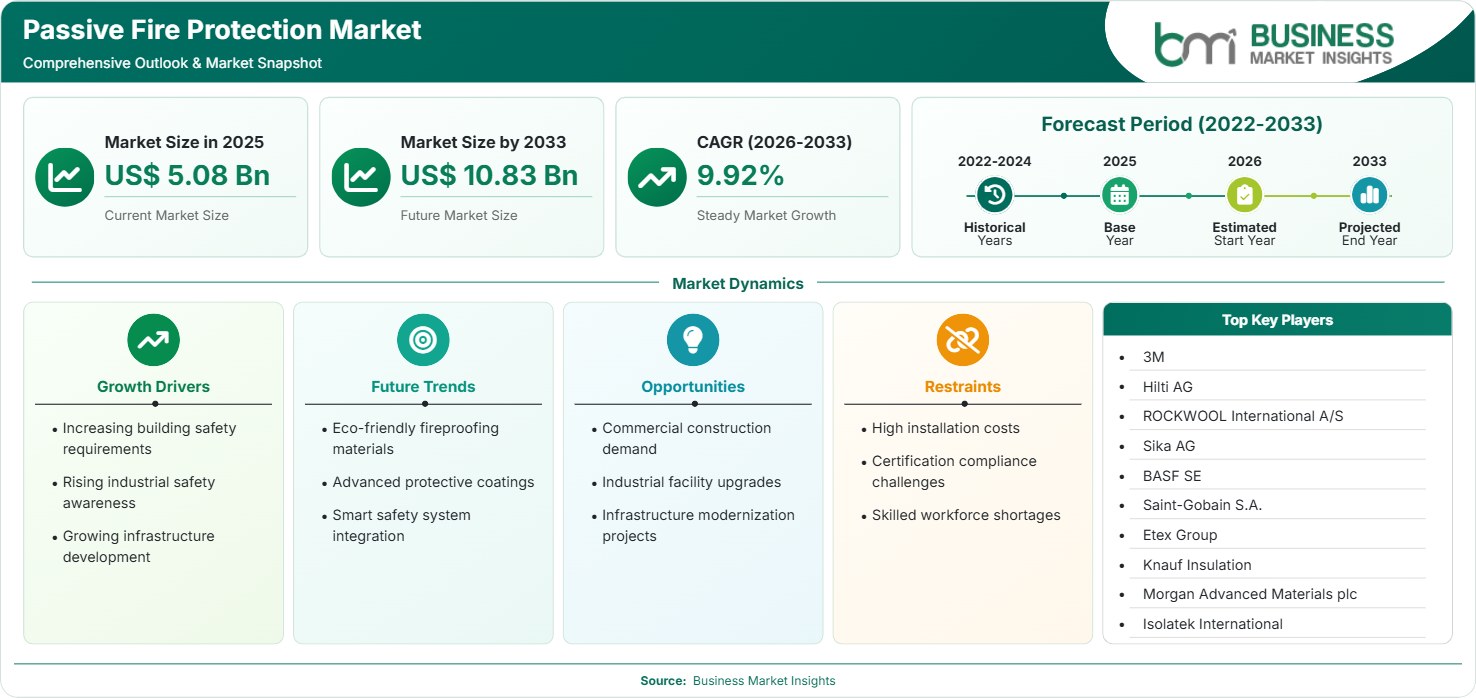
The Passive Fire Protection Market size was valued at US$ 5.08 billion in 2025 and is projected to reach US$ 10.83 billion by 2033, growing at a CAGR of 9.92% during 2026–2033. Increasing building safety regulations, expanding industrial infrastructure, and stronger fire resilience standards continue driving adoption, while commercial construction, industrial modernization, and public infrastructure investments create long-term growth opportunities.

Report Coverage
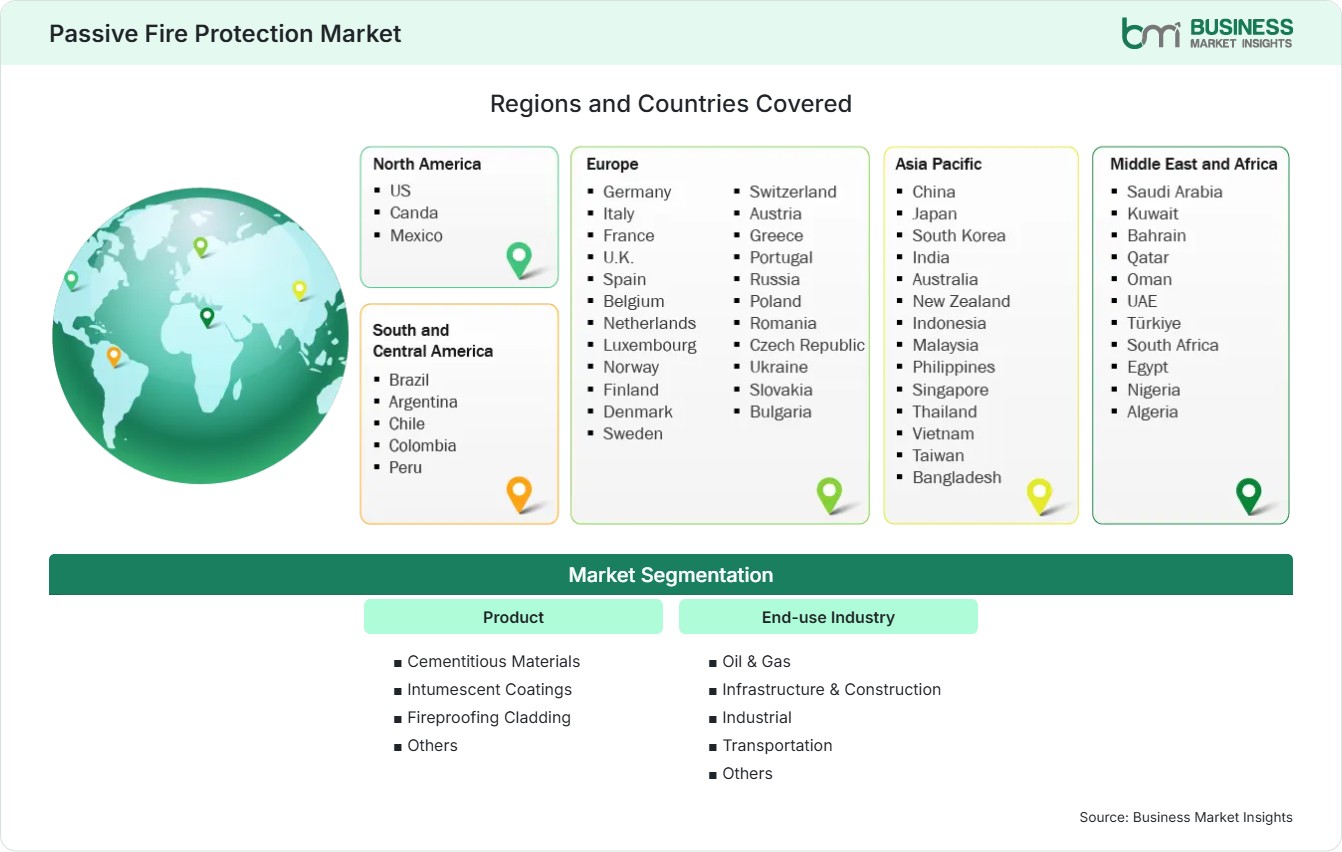
  • Product: Cementitious Materials, Intumescent Coatings, Fireproofing Cladding, Others
  • End-use Industry: Oil & Gas, Infrastructure & Construction, Industrial, Transportation, Others
US$ 5.08 Bn Market size in 2025
US$ 10.83 Bn Market Size by 2033
9.92% CAGR, 2026 - 2033
2026-2033 Forecast Period

01 AI Overview

Passive Fire Protection Market Summary

  • North America Region: North America holds a market share of 33%–36% in 2025, growing with a CAGR of 8.8%–9.6% during 2026–2033. Strict building regulations, investments in industrial safety, and the renovation of aging infrastructure continue to support adoption across commercial, industrial, and institutional facilities. The United States dominates regional demand, with a CAGR of 8.9%–9.7%, supported by growth in commercial construction and the modernization of critical infrastructure.
  • Fastest Growing Region: Asia Pacific accounts for 29%–32% of the market in 2025 and is projected to expand at a CAGR of 11.2%–12.0% during 2026–2033. Rapid urbanization, infrastructure expansion, industrial development, and stronger fire safety regulations continue to accelerate deployment across residential, commercial, and industrial construction projects.
  • Leading Segment: Cementitious Materials hold a market share of 35%–38% in 2025 and are anticipated to register a CAGR of 9.4%–10.1% during 2026–2033. Their cost-effectiveness, durability, and extensive use in structural steel protection continue to support widespread adoption in large construction and industrial projects.
  • High Growth Segment: Infrastructure & Construction represents 39%–42% of end-use demand in 2025 while advancing at a CAGR of 10.4%–11.2% during 2026–2033. Increasing investments in commercial buildings, transportation infrastructure, and public facilities continue driving demand for advanced fire protection systems.
  • Key Market Opportunity: Expanding investment in resilient infrastructure, sustainable construction materials, and advanced passive fire protection technologies enables manufacturers to develop innovative solutions meeting increasingly stringent fire safety and environmental performance requirements.
  • Major Market Players: 3M, Hilti AG, ROCKWOOL International A/S, Sika AG, BASF SE, Saint-Gobain S.A., Etex Group, Knauf Insulation, Morgan Advanced Materials plc, and Isolatek International.
02 Strategic Insights

Passive Fire Protection Market: Strategic Insights

passive-fire-protection-market-market-strategic-framework
FREE PDF
Request your free sample
Request free sample
03 Stakeholder View

Key Takeaways

  • The value chain increasingly integrates raw material suppliers, coating manufacturers, insulation producers, engineering firms, contractors, and certification bodies to deliver compliant fire protection solutions across commercial and industrial infrastructure.
  • Infrastructure development, industrial modernization, and commercial building construction represent the strongest long-term revenue opportunities as governments and private developers prioritize resilient and code-compliant structures.
  • Innovation continues shifting toward lightweight fire-resistant materials, environmentally sustainable insulation products, advanced intumescent coatings, and modular installation technologies that reduce construction time while improving fire performance.
  • Asia Pacific offers the most attractive investment potential due to expanding urbanization, large-scale transportation projects, manufacturing growth, and the continuous strengthening of regional fire safety regulations.
  • Strategic acquisitions, technology partnerships, and product portfolio expansion remain key competitive strategies as manufacturers seek to strengthen regional presence and address increasingly specialized fire protection requirements.
04 Geographic Outlook

Passive Fire Protection Market Regional Highlights

North America Passive Fire Protection Market

North America accounted for 33%–36% of the global market in 2025 and is projected to expand at a CAGR of 8.8%–9.6% during 2026–2033. Implementation of fire safety regulations, modernization of the existing commercial buildings, and improvement in industrial safety continue to be the driving factors for regional dominance. The passive fire protection market share is the highest throughout the world, owing to the established construction norms, renovations, and use of certified fireproof building materials.

  • Commercial construction projects increasingly specify advanced fire-resistant coatings, insulation systems, and structural protection materials to comply with stringent building safety regulations and improve occupant protection.
  • Oil and gas operators continue investing in certified fire protection systems to safeguard processing facilities, storage terminals, and offshore assets while meeting evolving industrial safety standards.
  • Healthcare, education, and public infrastructure modernization projects continue supporting demand for durable passive fire protection materials with long service life and regulatory compliance.
  • Growing emphasis on sustainable construction encourages the adoption of environmentally responsible fire-resistant materials with improved thermal performance and reduced lifecycle environmental impact.
  • Manufacturers continue expanding product certification, testing capabilities, and technical support services to meet increasingly complex project specifications.

US Passive Fire Protection Market

The United States is the largest national market in North America, contributing approximately 26%–29% of global revenue in 2025 and growing at a CAGR of 8.9%–9.7% through 2026–2033. Increasing commercial construction, infrastructure rehabilitation, industrial facility expansion, and strict compliance with national fire safety standards continue to strengthen demand for the passive fire protection market.

  • Commercial office buildings, hospitals, airports, and educational institutions continue to adopt advanced fire-resistant systems to improve structural integrity during fire incidents.
  • Industrial manufacturers increasingly upgrade passive fire protection systems during plant modernization projects to improve operational safety and regulatory compliance.
  • Data centers, logistics facilities, and energy infrastructure projects continue creating strong demand for high-performance fireproofing materials with extended fire resistance ratings.
  • Government investment in transportation infrastructure renovation continues to accelerate the deployment of certified passive fire protection systems across bridges, tunnels, rail facilities, and public buildings.

Europe Passive Fire Protection Market

Europe captured approximately 25%–28% of global revenue in 2025 and is forecast to register a CAGR of 9.3%–10.0% during 2026–2033. Strict fire safety legislation, sustainable construction initiatives, and the renovation of aging infrastructure continue to drive regional demand. Germany leads regional revenue generation, while Poland demonstrates the fastest projected growth through industrial expansion and commercial construction investment.

  • Germany maintains regional leadership through advanced industrial manufacturing, stringent construction regulations, and consistent investment in commercial building modernization.
  • Poland records one of Europe's strongest growth rates as industrial development, logistics infrastructure, and commercial real estate investments accelerate the adoption of certified fire protection systems.
  • Green building initiatives increasingly encourage the use of sustainable insulation materials and environmentally responsible fire-resistant construction products across public and private developments.
  • Industrial operators continue upgrading fire protection infrastructure to comply with evolving occupational safety and operational risk management standards.
  • Manufacturers expand certified product portfolios addressing higher fire performance requirements while improving ease of installation and lifecycle durability.

Asia Pacific Passive Fire Protection Market

Asia Pacific accounted for 29%–32% of global revenue in 2025 and is expected to grow at a CAGR of 11.2%–12.0% through 2026–2033, making it the fastest-growing regional market. The Growth of the Passive Fire Protection Market is driven by urbanization, industrialization, infrastructure development, and the strict implementation of fire safety rules. China accounts for the maximum regional consumption, while India boasts the largest expected growth rate.

  • China continues dominating regional demand through extensive commercial construction, industrial expansion, and government investment in transportation and public infrastructure.
  • India is projected to register a CAGR of 11.8%–12.6%, supported by expanding urban infrastructure, industrial corridors, smart city initiatives, and stricter building safety regulations.
  • Southeast Asian economies continue investing in airports, commercial complexes, manufacturing facilities, and logistics infrastructure requiring certified passive fire protection systems.
  • Oil and gas, power generation, and petrochemical investments continue creating strong demand for specialized fire-resistant materials across industrial installations.
  • Increasing awareness of workplace safety and regulatory compliance supports sustained adoption of advanced fireproofing technologies throughout the region.

Rest of World Passive Fire Protection Market

The Rest of World region accounted for approximately 9%–11% of global revenue in 2025 and is projected to expand at a CAGR of 9.8%–10.6% during 2026–2033.

South & Central America benefit from increasing commercial construction, mining investments, and industrial facility expansion. At the same time, the Middle East & Africa continue investing heavily in energy infrastructure, airports, transportation projects, and smart city developments. Brazil leads South & Central America, whereas the United Arab Emirates demonstrates the strongest projected growth.

  • Brazil continues expanding commercial construction, industrial manufacturing, and mining operations, supporting greater deployment of certified passive fire protection systems.
  • The United Arab Emirates is expected to record a CAGR of 10.9%–11.6%, driven by large-scale commercial developments, aviation infrastructure, hospitality projects, and smart city investments.
  • Oil and gas infrastructure continues requiring high-performance fireproofing systems capable of protecting critical assets under demanding operating conditions.
  • Infrastructure modernization across transportation, utilities, and public facilities supports increasing demand for durable fire-resistant construction materials.
  • Growing regulatory enforcement and international construction standards continue encouraging broader adoption of tested and certified passive fire protection products across emerging markets.
global-market-geography
FREE PDF
Request your free sample
Request free sample
05 Segment Analysis

Passive Fire Protection Market Segmentation

Product

The Product segment forms the foundation of passive fire protection systems by providing structural fire resistance, thermal insulation, and compartmentalization across commercial, industrial, and infrastructure applications. Cementitious Materials accounted for 35%–38% of the market in 2025 and are projected to register a CAGR of 9.4%–10.1% during 2026–2033. The Passive Fire Protection Market scope continues expanding as manufacturers develop lightweight, durable, and environmentally sustainable fireproofing materials that simplify installation while improving long-term structural performance.

  • Cementitious Materials: Widely used for structural steel protection, tunnels, commercial buildings, and industrial facilities because of excellent fire resistance, durability, cost efficiency, and compatibility with large-scale construction projects.
  • Intumescent Coatings: Increasingly adopted for architectural steel structures, commercial buildings, and industrial facilities owing to their aesthetic finish, lightweight characteristics, and ability to expand during fire exposure.
  • Fireproofing Cladding: Extensively utilized across oil and gas installations, transportation infrastructure, power generation facilities, and heavy industrial assets requiring long-duration fire resistance and enhanced mechanical protection.

End-use Industry

The End-use Industry segment demonstrates broad adoption of passive fire protection solutions across high-risk industries requiring compliance with increasingly stringent fire safety regulations. Infrastructure & Construction accounted for 39%–42% of the Passive Fire Protection Market revenue in 2025 and is expected to expand at a CAGR of 10.4%–11.2% through 2026–2033. Growing commercial development, public infrastructure investment, and stricter building codes continue accelerating the deployment of certified fire-resistant systems.

  • Oil & Gas: Exploration facilities, refineries, petrochemical plants, LNG terminals, and offshore platforms increasingly deploy advanced passive fire protection systems to safeguard critical infrastructure and improve operational resilience.
  • Infrastructure & Construction: Commercial buildings, airports, tunnels, bridges, hospitals, educational institutions, and residential developments continue driving strong demand for certified structural fire protection materials and insulation systems.
  • Industrial: Manufacturing facilities, warehouses, chemical processing plants, power generation sites, and logistics centers increasingly implement passive fire protection solutions to minimize operational risks and comply with workplace safety regulations.
  • Transportation: Rail infrastructure, airports, marine vessels, road tunnels, metro systems, and automotive manufacturing facilities continue to adopt advanced fire-resistant materials to improve passenger safety and infrastructure resilience.
06 Market Forces

Passive Fire Protection Market Dynamics

Key Market Drivers

Increasing building safety requirements

Governments across the globe keep on enhancing the building code regulations as well as the fire safety standards for various types of buildings, such as commercial, residential, hospitals, educational, and industrial infrastructures. Increasingly, modern-day construction projects call for the use of passive fire protection products that can protect structures against fire incidents. Some of the Passive Fire Protection Market trends include growing compliance demands, growing third-party certifications, and growing adoption of international fire testing standards.

Rising industrial safety awareness

Fire safety initiatives in industrial settings continue gaining momentum as a way to minimize operational hazards in various manufacturing, oil and gas, petrochemical, mining, and energy industries. Passive fire safety is a vital tool in terms of delaying the structural damage, safeguarding the processing machinery, and ensuring the safety of rescue operations. The increased focus on modernizing industrial assets and increasing their protection keeps pushing forward the application of improved fireproofing materials.

Growing infrastructure development

Major investment projects in transportation networks, airports, railways, bridges, tunnels, utilities, hospitals, and public works will continue to fuel demand for passive fire protection systems. The owners of such infrastructure will require highly fire-resistant construction materials to make their structures resilient and reduce maintenance needs, while complying with current national construction regulations. Government-funded urbanization and infrastructure projects will continue to generate commercial opportunities in the industry.

Key Market Opportunities

Commercial construction demand

The growth of the commercial real estate sector continues to generate significant opportunities for passive fire protection companies. Commercial office structures, retail complexes, hotels, mixed-use properties, healthcare institutions, and schools are increasingly relying on certified fireproofing to meet stringent building codes. Passive Fire Protection Market Forecasts indicate that increasing urbanization, green building programs, and rising investments in high-end commercial real estate will continue to favor the use of fire-proofed products in the years to come.

Industrial facility upgrades

Decaying infrastructure within the industrial complex will continue to provide substantial retrofit possibilities. There has been a growing trend among operators to upgrade existing fireproofing systems by using more advanced materials to improve durability and compliance with evolving fire protection safety standards. The continuous process of upgrading the industrial sector creates an ever-lasting need for cutting-edge passive fire protection solutions.

Infrastructure modernization projects

Governments around the world continue to focus on modernizing transportation systems, building intelligent infrastructure, installing utilities, and providing robust civic structures. More and more bridges, tunnels, airports, metros, and other public structures need fire protection systems that can provide extended fire resistance along with longevity. This provides an excellent opportunity for manufacturers dealing in fireproofing solutions and other such materials.

Market Restraints and Challenges

High installation costs

Factor: Premium fire-resistant materials, specialized installation procedures, engineering assessments, and ongoing inspection requirements significantly increase total project costs. Impact: Higher capital expenditure may discourage adoption among budget-constrained developers and smaller industrial operators, particularly in emerging economies. Although passive fire protection provides long-term operational and safety benefits, elevated installation costs can delay procurement decisions, encourage phased implementation strategies, or increase preference for lower-cost alternatives that may provide reduced fire performance.

Certification compliance challenges

  • Factor: Passive fire protection products must satisfy complex certification requirements, regional building codes, fire testing standards, and project-specific regulatory approvals before commercial deployment.Impact: Compliance processes increase product development timelines, testing expenses, certification costs, and documentation requirements for manufacturers. Companies expanding into multiple international markets must often adapt products to varying regulatory frameworks, adding operational complexity and extending commercialization timelines despite growing global demand for certified fire-resistant construction materials.Top of Form
07 Company Analysis

Competitive Landscape

Continuous investments in advanced fire-resistant materials, sustainable insulation technologies, and certified structural protection systems characterize the competitive environment. The Passive Fire Protection Market analysis indicates that leading manufacturers are expanding production capacities, enhancing product certifications, and strengthening partnerships with engineering, procurement, and construction (EPC) firms to meet growing demand across the infrastructure, industrial, and commercial construction sectors.

Company Name

Overview

Products and Services Relevant to this Market

3M

Global diversified technology company providing innovative industrial safety, fire protection, and specialty material solutions across multiple industries.

Fire barrier products, firestop systems, insulation materials, sealants, passive fire protection solutions, and industrial safety products.

Hilti AG

International construction technology company specializing in fastening systems, fire protection, and building construction solutions.

Firestop systems, fire-resistant sealants, fire-protection coatings, cable transit systems, and structural fire-protection products.

ROCKWOOL International A/S

Leading manufacturer of stone wool insulation solutions supporting fire safety, thermal efficiency, and sustainable construction.

Stone wool insulation, fire-resistant boards, structural insulation systems, passive fire protection products, and industrial insulation.

Sika AG

Global specialty chemicals company delivering construction materials and protective solutions for infrastructure and industrial markets.

Intumescent coatings, fire-resistant mortars, sealants, structural protection systems, and concrete protection solutions.

BASF SE

International chemical manufacturer offering advanced construction chemicals and fire protection materials for commercial and industrial applications.

Construction chemicals, fire-resistant coatings, specialty polymers, insulation materials, and industrial fire protection solutions.

Saint-Gobain S.A.

Global building materials manufacturer providing high-performance construction solutions focused on safety, sustainability, and energy efficiency.

Fire-resistant gypsum systems, insulation products, passive fire protection materials, construction boards, and building solutions.

Etex Group

International building materials company specializing in lightweight construction systems and passive fire protection products.

Fire-resistant boards, drywall systems, passive fire protection panels, structural protection systems, and construction materials.

Knauf Insulation

Global insulation manufacturer specializing in energy-efficient, fire-resistant insulation technologies for buildings and industry.

Mineral wool insulation, fire-resistant insulation systems, acoustic insulation, thermal protection products, and industrial insulation.

Morgan Advanced Materials plc

Advanced materials manufacturer delivering engineered thermal management and high-temperature fire protection technologies.

High-temperature insulation, fire-resistant materials, thermal barriers, industrial fire protection products, and engineered ceramic solutions.

Isolatek International

Specialized manufacturer focused exclusively on passive fireproofing technologies for commercial and industrial construction.

Cementitious fireproofing, intumescent coatings, spray-applied fireproofing materials, and structural steel protection systems.

08 Industry Activity

Recent Developments

May 2026

Complii (formerly Compliance Group) acquired Total Fire Safety, a specialist in passive fire protection services including fire stopping and fire doors, strengthening its passive fire protection offering amid increasing regulatory requirements.

May 2026

MSA Safety Incorporated announced the acquisition of Autronica Fire and Security, a Norwegian manufacturer of fire detection and alarm systems, strengthening its fire safety portfolio and expanding integrated fire protection solutions for critical infrastructure, marine, and energy applications.

April 2026

APi Group Corporation announced a definitive agreement to acquire Onyx-Fire Protection Services, Inc., one of Canada's leading providers of fire and life safety services, further expanding its fire protection platform across North America.

March 2026

Galliford Try Holdings plc acquired Nene Valley Fire & Acoustics, expanding its passive fire protection business through the integration with Oak Fire Protection to provide comprehensive passive and active fire safety solutions across the UK.

10 Trust & Transparency

Research Methodology

The market analysis combines proprietary research with secondary data from government agencies, company disclosures, regulatory filings, industry databases and expert interviews. Market estimates are validated through data triangulation, cross-market benchmarking and analyst review.

View Full Research Methodology

11 Questions Answered

Frequently Asked Questions

What future opportunities are expected in this industry?

Long-term opportunities include sustainable, fire-resistant materials; infrastructure modernization; retrofit construction projects; smart commercial buildings; industrial facility upgrades; and advanced intumescent coating technologies that support increasingly stringent global fire safety requirements.

Which companies are covered in the Market Report?

The Passive Fire Protection Market Report includes 3M, Hilti AG, ROCKWOOL International A/S, Sika AG, BASF SE, Saint-Gobain S.A., Etex Group, Knauf Insulation, Morgan Advanced Materials plc, and Isolatek International.

Which product segment dominates the market?

Cementitious Materials remain the leading product segment due to their cost-effectiveness, durability, ease of application, and extensive use in protecting structural steel in commercial buildings, industrial facilities, tunnels, and infrastructure projects.

Which region is expected to record the fastest growth?

Asia Pacific is anticipated to achieve the highest growth during the forecast period due to rapid urbanization, expanding industrial investments, smart city developments, commercial construction, and increasingly stringent fire safety regulations across developing economies.

What is driving the Passive Fire Protection Market?

Growing building safety regulations, industrial risk management initiatives, infrastructure expansion, commercial construction activity, and stricter international fire safety standards are the primary factors driving demand for passive fire protection across the residential, commercial, industrial, and transportation sectors.

Access the Full Passive Fire Protection Market Report

Get segment-level forecasts, regional estimates, competitive benchmarking, company profiles and downloadable Excel datasets.

Access the full Passive Fire Protection Market Report
350 pages PDF & Excel | 2026-07-30