Market Summary
Executive Summary and Global Market Analysis
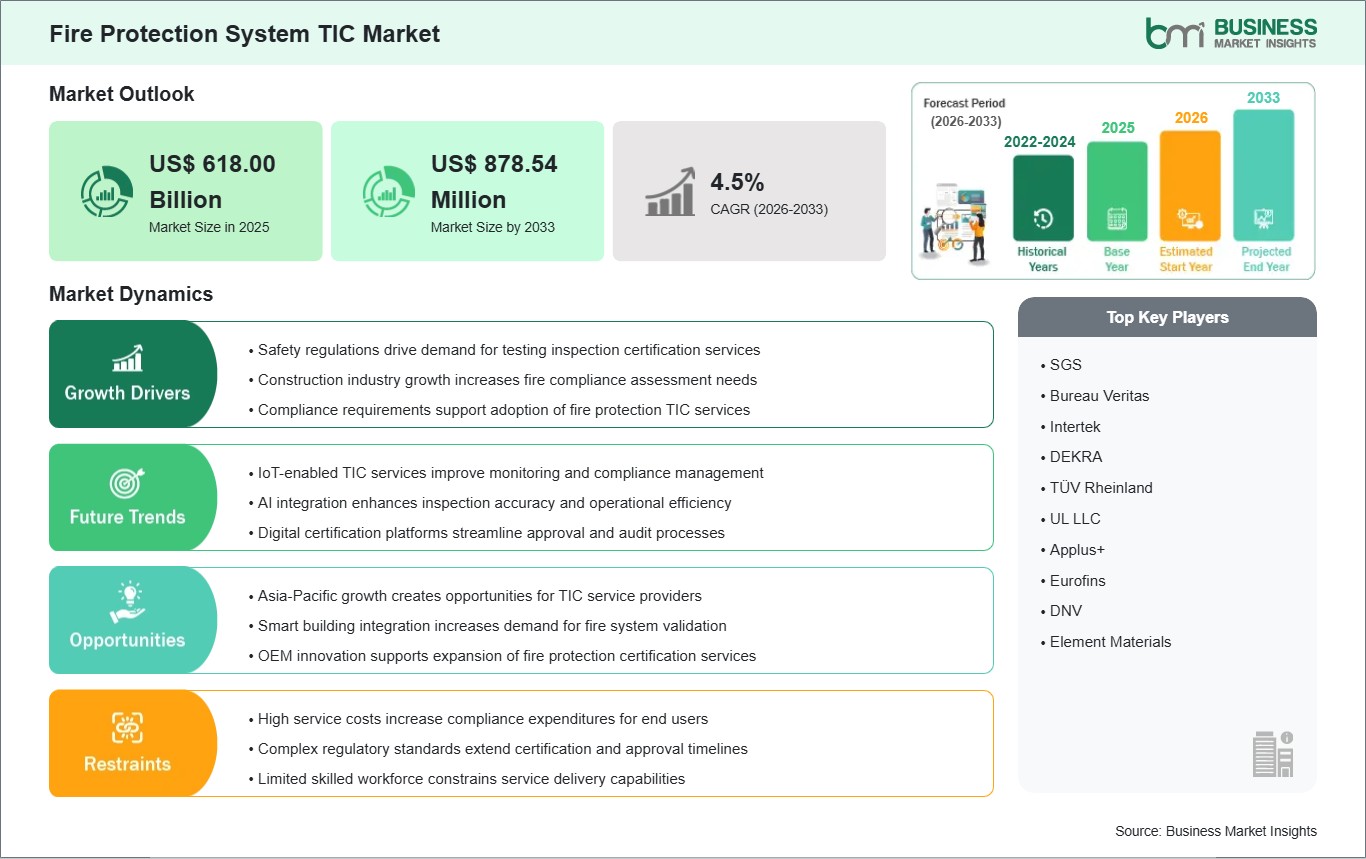
Fire protection system testing, inspection, and certification services encompass structured compliance activities that evaluate the reliability, safety, and regulatory alignment of fire protection installations. The services can be utilized in operational equipment like alarms and suppression equipment, as well as passive fire barriers in structures. The services help to ensure that the equipment works efficiently in case of an emergency, complying with safety regulations in various construction sites, industries, and infrastructure.
Increasing regulation and enforcement in construction and manufacturing industries are driving the need for standardized methods to validate compliance. The requirement that fire safety systems be inspected and certified on a regular basis to guarantee their readiness and compliance with codes is being imposed by regulating authorities. This practice has resulted in increased deployment of TIC services provided by third parties especially in large-scale and densely populated construction sites.
Demand levels differ from one category to another depending on the need to prove their authenticity. Testing services aim at ensuring that a product meets its intended purpose when placed in simulated situations, whereas inspection services concentrate on verifying installation accuracy. Certifications guarantee compliance with relevant regulations. There is higher usage of such services in commercial and industrial buildings due to increased safety regulations.
The development of technologies is changing the process of TIC service provision using electronic inspection tools, automation of compliance tracking, and remote monitoring. Technology advances have made the processes more accurate, minimized manual interference, and made documentation faster even for huge buildings. With integration of the intelligent buildings, continuous assessment of the building performance systems becomes possible. Competition in the market depends on the level of accreditation, technical knowledge, and compliance to international regulations.
Segment Analysis
Fire Protection System TIC Market Segmentation
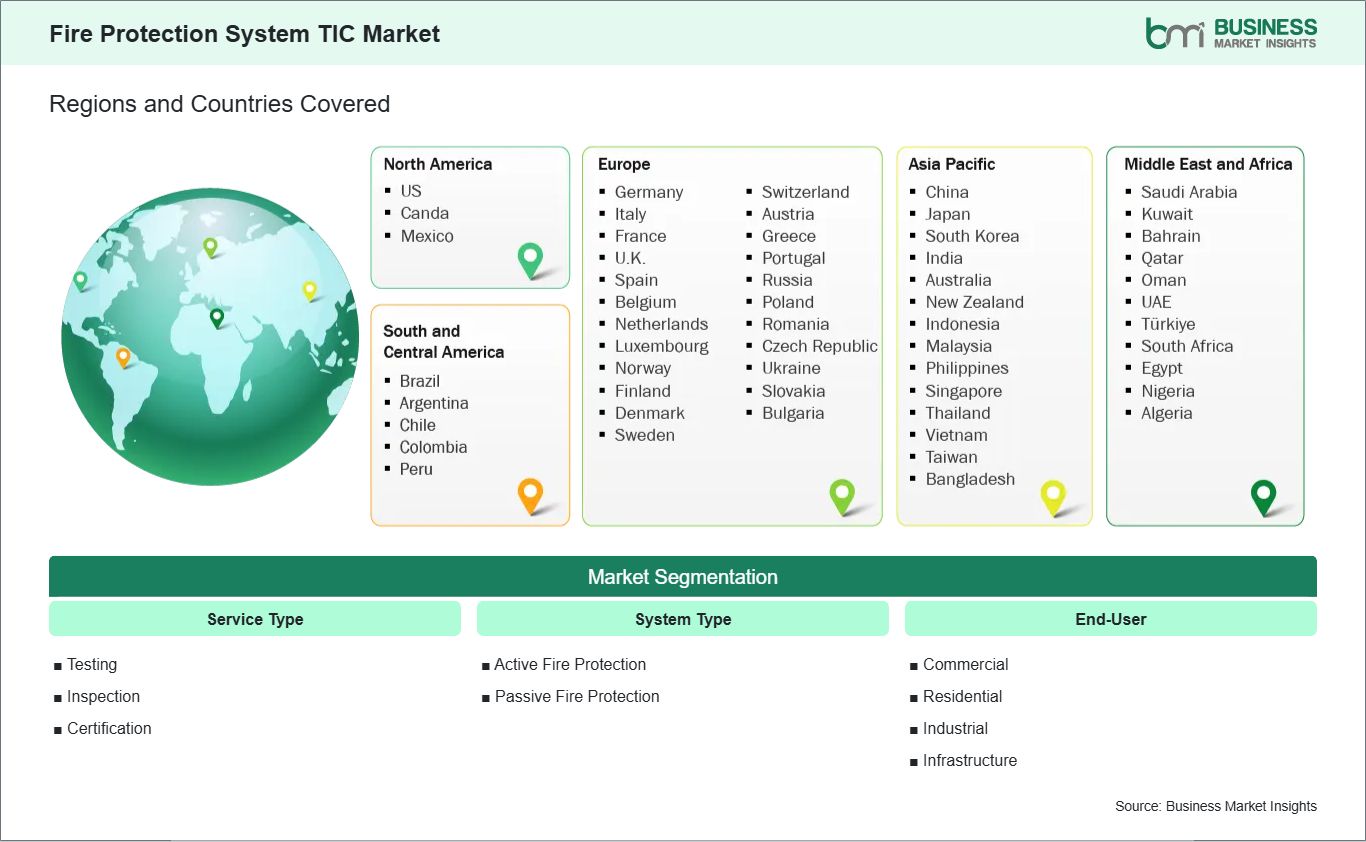
The fire protection system TIC market is segmented based on service type, system type, and end-user, reflecting the increasing emphasis on regulatory compliance verification, system performance validation, and structured safety assurance across built environments and infrastructure ecosystems.
By Service Type
- Testing - Validates operational performance of fire protection systems under controlled conditions.
- Inspection - Assesses installation quality, system integrity, and functional readiness.
- Certification - Confirms compliance with fire safety codes and regulatory standards.
By System Type
- Active Fire Protection - Evaluates alarms, sprinklers, and suppression system functionality and response efficiency.
- Passive Fire Protection - Verifies structural fire barriers, compartmentation, and containment effectiveness.
By End-User
- Commercial - Ensures compliance across offices, retail complexes, and hospitality infrastructure.
- Residential - Focuses on safety validation within housing and apartment developments.
- Industrial - Covers high-risk facilities requiring stringent fire safety verification protocols.
- Infrastructure - Includes transport systems, utilities, and public service installations requiring regulatory compliance assurance.
Market Forces
Fire Protection System TIC Market Drivers and Opportunities
Stringent safety regulations
Rising enforcement of fire safety regulations across construction and industrial sectors is increasing reliance on structured testing and certification services. The need for systematic testing of fire suppression systems has been mandated by relevant authorities to make sure that they are fully functional and meet new safety standards. The need for third-party thermal imaging camera services in this regard cannot be overemphasized.
Tightening in regulations has effects that are felt throughout the lifecycle of projects, from approvals right through to inspections after installation. Continuous inspection programs are being implemented by facility managers in order to prevent compliance issues. This development increases the need for TIC certification services, especially in large and densely populated infrastructures where regulatory approvals depend on safety accountability and accurate documentation.
Integration with smart building systems
Digitalization of building infrastructure is enabling integration of TIC services with smart monitoring platforms and automated safety systems. Real-time monitoring through fire safety equipment is an example of predictive diagnostics and remote inspection systems. The technology makes it easier to assess the performance of fire safety equipment due to its ability to reduce dependence on manual inspections.
Development will be further enhanced by way of infrastructure ecosystem interconnection and intelligent compliance tracking mechanisms. There is a growing trend of TIC service providers matching their offerings in line with the intelligent building technology platform. This facilitates the efficiency of the inspection process in ensuring ongoing safety management in technologically advanced settings.
Size and Share Analysis
Fire Protection System TIC Market Size and Share Analysis
The fire protection system TIC market size is expected to reach US$ 618.00 Million by 2033 from US$ 878.54 Million by 2025. The market is estimated to record a CAGR of 4.5% during 2026 to 2033. Growth is supported by stricter fire safety compliance requirements, expansion of complex infrastructure projects, and increasing dependence on independent verification services for system reliability and regulatory approval. Rising emphasis on lifecycle safety assurance continues to strengthen demand across construction and industrial ecosystems.
By Service Type, testing services hold a dominant share due to recurring performance validation requirements for installed fire safety systems. Inspection services maintain strong adoption as regulatory frameworks mandate periodic system assessments across operational facilities. Certification services continue to grow steadily, supported by formal compliance requirements and mandatory approvals across commercial, industrial, and infrastructure projects.
By System Type, active fire protection systems account for a major share owing to continuous verification needs for alarms, sprinklers, and suppression equipment. Passive fire protection systems also hold significant relevance, driven by structured evaluation of fire barriers and containment integrity. Both segments collectively support compliance assurance across integrated building safety frameworks.
By End-User, commercial facilities dominate due to strict regulatory oversight and high occupancy safety requirements. Industrial sectors maintain strong demand driven by operational risk management and asset protection needs. Infrastructure and residential segments are expanding gradually as fire safety compliance becomes increasingly embedded within construction approval processes and long-term maintenance frameworks.
Report Coverage
Fire Protection System TIC Market Report Coverage and Deliverables
The "Fire Protection System TIC Market Size and Forecast (2022 - 2033)" report provides a detailed analysis of the market covering below areas:
- Market size and forecast at global, regional, and country levels for all key market segments covered under the scope
- Market trends, along with market dynamics such as drivers, restraints, and key opportunities
- Market analysis covering key trends, global and regional frameworks, major players, regulations, and recent developments
- Industry landscape and competitive analysis covering market concentration, heat map analysis, prominent players, and recent developments
- Detailed company profiles, including SWOT analysis
Geographic Insights
Fire Protection System TIC Market Geographic Insights
The Fire Protection System TIC Market shows diverse regional adoption patterns influenced by regulatory enforcement intensity, infrastructure modernization pace, and maturity of compliance ecosystems. Across global markets, demand is increasingly shaped by the need for verified fire safety performance and structured certification processes supporting building approvals and operational continuity. Service providers are expanding capabilities to align with evolving international safety standards.
North America demonstrates strong adoption supported by well-established regulatory frameworks and stringent compliance requirements. Testing and certification services are widely integrated into construction and industrial operations to ensure adherence to safety codes. Advanced digital inspection tools are increasingly used to improve accuracy and efficiency in system verification across large commercial and institutional facilities.
Asia Pacific demonstrates rising usage due to the pace of urbanization and infrastructure development as well as strict fire protection policies. The growing number of projects involving commercial complexes, industrial facilities, and transport infrastructure is making more use of TIC inspections. More often than not, compliance inspections are included in the lifecycle of development projects.
In Europe, there is established adoption in the sector, which is backed up by strong legislation governing safety and certification processes. The focus on sustainability and building safety ensures that there is continued growth in the need for inspection services. In the developing world, including the Middle East, Africa, and South America, TIC adoption is beginning to increase due to infrastructure investments.
Industry Activity
Recent Developments
The fire protection system TIC market is evaluated by gathering qualitative and quantitative data post primary and secondary research, which includes important corporate publications, association data, and databases. Recent developments and news in the market include:
- In October 2025, Honeywell (NOTIFIER) announced the launch of the INSPIRE fire alarm control system platform, which received UL/ULC certification updates for connected fire detection systems, enabling advanced remote diagnostics, cloud connectivity (CLSS integration), and compliance with updated North American fire alarm control panel standards for commercial and critical infrastructure applications.
- In May 2026, Kirloskar Brothers Ltd (KBL) announced the launch of its Smart Skid Mounted Fire Pump Set, a factory-assembled fire protection system combining FM and UL-certified pump sets with IoT-based remote monitoring, designed to improve installation speed and ensure certified performance compliance for industrial and commercial fire protection systems globally.
Trust & Transparency
Research Methodology
The market analysis combines proprietary research with secondary data from government agencies, company disclosures, regulatory filings, industry databases and expert interviews. Market estimates are validated through data triangulation, cross-market benchmarking and analyst
review.
View Full Research Methodology
Key Sources Referred:
International Organization for Standardization National Fire Protection Association International Code Council ASTM International European Committee for Standardization Underwriters Laboratories National Institute of Standards and Technology Fire Protection Association