Market Summary
Executive Summary and Global Market Analysis
Cellulosic fire protection coatings are passive fire-resistant materials designed to delay structural failure during fire exposure. The coatings swell when the temperature increases to form a char layer that acts as an insulator protecting substrates from fast thermal transfer. Application of the coatings is still important for both building and industrial structures that must meet the required fire safety performance criteria.
Increasing concern regarding structural durability during fires has maintained their usage in both industrial and commercial developments. Programs for building upgrades, new construction regulations, and insurance assessments have helped increase the adoption of these coatings for wood and steel substrates. The market players are also witnessing increased purchasing activity for infrastructure development projects that need new passive fire protection systems.
There is diversified demand from the coatings industry in terms of chemistry type, substrate material, and end-user environment. The epoxy resins continue to be relevant in industrial settings due to their ability to handle harsh operating conditions. Commercial establishments contribute significantly to the installed base, owing to the high standards of safety required for occupancy purposes and longer protection durations.
Innovations in material usage have been impacting formulation effectiveness and versatility. In particular, companies are investing in formulation improvements aimed at enhanced adhesive properties, faster curing speeds, and reduced emissions coatings in response to changing environmental demands.
Developments in acrylic and composite binders are further improving substrates compatibility along with extending maintenance intervals. Market rivalry is somewhat fragmented, with participants concentrating on formulation reliability, certification abilities, and regional coverage. Product differentiation is more dependent on factors such as compliance testing, coating longevity, and material compatibility than ever before. The focus on retrofits and customized projects influences procurement throughout the worldwide market.
Segment Analysis
Cellulosic Fire Protection Market Segmentation
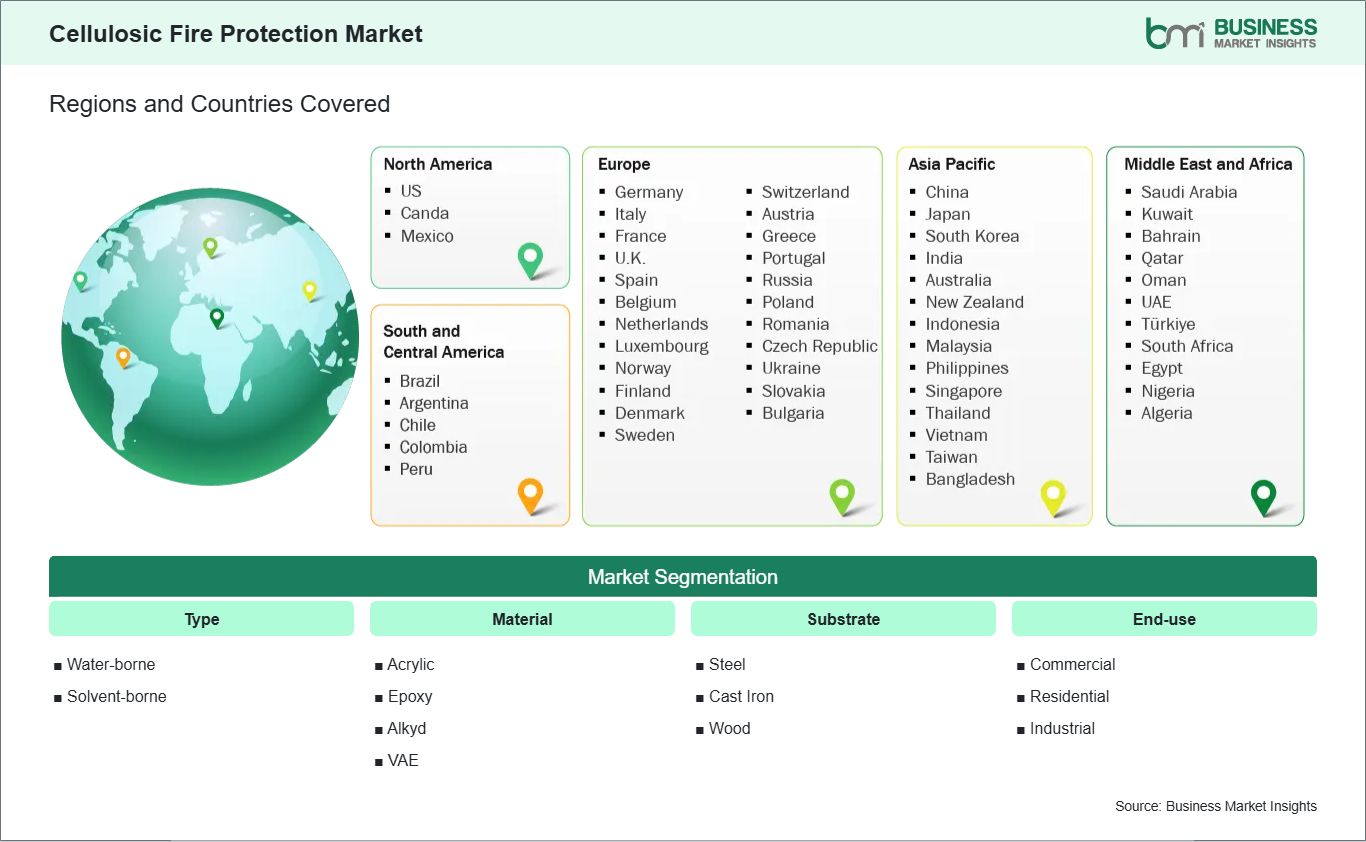
The cellulosic fire protection market is segmented based on type, material, substrate, and end-use, reflecting the increasing emphasis on passive fire protection, building safety compliance, and enhanced structural fire resistance across residential, commercial, and industrial applications.
By Type
- Water-borne - Preferred for indoor projects requiring lower emissions and simplified application handling.
- Solvent-borne - Selected for demanding environments requiring stronger moisture and temperature resistance.
By Material
- Acrylic - Supports flexible coating performance with efficient surface adhesion characteristics.
- Epoxy - Enables durable protection under aggressive industrial operating conditions.
- Alkyd - Utilized in cost-sensitive projects requiring balanced protective performance.
- VAE - Enhances coating stability and application consistency on porous surfaces.
By Substrate
- Steel - Dominates installations due to structural fire resistance requirements in construction projects.
- Cast Iron - Applied where thermal shielding and corrosion resistance remain operational priorities.
- Wood - Gains traction in architectural structures emphasizing passive fire safety enhancement.
By End-use
- Commercial - Accounts for substantial utilization across offices, retail spaces, and public facilities.
- Residential - Expands through stricter building safety awareness and renovation activities.
- Industrial - Maintains steady deployment in manufacturing and processing infrastructure applications.
Market Forces
Cellulosic Fire Protection Market Drivers and Opportunities
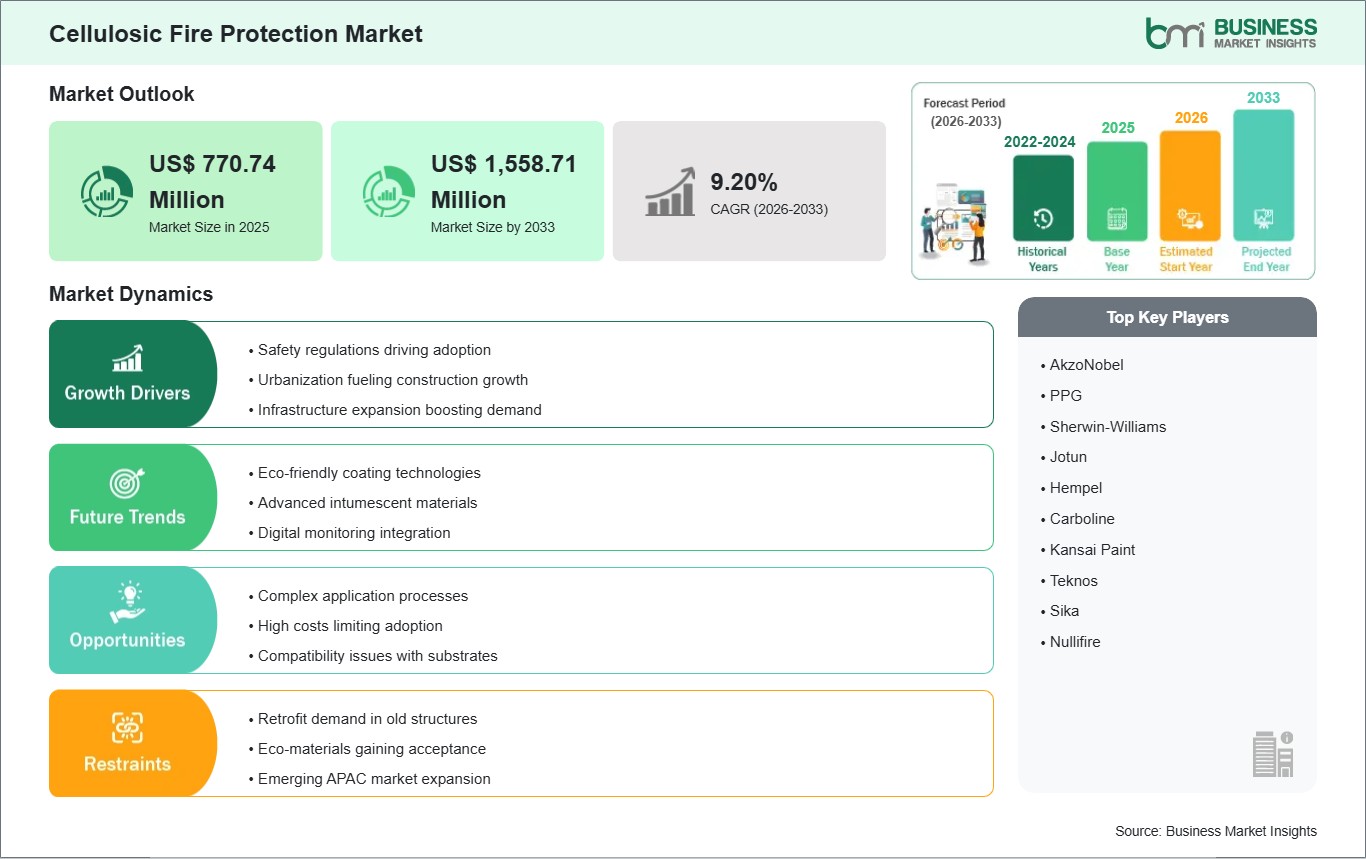
Safety regulations driving adoption
Stringent fire safety regulations across commercial and industrial infrastructure continue reshaping coating selection practices. Increasingly, there is a push towards the requirement of having a certified system of passive fire protection for structures that are subject to higher fire risks. As such, there will be a greater likelihood of incorporating cellulosic fire protection paint in new construction or remodeling projects.
The larger concern for both occupant protection and structural resilience has made procurement more consistent for other industries as well. Insurance assessments and inspections have played a big role in increasing the relevance of these systems in critical infrastructures. In the face of evolving regulations that push for greater fire resistance, the use of coated materials is directly related to longevity.
Retrofit demand in old structures
Aging commercial buildings and industrial facilities are generating stronger retrofit opportunities for passive fire protection systems. Owners of properties are looking for such coating systems that would increase their structural strength without having to resort to major reconstruction operations. With improved application and better curing, it is possible to effectively use them in buildings under operation.
The expansion prospects in the future are likely to arise from the efforts at urban renewal and rehabilitation of infrastructure systems. Fireproofing the older steel and wooden structures with high-performance materials is consistent with the changing expectations for improved safety performance. The process will also ensure that longer service lifecycles are attained, alongside updating facilities built with weaker standards.
Size and Share Analysis
Cellulosic Fire Protection Market Size and Share Analysis
The Cellulosic Fire Protection Market is projected to grow from US$ 770.74 Million in 2025 to US$ 1,558.71 Million by 2033 , registering a CAGR of 9.20% from 2026 to 2033. Market expansion is supported by stricter fire safety standards, modernization of commercial infrastructure, and broader deployment of passive fire-resistant coatings across industrial and residential construction applications requiring enhanced structural protection.
By type, water-borne coatings account for a significant market share due to their lower emission profile and suitability for indoor construction environments. Solvent-borne coatings continue witnessing deployment across industrial applications requiring stronger environmental resistance and durable surface performance.
By material, epoxy coatings hold a considerable share owing to their superior adhesion strength and high-temperature resistance capabilities. Acrylic materials continue expanding across commercial projects emphasizing flexible application performance and reduced maintenance requirements. Alkyd and VAE formulations maintain utilization in cost-sensitive and substrate-specific coating applications.
By substrate, steel dominates market utilization because of its widespread application in structural frameworks requiring certified passive fire protection systems. Wood substrates continue gaining attention in architectural and residential construction projects focused on improved fire resistance without compromising design flexibility. Cast iron applications maintain stable demand within industrial infrastructure requiring long-term thermal protection performance.
By end-use, commercial infrastructure represents a substantial share of market deployment supported by strict occupancy safety regulations and extensive renovation activities. Industrial facilities continue strengthening coating adoption to enhance asset protection and operational compliance. Residential applications are also progressing steadily as awareness regarding structural fire safety and retrofit protection solutions continues expanding.
Report Coverage
Cellulosic Fire Protection Market Report Coverage and Deliverables
The "Cellulosic Fire Protection Market Size and Forecast (2022 - 2033)" report provides a detailed analysis of the market covering below areas:
- The market size and forecast at global, regional, and country levels for all market segments covered under the scope
- The market trends, as well as drivers, restraints, and opportunities
- The market analysis covering key trends, global and regional framework, major players, regulations, and recent developments
- Industry landscape and competition analysis covering market concentration, heat map analysis, prominent players, and recent developments for the market
- Detailed company profiles, including SWOT analysis
Geographic Insights
Cellulosic Fire Protection Market Geographic Insights
The Cellulosic Fire Protection Market shows diverse regional adoption patterns influenced by construction regulations, infrastructure modernization priorities, and industrial safety frameworks. Demand distribution varies according to building standards, renovation cycles, and material preferences across developed and emerging economies. Regulatory enforcement and fire-resistance certification practices continue shaping procurement decisions globally.
North America demonstrates stable market maturity supported by stringent fire safety compliance across commercial and institutional buildings. Retrofit investments within aging infrastructure contribute to sustained coating utilization for structural steel protection. Industrial operators across manufacturing and energy facilities also maintain continuous emphasis on certified passive fire protection systems capable of meeting operational safety expectations.
Asia Pacific reflects expanding deployment associated with urban construction activity and industrial capacity development. Rapid infrastructure expansion across metropolitan regions has elevated the need for fire-resistant structural materials in commercial complexes and public facilities. Regional manufacturers are additionally focusing on environmentally compatible formulations aligned with evolving sustainability objectives and regional construction regulations.
Europe maintains a strong emphasis on environmentally responsible coating technologies and advanced safety compliance standards. Water-borne formulations continue receiving preference across renovation and restoration projects emphasizing emission reduction targets. Emerging markets in the Middle East, Africa, and South and Central America are gradually strengthening adoption through infrastructure investments, commercial development projects, and modernization of industrial safety practices.
Industry Activity
Recent Developments
The cellulosic fire protection market is evaluated by gathering qualitative and quantitative data post primary and secondary research, which includes important corporate publications, association data, and databases. A few of the key developments in the cellulosic fire protection market are:
- In September 2022, ROCKWOOL, announced the launch of ProRox® PS 680 insulation with FR-Tech™ technology to improve fire resistance performance for industrial pipe systems and critical infrastructure applications.
- In June 2023, Birla Cellulose, announced the launch of Birla SaFR, a sustainable flame-retardant cellulosic fibre designed for technical textile and fire-protection applications.
Trust & Transparency
Research Methodology
The market analysis combines proprietary research with secondary data from government agencies, company disclosures, regulatory filings, industry databases and expert interviews. Market estimates are validated through data triangulation, cross-market benchmarking and analyst
review.
View Full Research Methodology
Key Sources Referred:
National Fire Protection Association International Code Council European Fire Safety Alliance American Coatings Association UL Solutions ASTM International British Coatings Federation International Organization for Standardization