Market Summary
Executive Summary and Global Market Analysis
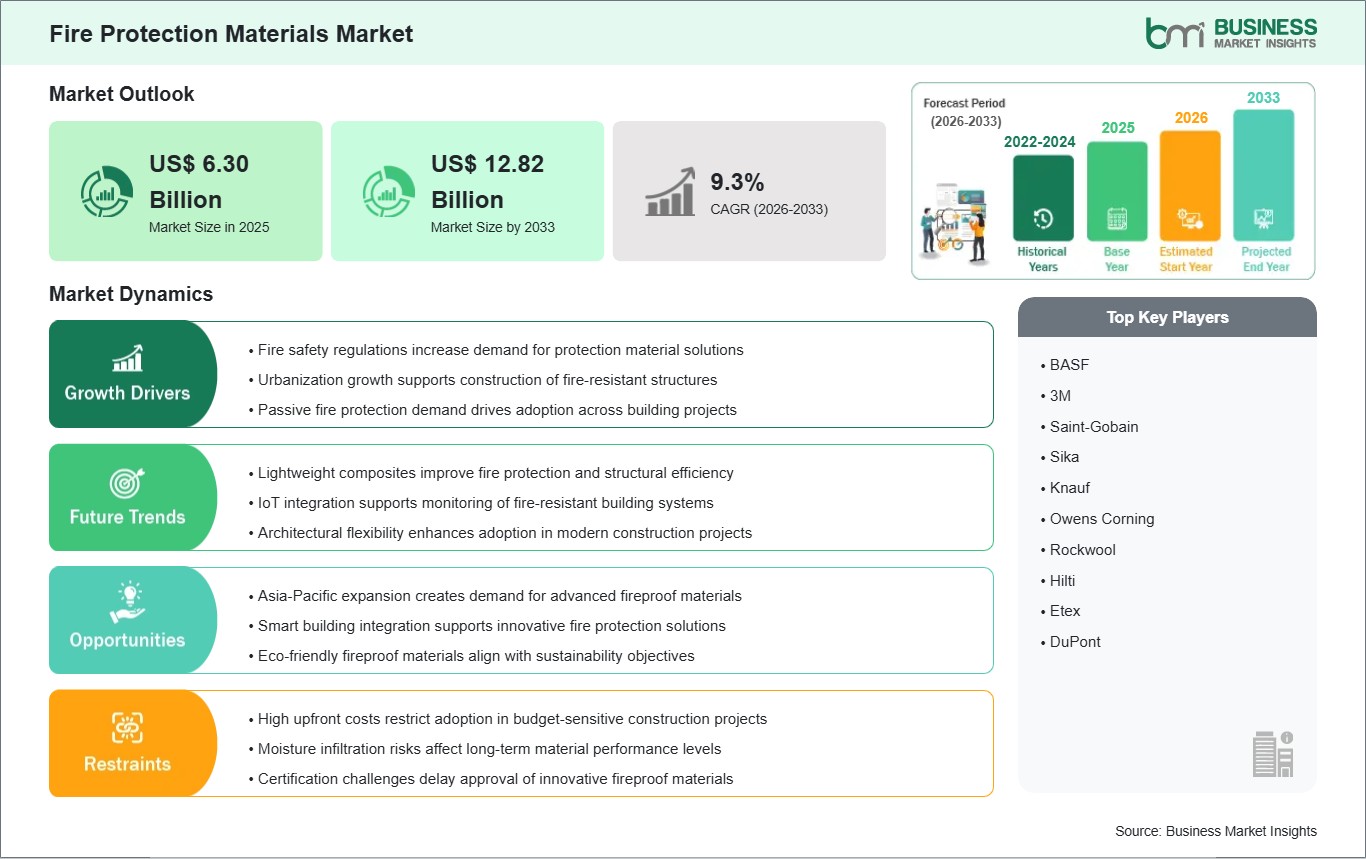
Fire protection materials comprise specialized products engineered to limit fire spread, maintain structural stability, and enhance occupant safety during fire incidents. This includes sealants, paints, panels, spray, and sheeting utilized in residential, commercial, industrial, and infrastructure construction. The use of these products helps in meeting fire safety standards while adding to building resilience. With the changing construction codes, there is an increasing need for integrating passive fire protection products in buildings.
Building works and urban development keep affecting the demand for fireproofing materials in a variety of sectors. There has been increasing attention being paid to technologies that enhance fire protection and make the structure more durable at high temperatures. Standards of buildings' performance have increased the relevance of fire-proofed materials too. Modernization programs in areas like infrastructure, industries, and large scale business establishments are also driving growth in this sector.
Demand exists for various materials depending on the application areas and the fire protection demands that exist therein. Sealers and coatings are extensively used for compartmentation and structural protection purposes, while boards, spray applications, and sheets cater to certain installation requirements. Fire protection applications include but are not limited to structural protection, insulation, firestopping, flooring, and roofing. The end-user demand comes from commercial establishments, residential construction projects, industrial applications, and infrastructural activities.
The evolution of technology is bringing changes in the realm of product development in terms of better formulations, increased durability, and increased functionalities. There is a trend among players to launch products which offer not only fire-resistant but other functions as well, such as thermal management and eco-friendly solutions. The competitive activity continues to revolve around innovations, certifications, production efficiency, and diversification of product offerings.
Segment Analysis
Fire Protection Materials Market Segmentation
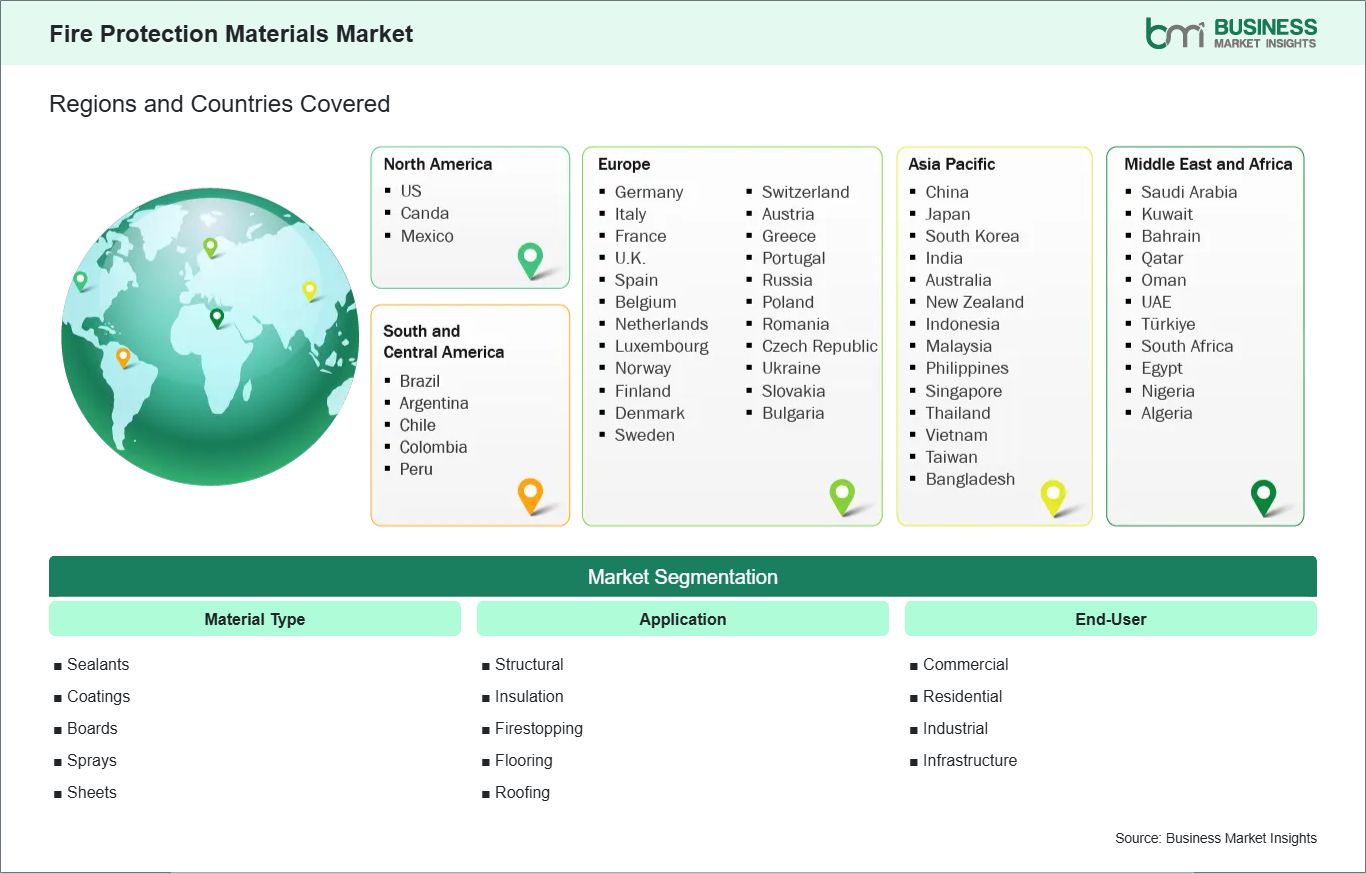
The fire protection materials market is segmented based on material type, application, and end-user, reflecting the increasing focus on fire safety compliance, structural resilience, and passive fire protection requirements across construction and industrial environments.
By Material Type
- Sealants - Prevent fire and smoke passage through joints, gaps, and penetrations.
- Coatings - Protect structural elements by delaying heat transfer during fire exposure.
- Boards - Create fire-resistant barriers for walls, ceilings, and partitions.
- Sprays - Provide uniform fire protection across complex structural surfaces.
- Sheets - Offer flexible fire-resistant layers for specialized construction applications.
By Application
- Structural - Preserves load-bearing capacity under elevated temperature conditions.
- Insulation - Combines thermal efficiency with enhanced fire resistance properties.
- Firestopping - Restricts flame and smoke movement between building compartments.
- Flooring - Improves fire endurance within occupied interior environments.
- Roofing - Enhances protection against fire exposure from multiple sources..
By End-User
- Commercial - Supports compliance and occupant safety in business facilities.
- Residential - Strengthens fire protection measures across housing developments.
- Industrial - Protects critical assets operating in high-risk environments.
- Infrastructure - Enhances safety performance in public and transportation projects.
Market Forces
Fire Protection Materials Market Drivers and Opportunities
Urbanization Driving Construction
Urban expansion continues to reshape construction priorities, creating sustained demand for materials that support building safety and compliance. Large residential developments, business centers, transportation infrastructure projects, and mixed-use projects will necessitate a fire protection strategy that must be considered during planning and construction phases. With increased buildings per area, there is more attention to be paid to passive fire protection systems that can increase safety.
This, in turn, makes the need for fire-resistant materials even more relevant in a variety of projects. Regulations, changes in building codes, as well as increased consciousness concerning the safety of structures, have led to an increase in the usage of certified fire protection materials in various applications. This makes it easier to utilize different types of fire protection materials.
Integration with Smart Building Technology
The emergence of intelligent building ecosystems is influencing the development of advanced fire protection strategies. Modern buildings incorporate passive protection measures in tandem with digital surveillance, predictive maintenance, and networked safety infrastructure. Material producers have adjusted their range of products to conform to construction settings that utilize technology and are more concerned with proving effectiveness and longevity.
There will be opportunities in the future within smart cities, intelligent infrastructure, and technologically advanced buildings. With building managers wanting a more holistic approach towards risk management, fire protection products can be used not only as a way of achieving safety but also in conjunction with monitoring and automation systems.
Size and Share Analysis
Fire Protection Materials Market Size and Share Analysis
The fire protection materials market size is expected to reach US$ 12.82 billion by 2033 from US$ 6.30 billion by 2025. The market is estimated to record a CAGR of 9.3% during 2026 to 2033. Market expansion is supported by increasingly stringent fire safety regulations, rising construction activities, and greater emphasis on protecting buildings and infrastructure from fire-related risks. The growing integration of passive fire protection systems within modern construction projects continues to strengthen the utilization of advanced fire protection materials across multiple end-use sectors.
By Material Type, coatings account for a dominant share due to their ability to provide effective thermal insulation and structural fire resistance. Sealants maintain significant adoption as they prevent the spread of fire and smoke through building penetrations and joints. Boards and sprays remain widely deployed across passive fire protection systems, while sheets continue to gain traction in applications requiring flexible and adaptable fire-resistant solutions.
By Application, structural applications hold a major share as preserving the integrity of load-bearing components remains a critical fire safety requirement. Firestopping represents a substantial segment owing to its role in compartmentalization and containment. Insulation applications continue to expand where thermal efficiency and fire protection objectives overlap, while flooring and roofing applications support comprehensive building safety strategies.
By End-User, commercial buildings dominate the market due to stringent compliance requirements and extensive implementation of fire safety systems. Industrial facilities maintain strong demand driven by asset protection and operational safety considerations. Residential construction continues to incorporate advanced fire protection materials as awareness of building safety increases, while infrastructure projects contribute to market expansion through investments in transportation, utility, and public-use developments.
Report Coverage
Fire Protection Materials Market Report Coverage and Deliverables
The "Fire Protection Materials Market Size and Forecast (2022 - 2033)" report provides a detailed analysis of the market covering below areas:
- Market size and forecast at global, regional, and country levels for all key market segments covered under the scope
- Market trends, along with market dynamics such as drivers, restraints, and key opportunities
- Market analysis covering key trends, global and regional frameworks, major players, regulations, and recent developments
- Industry landscape and competitive analysis covering market concentration, heat map analysis, prominent players, and recent developments
- Detailed company profiles, including SWOT analysis
Geographic Insights
Fire Protection Materials Market Geographic Insights
The fire protection materials market shows diverse regional adoption patterns influenced by construction activity, regulatory frameworks, infrastructure modernization programs, and evolving safety requirements. Across global markets, stakeholders are placing stronger emphasis on passive fire protection measures that support building resilience and long-term compliance. Material selection increasingly reflects project complexity, lifecycle considerations, and the need for enhanced protection standards.
North America maintains a mature market environment supported by established building regulations and widespread implementation of fire safety standards. Commercial developments, industrial facilities, and renovation projects continue incorporating advanced fire protection materials to improve structural performance and meet evolving compliance requirements. Demand also benefits from ongoing upgrades within public infrastructure and institutional facilities.
There is evident market potential for Asia Pacific based on its strong urbanization processes and large infrastructure development. Increased activities in residential building, industries, and transport projects can lead to further applications of fire-retardant products. Both manufacturers and project planners aim at developing products that combine safety, effectiveness, and ease of application.
Europe maintains strong adoption patterns supported by stringent safety regulations and sustainability-focused building practices. Fire-resistant materials are increasingly incorporated into energy-efficient construction projects and refurbishment initiatives. Emerging markets across the Middle East, Africa, and South and Central America are also strengthening fire safety practices as urbanization progresses and infrastructure investments accelerate. These regions present opportunities for expanded deployment of advanced materials tailored to local construction requirements and regulatory developments.
Industry Activity
Recent Developments
The fire protection materials market is evaluated by gathering qualitative and quantitative data post primary and secondary research, which includes important corporate publications, association data, and databases. Recent developments and news in the market include:
- In May 2025, Huntsman Corporation announced the launch of its POLYRESYST® EV5005 intumescent polyurethane coating system for electric vehicles, designed to provide passive fire protection for battery cells and structural components while maintaining design flexibility.
- In June 2025, CharCoat Passive Fire Protection Inc. announced the global launch of CharCoat 1709, an advanced intumescent epoxy fireproof coating for structural steel in hydrocarbon fire environments, offering up to 300 minutes of fire protection and targeting the oil & gas and industrial sectors.
Trust & Transparency
Research Methodology
The market analysis combines proprietary research with secondary data from government agencies, company disclosures, regulatory filings, industry databases and expert interviews. Market estimates are validated through data triangulation, cross-market benchmarking and analyst
review.
View Full Research Methodology
Key Sources Referred:
National Fire Protection Association (NFPA)International Code Council (ICC)ASTM InternationalInternational Organization for StandardizationEuropean Committee for StandardizationUnderwriters LaboratoriesFire Protection AssociationNational Institute of Standards and Technology