
Optical Transceiver Market Outlook: Size, Share, Trends, Growth Analysis, Competitive Landscape & Forecast, 2026-2033

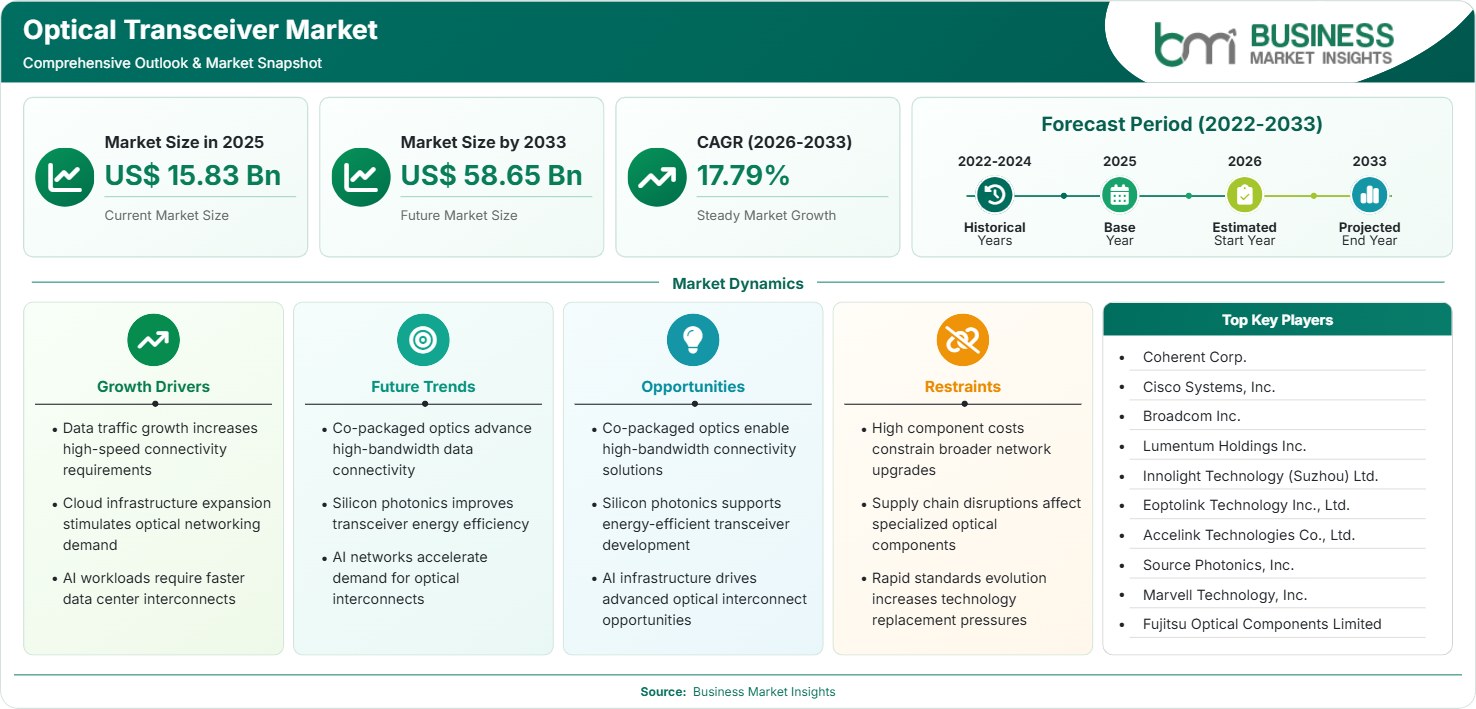
The Optical Transceiver Market size was valued at US$ 15.83 Billion in 2025 and is projected to reach US$ 58.65 Billion by 2033, growing at a CAGR of 17.79% during 2026–2033, driven by AI data-center expansion, higher Ethernet speeds, optical circuit switching, and demand for power-efficient long-reach connectivity.

Report Coverage
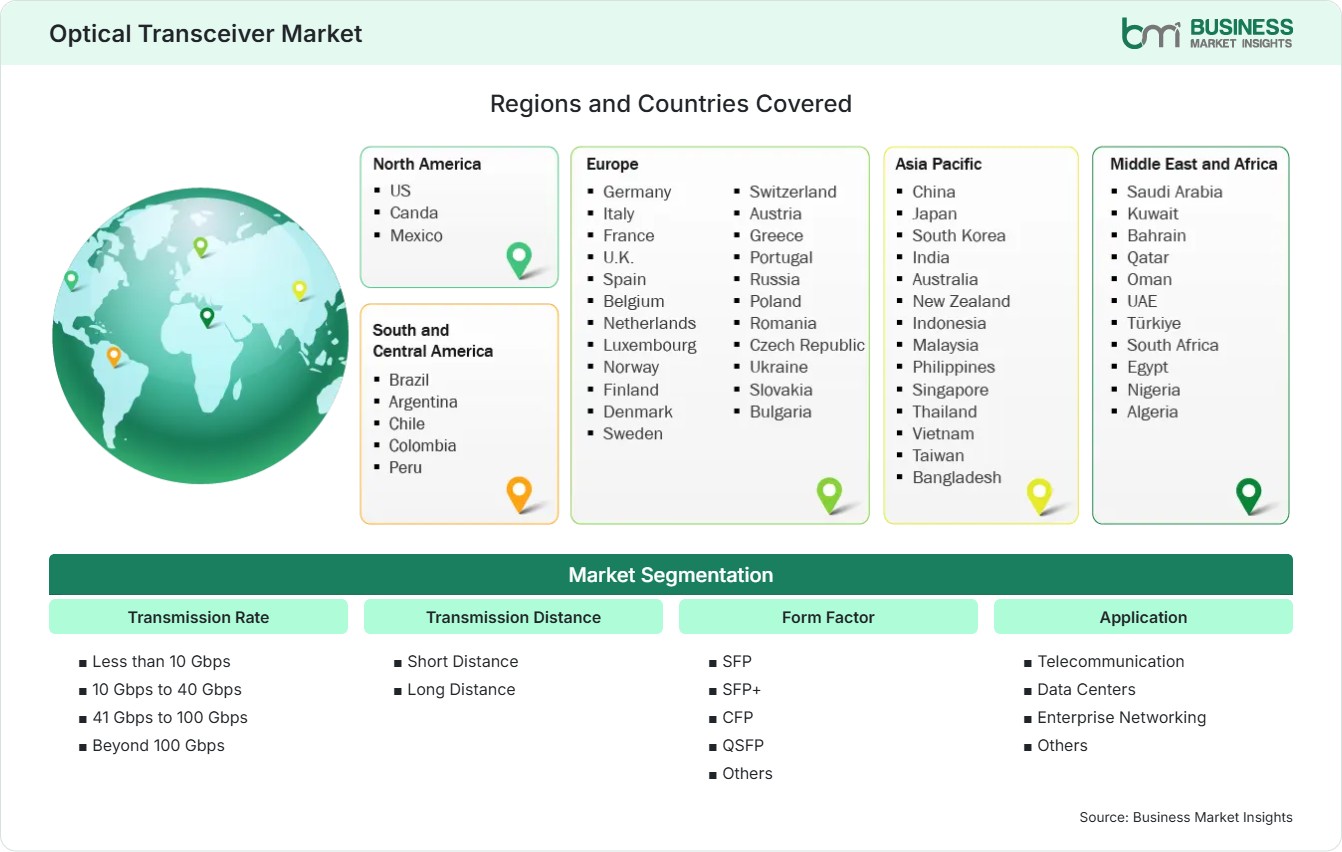
  • Transmission Rate: Less than 10 Gbps, 10 Gbps to 40 Gbps, 41 Gbps to 100 Gbps, Beyond 100 Gbps
  • Transmission Distance: Short Distance, Long Distance
  • Form Factor: SFP, SFP+, CFP, QSFP, Others
  • Application: Telecommunication, Data Centers, Enterprise Networking, Others
US$ 15.83 Bn Market size in 2025
US$ 58.65 Bn Market Size by 2033
17.79% CAGR, 2026 - 2033
2026-2033 Forecast Period

AI Overview

Optical Transceiver Market Summary

  • North America Region: holds a market share of 34%–38% in 2025, growing at a CAGR of 16%–18%, supported by hyperscale data centers, AI clusters, cloud investment, advanced Ethernet adoption, and coherent interconnect upgrades.
  • Fastest Growing Region: Asia Pacific holds a market share of 27%–31% in 2025, growing at a CAGR of 20%–23%, supported by hyperscale construction, 5G networks, manufacturing capacity, cloud adoption, and accelerating AI infrastructure investment.
  • Leading Segment: Beyond 100 Gbps holds a 43%–47% Optical Transceiver Market share in 2025, expanding at a CAGR of 21%–24%, supported by AI workloads, 800G deployments, 1.6T development, high-density switching, and bandwidth-intensive data-center architectures.
  • High Growth Segment: Data Centers hold a 42%–46% share in 2025, expanding at a CAGR of 21%–24%, driven by accelerated AI computing, hyperscale expansion, server interconnect upgrades, optical circuit switching, and escalating bandwidth requirements.
  • Key Market Opportunity: AI-driven networking creates opportunities for 800G and 1.6T modules, silicon photonics, co-packaged optics, coherent pluggables, lower-power DSPs, and vertically integrated optical supply chains.
  • Major Market Players: Coherent Corp., Cisco Systems, Inc., Broadcom Inc., Lumentum Holdings Inc., Innolight Technology (Suzhou) Ltd., Eoptolink Technology Inc., Ltd., Accelink Technologies Co., Ltd., Source Photonics, Inc., Marvell Technology, Inc., and Fujitsu Optical Components Limited.
Strategic Insights

Optical Transceiver Market: Strategic Insights

Optical Transceiver Market Strategic Framework
FREE PDF
Request your free sample
Request free sample
Stakeholder View

Key Takeaways

  • The value chain is becoming more vertically integrated as vendors combine optical sources, photonic components, DSPs, packaging, firmware, and testing capabilities. This integration improves qualification control and reduces exposure to component shortages.
  • The strongest upside is concentrated in high-speed datacenter applications, particularly 800G and emerging 1.6T connections. AI accelerator clusters require increasingly dense optical connectivity between compute, switching, and storage layers.
  • Product development is moving toward 200G electrical and optical lanes, silicon photonics, advanced EMLs, high-performance VCSELs, lower-power DSPs, and optical circuit switching. These technologies address bandwidth, thermal, and footprint constraints simultaneously.
  • Asia Pacific presents an attractive investment case because hyperscale construction, telecom modernization, electronics manufacturing, and domestic cloud platforms are expanding simultaneously. China, Japan, South Korea, Taiwan, and Singapore remain strategically important ecosystems.
  • Investment priorities are shifting toward manufacturing capacity, photonic integration, optical packaging, and high-speed transceiver design. Acquisitions and partnerships increasingly target complementary optical components and module capabilities rather than standalone commodity products.
Geographic Outlook

Optical Transceiver Market Regional Highlights

North America Optical Transceiver Market

North America held approximately 34%–38% of the optical transceiver market share in 2025 and is projected to expand at a 16%–18% CAGR through 2033. AI infrastructure, hyperscale data centers, cloud migration, and accelerated Ethernet upgrades support demand. The region benefits from established optical vendors, advanced semiconductor capabilities, and large-scale technology procurement. The US accounts for most regional demand because hyperscalers are deploying high-density AI clusters requiring 800G and emerging 1.6T connections across compute and switching environments.

  • Hyperscale operators are increasing optical port density as AI clusters connect larger accelerator pools, making 800G modules increasingly important for switch-to-server and switch-to-switch architectures.
  • US cloud infrastructure investment supports sustained demand for high-speed pluggables, while data-center operators increasingly evaluate power-per-bit metrics alongside bandwidth and equipment footprint.
  • Canada contributes through cloud, telecom, and data-center modernization, although its addressable volume remains smaller than the US because of a less concentrated hyperscale ecosystem.
  • Optical vendors benefit from proximity to major network equipment companies, hyperscalers, and semiconductor designers, shortening qualification cycles for new generations of high-speed modules.

US Optical Transceiver Market

The US accounted for around 28%–32% of worldwide demand and 76%–82% of North American demand in 2025, forecast to grow at a CAGR of 16%–18% through 2033. AI-enabled data center builds drive demand. Big cloud companies are ramping up their optical builds as accelerator cluster deployments boost bandwidth demands. Domestic semiconductor development, networking advancements, and investments in resilient digital infrastructure boost the competitiveness of US technology and optical components players.

  • Hyperscale AI campuses require massive quantities of short-reach and medium-reach modules, creating strong demand for 800G, 1.6T, and next-generation multimode optical solutions.
  • US networking companies are advancing optical circuit switching, coherent pluggables, and silicon photonics to improve scalability while controlling energy consumption and network complexity.
  • Federal and private investment in digital infrastructure reinforces demand for higher-capacity telecom and enterprise networking equipment, supporting long-term optical component procurement.

Europe Optical Transceiver Market

Europe accounted for about 20%-24% of the Optical Transceiver Market share in 2025 and is projected to grow at a CAGR of 14%-17% until 2033. Germany, the UK, France, and the Netherlands remain leading markets in Europe due to networking requirements, cloud computing, telecommunications upgrades, and the presence of many data centers. The Netherlands and Ireland have strong demand for data centers, and Germany is a leader in the industrial use of Optical Transceivers. Energy efficiency is another important factor in European market growth.

  • Germany remains a leading market because industrial automation, enterprise networking, and telecommunications operators are upgrading infrastructure to accommodate increasingly data-intensive applications.
  • The United Kingdom and Netherlands benefit from major interconnection hubs, cloud infrastructure, and data-center ecosystems requiring high-capacity optical links.
  • France is strengthening digital infrastructure investment, supporting demand for high-speed optical modules across telecom, enterprise, and cloud applications.
  • European data-center operators increasingly prioritize power efficiency, making low-power DSPs, efficient optical engines, and higher-capacity modules strategically valuable.

Asia Pacific Optical Transceiver Market

Asia Pacific segment holds a share of around 27% to 31% in 2025 and is expected to grow at a 20% to 23% CAGR from 2023 to 2033. Countries such as China, Japan, South Korea, Taiwan, Singapore, and India are the major bases for consumption and manufacturing in the region. Fast-paced developments in cloud technology, 5G, artificial intelligence, electronics, and the data center industry serve as an opportunity pool for the market.

  • China combines extensive telecom infrastructure with large domestic cloud and data-center investments, supporting strong consumption of high-speed optical modules and locally manufactured components.
  • Japan and South Korea are important for advanced photonics, semiconductor integration, telecom equipment, and enterprise networking, creating demand for technically differentiated transceiver products.
  • Taiwan benefits from semiconductor and electronics manufacturing capabilities, while Singapore serves as a strategic data-center and regional connectivity hub.
  • India represents a high-growth opportunity as cloud adoption, hyperscale facilities, digital services, and telecom modernization increase optical connectivity requirements.

Rest of World Optical Transceiver Market

South and Central America represented approximately 6%–9% of the Optical Transceiver Market share in 2025 and are projected to expand at a 15%–18% CAGR. Brazil leads regional demand through telecom, cloud, and enterprise investment. Mexico benefits from nearshoring and data-center development. Middle Eastern markets are also expanding through digital transformation, cloud deployment, and AI initiatives, while the UAE and Saudi Arabia lead high-capacity infrastructure investment across the region.

  • Brazil remains the principal South American opportunity because telecom modernization and expanding cloud infrastructure require greater backbone and data-center capacity.
  • Mexico benefits from nearshoring, hyperscale data-center investment, and growing enterprise digitization, increasing requirements for high-speed optical connectivity.
  • The UAE is accelerating digital infrastructure development, supporting advanced optical networking across cloud, telecom, government, and AI-focused applications.
  • Saudi Arabia is investing heavily in digital infrastructure and data-center capacity, creating opportunities for high-speed optical modules and regional network expansion.
Global Market Geography
FREE PDF
Request your free sample
Request free sample
Segment Analysis

Optical Transceiver Market Segmentation

Transmission Rate

The transmission rate is emerging as the primary differentiating factor among products as networks move away from legacy interfaces toward 400G, 800G, and 1.6T infrastructure. The Beyond 100 Gbps segment, which accounted for around 43% - 47% of the optical transceiver market in 2025, is anticipated to grow at a CAGR of 21% - 24% through 2033, supported by AI networking, hyperscale deployments, and high-density switching.

  • Less than 10 Gbps: Legacy telecom, enterprise, industrial, and access applications sustain demand where bandwidth requirements remain moderate. Replacement cycles and installed-base compatibility continue supporting this category.
  • 10 Gbps to 40 Gbps: Enterprise networks, access systems, and telecom applications use this range for established connectivity requirements. Demand remains linked to modernization and replacement of older optical interfaces.
  • 41 Gbps to 100 Gbps: This range remains important across telecom, enterprise, and data-center environments. Migration toward higher speeds is gradually limiting incremental demand while replacement and interoperability sustain adoption.
  • Beyond 100 Gbps: AI clusters, hyperscale data centers, and high-capacity networks are accelerating adoption. 800G and 1.6T platforms increasingly address bandwidth density, power efficiency, and network scalability requirements.

Transmission Distance

Transmission distance remains key in the choice of optical architecture, since it dictates the type of laser, modulation, required DSPs, and thermal properties. The Short Distance segment held around 58%–62% market share in 2025 and is expected to grow at a CAGR of 18%–21% from 2026 to 2033. Long-distance demand remains critical for telecom and data-center interconnect applications.

  • Short Distance: Data-center interconnects, server links, and switch connections dominate adoption. VCSELs, multimode optics, PAM4, and compact pluggable modules support cost-sensitive high-density deployments.
  • Long Distance: Telecom backbones, metro networks, regional interconnects, and data-center interconnects require coherent technologies. Higher-capacity coherent pluggables increasingly reduce dependence on dedicated transport equipment.

Form Factor

Form factor influences switch compatibility, thermal considerations, power density, and installation flexibility. QSFP accounted for about 36%–40% in 2025 and will continue to grow at an 18%–21% CAGR through 2033. Higher-density form factors will be increasingly used in 800G and future 1.6T applications.

  • SFP: Compact SFP modules remain widely deployed across enterprise, access, telecom, and industrial networking. Their established ecosystem and broad interoperability sustain replacement and incremental demand.
  • SFP+: SFP+ remains relevant for mature 10G networking applications. Enterprise upgrades and installed-base replacement provide recurring demand despite migration toward faster interfaces.
  • CFP: CFP supports selected telecom and coherent applications requiring greater optical capability. Adoption is increasingly concentrated in specialized deployments and infrastructure requiring compatibility with established systems.
  • QSFP: QSFP variants provide strong density and interoperability for data-center networking. QSFP-DD architectures increasingly support 400G and 800G deployments where rack-level bandwidth density is critical.

Application

Application demand is shifting toward data centers due to increased optical connectivity needs for AI workloads across the compute and switching layers. The share of Data Centers was around 42%-46% in 2025, while the growth rate is expected to be around 21%-24% CAGR until 2033. This shift defines major Optical Transceiver Market trends and raises requirements for low-power, high-density modules.

  • Telecommunication: Telecom operators deploy optical modules across access, metro, backbone, and interconnect networks. Coherent pluggables support capacity upgrades while reducing equipment complexity and improving network flexibility.
  • Data Centers: Hyperscale and AI data centers require rapidly increasing optical bandwidth between servers, switches, and clusters. 800G, 1.6T, silicon photonics, and optical circuit switching are major growth technologies.
  • Enterprise Networking: Enterprises use optical modules for campus backbones, storage, data-center networks, and high-performance computing. Modernization supports demand for interoperable modules across multiple switch platforms.
Market Forces

Optical Transceiver Market Dynamics

Key Market Drivers

AI Infrastructure Is Accelerating High-Speed Optical Connectivity

AI training and inference clusters require high-bandwidth connections between accelerators, switches, storage systems, and distributed computing resources. This architecture increases optical port density because electrical interconnects become increasingly constrained by reach, signal integrity, and power consumption. The Optical Transceiver Market growth is therefore moving toward 800G and 1.6T products capable of carrying substantially more data per physical connection. At OFC 2025, industry showcases featured 1.6T modules, 200G-per-lane solutions, advanced DSP chips, VCSEL lasers, and silicon photonics. The product cycle is getting even shorter due to the qualification of one generation after another by hyperscalers as they grow their AI clusters. Companies that can blend fast optics, heat management, and scalability will have an edge in capturing future orders for AI networks.

200G-per-Lane Technology Is Reshaping Module Architectures

The move from 100G-per-lane to 200G-per-lane signaling is impacting the designs of the optical engine, DSP, lasers, and the overall package. Increased lane rates enable equipment makers to achieve greater aggregate bandwidth without proportionately increasing module size. Coherent, VCSEL, EML, and silicon photonics solutions compete across various reach and price points. This technological change is shaping Optical Transceiver Market trends because customers now judge products based on parameters such as power-per-bit, thermal density, insertion loss, and manufacturability, in addition to bandwidth alone. New-generation DSPs using smaller process nodes enable electricity savings and more advanced signal processing.

Cloud and Telecom Capacity Upgrades Are Expanding Optical Demand

Cloud computing, 5G traffic, enterprise digitization, and content delivery continue increasing bandwidth requirements across metro and long-haul networks. By utilizing coherent pluggables with higher capacities, operators can enhance their optical infrastructure without requiring separate transport equipment for each additional capacity requirement. This is a better approach because it enables the modules to be incorporated into routers and switches for IP-over-DWDM deployments. There is an additional dimension introduced by the growth of AI services, as traffic between data centers and cloud regions will increase. This means that suppliers with diverse product portfolios covering both short-reach datacom and coherent long-reach can tap into several spending cycles.

Key Market Opportunities

800G and 1.6T Pluggables Create a New Upgrade Cycle

Migration to 800G and 1.6T presents a great opportunity for upgrades and expansion in hyperscale data centers and DCI links. Coherent introduced an 800G ZR/ZR+ QSFP-DD transceiver module in March 2025 that provides over 500 km in ZR mode and over 1000 km in ZR+ mode. Coherent also showcased silicon-photonics-based 1.6T modules with a 3nm DSP at OFC 2025. Optical Transceiver Market Forecasts will consequently rely more on the commercial availability of higher-speed transceivers than on proof of concept in the lab alone. Companies that succeed in manufacturing, interoperability, and power consumption of modules can lock in hyperscaler qualifications for years to come.

Silicon Photonics and Integrated Optical Engines Expand Addressable Demand

Silicon photonics provides an opportunity to integrate optical functions more densely while supporting high-speed connectivity and potentially improving manufacturing scalability. The technology is increasingly paired with advanced DSPs, laser sources, photonic integrated circuits, and compact packages. A coherent module showed a 1.6T DR8 module utilizing silicon photonic technology and 3nm DSP technology at the OFC 2025 conference, with reduced power as the goal in AI-based networking. The same trend is evident in optical engines and the integration of semiconductor technology, and there is potential to extend the field even further towards optical circuit switching, where pluggable transceivers could enhance network agility.

Regional Manufacturing and Supply-Chain Diversification Offer Investment Potential

Optical components manufacturing has become strategically significant, with growing demand highlighting capacity limitations in lasers, DSPs, photonic components, packaging, and testing. Asia Pacific has existing electronics and semiconductor manufacturing infrastructure, while North America and Europe have strong technology innovation and customer qualification capabilities. This gives investment potential not only for completed modules but also for InP and GaAs components, silicon photonics, advanced packaging, testing, and optical components. To increase their resilience, manufacturers should consider geographic diversification of production facilities and dual sourcing of materials. Scale becomes particularly significant considering that 800G and 1.6T volumes are growing, and yield, heat dissipation, and test time have a big effect on module costs.

Market Restraints and Challenges

Thermal Density and Power Consumption Limit High-Speed Scaling

Factor: Higher transmission speeds require more complex DSPs, optical engines, lasers, and signal-conditioning circuitry in smaller modules, leading to increased electricity consumption and heat generation. Impact: Data centers will have increased cooling needs and higher operational costs due to the rising speed of modules. Even though more advanced semiconductor technology nodes and optical architectures would help reduce power per bit, overall power consumption could still rise due to an increased number of ports. Thermal testing is required for high-speed modules due to the sensitivity of lasers to temperature changes. Thus, vendors have to optimize bandwidth, power consumption, heat dissipation, and size. This may delay the implementation of new module generations if they perform better but require major modifications to existing infrastructure.

Complex Supply Chains Increase Production and Qualification Risk

Factor: High-speed modules rely on special-purpose lasers, DSPs, photonic integrated circuits, passive components, substrates, advanced packaging, and precise testing, which are typically provided by geographically focused vendors. Impact: Component availability, yield issues, geopolitical sanctions, and component qualification could affect module manufacturing and product deployment for end customers. With the development of 800G and 1.6T, the risk would be higher because new designs would require the qualification of many components at once. Vertical photonics integration helps in mitigating certain risks, but no company can manufacture all the components used in the ecosystem. End customers concentrate on multisourcing, having standard interfaces, and working with component suppliers.

Company Analysis

Competitive Landscape

The Optical Transceiver Market analysis indicates a competitive structure shaped by vertically integrated photonics companies, networking equipment suppliers, merchant semiconductor vendors, and specialist module manufacturers. Competition is increasingly determined by 800G and 1.6T qualification, power efficiency, optical component access, manufacturing yield, and hyperscaler relationships.

Company Name

Overview

Products and Services relevant to this market

Coherent Corp.

Vertically integrated photonics company with extensive datacom and telecom optical capabilities.

400G, 800G, 1.6T transceivers, coherent optics, VCSELs, EMLs, silicon photonics, optical components.

Cisco Systems, Inc.

Networking equipment provider integrating optical connectivity into high-capacity routing and switching platforms.

Pluggable optics, coherent modules, data-center optics, routing and switching optical interfaces.

Broadcom Inc.

Semiconductor and connectivity technology company developing optical networking and co-packaged architectures.

Optical DSPs, PAM4 technologies, optical connectivity solutions, CPO technologies, networking semiconductors.

Lumentum Holdings Inc.

Photonics technology company supplying components and high-speed optical solutions for networking infrastructure.

Datacom transceivers, optical components, lasers, coherent technologies, high-speed networking optics.

Innolight Technology (Suzhou) Ltd.

Specialist optical module supplier focused strongly on high-speed data-center connectivity.

400G, 800G, 1.6T optical transceivers, high-speed datacom and telecom modules.

Eoptolink Technology Inc., Ltd.

Optical communication supplier serving data-center and telecom infrastructure markets.

400G, 800G, 1.6T transceivers, Ethernet optics, coherent and high-speed optical modules.

Accelink Technologies Co., Ltd.

Chinese optical communications manufacturer with broad component and module capabilities.

Datacom modules, telecom optics, coherent products, optical components and networking solutions.

Source Photonics, Inc.

Optical communications company supplying components and modules for data-center and telecom applications.

High-speed Ethernet transceivers, coherent optics, optical components and connectivity products.

Marvell Technology, Inc.

Semiconductor supplier developing DSP and optical connectivity technologies for AI networking.

Coherent DSPs, PAM4 technologies, optical interconnect platforms, data-center connectivity solutions.

Fujitsu Optical Components Limited

Japanese optical component specialist serving telecom and data-center networking applications.

CFP2-DCO coherent transceivers, optical components, high-capacity coherent and pluggable solutions.

Trust & Transparency

Research Methodology

The market analysis combines proprietary research with secondary data from government agencies, company disclosures, regulatory filings, industry databases and expert interviews. Market estimates are validated through data triangulation, cross-market benchmarking and analyst review.

View Full Research Methodology

Questions Answered

Frequently Asked Questions

Which applications offer the strongest future demand for optical modules?

Data centers provide the strongest growth opportunity because AI workloads, hyperscale expansion, high-density switching, distributed computing, and increasing bandwidth requirements are accelerating adoption of 800G and emerging 1.6T connectivity.

How will the Optical Transceiver Market report support technology planning?

The report evaluates transmission rate, distance, form factor, application, regional demand, competitive positioning, technology shifts, investment opportunities, and constraints to support product, sourcing, and capacity decisions.

What determines the selection of an optical transceiver?

Network speed, transmission distance, optical interface, switch compatibility, power consumption, thermal conditions, wavelength, modulation technology, form factor, interoperability, and total cost of ownership determine module selection.

Why are 800G transceivers becoming important for AI data centers?

AI clusters generate substantial east-west traffic between accelerators and switches. 800G modules increase bandwidth per optical port, helping operators scale network capacity without proportionally increasing port counts and cabling density.

What technologies are shaping the Optical Transceiver Market through 2033?

800G and 1.6T modules, 200G-per-lane signaling, silicon photonics, advanced EMLs, VCSELs, coherent pluggables, smaller-node DSPs, and optical circuit switching are shaping product development and deployment economics.

Access the Full Optical Transceiver Market Report

Get segment-level forecasts, regional estimates, competitive benchmarking, company profiles and downloadable Excel datasets.

Access the full Optical Transceiver Market Report
350 pages PDF & Excel | 2026-09-22
Similar Research

Related Market Reports