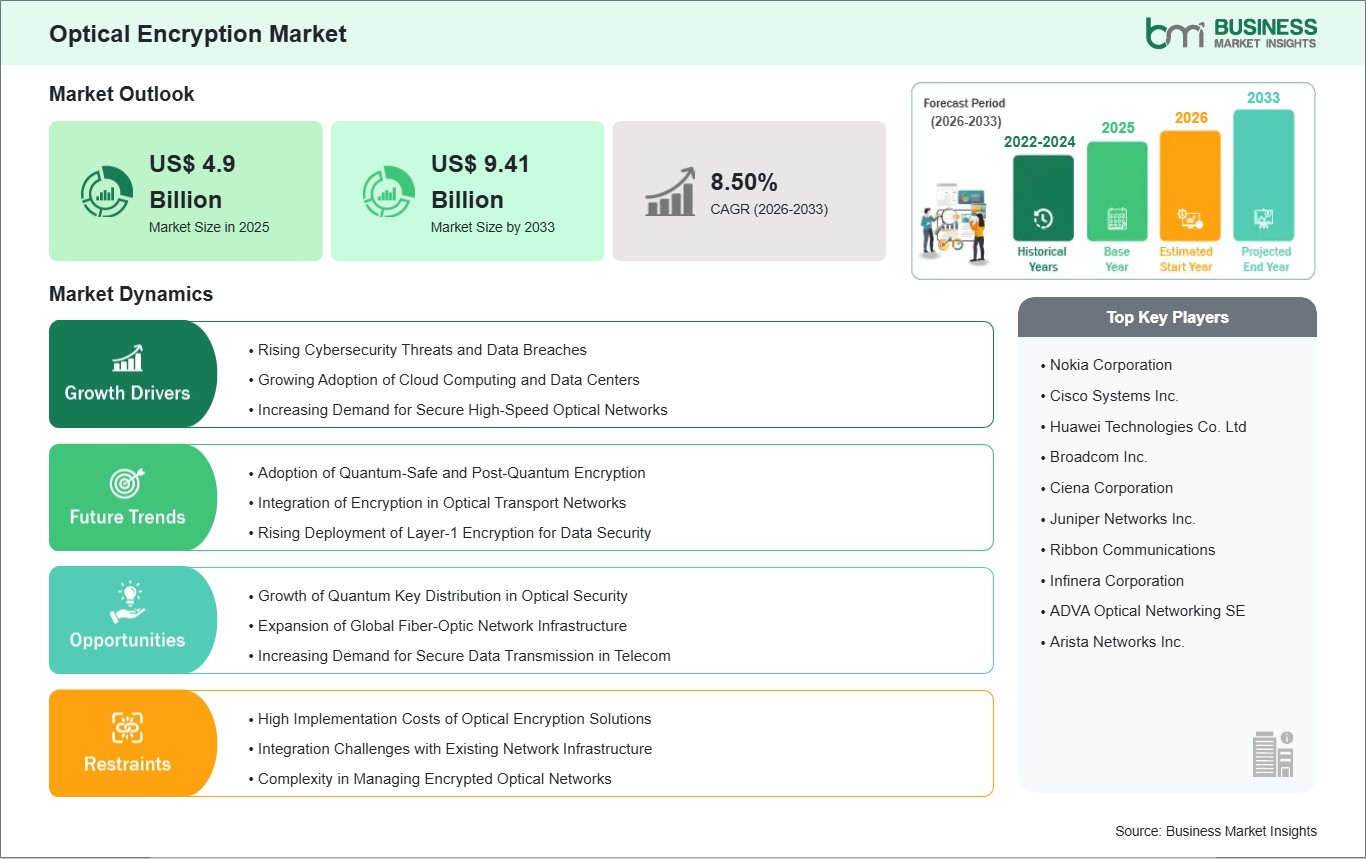
The Optical Encryption Market size is expected to reach US$ 9.41 Billion by 2033 from US$ 4.9 Billion in 2025. The market is estimated to record a CAGR of 8.50% from 2026 to 2033.
The optical encryption market is gaining importance as organizations focus on protecting sensitive information transmitted through high-speed communication networks. Optical encryption technologies secure data directly at the fiber optic transmission layer, which helps protect information before it reaches higher network layers. These solutions are widely used by telecommunications providers, financial institutions, government organizations, and cloud service operators that require secure and reliable data transmission. As global data traffic continues to expand due to digital transformation, cloud computing, and connected technologies, protecting optical communication infrastructure has become a key priority for many industries.
One of the major factors supporting market growth is the rising number of cybersecurity threats and data breaches affecting communication networks. Organizations are increasingly concerned about unauthorized access, data interception, and network attacks that can compromise critical information. Optical encryption provides strong protection by securing data as it travels through fiber networks. In addition, emerging technologies such as quantum key distribution are creating new opportunities for improving encryption strength and ensuring secure key exchange across optical networks. However, the market also faces certain restraints. Optical encryption solutions often require specialized infrastructure and integration with existing network equipment, which can increase deployment complexity. In addition, high implementation costs and limited technical expertise in some regions may slow adoption among smaller organizations.

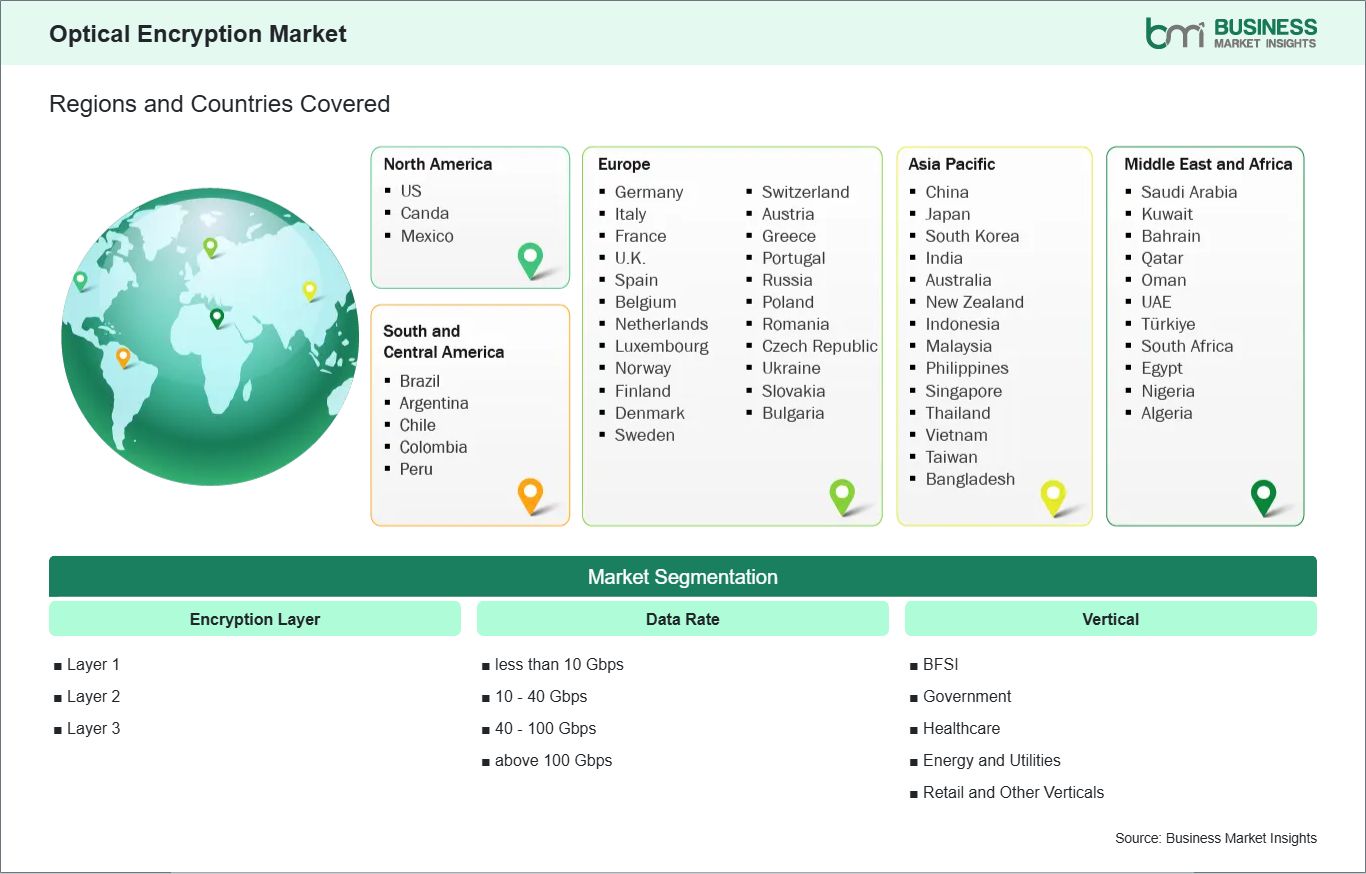
Key segments that contributed to the derivation of the optical encryption market analysis are encryption layer, data rate, vertical.
The increasing frequency of cybersecurity threats and data breaches is a key factor driving the optical encryption market. As global data traffic continues to rise, industries are transmitting large volumes of sensitive information through optical networks. These networks are vital for communication, cloud computing, banking, healthcare, and defense operations. However, with growing cyberattacks and data interception attempts, organizations are prioritizing the protection of information transmitted through fiber optic networks. Optical encryption technologies help safeguard this data by encrypting signals at the physical layer, making it extremely difficult for attackers to access or manipulate the transmitted information. Industries are recognizing that traditional encryption solutions, which protect data at higher network layers, may not provide sufficient security for modern high-capacity optical networks. Optical encryption offers faster data protection with minimal latency, ensuring secure communication without impacting performance.
As businesses expand cloud-based operations and rely more on high-speed data exchange, the demand for robust encryption across optical transport networks is increasing. This is especially true in sectors where data confidentiality and network integrity are critical, such as government, banking, and defense. Moreover, with the rise of remote operations, cloud services, and digital transformation initiatives, the need for end-to-end network protection is growing rapidly. Telecom operators and service providers are increasingly adopting optical encryption solutions to ensure secure data transmission and maintain customer trust. As cyber threats evolve in complexity, the implementation of optical encryption is becoming an essential component of modern network security strategies across industries worldwide.
The development and growth of quantum key distribution (QKD) pose a tremendous opportunity in the optical encryption market. Conventional encryption techniques are becoming increasingly vulnerable in the face of modern computer technologies, especially quantum computing. As a result, QKD is being recognized as a future-proof encryption technique. QKD is a method for secure key exchange between network users based on the principles of quantum mechanics. Any detection of a key during communication changes the state of the key itself. Hence, QKD is one of the safest forms of key exchange for secure communication in an optical network. Telecommunications organizations and research institutions are increasingly investing in QKD for the secure communication in optical networks. The technology is being researched for implementation in the financial sector, defense communications, and government networks, where data confidentiality is a prime concern.
The development and use of QKD for the generation of unbreakable encryption keys align perfectly with the need for future-proof network security. As the world moves towards a future-proof network infrastructure, QKD-based optical encryption solutions are being recognized as a highly viable solution. In addition, ongoing collaborations between technology providers, telecom companies, and research institutions are helping advance the deployment of QKD systems in real-world networks. Countries across North America, Europe, and Asia are launching pilot projects to integrate quantum-safe communication technologies into existing optical networks. As organizations prepare for the era of quantum computing, the demand for QKD-based optical encryption is expected to grow rapidly, creating strong opportunities for innovation and market expansion.

The global optical encryption market is experiencing steady growth, with market size and share analysis reflecting evolving treatment preferences and competitive dynamics among key players. The report evaluates important subsegments categorized within encryption layer, data rate, vertical, and end user, highlighting their respective contributions to overall market performance.
By encryption layer, the layer 1 subsegment dominated the market in 2025, due to its ability to provide line-rate encryption directly at the optical layer, ensuring minimal latency and high data security for high-capacity fiber networks used by telecom operators, government agencies, and data center operators.
Based on data rate, the 100 Gbps subsegment dominated the market in 2025, due to the rapid expansion of high-capacity fiber networks, hyperscale data centers, and long-haul communication infrastructure requiring secure high-speed data transmission.
By vertical, the government subsegment dominated the market in 2025, due to strong demand for highly secure communication networks used for defense, intelligence operations, and protection of classified information across national critical infrastructure.
| Report Attribute | Details |
|---|---|
| Market size in 2025 | US$ 4.9 Billion |
| Market Size by 2033 | US$ 9.41 Billion |
| Global CAGR (2026 - 2033) | 8.50% |
| Historical Data | 2022-2024 |
| Forecast period | 2026-2033 |
| Segments Covered | By Encryption Layer
|
|
Regions and Countries Covered
| |
| North America | US, Canada, Mexico |
| Europe | Belgium, Austria, Finland, Denmark, Greece, Poland, Romania, Russia, Ukraine, Czech Republic, Slovakia, Bulgaria, Italy, Luxembourg, Germany, Switzerland, France, Netherlands, Norway, Portugal, Spain, Sweden, United Kingdom |
| Asia-Pacific | Australia, China, India, Japan, South Korea, Indonesia, Malaysia, Philippines, Singapore, Thailand, Vietnam, Bangladesh, New Zealand, Taiwan |
| South and Central America | Brazil, Argentina, Peru, Chile, Colombia |
| Middle East and Africa | Bahrain, Kuwait, Oman, Qatar, Saudi Arabia, United Arab Emirates, Turkiye, South Africa, Egypt, Algeria, Nigeria |
| Market leaders and key company profiles |
|
The "Optical Encryption Market Size and Forecast (2022 - 2033)" report provides a detailed analysis of the market covering below areas:
The geographical scope of the optical encryption market report is divided into: North America, Asia Pacific, Europe, Middle East & Africa, and South & Central America. North America held the largest share in 2025.
North America dominates the optical encryption market due to its advanced communication infrastructure and strong focus on data security. The region has a highly developed telecommunications network and large data traffic volumes driven by cloud computing, digital services, and enterprise connectivity. Organizations across sectors such as finance, government, healthcare, and technology are prioritizing secure communication channels to protect sensitive information. The mounting appetite for network security solutions has impelled the deployment of optical encryption technologies in major network infrastructures worldwide. Operators of telecommunication and cloud services in the region are heavily investing in secure optical transport networks that will enable protection of very high capacity data transmissions. These organizations are outfitting fiber optic communication systems with state-of-the-art encryption technologies that will help their networks stay secure even over longer distances.
Moreover, companies that run large data centers and critical communication systems are relying on optical encryption to provide enhanced network security. The existence of leading technology vendors and robust investments in cybersecurity innovations today stand as big market drivers helping North America maintain its dominance in the industry. Organizations in the region are also actively exploring advanced security technologies, including quantum-based encryption methods, to prepare for future cybersecurity challenges. This combination of strong technological capabilities, security awareness, and continuous investment in network protection helps North America maintain its leading position in the global optical encryption market.

The optical encryption market is evaluated by gathering qualitative and quantitative data post primary and secondary research, which includes important corporate publications, association data, and databases. A few of the key developments in the Optical Encryption market are:
The Optical Encryption Market is valued at US$ 4.9 Billion in 2025, it is projected to reach US$ 9.41 Billion by 2033.
As per our report Optical Encryption Market, the market size is valued at US$ 4.9 Billion in 2025, projecting it to reach US$ 9.41 Billion by 2033. This translates to a CAGR of approximately 8.50% during the forecast period.
The Optical Encryption Market report typically cover these key segments-
The historic period, base year, and forecast period can vary slightly depending on the specific market research report. However, for the Optical Encryption Market report:
The Optical Encryption Market is populated by several key players, each contributing to its growth and innovation. Some of the major players include:
The Optical Encryption Market report is valuable for diverse stakeholders, including:
Essentially, anyone involved in or considering involvement in the Optical Encryption Market value chain can benefit from the information contained in a comprehensive market report.
Please tell us your area of interest
(Market Segments/ Regions and Countries/ Companies)