Market Summary
Executive Summary and Global Market Analysis
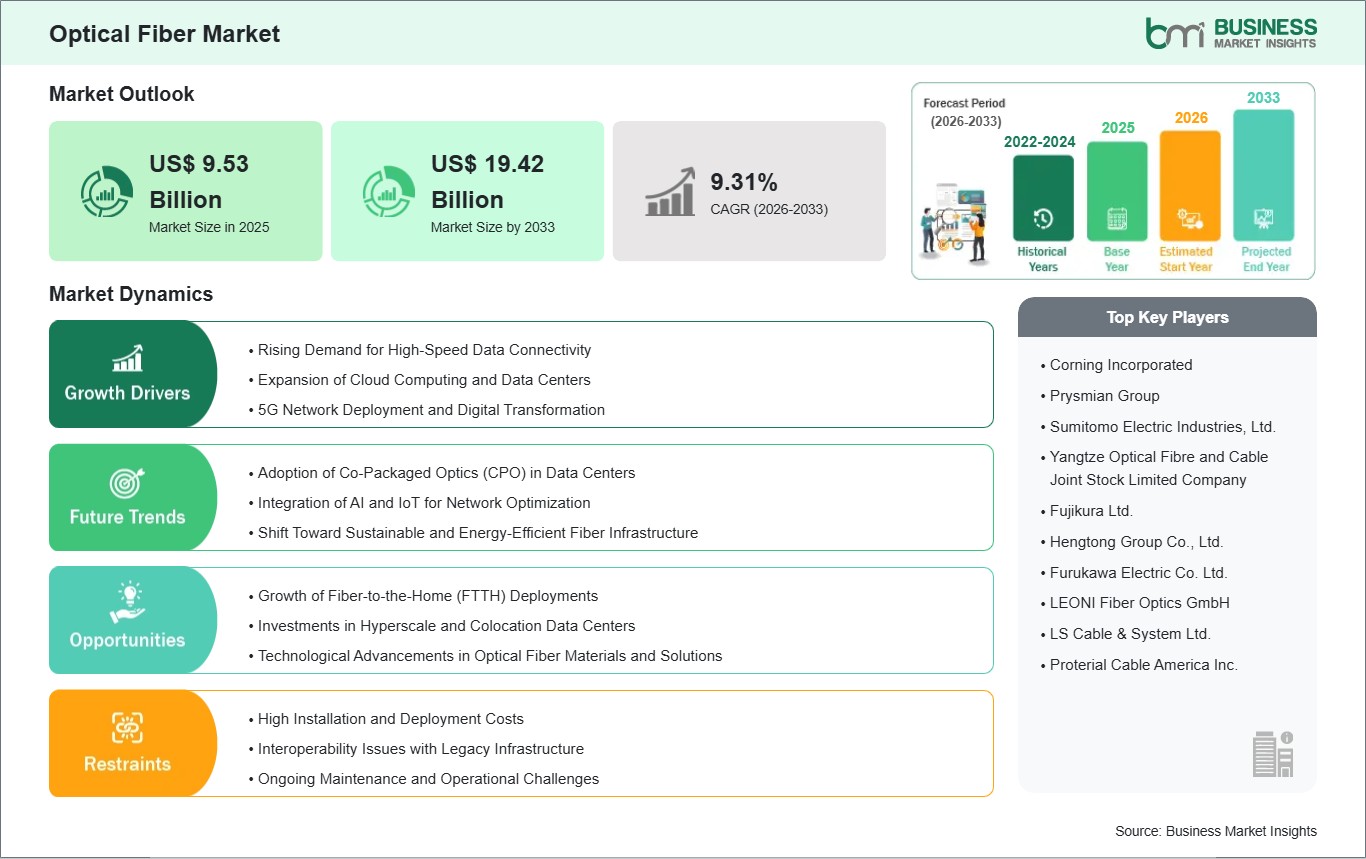
The optical fiber market is essential to supporting the modern digital infrastructure that it forms the backbone of, as it is the means through which fast, reliable, and secure data transmission is achieved over the networks. The application of optical fibers has been extended to telecommunications networks, data centers, enterprise networks, and cloud computing environments, on account of their high bandwidth capacity, low latency, and immunity to electromagnetic interference. In a world where hyperscale, colocation, and enterprise data centers are rapidly expanding, the use of optical fiber has become indispensable for the interconnection of servers, storage systems, and network equipment. The technology's ability to facilitate long, distance, high, volume data transfer is what makes it a non, negotiable requirement for the continuity of operations, scalability, and performance in the data, driven ecosystem of today.
The market expansion is largely a result of the increased demand for cloud computing, internet penetration, 5G network rollout, and the global data center proliferation. The growth of data traffic, to be driven primarily by AI workloads, video streaming, IoT, and enterprise digital transformation, will also be a major factor in the pace of the optical fiber adoption. Nevertheless, the sector has to contend with issues such as the hefty initial installation costs, complicated deployment procedures, interoperability problems with legacy infrastructure, and maintenance that is required continuously. Besides, limitations on the capital expenditures and regulatory requirements may also affect the schedules of deployment. Still, there are significant opportunities for growth as a result of a rising investment in hyperscale and colocation data centers, ongoing advancements fiber technology, and so on.
Segment Analysis
Optical Fiber Market Segmentation
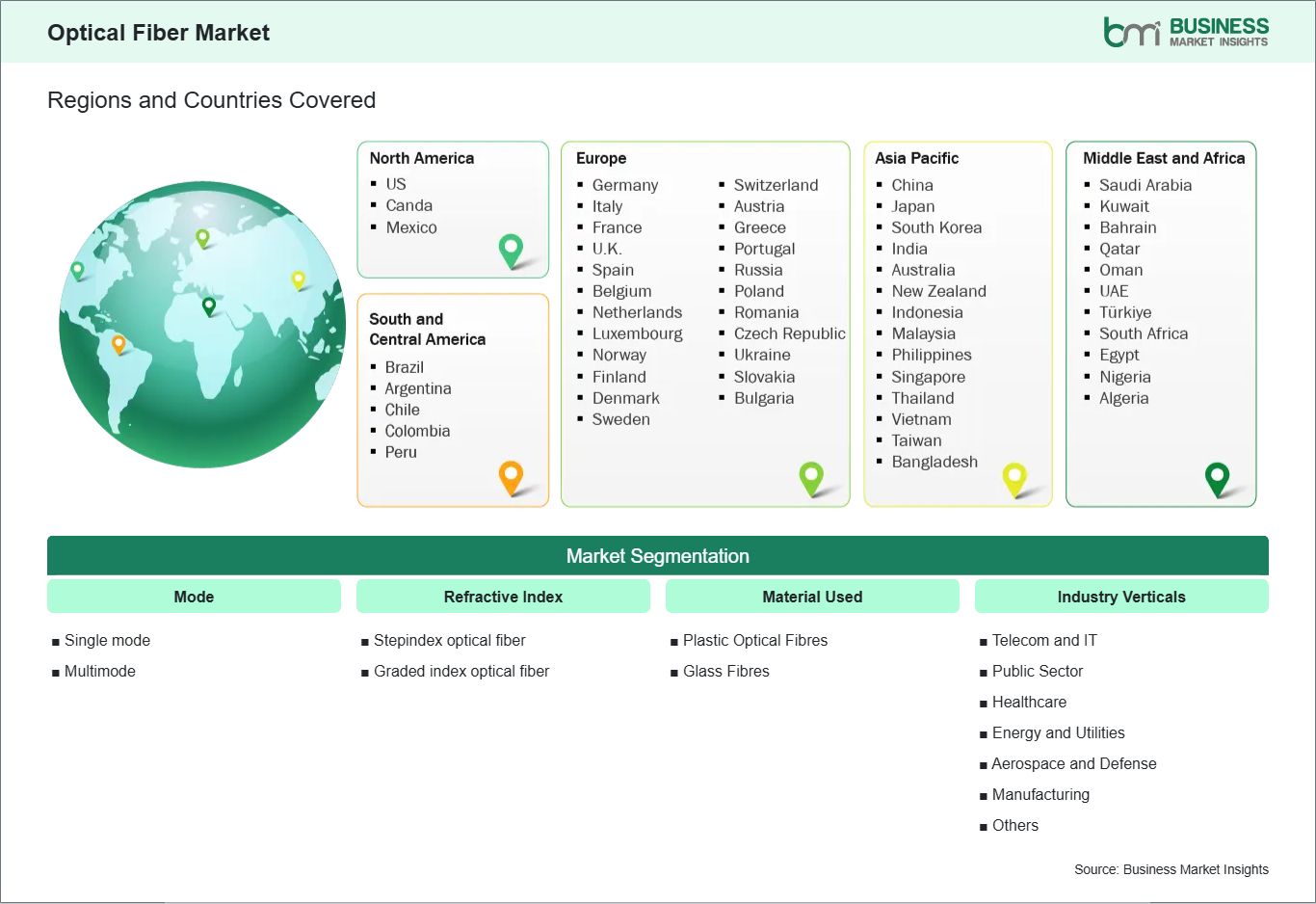
Key segments that contributed to the derivation of the optical fiber market analysis are mode, refractive index, material used, and industry verticals.
- By mode, the optical fiber market is segmented into single-mode and multi-mode. The single-mode segment dominated the market in 2024.
- By refractive index, the market is segmented into step-index optical fiber and graded-index optical fiber. The graded-index optical fiber segment held the largest share of the market in 2024.
- By material used, the optical fiber market is segmented into plastic optical fibres and glass fibres. The glass fibres segment accounted for the largest share of the market in 2024.
- By industry verticals, the market is segmented into telecom and IT, public sector, healthcare, energy and utilities, aerospace and defense, manufacturing, and others. The telecom and IT segment dominated the market in 2024.
Market Forces
Optical Fiber Market Drivers and Opportunities
Growing Demand for High-Speed Data Connectivity
The need for data connectivity that is fast and reliable is one of the major factors that has led to the growth of the optical fiber market. The exponential growth of the internet usage, cloud computing, video streaming, and data, intensive applications has led to a very big increase in global data traffic. To keep up with the demand for higher bandwidth, lower latency, and better transmission efficiency, telecom operators and enterprises are upgrading their network infrastructures, thus making a strong use of optical fiber instead of the traditional copper, based systems. The deployment of 5G networks and the development of data centers are two main factors that, in turn, are further accelerating the deployment of fiber as the use of optical fiber is a must for backhaul, fronthaul, and interconnection. Besides that, the ongoing digitalization in different sectors such as healthcare, manufacturing, and government is still a strong driver for the adoption of advanced fiber, optic networks.
Expansion of Data Centers and Cloud Infrastructure
The large, scale expansion of data centers and cloud infrastructure is a significant growth opportunity for the optical fiber market. The increased use of cloud services, artificial intelligence, big data analytics, and enterprise digital transformation is the primary reason for the demand for communication networks with scalable and high, capacity. Hyperscale and colocation data centers, as a result, are using optical fiber extensively to guarantee quick, safe, and stable data transmission between servers, storage systems, and network hardware.
Additionally, emerging markets are pouring substantial amounts of money into new data center facilities to facilitate their growing digital economies. This trend results in a perpetually positive market for optical fiber producers and suppliers to deliver sophisticated solutions that can support faster speeds, larger amounts of data, and future network upgrades.
Size and Share Analysis
Optical Fiber Market Size and Share Analysis
By mode, the optical fiber market is segmented into single-mode and multi-mode fibers. The single-mode segment dominated the market in 2024 due to its widespread use in long-distance and high-bandwidth communication networks.
By refractive index, the market is classified into step-index optical fiber and graded-index optical fiber. The graded-index optical fiber segment held a significant share of the market in 2024, supported by its superior performance in reducing signal distortion in short-distance applications.
By material used, the optical fiber market is segmented into plastic optical fibers and glass fibers. The glass fibers segment accounted for the largest share of the market in 2024, driven by high transmission efficiency and extensive adoption in telecom and data center applications.
By industry verticals, the market is segmented into telecom and IT, public sector, healthcare, energy and utilities, aerospace and defense, manufacturing, and others. The telecom and IT segment dominated the market in 2024, supported by increasing demand for high-speed data transmission and network expansion.
Report Coverage
Optical Fiber Market Report Coverage and Deliverables
The Optical Fiber Market Size and Forecast (2022–2033) report provides a detailed analysis of the market covering below areas:
- Optical fiber market size and forecast at global, regional, and country levels for all the key market segments covered under the scope
- Optical fiber market trends, as well as market dynamics such as drivers, restraints, and key opportunities
- Optical fiber market analysis covering key market trends, global and regional framework, major players, regulations, and recent market developments
- Industry landscape and competition analysis covering market concentration, heat map analysis, prominent players, and recent developments for the optical fiber market
- Detailed company profiles, including SWOT analysis
Geographic Insights
Optical Fiber Market Geographic Insights
The geographical scope of the optical fiber market report is divided into five regions: North America, Asia Pacific, Europe, Middle East & Africa, and South & Central America. The optical fiber market in Asia Pacific is expected to grow significantly during the forecast period.
The Asia-Pacific optical fiber market is segmented into China, Japan, South Korea, India, Australia, New Zealand, Indonesia, Malaysia, the Philippines, Singapore, Thailand, Vietnam, Taiwan, Bangladesh, and the Rest of Asia. The region is witnessing strong growth, driven by rapid urbanization, expansion of telecom networks, and increasing investments in digital infrastructure. Major economies such as China, Japan, and India are leading market growth due to large-scale deployment of fiber optic networks for broadband expansion, 5G rollout, and data center development.
The region is also experiencing rising adoption of optical fiber across industries such as telecom and IT, public sector, healthcare, and manufacturing, supported by growing demand for high-speed, reliable data transmission. Government initiatives promoting digital transformation, smart cities, and nationwide broadband connectivity are further accelerating market growth. Additionally, increasing investments in hyperscale and colocation data centers, along with continuous upgrades of legacy communication infrastructure, are strengthening demand. These factors collectively position Asia-Pacific as a key growth region in the global optical fiber market.
Industry Activity
Recent Developments
The optical fiber market is evaluated by gathering qualitative and quantitative data post primary and secondary research, which includes important corporate publications, association data, and databases. A few of the key developments in the optical fiber market are:
- In May 2025, Nokia announced the launch of Aurelis Optical LAN, its next-generation fiber-based LAN solution developed to meet the evolving demands of enterprise connectivity. Designed as a future-ready solution, it brings fiber’s unmatched longevity, performance, and efficiency to in-building and campus environments.
- On January 7, 2025, the Ministry of Industry and Information Technology (MIIT) issued a notice regarding the launch of a pilot program for 10-gigabit optical networks. The plan focuses on residential communities, factories, and industrial parks in cities and regions with the necessary infrastructure, conducting pilot tests for the 10-gigabit optical network by the end of 2025. This policy accelerates the upgrade of China’s optical fiber communication network and presents opportunities for technological innovation and market expansion.
- In May 2025, Corning Incorporated announced a collaboration with Broadcom Incorporated on a co-packaged optics (CPO) infrastructure that will significantly increase processing capacity within data centers, enhancing performance and efficiency in large-scale optical networks.
Trust & Transparency
Research Methodology
The market analysis combines proprietary research with secondary data from government agencies, company disclosures, regulatory filings, industry databases and expert interviews. Market estimates are validated through data triangulation, cross-market benchmarking and analyst
review.
View Full Research Methodology
Key Sources Referred:
World Bank – Global Trade Indicators
World Trade Organization (WTO)
(International Monetary Fund )IMF
International Trade Administration (ITA)
Company website
Company annual reports
Company investor presentations