
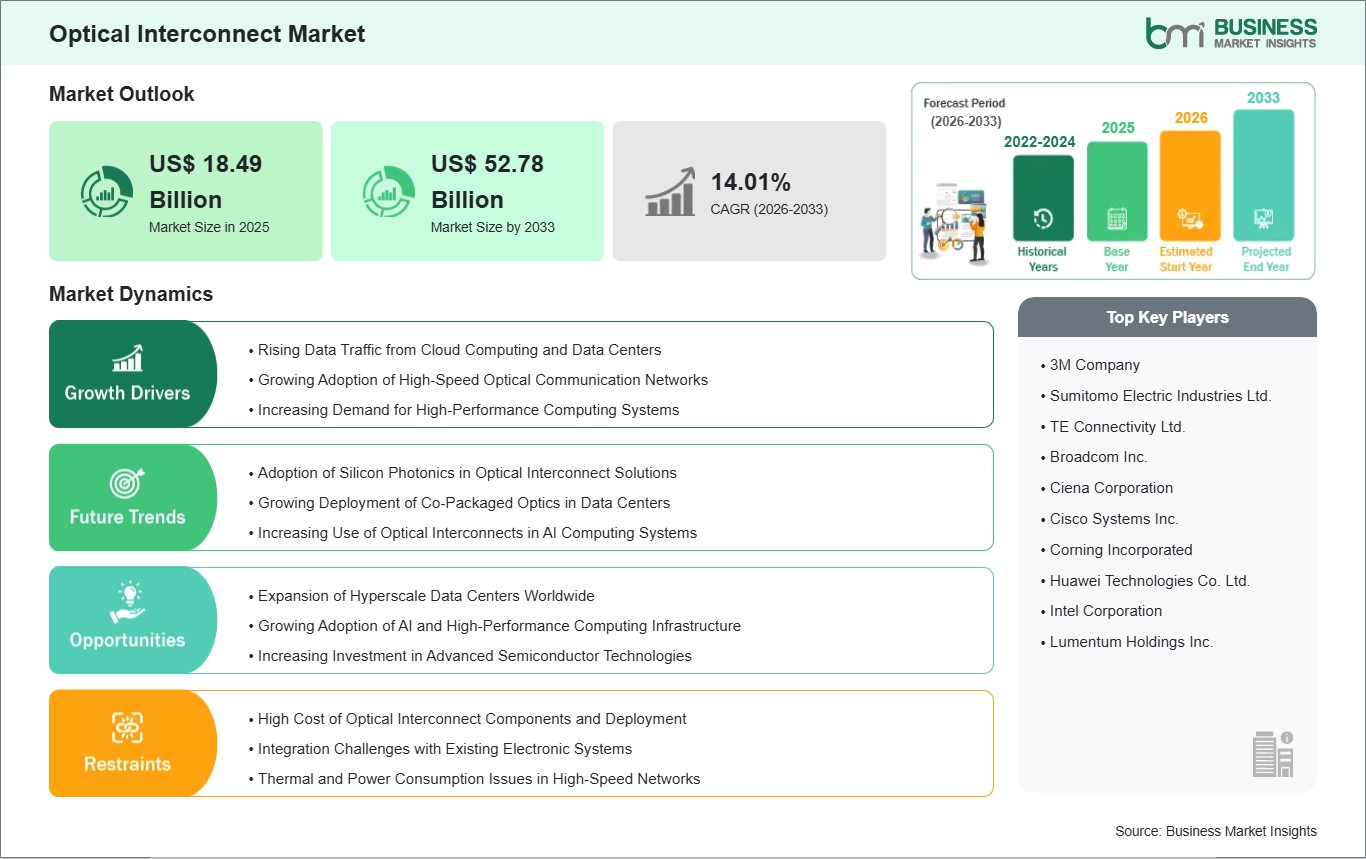
The Optical Interconnect Market size is expected to reach US$ 52.78 Billion by 2033 from US$ 18.49 Billion in 2025. The market is estimated to record a CAGR of 14.01% from 2026 to 2033.
The optical interconnect market is gaining strong attention as organizations seek faster and more efficient communication technologies for modern computing and data center environments. Optical interconnect solutions use light-based transmission to transfer data between computing components, storage systems, and networking equipment. These technologies are widely used in data centers, high-performance computing systems, and advanced communication networks where high bandwidth and low latency are essential. As global data generation continues to increase due to digital services, artificial intelligence, and cloud computing, the need for high-speed data communication technologies is expanding. The market is primarily driven by the rising demand for high-performance computing systems that require rapid data exchange between processors and storage devices.
In addition, the rapid growth of hyperscale data centers is increasing the demand for high-bandwidth communication solutions within server infrastructure. Optical interconnect technologies help support these data-intensive environments by enabling faster and more reliable data transmission. However, certain challenges remain for the market. Optical interconnect systems often require specialized components and integration with advanced computing infrastructure, which can increase deployment complexity. In addition, the cost of implementing optical technologies can be higher compared to traditional electrical interconnect solutions, particularly for smaller data center operators.

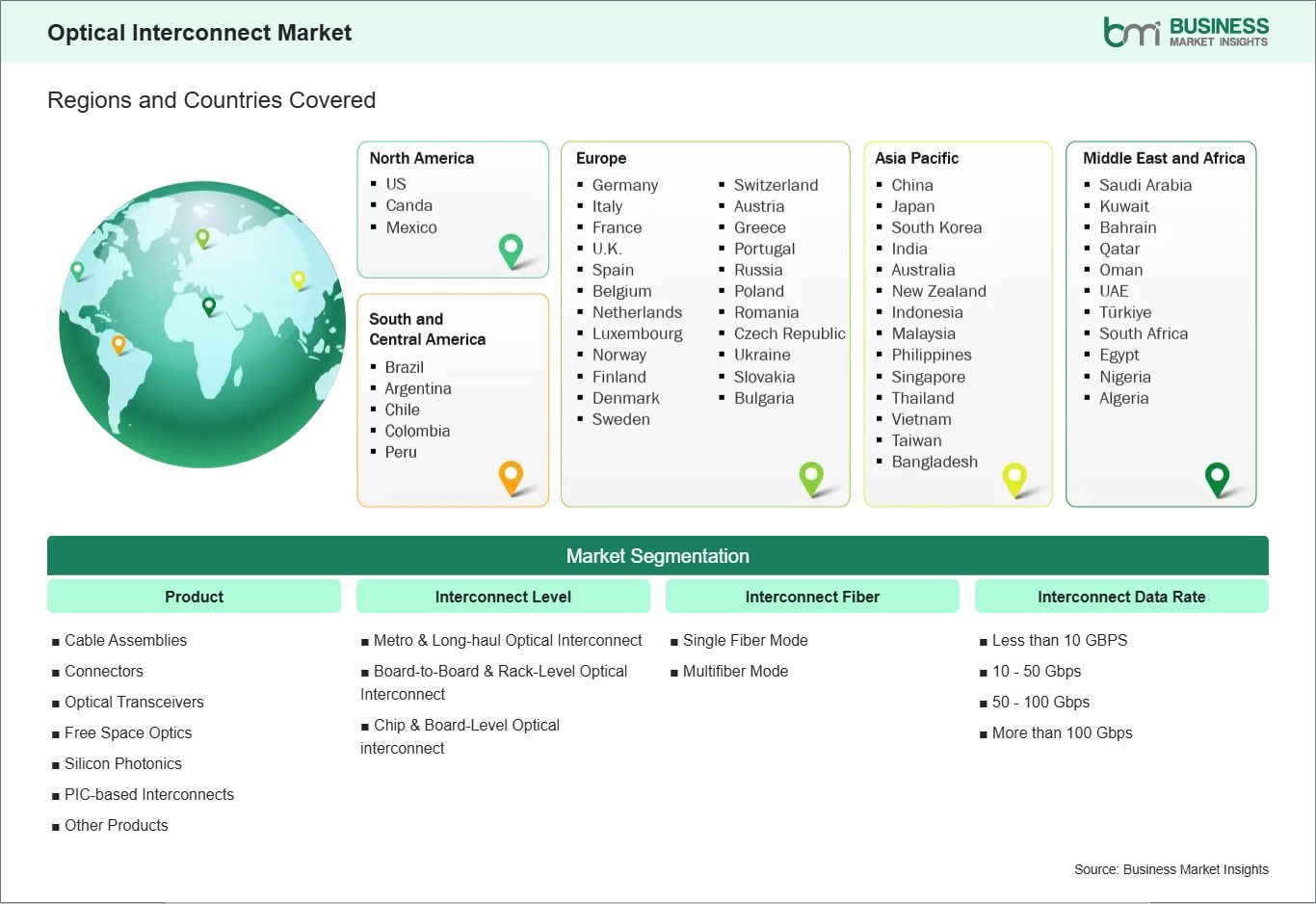
Key segments that contributed to the derivation of the optical interconnect market analysis are product, interconnect level, interconnect fiber, interconnect data rate, application, interconnect distance
Another important driver for the optical interconnect market is the increasing demand for high performance computing environments, such as advanced supercomputers that churn through large amounts of data. Such environments require extremely fast communication between processors, storage units and networking equipment, which can only be achieved by optical interconnects. Instead, the researchers aim to tackle the challenge of high data bandwidths using optical interconnect technologies rather than electrical ones, an approach that holds promise for decreasing the time and power needed to transmit data. Today, most systems use electrical interconnects, or metal wires; however, optical interconnects use light signals to transmit data and can handle higher data loads more efficiently. These features make them an excellent fit for supercomputers.
Organizations in all sectors, including research institutions, financial services, healthcare, and advanced manufacturing, are turning to high-performance computing (HPC) platforms more frequently to allow for the analysis of large volumes of data (Big Data) and to run resource-intensive simulations. To maintain optimum efficiency, these high-performance computing systems must have very reliable and fast communication between their different computing components. Optical interconnect solutions can provide the necessary bandwidth and low latency to support these demanding workloads. As organizations’ computing environments continue to evolve towards more complex architectures, there is an increasing demand for the use of very high-speed optical communications between the various components of the computing system.
The increased use of artificial intelligence, machine learning, and data analytics is driving an even greater workload on computing infrastructure. In order to accommodate the demands of these technologies, organizations require very large, powerful computing systems able to process, transfer, and communicate large amounts of data very rapidly. The use of optical interconnects within computing infrastructures will help improve the communication performance between the processor(s) and the storage subsystem in data-intensive environments. Therefore, as demand for high-performance computing increases across sectors, the market for optical interconnect technology is expected to grow substantially.
The rapid expansion of hyperscale data centers worldwide is creating strong opportunities in the optical interconnect market. Hyperscale data centers are designed to support large-scale cloud computing services, digital platforms, and data-intensive applications. These facilities contain thousands of servers and networking devices that must communicate efficiently to manage massive data workloads. Optical interconnect technologies play an important role in enabling high-speed data transmission between servers, storage systems, and networking infrastructure within these large data centers.
Cloud service providers and technology companies are continuously expanding hyperscale data center infrastructure to support growing demand for digital services. Applications such as cloud computing, artificial intelligence, video streaming, and online platforms require reliable and high-capacity data processing environments. Optical interconnect solutions help improve communication speed and reduce latency within data center networks, allowing operators to manage increasing data traffic more efficiently. As hyperscale facilities become larger and more complex, the demand for advanced optical communication technologies continues to rise.
In addition, many technology companies are investing in next-generation data center architectures that support faster data exchange and improved energy efficiency. Optical interconnects provide advantages such as higher bandwidth, lower signal loss, and improved scalability compared with traditional electrical connections. These capabilities make them well suited for modern hyperscale data center environments. As global digital infrastructure continues to expand, the increasing deployment of hyperscale data centers is expected to create significant growth opportunities for the optical interconnect market.
The global optical interconnect market is experiencing steady growth, with market size and share analysis reflecting evolving treatment preferences and competitive dynamics among key players. The report evaluates important subsegments categorized within product, interconnect level, interconnect fiber, interconnect data rate, application, interconnect distance, highlighting their respective contributions to overall market performance.
By product, the optical transceivers subsegment dominated the market in 2025, due to their essential role in converting electrical signals into optical signals for high-speed data transmission across data centers, telecom networks, and high-performance computing systems.
Based on interconnect level, the metro & long-haul optical interconnect subsegment dominated the market in 2025, due to extensive deployment in telecommunications networks and large-scale data transmission infrastructure requiring high bandwidth and long-distance connectivity.
By interconnect fiber, the single fiber mode subsegment dominated the market in 2025, due to its superior performance in long-distance data transmission, lower signal attenuation, and high bandwidth capabilities widely used in telecom and data center backbone networks.
Based on interconnect data rate, the more than 100 Gbps subsegment dominated the market in 2025, due to the increasing demand for ultra-high-speed connectivity in hyperscale data centers, cloud computing infrastructure, and high-performance computing environments.
By application, the data communication subsegment dominated the market in 2025, due to the rapid growth of cloud services, hyperscale data centers, and large-scale data traffic requiring high-bandwidth optical connectivity solutions.
Based on interconnect distance, the less than 10 km subsegment dominated the market in 2025, due to the widespread deployment of short-reach optical interconnects within data centers and campus networks where high-speed and low-latency connectivity is critical.
| Report Attribute | Details |
|---|---|
| Market size in 2025 | US$ 18.49 Billion |
| Market Size by 2033 | US$ 52.78 Billion |
| Global CAGR (2026 - 2033) | 14.01% |
| Historical Data | 2022-2024 |
| Forecast period | 2026-2033 |
| Segments Covered | By Product
|
|
Regions and Countries Covered
| |
| North America | US, Canada, Mexico |
| Europe | Belgium, Austria, Finland, Denmark, Greece, Poland, Romania, Russia, Ukraine, Czech Republic, Slovakia, Bulgaria, Italy, Luxembourg, Germany, Switzerland, France, Netherlands, Norway, Portugal, Spain, Sweden, United Kingdom |
| Asia-Pacific | Australia, China, India, Japan, South Korea, Indonesia, Malaysia, Philippines, Singapore, Thailand, Vietnam, Bangladesh, New Zealand, Taiwan |
| South and Central America | Brazil, Argentina, Peru, Chile, Colombia |
| Middle East and Africa | Bahrain, Kuwait, Oman, Qatar, Saudi Arabia, United Arab Emirates, Turkiye, South Africa, Egypt, Algeria, Nigeria |
| Market leaders and key company profiles |
|
The "Optical Interconnect Market Size and Forecast (2022 - 2033)" report provides a detailed analysis of the market covering below areas:
The geographical scope of the optical interconnect market report is divided into: North America, Asia Pacific, Europe, Middle East & Africa, and South & Central America. North America held the largest share in 2025.
North America dominates the optical interconnect market due to the strong presence of advanced data center infrastructure and leading technology companies. The region hosts a large number of hyperscale data centers operated by major cloud service providers and technology firms. These facilities require high-speed communication technologies to manage large volumes of data traffic and support digital services. As a result, the adoption of optical interconnect solutions is strong across data center networks and high-performance computing environments in the region. Organizations in North America are also heavily investing in artificial intelligence, cloud computing, and advanced computing platforms. These technologies require powerful computing systems capable of processing and transferring massive datasets efficiently. Optical interconnect solutions help support these requirements by providing high bandwidth and low latency communication between computing components.
The region also benefits from strong technological innovation and the presence of companies that develop advanced optical communication technologies. Continuous investment in digital infrastructure, data center expansion, and next-generation computing systems is supporting the growth of optical interconnect technologies. These factors collectively help North America maintain its leading position in the global optical

The optical interconnect market is evaluated by gathering qualitative and quantitative data post primary and secondary research, which includes important corporate publications, association data, and databases. A few of the key developments in the Optical Interconnect market are:
The Optical Interconnect Market is valued at US$ 18.49 Billion in 2025, it is projected to reach US$ 52.78 Billion by 2033.
As per our report Optical Interconnect Market, the market size is valued at US$ 18.49 Billion in 2025, projecting it to reach US$ 52.78 Billion by 2033. This translates to a CAGR of approximately 14.01% during the forecast period.
The Optical Interconnect Market report typically cover these key segments-
The historic period, base year, and forecast period can vary slightly depending on the specific market research report. However, for the Optical Interconnect Market report:
The Optical Interconnect Market is populated by several key players, each contributing to its growth and innovation. Some of the major players include:
The Optical Interconnect Market report is valuable for diverse stakeholders, including:
Essentially, anyone involved in or considering involvement in the Optical Interconnect Market value chain can benefit from the information contained in a comprehensive market report.
Please tell us your area of interest
(Market Segments/ Regions and Countries/ Companies)