Market Summary
Executive Summary and Global Market Analysis
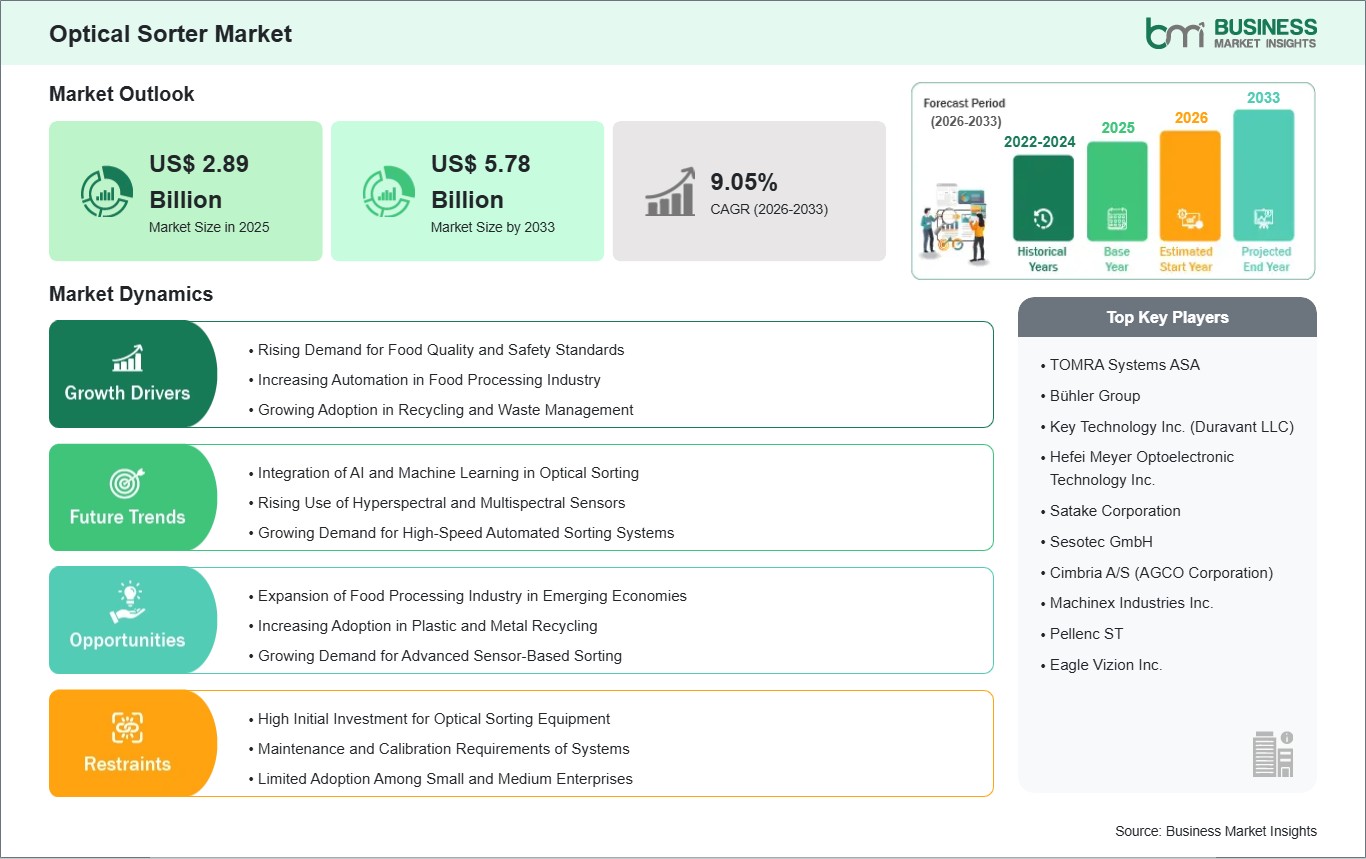
The optical sorter market is growing as industries increasingly adopt automated sorting technologies to improve product quality, processing efficiency, and material separation. Optical sorting systems use advanced cameras, sensors, and image processing technologies to identify and separate materials based on color, shape, and other visual characteristics. These systems are widely used in industries such as food processing, agriculture, recycling, and mining where accurate sorting is essential for maintaining quality standards and improving operational efficiency.
One of the key factors supporting market growth is the rising demand for high food quality and safety standards in the food processing industry. Optical sorting technologies help remove contaminants and defective products during processing, which improves product quality and supports compliance with safety regulations. In addition, the growing adoption of optical sorting systems in plastic and metal recycling facilities is creating new opportunities for market expansion. Recycling operations require efficient technologies to separate materials accurately and improve the recovery of reusable resources.However, certain factors may limit market growth. Optical sorting equipment often involves advanced sensors and imaging technologies, which can increase the initial cost of installation. In addition, smaller processing facilities may face challenges related to system integration and operational expertise, which can slow the adoption of automated sorting technologies.
Segment Analysis
Optical Sorter Market Segmentation
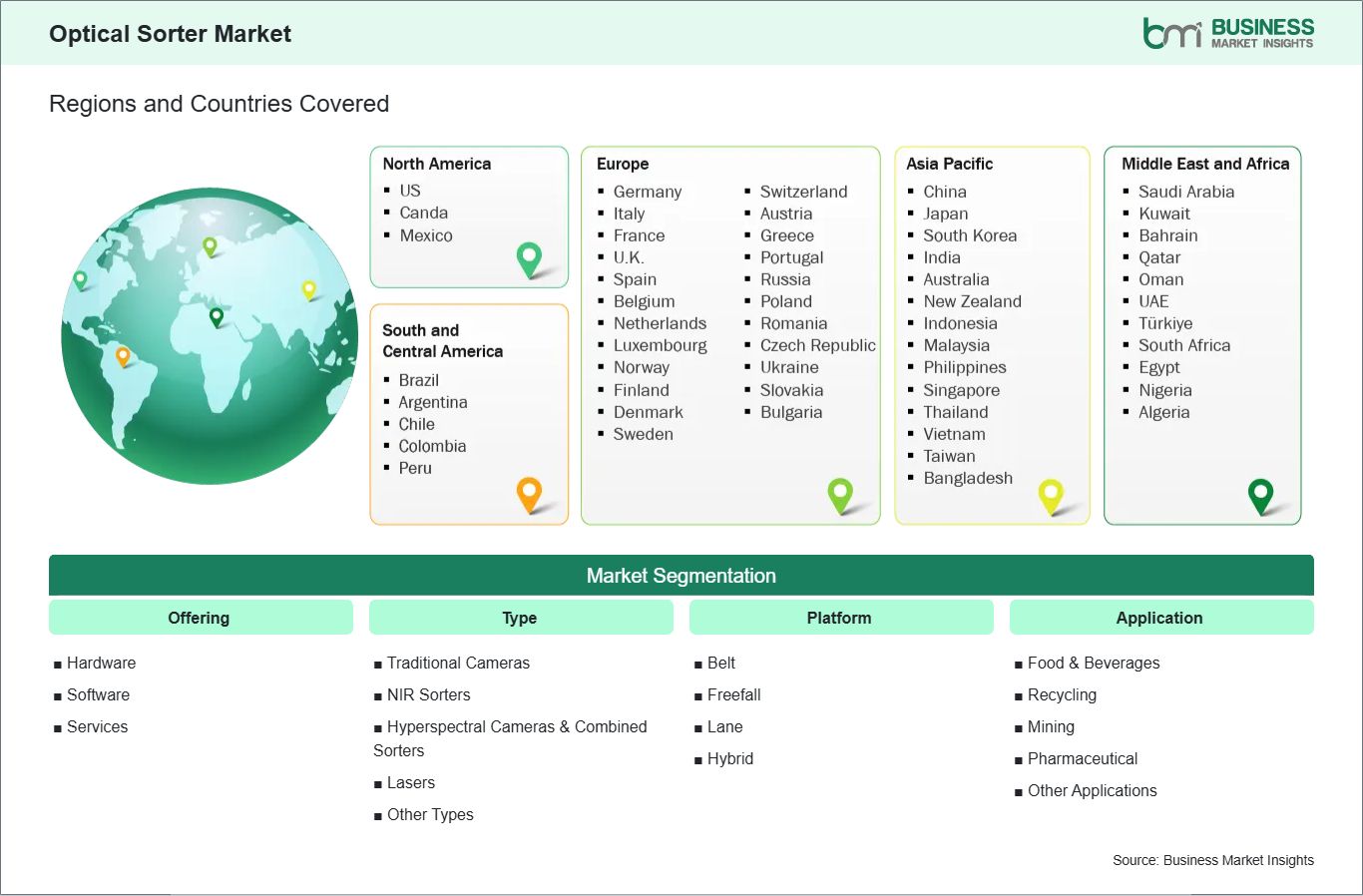
Key segments that contributed to the derivation of the optical sorter market analysis are offering, type, platform, application.
- By offering, the optical sorter market is segmented into hardware, software, and services. The hardware segment dominated the market in 2025.
- Based on type, the optical sorter market is classified into traditional cameras, NIR sorters, hyperspectral cameras & combined sorters, lasers, and other types. The NIR sorters segment dominated the market in 2025.
- By platform, the optical sorter market is segmented into belt, freefall, lane, and hybrid. The belt segment dominated the market in 2025.
- Based on application, the optical sorter market is segmented into food & beverages, recycling, mining, pharmaceutical, and other applications. The food & beverages segment dominated the market in 2025.
Market Forces
Optical Sorter Market Drivers and Opportunities
Rising Demand for Food Quality and Safety Standards
The rising demand for food quality and safety standards is a major driver for the optical sorter market. Food processing companies are under increasing pressure to ensure that food products meet strict quality requirements and safety regulations. Contaminants such as stones, defective grains, discolored products, and foreign materials can affect food quality and consumer safety. Optical sorting systems help address these challenges by using cameras, sensors, and advanced imaging technologies to identify and remove unwanted materials during the processing stage. This allows food manufacturers to maintain consistent product quality while improving operational efficiency.
Food processing industries such as grains, pulses, nuts, fruits, and vegetable processing are increasingly adopting optical sorting technologies to improve product purity and reduce contamination risks. These systems allow manufacturers to inspect large volumes of products quickly and accurately, which is difficult to achieve with manual inspection methods. Optical sorters also help companies comply with food safety regulations by improving quality control across production lines. As consumers become more aware of food quality and safety, food producers are prioritizing technologies that support reliable inspection and sorting processes.
In addition, global food trade and export requirements are encouraging producers to adopt advanced sorting technologies. Export markets often require strict quality standards, which makes accurate sorting an important part of the food processing workflow. Optical sorters help ensure that only high-quality products reach the market, reducing the risk of product rejection and improving brand reputation.
Increasing Adoption in Plastic and Metal Recycling
There is a growing trend toward the use of optical sorting technology in plastics and metals recycling, which provides a lucrative opportunity in the optical sorter market. Recycling facilities are seeing a larger volume of mixed waste materials, which need to be separated correctly to enhance the efficiency of the recycling of such waste. Optical sorters utilize advanced sensors and imaging technology to classify various materials by their respective color, shape, and content (i.e. metal or plastic). Therefore, they can sort by type (metal or plastic) and do so in a fast and accurate manner to enhance the quality of the recycled materials. Fiscal support for recycling and waste management has been received through governmental and environmental agencies, and initiativess have been created to encourage the reduction of landfill waste and encourage the sustainable use of resources through recycling. After many accommodating programs, many companies are investing in advanced sorting technologies that help to improve materials recovery rates. By automating the separation process, thereby eliminating the need for manual labor, recycling companies increase the purity of the recovered materials. In the plastic recycling sector, optical sorters help identify different plastic types and remove contaminants that may affect recycling quality. In metal recycling operations, these systems assist in separating different metal types and removing unwanted materials from the waste stream. As recycling activities expand across industries and environmental regulations become more strict, the demand for efficient sorting technologies is expected to increase significantly.
Size and Share Analysis
Optical Sorter Market Size and Share Analysis
The global optical sorter market is experiencing steady growth, with market size and share analysis reflecting evolving treatment preferences and competitive dynamics among key players. The report evaluates important subsegments categorized within offering, type, platform, application, highlighting their respective contributions to overall market performance.
By offering, the hardware subsegment dominated the market in 2025, due to the high demand for physical sorting machines equipped with cameras, sensors, lasers, and ejector systems used in industrial material sorting and quality inspection processes.
Based on type, the NIR sorters subsegment dominated the market in 2025, due to their strong capability to detect material composition and differentiate products based on chemical properties, making them widely used in food processing, recycling, and agricultural product sorting.
By platform, the belt subsegment dominated the market in 2025, due to its suitability for handling fragile and irregularly shaped products while enabling precise inspection and sorting in food processing and recycling applications.
Based on application, the food & beverages subsegment dominated the market in 2025, due to the extensive use of optical sorting systems for detecting contaminants, ensuring product quality, and improving processing efficiency in grains, fruits, vegetables, and packaged food products.
Report Coverage
Optical Sorter Market Report Coverage and Deliverables
The "Optical Sorter Market Size and Forecast (2022 - 2033)" report provides a detailed analysis of the market covering below areas:
- Optical Sorter market size and forecast at the regional and country levels for segments covered under the scope
- Optical Sorter market trends, as well as drivers, restraints, and opportunities
- Optical Sorter market analysis covering key trends, regional framework, major players, regulations, and recent developments
- Industry landscape and competition analysis covering market concentration, heat map analysis, prominent players, and recent developments for the Optical Sorter market
- Detailed company profiles, including SWOT analysis
Geographic Insights
Optical Sorter Market Geographic Insights
The geographical scope of the optical sorter market report is divided into: North America, Asia Pacific, Europe, Middle East & Africa, and South & Central America. North America held the largest share in 2025.
North America leads the optical sorter market mainly because it has a large number of sophisticated food processing industries and a well-established recycling infrastructure. Food manufacturers in the continent give great attention to maintaining top-quality products and adhering to stringent food safety standards. Therefore, a number of processing plants have gone for the optical sorting technology to enhance the quality inspection and minimize contamination risks during production. Besides that, the continent also has a well-established recycling industry that encourages the use of high-tech material separation methods. Recycling plants all over North America are progressively depending on the optical sorting systems to optimize their plastic and metal recycling processes. These systems not only automate the separation of materials but also minimize the labor-intensive sorting and enhance the quality of the recovered items. Furthermore, vigorous technological development and the existence of top equipment manufacturers help the spread of optical sorting solutions among industries. Firms in North America are quite committed to pouring money into the automation technologies as a means of raising the productivity and sustainability levels of food processing and recycling operations. Altogether, these factors back up the regions top spot in the worldwide market for optical sorters.
Industry Activity
Recent Developments
The optical sorter market is evaluated by gathering qualitative and quantitative data post primary and secondary research, which includes important corporate publications, association data, and databases. A few of the key developments in the Optical Sorter market are:
- In September 2025, TOMRA Systems ASA announced that it launched the TOMRA 4C, an AI‑powered optical sorting machine designed for the nuts and IQF (individually quick frozen) food processing industry, featuring advanced machine learning and sensor technologies to improve defect and foreign material detection.
- In June 2025, Satake Corporation announced that it launched the Pellet Sorter II, a specialized optical sorter for precision sorting of plastic pellets, capable of detecting and removing speck defects and discolorations from raw materials with high throughput.
- In March 2025, Bühler Group announced that it partnered with West‑Link to open a state‑of‑the‑art optical sorting research and training center in Stockton, California, aimed at providing food processors access to the latest SORTEX optical sorting technologies and specialized training.
Trust & Transparency
Research Methodology
The market analysis combines proprietary research with secondary data from government agencies, company disclosures, regulatory filings, industry databases and expert interviews. Market estimates are validated through data triangulation, cross-market benchmarking and analyst
review.
View Full Research Methodology
Key Sources Referred:
International Electrotechnical Commission Institute of Electrical and Electronics Engineers International Organization for Standardization Bureau of Indian Standards Central Electricity Authority Ministry of Power Indian Electrical and Electronics Manufacturers' Association European Committee for Electrotechnical Standardization VDE Association for Electrical Electronic & Information Technologies Company Websites Company Annual Reports Company Investor Presentations