Market Summary
Executive Summary and Global Market Analysis
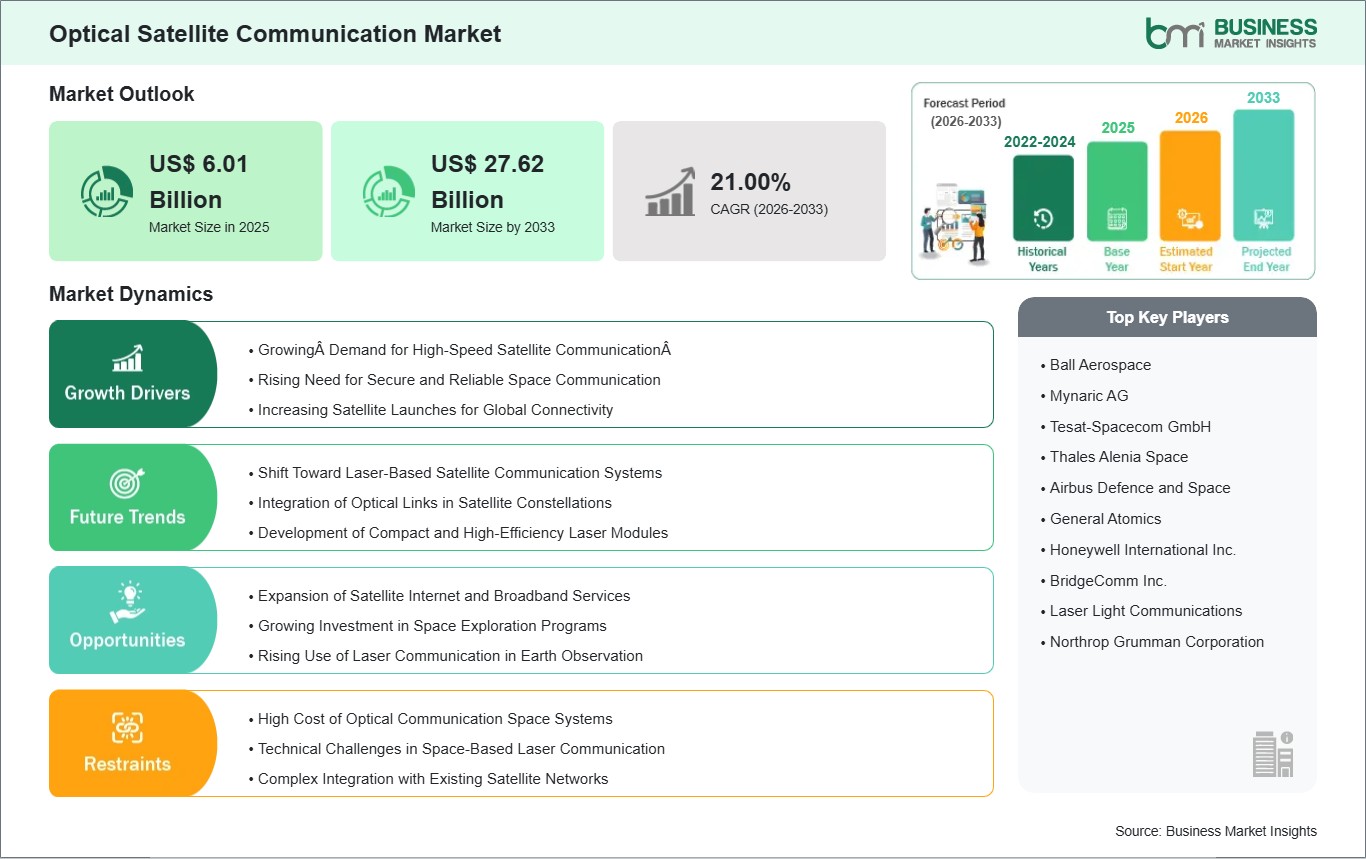
The optical satellite communication market is growing as satellite operators and communication providers seek faster and more efficient data transmission technologies. Optical satellite communication uses laser-based systems to transmit data between satellites and ground stations. Compared with traditional radio frequency communication, optical communication offers higher bandwidth, improved security, and faster data transfer. These advantages make the technology suitable for applications such as satellite internet services, earth observation systems, space exploration missions, and secure government communication networks.
The increasing demand for global connectivity and high-speed data transmission is encouraging the development of advanced satellite communication technologies. Satellite operators are investing in new systems that support large volumes of data transfer across space networks. Optical communication technology enables satellites to communicate directly with each other using laser links, improving network efficiency and reducing communication delays. As demand for reliable and high-capacity communication infrastructure continues to grow, the optical satellite communication market is expected to expand across multiple space and communication applications.
Segment Analysis
Optical Satellite Communication Market Segmentation
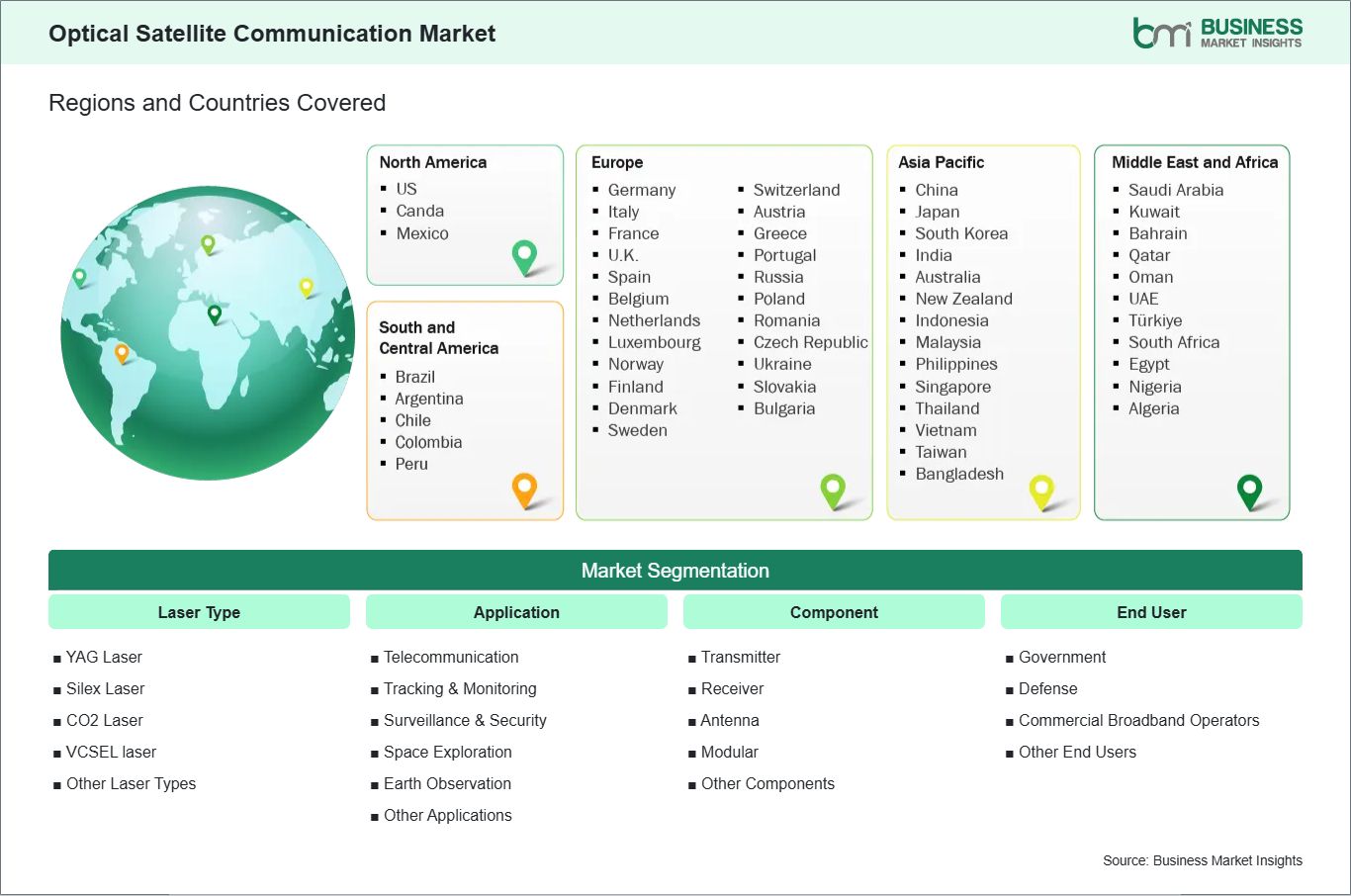
Key segments that contributed to the derivation of the optical satellite communication market analysis are laser type, application, component, end user.
- By laser type, the optical satellite communication market is segmented into YAG laser, Silex laser, CO2 laser, VCSEL laser, and others. The VCSEL laser segment dominated the market in 2025.
- By application, the market is classified into telecommunication, tracking and monitoring, surveillance and security, space exploration, earth observation, and other applications. The telecommunication segment dominated the market in 2025.
- By component, the market is segmented into transmitter, receiver, antenna, modular, and other components. The transmitter segment dominated the market in 2025.
- By end user, the market is segmented into government, defense, commercial broadband operators, and other end users. The defense segment dominated the market in 2025.
Market Forces
Optical Satellite Communication Market Drivers and Opportunities
Growing Demand for High-Speed Satellite Communication
The growing demand for high-speed satellite communication is a major driver for the optical satellite communication market. Traditional radio frequency communication systems are facing limitations in bandwidth and data transmission capacity. Optical satellite communication uses laser-based technologies that enable faster and more efficient data transfer between satellites and ground stations. This technology allows communication networks to handle large volumes of data required for modern digital services.
Telecommunication providers and satellite operators are increasingly focusing on improving global connectivity through advanced satellite networks. Optical communication systems provide higher data capacity and reduced signal interference compared with conventional communication technologies. These advantages make them suitable for applications such as broadband internet, secure communication, and large-scale data transfer between satellites.
In addition, the growing demand for global connectivity, remote communication services, and data transmission is encouraging investment in advanced satellite technologies. Optical satellite communication helps support high-speed communication infrastructure in space, enabling faster data exchange across global networks. As demand for reliable and high-capacity communication systems increases, the adoption of optical satellite communication technologies is expected to grow significantly.
Expansion of Satellite Internet and Broadband Services
The expansion of satellite internet and broadband services presents significant opportunities for the optical satellite communication market. Many regions around the world still lack reliable high-speed internet access, especially in remote and rural areas. Satellite communication systems help extend connectivity to these regions, supporting digital communication, education, and business activities. Optical communication technologies improve the performance of satellite networks by enabling faster and more efficient data transmission.
Satellite internet providers are deploying large constellations of satellites to deliver global broadband coverage. Optical communication links between satellites allow them to exchange data quickly and efficiently without relying entirely on ground infrastructure. This improves network performance and reduces communication delays, making satellite internet services more reliable.
In addition, increasing demand for digital services such as cloud computing, video streaming, and remote communication is encouraging the development of advanced satellite networks. Optical satellite communication plays an important role in supporting these services by enabling high-capacity data transmission in space. As satellite broadband networks expand worldwide, the demand for optical communication systems is expected to increase steadily.
Size and Share Analysis
Optical Satellite Communication Market Size and Share Analysis
The global optical satellite communication market is experiencing steady growth, with market size and share analysis reflecting evolving treatment preferences and competitive dynamics among key players. The report evaluates important subsegments categorized within laser type, application, component, end user, highlighting their respective contributions to overall market performance.
By laser type, the VCSEL laser subsegment dominated the market in 2025, due to its efficiency, compact design, and ability to support high-speed optical data transmission required for modern satellite communication systems.
By application, the telecommunication subsegment dominated the market in 2025, driven by increasing demand for high-speed satellite connectivity and data transmission across global communication networks.
By component, the transmitter subsegment dominated the market in 2025, because transmitters play a critical role in sending optical signals between satellites and ground stations for long-distance data communication.
By end user, the defense subsegment dominated the market in 2025, due to growing demand for secure, high-capacity communication systems used in military operations, satellite surveillance, and strategic communication networks.
Report Coverage
Optical Satellite Communication Market Report Coverage and Deliverables
The "Optical Satellite Communication Market Size and Forecast (2022 - 2033)" report provides a detailed analysis of the market covering below areas:
- Optical Satellite Communication market size and forecast at the regional and country levels for segments covered under the scope
- Optical Satellite Communication market trends, as well as drivers, restraints, and opportunities
- Optical Satellite Communication market analysis covering key trends, regional framework, major players, regulations, and recent developments
- Industry landscape and competition analysis covering market concentration, heat map analysis, prominent players, and recent developments for the Optical Satellite Communication market
- Detailed company profiles, including SWOT analysis
Geographic Insights
Optical Satellite Communication Market Geographic Insights
The geographical scope of the optical satellite communication market report is divided into: North America, Asia Pacific, Europe, Middle East & Africa, and South & Central America. North America held the largest share in 2025.
North America dominates the optical satellite communication market due to its strong space technology ecosystem and significant investments in satellite communication infrastructure. The region is home to major aerospace companies, satellite manufacturers, and technology developers that are actively working on advanced space communication systems. Government space agencies and defense organizations in North America are also investing in secure and high-capacity satellite communication technologies. Satellite communication plays an important role in defense operations, global connectivity programs, and scientific missions in the region. Optical satellite communication systems are being developed to support high-speed data transfer between satellites and ground stations. These technologies help improve communication reliability and support advanced applications such as space exploration and earth observation. The presence of advanced research institutions, technology companies, and strong government support encourages continuous innovation in satellite communication technologies. In addition, increasing satellite launches and development of satellite constellations for broadband services are supporting market growth. These factors help North America maintain a leading position in the global optical satellite communication market.
Industry Activity
Recent Developments
The optical satellite communication market is evaluated by gathering qualitative and quantitative data post primary and secondary research, which includes important corporate publications, association data, and databases. A few of the key developments in the Optical Satellite Communication market are:
- In September 2025, General Atomics Electromagnetic Systems announced that it successfully demonstrated bi-directional air-to-space optical communications with Kepler Communications using its Optical Communication Terminal (OCT) mounted on an aircraft and a satellite in low Earth orbit, validating secure high-data-rate connectivity between airborne and space assets.
- In November 2024, Kepler Communications announced that it is shifting its strategy to develop an optical data relay network designed to modernize satellite communications infrastructure for commercial and government customers using laser-based links.
Trust & Transparency
Research Methodology
The market analysis combines proprietary research with secondary data from government agencies, company disclosures, regulatory filings, industry databases and expert interviews. Market estimates are validated through data triangulation, cross-market benchmarking and analyst
review.
View Full Research Methodology
Key Sources Referred:
World BankAcademic JournalsCompany WebsitesCompany Annual ReportsCompany Investor Presentations