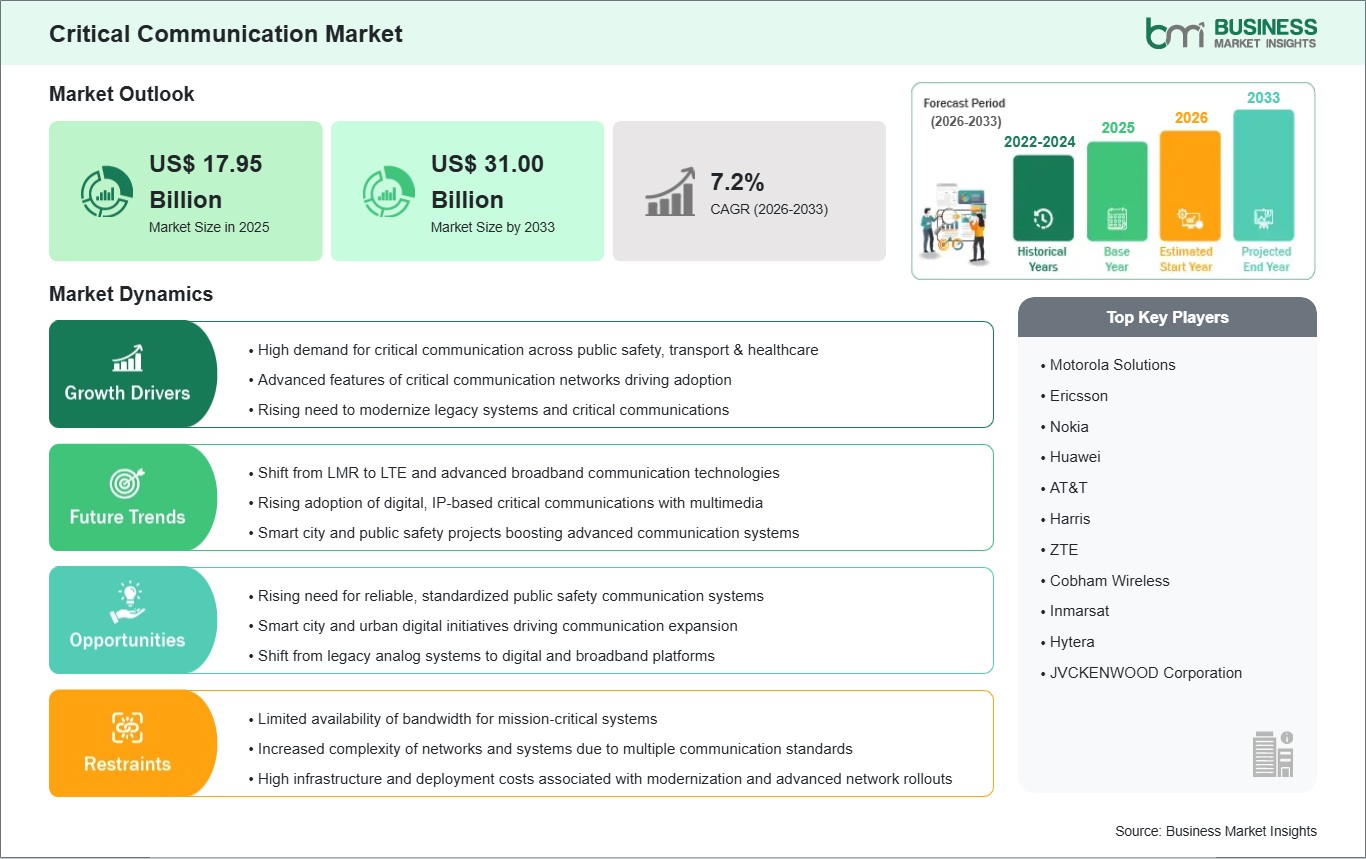
The Critical Communication market size is expected to reach US$ 31.00 billion by 2033 from US$ 17.95 billion in 2025. The market is estimated to record a CAGR of 7.2% from 2026 to 2033.
The global Critical Communication Market is witnessing substantial growth, driven by increasing demand for reliable and secure communication solutions across public safety, transportation, utilities, and industrial sectors. Critical communication systems, including Land Mobile Radio (LMR) and Long-Term Evolution (LTE) technologies, are essential for mission-critical operations where uninterrupted and secure communication is vital. These solutions enable real-time data sharing, incident management, and coordinated response in emergency situations, enhancing operational efficiency and safety.
Hardware components, such as radios, base stations, repeaters, and terminals, dominate the offering segment, supported by growing deployment of digital communication networks. Services, including system integration, network management, and maintenance, complement these offerings by ensuring seamless operation and scalability of critical communication systems. Among technology types, LMR systems remain widely adopted due to their reliability in mission-critical environments, while LTE-based systems are gaining traction with the shift toward broadband, IP-based communications.
Regionally, North America leads the market, fueled by advanced infrastructure, government initiatives, and early adoption of digital communication technologies. Europe follows closely, with emphasis on public safety modernization and industrial communication networks. Asia Pacific is the fastest-growing region due to expanding urban infrastructure, increasing industrialization, and rising investments in mission-critical networks. Overall, the market outlook is positive, with advancements in LTE, push-to-talk over cellular (PoC), and AI-enabled network management expected to drive future growth across all sectors and regions..

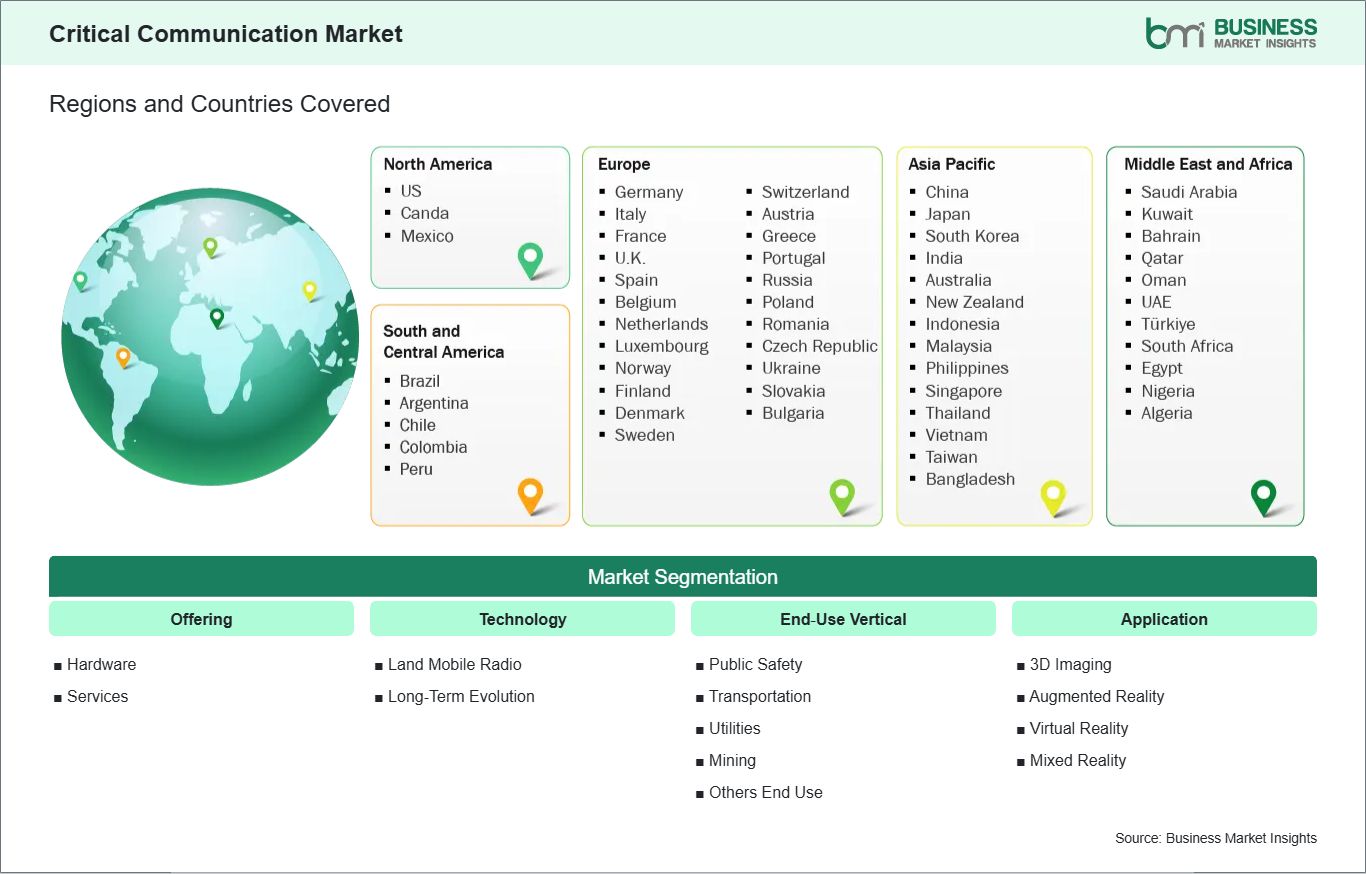
Key segments that contributed to the derivation of the Critical Communication market analysis are offering, technology, end-use vertical.
One of the primary drivers of the global critical communication market is the increasing demand for reliable and secure communication systems within public safety, law enforcement, and emergency services. Mission-critical operations in these sectors require uninterrupted, real-time communication to coordinate field personnel, manage incidents, and respond to emergencies efficiently. Any communication failure can have serious consequences, making robust critical communication networks indispensable.
The growing frequency of natural disasters, urban emergencies, and industrial accidents has further emphasized the need for dependable communication solutions. Agencies are increasingly adopting Land Mobile Radio (LMR) systems and LTE-based broadband solutions that allow for instant voice, video, and data sharing across multiple platforms. Push-to-talk (PTT) functionality, real-time GPS tracking, and encrypted communication features enable seamless coordination and situational awareness, which are vital for saving lives and maintaining public safety.
Governments worldwide are also implementing regulations and allocating budgets to modernize public safety communication infrastructure, replacing outdated analog systems with digital, interoperable networks. This trend is driving demand not only in North America and Europe, where infrastructure upgrades are already underway, but also in emerging regions such as Asia Pacific, where urbanization and industrialization require scalable and resilient communication systems. Overall, the critical need for reliability, security, and real-time connectivity in emergency and public safety operations continues to fuel the growth of the critical communication market globally, positioning it as a vital technology for modern societies..
The industrial and utility sectors present significant growth opportunities for the critical communication market. Industries such as oil & gas, manufacturing, construction, and energy utilities increasingly rely on mission-critical communication solutions to ensure operational efficiency, worker safety, and real-time monitoring of remote or hazardous environments. Critical communication systems allow instant coordination across large facilities, distributed sites, and mobile workforces, reducing downtime and enhancing productivity.
With the rise of smart grids, industrial IoT, and automated operations, the demand for integrated communication solutions that combine voice, data, and video functionalities is increasing. Push-to-talk over cellular (PoC), LTE-based systems, and cloud-enabled communication platforms allow industries to improve situational awareness, monitor equipment remotely, and respond quickly to operational disruptions. Furthermore, regulatory compliance and safety standards across sectors such as energy, mining, and construction are driving the adoption of secure, reliable, and interoperable communication networks.
Emerging markets in Asia Pacific and Latin America represent additional opportunities, where rapid industrialization and infrastructure expansion are increasing the need for critical communication solutions. Companies offering scalable, flexible, and integrated solutions tailored to industrial and utility operations can capture this growing demand. By targeting these verticals, market players can diversify their offerings beyond traditional public safety applications, capitalize on technological advancements, and accelerate global market growth..

By Offering the market is divided into Hardware and Services. The hardware segment accounted for the largest share of the Critical Communication market in 2025, owing to the high demand for radios, base stations, repeaters, and terminals across public safety and industrial sectors.
By Technology the market is divided into Land Mobile Radio (LMR) and Long-Term Evolution (LTE). The LMR segment held the largest share of the Critical Communication market in 2025, due to its reliability, interoperability, and established use in mission-critical communications.
By End‑Use Vertical the market is divided into Public Safety, Transportation, Utilities, Mining, and Others — including Oil & Gas, Manufacturing, Construction, and Healthcare sectors. The public safety segment accounted for the largest share of the Critical Communication market in 2025, driven by stringent government regulations, rising emergency response requirements, and investments in modernized communication networks.
| Report Attribute | Details |
|---|---|
| Market size in 2025 | US$ 17.95 Billion |
| Market Size by 2033 | US$ 31.00 Billion |
| Global CAGR (2026 - 2033) | 7.2% |
| Historical Data | 2022-2024 |
| Forecast period | 2026-2033 |
| Segments Covered | By Offering
|
| Regions and Countries Covered | North America
|
| Market leaders and key company profiles |
|
The "Critical Communication Market Size and Forecast (2022-2033)" report provides a detailed analysis of the market covering below areas:
The geographical scope of the Critical Communication market report is divided into five regions: North America, Asia Pacific, Europe, Middle East & Africa, and South & Central America. The Critical Communication market in Asia Pacific is expected to grow significantly during the forecast period.
The global Critical Communication Market shows strong regional variation, driven by infrastructure maturity, government initiatives, and industrial adoption. North America dominates the market, holding the largest share in 2025, supported by advanced infrastructure, early adoption of digital and LTE-based communication systems, and substantial government investments in public safety modernization and emergency response networks.
Europe also holds a significant share, driven by public safety modernization programs, transportation safety regulations, and adoption of industrial communication solutions in utilities and mining sectors. Countries such as the UK, Germany, and France are key contributors due to robust regulatory frameworks and advanced technological ecosystems.
Asia Pacific is the fastest-growing region, fueled by rapid urbanization, industrialization, and rising investments in mission-critical communication systems across emerging economies like China, India, Japan, and South Korea. Increasing deployment in utilities, transportation, and manufacturing sectors is further driving market growth.

The Critical Communication market is evaluated by gathering qualitative and quantitative data post primary and secondary research, which includes important corporate publications, association data, and databases. A few of the key developments in the Critical Communication market are:
The Critical Communication Market is valued at US$ 17.95 Billion in 2025, it is projected to reach US$ 31.00 Billion by 2033.
As per our report Critical Communication Market, the market size is valued at US$ 17.95 Billion in 2025, projecting it to reach US$ 31.00 Billion by 2033. This translates to a CAGR of approximately 7.2% during the forecast period.
The Critical Communication Market report typically cover these key segments-
The historic period, base year, and forecast period can vary slightly depending on the specific market research report. However, for the Critical Communication Market report:
The Critical Communication Market is populated by several key players, each contributing to its growth and innovation. Some of the major players include:
The Critical Communication Market report is valuable for diverse stakeholders, including:
Essentially, anyone involved in or considering involvement in the Critical Communication Market value chain can benefit from the information contained in a comprehensive market report.
Please tell us your area of interest
(Market Segments/ Regions and Countries/ Companies)