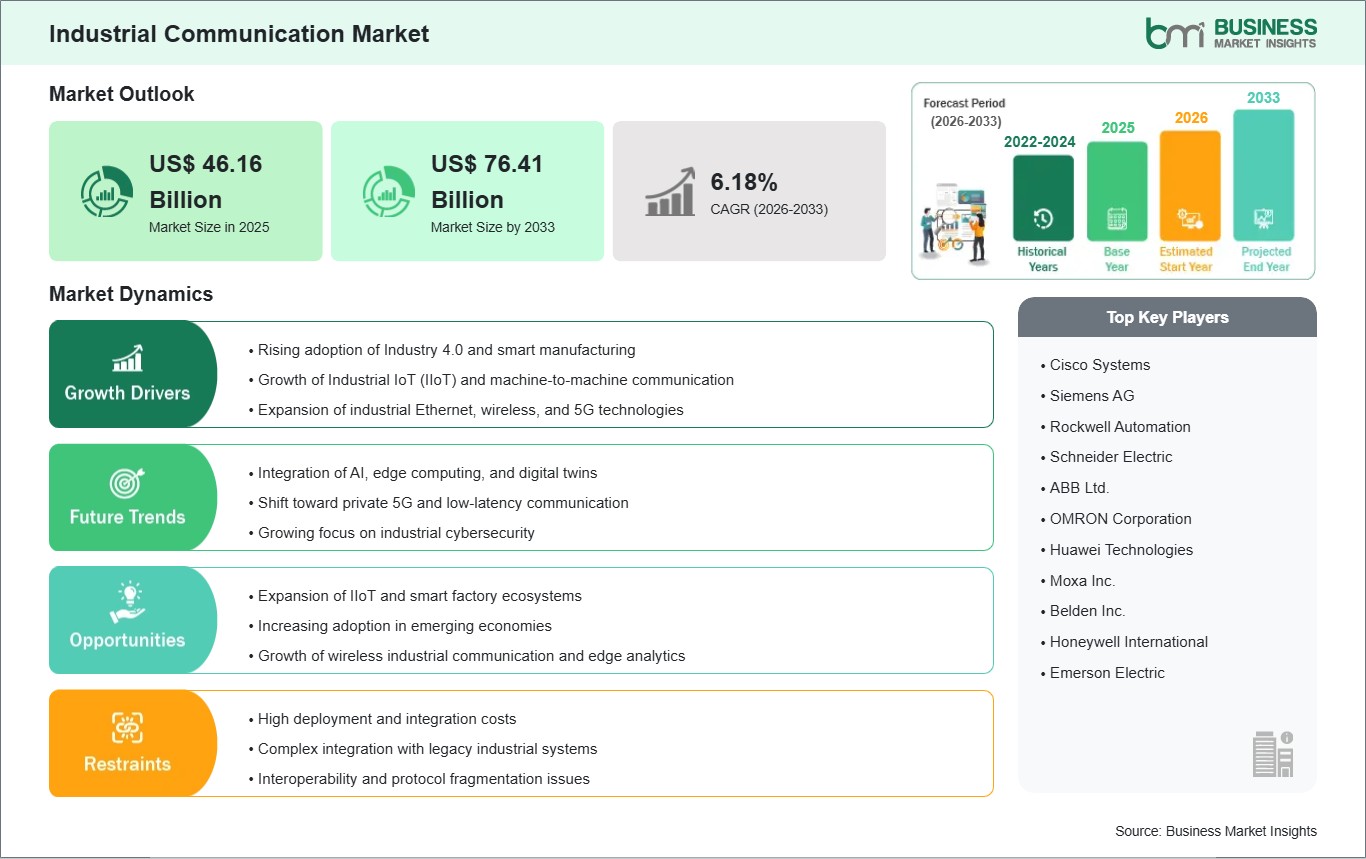
The Industrial Communication market size is expected to reach US$ 76.41 billion by 2033 from US$ 46.61 billion in 2025. The market is estimated to record a CAGR of 6.18% from 2026 to 2033.
Industrial communication refers to the integrated application of networking protocols and hardware engineered to facilitate seamless data exchange between sensors, controllers, and enterprise systems within industrial environments. By utilizing a coordinated framework of wired and wireless technologies, including industrial Ethernet, fieldbus, and private 5G, these systems enable deterministic, real-time communication essential for synchronized manufacturing operations. This technology is fundamental to the operational architecture of smart factories, oil and gas refineries, and automated power grids. Market expansion is being propelled by the rapid global transition toward Industry 4.0, the rising institutional requirement for low-latency data flow to support edge computing, and the increasing integration of artificial intelligence (AI) to optimize network performance and predict equipment failures.
However, several factors may restrain market progression. The high capital intensity associated with the initial deployment and integration of modern communication nodes, especially when retrofitting legacy facilities with high-speed fiber or wireless arrays, remains a primary hurdle for many industrial operators. The industry also faces persistent technical challenges regarding interoperability, as the presence of multiple, often incompatible, communication protocols complicates the seamless synchronization of diverse hardware from different vendors. Additionally, the proliferation of interconnected endpoints has intensified concerns regarding cybersecurity and network reliability, as vulnerable communication ports can serve as entry points for disruptive digital attacks on critical infrastructure. These hurdles, compounded by a documented scarcity of personnel proficient in both operational technology (OT) and information technology (IT) networking, increase the total cost of ownership and may lengthen the digital transformation cycle for traditional industrial sectors.
Despite these hurdles, the market outlook remains highly favorable as the sector transitions toward Wireless and Deterministic networking ecosystems. Opportunities are emerging through the adoption of Time-Sensitive Networking (TSN); the market is witnessing a surge in Ethernet-based solutions that provide the guaranteed low-latency and deterministic delivery required for high-speed motion control and real-time robotics. The automotive and process control segments are gaining significant traction, with a rising requirement for Private 5G networks to manage massive volumes of sensor data across expansive, cable-free production floors. Furthermore, the growth of Software-Defined Communication, utilizing AI-driven platforms for automated network configuration and diagnostics, aligns with global goals for enhanced operational resilience and reduced unplanned downtime.

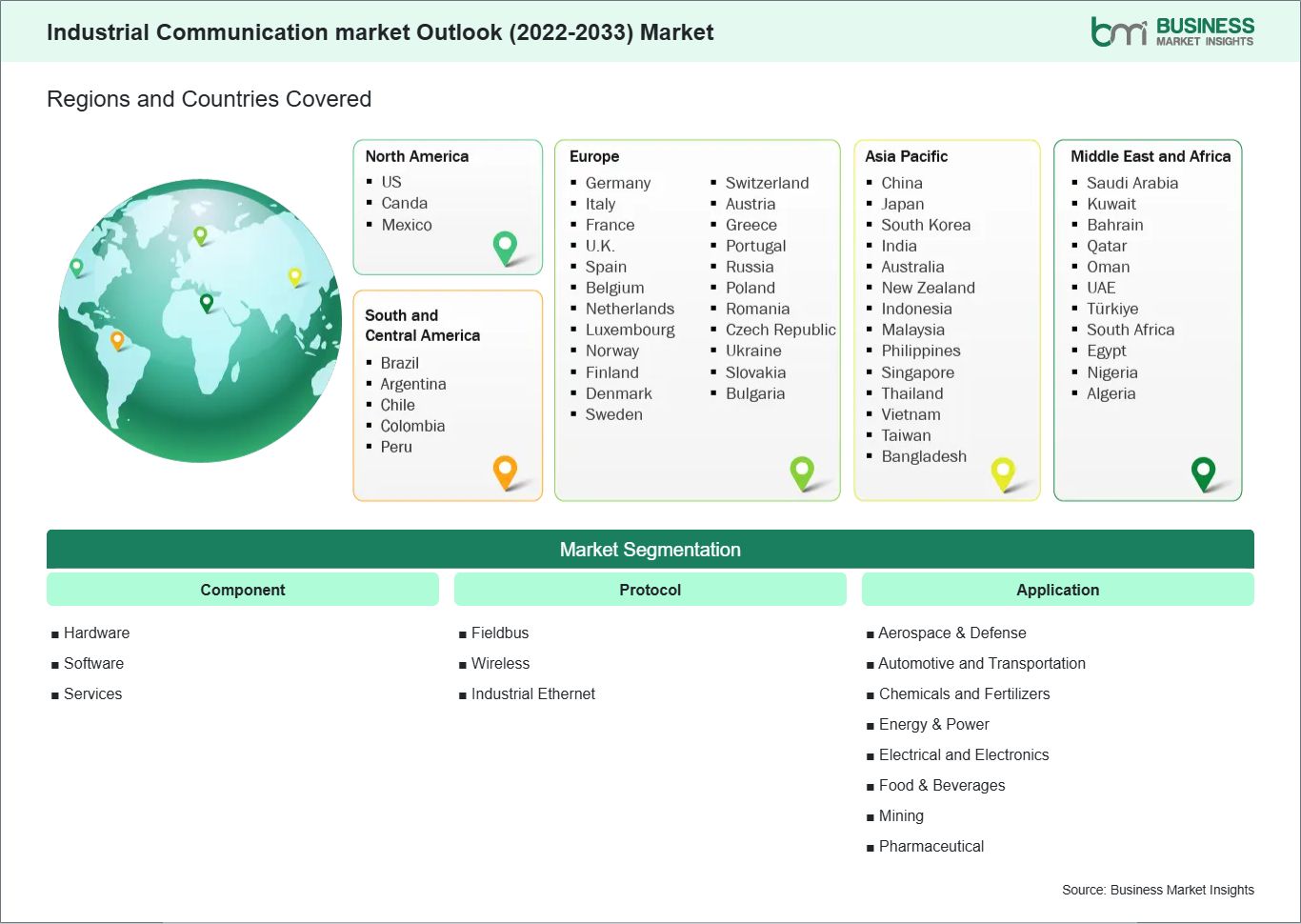
Key segments that contributed to the derivation of the Industrial Communication market analysis are component, protocol, and application.
The industrial communication market is being driven by the growing need for automation, seamless connectivity, and operational efficiency across manufacturing, energy, automotive, and process industries. Industrial communication systems, including fieldbus, industrial Ethernet, and wireless protocols, enable real‑time data exchange between machines, sensors, and control systems, forming the backbone of Industry 4.0. The rapid expansion of smart factories and digital transformation initiatives is amplifying adoption, as companies seek to optimize production, reduce downtime, and enhance resource utilization. Automotive and electronics industries are reinforcing demand, with industrial communication supporting robotics, assembly lines, and quality inspection. Energy and utilities are also fueling growth, as communication networks enable predictive maintenance, smart grid management, and remote monitoring. Additionally, stricter regulatory standards for safety, cybersecurity, and interoperability are propelling investment in advanced communication solutions. Collectively, automation priorities, connectivity requirements, and efficiency goals are sustaining momentum in the global industrial communication market.
Opportunities in the industrial communication market are expanding through the integration of IoT ecosystems, 5G networks, and emerging cross‑industry applications. IoT‑enabled communication platforms are opening lucrative opportunities by offering real‑time monitoring, predictive analytics, and adaptive control across industrial environments. The rollout of 5G is gaining traction, enabling ultra‑low latency and high‑bandwidth communication for mission‑critical applications such as autonomous vehicles, robotics, and remote operations. The growing emphasis on digital transformation is fueling demand for interoperable communication systems that integrate seamlessly with cloud platforms, ERP systems, and industrial IoT frameworks. Emerging applications in healthcare and logistics are driving innovation, as industrial communication supports connected medical devices, automated warehouses, and supply chain visibility. Aerospace and defense sectors are reinforcing opportunities, where secure, high‑performance communication systems are essential for mission‑critical operations. Additionally, sustainability trends are encouraging deployment of energy‑efficient communication solutions that align with global environmental goals. The expansion of smart cities, renewable energy projects, and advanced manufacturing ecosystems is creating new pathways for adoption. Vendors who focus on IoT‑ready, 5G‑enabled, and industry‑specific communication solutions are well‑positioned to capture growth. The convergence of IoT, 5G, and smart automation underscores a transformative trajectory for the global industrial communication market.

The Industrial Communication market demonstrates steady growth, with size and share analysis revealing evolving trends and competitive positioning among key players. The report examines subsegments categorized within component, protocol, and application, offering insights into their contribution to overall market performance.
Based on Component, the Hardware subsegment dominates adoption, as routers, switches, controllers, and communication interfaces are indispensable for enabling connectivity in industrial environments. Hardware provides the backbone for automation, ensuring reliable data transfer between machines and systems. The Software subsegment is essential for managing communication protocols, monitoring networks, and integrating industrial IoT platforms. It anchors demand in industries adopting smart manufacturing and predictive maintenance. The Services subsegment supports deployment, training, and maintenance, ensuring long‑term efficiency and compliance. Together, hardware, software, and services highlight the ecosystem of industrial communication, balancing physical infrastructure, digital intelligence, and operational support.
| Report Attribute | Details |
|---|---|
| Market size in 2025 | US$ 46.16 Billion |
| Market Size by 2033 | US$ 76.41 Billion |
| Global CAGR (2026 - 2033) | 6.18% |
| Historical Data | 2022-2024 |
| Forecast period | 2026-2033 |
| Segments Covered | By Component
|
|
Regions and Countries Covered
| |
| North America | US, Canada, Mexico |
| Europe | Belgium, Austria, Finland, Denmark, Greece, Poland, Romania, Russia, Ukraine, Czech Republic, Slovakia, Bulgaria, Italy, Luxembourg, Germany, Switzerland, France, Netherlands, Norway, Portugal, Spain, Sweden, United Kingdom |
| Asia-Pacific | Australia, China, India, Japan, South Korea, Indonesia, Malaysia, Philippines, Singapore, Thailand, Vietnam, Bangladesh, New Zealand, Taiwan |
| South and Central America | Brazil, Argentina, Peru, Chile, Colombia |
| Middle East and Africa | Bahrain, Kuwait, Oman, Qatar, Saudi Arabia, United Arab Emirates, Turkiye, South Africa, Egypt, Algeria, Nigeria |
| Market leaders and key company profiles |
|
The “Industrial Communication Market Size and Forecast (2022–2033)” report provides a detailed analysis of the market covering below areas:
The geographical scope of the Industrial Communication market report is divided into five regions: North America, Asia Pacific, Europe, Middle East & Africa, and South & Central America.
North America maintains a preeminent position within the global industry, a status reinforced by the region's advanced digital infrastructure and substantial federal support for smart manufacturing and energy modernization. The regional landscape is characterized by a mature innovation ecosystem in the United States and Canada, where the transition toward high-speed, deterministic networking has become a strategic priority for maintaining industrial competitiveness. This market leadership is supported by a robust presence of technology pioneers, including Cisco Systems, Inc., Rockwell Automation, Inc., Honeywell International Inc., and Belden Inc., who drive the commercialization of sophisticated industrial Ethernet, private 5G, and secure gateway solutions.
Industrial and enterprise trends in the region reflect a decisive shift toward IT-OT Convergence and Edge-to-Cloud Connectivity. Organizations are increasingly moving away from isolated legacy systems to adopt unified communication frameworks that enable real-time data exchange between the factory floor and enterprise-level analytics platforms. Furthermore, the region is witnessing an escalating demand for Private 5G Networks and Wireless IIoT Solutions. This focus on Flexible Connectivity is particularly evident in the automotive and aerospace sectors, where high-bandwidth, low-latency wireless protocols are essential for supporting autonomous mobile robots, remote asset monitoring, and the synchronization of complex robotic assembly lines.

The Industrial Communication market is evaluated by gathering qualitative and quantitative data post primary and secondary research, which includes important corporate publications, association data, and databases. A few of the key developments in the Industrial Communication market are:
The Industrial Communication Market is valued at US$ 46.16 Billion in 2025, it is projected to reach US$ 76.41 Billion by 2033.
As per our report Industrial Communication Market, the market size is valued at US$ 46.16 Billion in 2025, projecting it to reach US$ 76.41 Billion by 2033. This translates to a CAGR of approximately 6.18% during the forecast period.
The Industrial Communication Market report typically cover these key segments-
The historic period, base year, and forecast period can vary slightly depending on the specific market research report. However, for the Industrial Communication Market report:
The Industrial Communication Market is populated by several key players, each contributing to its growth and innovation. Some of the major players include:
The Industrial Communication Market report is valuable for diverse stakeholders, including:
Essentially, anyone involved in or considering involvement in the Industrial Communication Market value chain can benefit from the information contained in a comprehensive market report.
Please tell us your area of interest
(Market Segments/ Regions and Countries/ Companies)