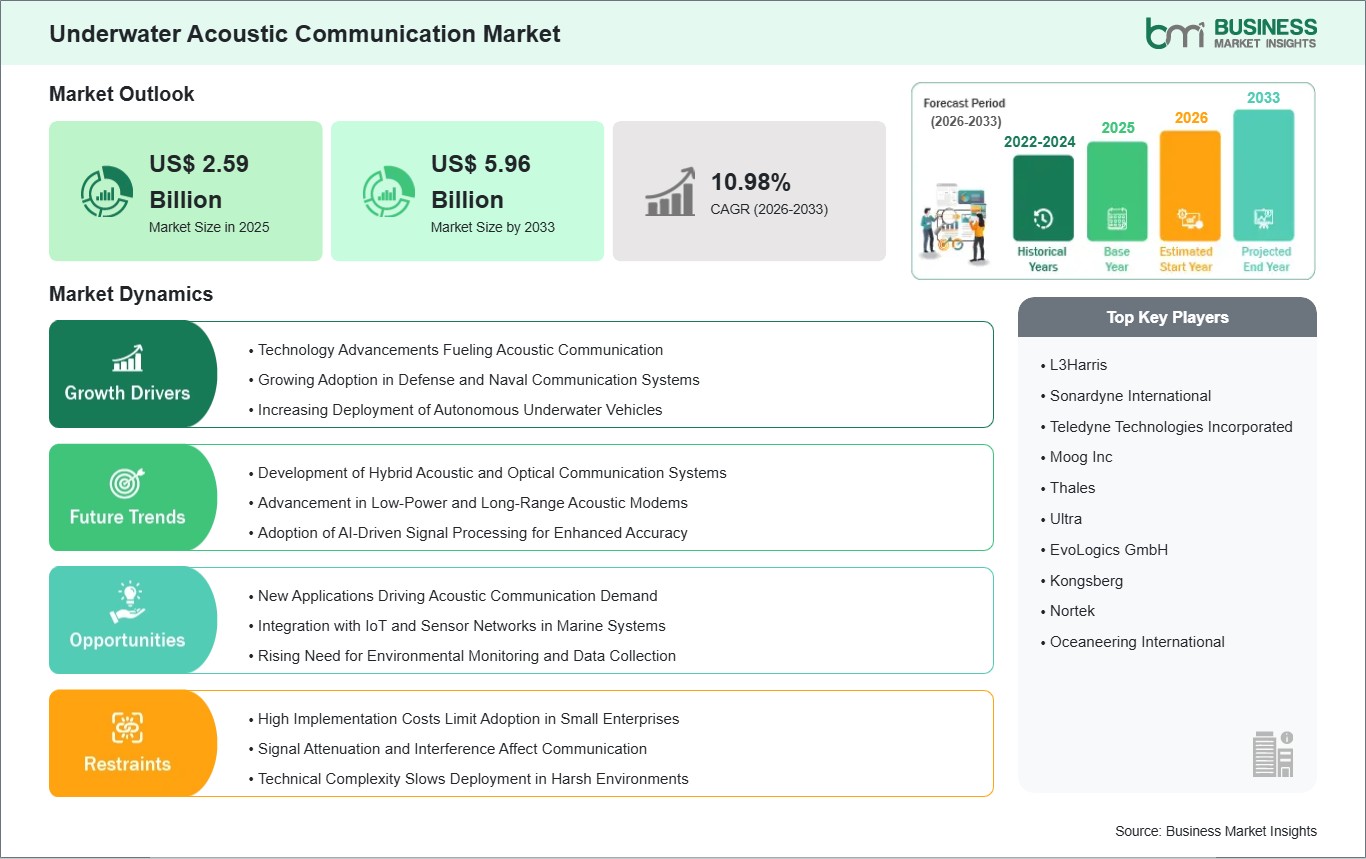
The Underwater Acoustic Communication Market size is expected to reach US$ 5.96 billion by 2033 from US$ 2.59 billion in 2025. The market is estimated to record a CAGR of 10.98% from 2026 to 2033.
The global underwater acoustic communication market is growing steadily as industries rely more on subsea operations in defense, commercial, and scientific sectors. Unlike traditional communication systems on land, radio waves degrade quickly in water. This makes acoustic waves the best option for transmitting data underwater. This technology has become crucial for various applications, such as networking unmanned underwater vehicles (UUVs), supporting submarine operations, monitoring offshore infrastructure, and collecting real-time environmental data. Recent technological advancements have strengthened the market. Modern acoustic modems now feature adaptive signal processing, noise reduction, and dynamic channel management, allowing for more reliable data transfer in challenging deep-sea or coastal conditions.
Additionally, AI-driven optimization helps systems adjust their transmission strategies in real time. This enables them to handle environmental challenges like multipath interference, changes in salinity, and temperature variations. Defense applications continue to drive global demand. Navies worldwide are updating their communication networks and deploying UUVs for surveillance, reconnaissance, and anti-submarine missions. Outside of defense, commercial sectors, including offshore oil and gas, subsea pipeline monitoring, and renewable energy installations, increasingly depend on acoustic networks to ensure operational safety and efficiently transmit sensor data. Scientific research and environmental monitoring are also key growth areas. Organizations are using these networks to study ocean currents, track marine biodiversity, and collect climate-related data in areas that surface communication technologies cannot reach.
Despite its growing use, the market faces challenges. Acoustic systems typically have lower data transfer rates compared to optical or radio-frequency alternatives. They are also influenced by environmental factors such as background noise and marine activity. Installation and maintenance costs can limit adoption, especially for smaller operations. However, ongoing innovations, such as hybrid communication systems that combine acoustic, optical, and RF technologies, along with enhanced signal processing methods, are expected to overcome these issues. With maritime activity increasing and subsea operations becoming more complex worldwide, underwater acoustic communication is set to remain essential for secure and efficient underwater data transfer.

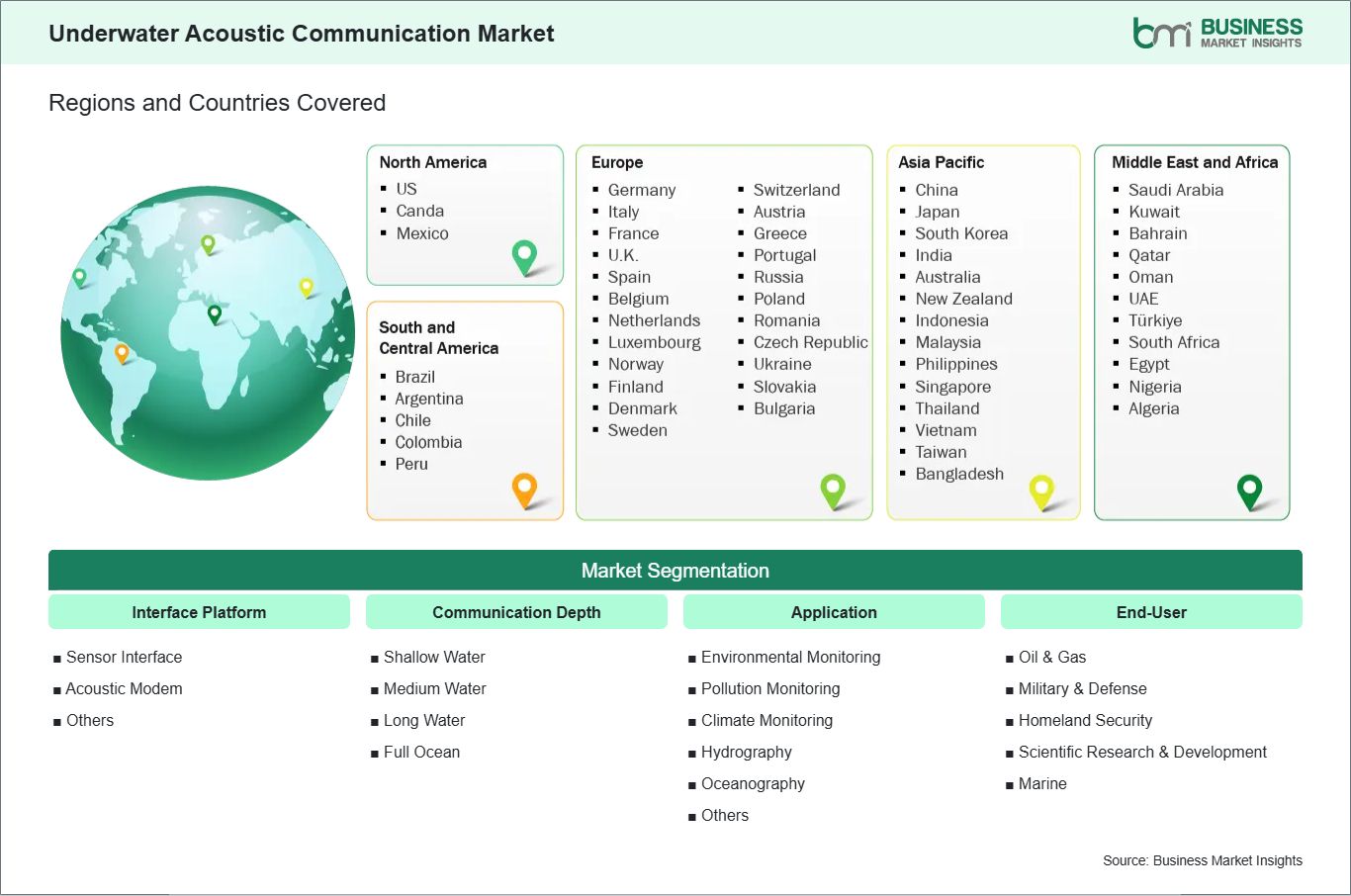
Key segments that contributed to the derivation of the underwater acoustic communication market analysis are interface platform, communication depth, application and end-user.
The global underwater acoustic communication market is driven by ongoing technological innovation that aims to improve performance, reliability, and data transfer speed. Modern acoustic modems now use adaptive signal processing and noise-reduction technologies. This allows for stable communication in both deep-sea and shallow-water environments. These improvements tackle old problems like multipath interference and slow transmission speeds, making long-distance communication more feasible and effective. Artificial intelligence (AI) and machine learning (ML) are also being added to improve system response.
By adjusting transmission settings based on environmental conditions, these systems maintain a steady, high-quality data flow. This is crucial for defense operations, offshore energy monitoring, and scientific research. New hybrid communication solutions combine acoustic systems with optical or radio-frequency technologies to meet specific operational needs. While optical methods offer fast data transfer over short distances, acoustic technology is still vital for long-distance subsea communication. This broadens the range and use of these systems around the world.
Underwater acoustic communication is becoming more common in various fields beyond just military use. Defense organizations still use these systems for secure submarine networks and coordination of unmanned underwater vehicles, especially in North America and Asia-Pacific, where naval modernization is happening. Commercial industries, like offshore oil, gas, and renewable energy, use acoustic networks to monitor subsea infrastructure and enhance operational safety. Real-time data transmission helps with predictive maintenance and reduces expensive downtime. This makes these systems essential for large-scale offshore work.
Furthermore, environmental monitoring and oceanographic research are increasing demand. Scientists and marine researchers set up acoustic communication networks to collect real-time data on biodiversity, ocean currents, and climate conditions. These varied applications highlight the flexibility of acoustic technology and indicate strong growth potential for the global market in the coming years.
The underwater acoustic communication market demonstrates steady growth, with size and share analysis highlighting evolving trends and competitive dynamics among key players. The report examines subsegments categorized within interface platform, communication depth, application and end-user, offering insights into their contribution to overall market performance.
By Interface platform, the acoustic modem subsegment dominated the market in 2025, driven by its essential role in enabling reliable underwater data transmission for a wide range of marine applications.
Based on communication depth, the medium water subsegment dominated the market in 2025, driven by the extensive deployment of underwater communication systems at intermediate depths for research, environmental monitoring, and industrial operations.
On the basis of application, the environmental monitoring subsegment dominated the market in 2025, driven by growing demand for real-time oceanic and aquatic ecosystem data collection to support climate studies and marine resource management.
In terms of end-user, the scientific research & development subsegment dominated the market in 2025, driven by high adoption of underwater acoustic communication systems for oceanography, marine biology, and experimental studies in controlled and open water environments.
| Report Attribute | Details |
|---|---|
| Market size in 2025 | US$ 2.59 Billion |
| Market Size by 2033 | US$ 5.96 Billion |
| Global CAGR (2026 - 2033) | 10.98% |
| Historical Data | 2022-2024 |
| Forecast period | 2026-2033 |
| Segments Covered | By Interface Platform
|
|
Regions and Countries Covered
| |
| North America | US, Canada, Mexico |
| Europe | Belgium, Austria, Finland, Denmark, Greece, Poland, Romania, Russia, Ukraine, Czech Republic, Slovakia, Bulgaria, Italy, Luxembourg, Germany, Switzerland, France, Netherlands, Norway, Portugal, Spain, Sweden, United Kingdom |
| Asia-Pacific | Australia, China, India, Japan, South Korea, Indonesia, Malaysia, Philippines, Singapore, Thailand, Vietnam, Bangladesh, New Zealand, Taiwan |
| South and Central America | Brazil, Argentina, Peru, Chile, Colombia |
| Middle East and Africa | Bahrain, Kuwait, Oman, Qatar, Saudi Arabia, United Arab Emirates, Turkiye, South Africa, Egypt, Algeria, Nigeria |
| Market leaders and key company profiles |
|
The "Underwater Acoustic Communication Market Size and Forecast (2022 - 2033)" report provides a detailed analysis of the market covering below areas:
The geographical scope of the Underwater Acoustic Communication Market report is divided into North America, Asia Pacific, Europe, Middle East & Africa, and South & Central America. North America held the largest share in 2025.
North America leads the global underwater acoustic communication market, driven by robust defense programs, advanced naval infrastructure, and the presence of major technology developers. The United States and Canada are at the forefront of deploying submarine communication systems, unmanned underwater vehicles (UUVs), and maritime surveillance networks that rely heavily on acoustic communication for long-distance, reliable data transfer.
In addition, the region’s offshore oil and gas operations, along with a growing number of renewable energy projects such as offshore wind farms, are increasingly adopting acoustic networks to monitor subsea assets and ensure operational safety. Strong collaboration between defense agencies, private industry, and research institutions further reinforces North America’s market leadership.
The Asia Pacific market is expanding rapidly, fueled by growing naval modernization, rising offshore energy exploration, and government initiatives supporting marine research. Nations including China, Japan, South Korea, and Australia are investing heavily in both defense and commercial subsea communication networks to strengthen maritime security and support offshore infrastructure and scientific research.
Europe maintains a stable market position, driven by defense upgrades, oceanographic research, and the monitoring of critical subsea infrastructure. Countries in Western Europe are integrating AI-based signal optimization and hybrid communication technologies to enhance the efficiency and reliability of acoustic networks.
The Middle East and Africa are witnessing moderate growth, primarily supported by offshore oil and gas projects in the Persian Gulf and North Africa, where acoustic systems play a crucial role in subsea monitoring and pipeline management.
Meanwhile, South and Central America are emerging markets, with Brazil and Argentina leading adoption through increasing offshore energy initiatives, naval development, and marine research programs. Across all regions, the push for advanced acoustic technologies, real-time monitoring solutions, and hybrid communication systems continues to drive global growth while addressing local operational challenges and environmental factors.

The Underwater Acoustic Communication Market is evaluated by gathering qualitative and quantitative data post primary and secondary research, which includes important corporate publications, association data, and databases. A few of the key developments in the underwater acoustic communication market are:
The Underwater Acoustic Communication Market is valued at US$ 2.59 Billion in 2025, it is projected to reach US$ 5.96 Billion by 2033.
As per our report Underwater Acoustic Communication Market, the market size is valued at US$ 2.59 Billion in 2025, projecting it to reach US$ 5.96 Billion by 2033. This translates to a CAGR of approximately 10.98% during the forecast period.
The Underwater Acoustic Communication Market report typically cover these key segments-
The historic period, base year, and forecast period can vary slightly depending on the specific market research report. However, for the Underwater Acoustic Communication Market report:
The Underwater Acoustic Communication Market is populated by several key players, each contributing to its growth and innovation. Some of the major players include:
The Underwater Acoustic Communication Market report is valuable for diverse stakeholders, including:
Essentially, anyone involved in or considering involvement in the Underwater Acoustic Communication Market value chain can benefit from the information contained in a comprehensive market report.
Please tell us your area of interest
(Market Segments/ Regions and Countries/ Companies)