Distributed Acoustic Sensing Market Outlook (2022–2033)

Historic Data: 2022-2024   |   Base Year: 2025   |   Forecast Period: 2026-2033
Report Content: Market Scope, Market Segmentation, Market Dynamics, and Competitive Analysis

Report Coverage:
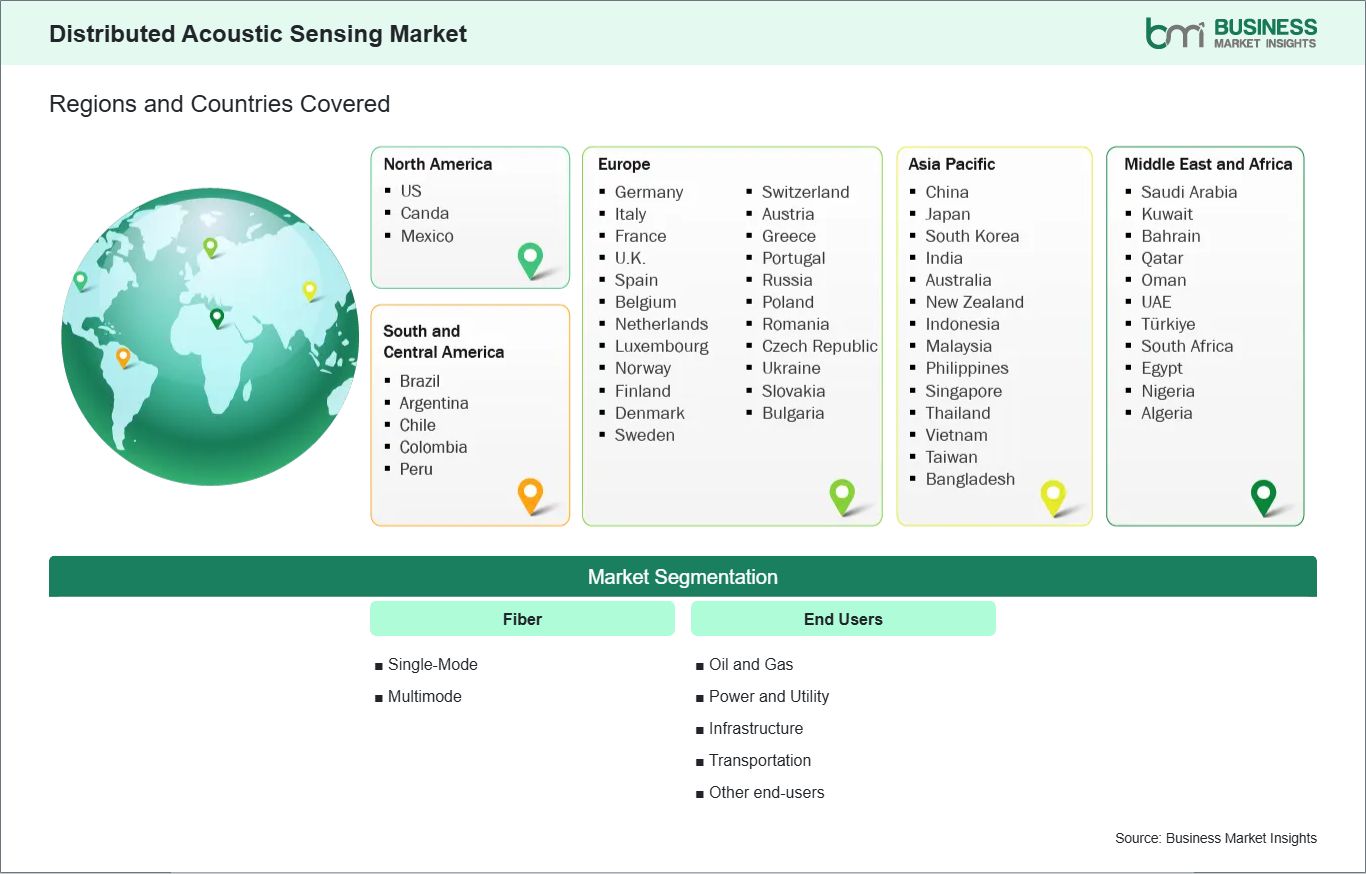
  • Fiber (Single-Mode, Multimode)
  • End Users (Oil and Gas, Power and Utility, Infrastructure, Transportation, Other end-users)

No. of Pages: 400
Report Code: BMIPUB00033693
Category: Electronics and Semiconductor
Distributed Acoustic Sensing Market

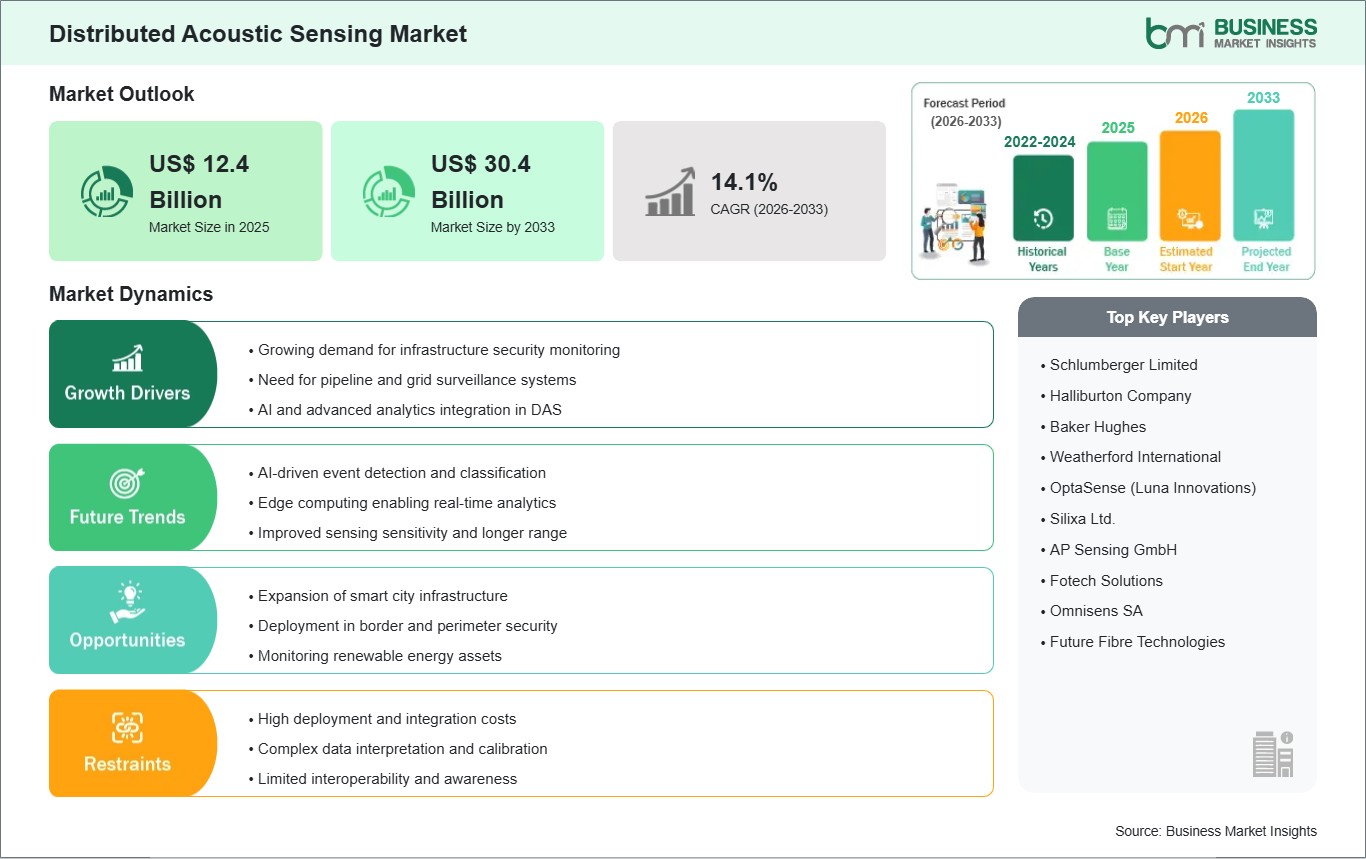
The Distributed Acoustic Sensing (DAS) market size is expected to reach US$ 30.4 billion by 2033 from US$ 12.4 billion in 2025, growing at a CAGR of 14.1% from 2026 to 2033.

Executive Summary and Global Market Analysis:

The Distributed Acoustic Sensing (DAS) market is emerging as a transformative segment within the fiber-optic sensing ecosystem. DAS technology utilizes standard fiber-optic cables as continuous acoustic sensors by detecting backscattered light variations caused by vibrations, strain, or temperature fluctuations along the fiber length. This enables real-time, long-range monitoring of critical infrastructure with high spatial resolution and sensitivity.

Industries such as oil & gas, power transmission, railways, border security, and smart infrastructure are increasingly deploying DAS systems to enhance operational visibility, prevent failures, and improve asset integrity management. The technology provides continuous monitoring over tens of kilometers using a single interrogator unit, offering cost-effective and scalable solutions compared to traditional point sensors.

Market growth is driven by rising demand for pipeline surveillance, leak detection, perimeter intrusion detection, and structural health monitoring. Integration with AI-driven analytics, cloud platforms, and edge computing enhances real-time data interpretation and predictive capabilities. However, high initial deployment costs, complex data interpretation, and integration challenges with legacy systems may restrain short-term growth. Nevertheless, increasing investments in critical infrastructure protection and smart city initiatives are expected to create substantial long-term opportunities.

Distributed Acoustic Sensing Market - Strategic Insights:

global-market-strategic-framework
Get more information on this report

Distributed Acoustic Sensing Market Segmentation Analysis:

Key segments that contributed to the Distributed Acoustic Sensing market analysis are fiber type, and end user.

  • By fiber type, the market is divided into single-mode fiber and multimode fiber. The single-mode fiber segment held the largest market share in 2025 due to its superior long-distance sensing capability and higher sensitivity.
  • By end user, the market is categorized into oil & gas, power & utility, transportation, defense & security, and other end-users. The oil & gas segment accounted for the largest share in 2025.

Distributed Acoustic Sensing Market Drivers and Opportunities:

Rising Demand for Infrastructure Security and Asset Integrity

Growing concerns regarding pipeline leaks, unauthorized intrusions, and structural failures are increasingly driving the adoption of Distributed Acoustic Sensing (DAS) systems across critical infrastructure sectors. In the oil & gas industry, pipelines often span hundreds or thousands of kilometers, traversing remote and environmentally sensitive regions. Even minor leaks or third-party interference can lead to severe environmental damage, operational disruption, and significant financial losses. DAS systems transform standard fiber-optic cables into continuous acoustic sensors, enabling operators to detect unusual vibrations, pressure changes, or mechanical disturbances along the entire pipeline in real time. This allows for immediate alerts and rapid intervention, preventing small anomalies from escalating into catastrophic events.

Similarly, utilities and energy transmission operators leverage DAS to monitor power lines, substations, and grid assets. By continuously tracking acoustic signatures along transmission corridors, DAS can detect tree falls, line sagging, conductor wear, or unauthorized human and vehicle activity near critical equipment, enhancing both operational safety and grid reliability. For renewable energy assets such as wind farms, DAS also monitors turbine vibrations, foundation stress, and mechanical integrity, ensuring proactive maintenance and optimized energy output.

Expansion of Smart Cities and Transportation Networks

Rapid urbanization, coupled with the global push for smart city initiatives, is significantly expanding opportunities for Distributed Acoustic Sensing (DAS) deployment across urban transportation, infrastructure, and public safety systems. Modern cities require continuous, real-time monitoring of highly complex networks, including railways, roads, metro systems, bridges, tunnels, and public facilities, to ensure operational efficiency, passenger safety, and asset longevity. DAS provides a scalable, non-intrusive solution by transforming existing fiber-optic cables into continuous acoustic sensors, offering high-resolution detection of vibrations, strains, and unusual acoustic events along entire infrastructure networks.

In the rail sector, DAS allows operators to monitor every segment of the track continuously. It can detect track defects, misalignments, rail breaks, rockfalls, or other obstructions, as well as monitor train movements for irregular patterns. Early detection of anomalies enables preventive maintenance, reducing service interruptions and minimizing the risk of accidents. For metro and high-speed rail networks, where delays or safety incidents can impact millions of commuters daily, DAS ensures operational reliability and passenger safety while optimizing maintenance schedules.

Distributed Acoustic Sensing Market Size and Share Analysis:

By fiber type, single-mode fiber dominated the market in 2025 due to its ability to monitor longer distances with higher accuracy.

By end user, the oil & gas sector led the market in 2025, while power & utility and transportation sectors are projected to witness steady growth driven by digital grid transformation and rail infrastructure upgrades.

Distributed Acoustic Sensing Market Report Highlights:

Report Attribute Details
Market size in 2025 US$ 12.4 Billion
Market Size by 2033 US$ 30.4 Billion
Global CAGR (2026 - 2033)14.1%
Historical Data 2022-2024
Forecast period 2026-2033
Segments Covered By Fiber
  • Single-Mode
  • Multimode
By End Users
  • Oil and Gas
  • Power and Utility
  • Infrastructure
  • Transportation
  • Other end-users
Regions and Countries Covered
North America US, Canada, Mexico
Europe Belgium, Austria, Finland, Denmark, Greece, Poland, Romania, Russia, Ukraine, Czech Republic, Slovakia, Bulgaria, Italy, Luxembourg, Germany, Switzerland, France, Netherlands, Norway, Portugal, Spain, Sweden, United Kingdom
Asia-Pacific Australia, China, India, Japan, South Korea, Indonesia, Malaysia, Philippines, Singapore, Thailand, Vietnam, Bangladesh, New Zealand, Taiwan
South and Central America Brazil, Argentina, Peru, Chile, Colombia
Middle East and Africa Bahrain, Kuwait, Oman, Qatar, Saudi Arabia, United Arab Emirates, Turkiye, South Africa, Egypt, Algeria, Nigeria
Market leaders and key company profiles
  • Schlumberger Limited
  • Halliburton Company
  • Baker Hughes
  • Weatherford International
  • OptaSense (Luna Innovations)
  • Silixa Ltd.
  • AP Sensing GmbH
  • Fotech Solutions
  • Omnisens SA
  • Future Fibre Technologies
Get more information on this report

Distributed Acoustic Sensing Market Report Coverage and Deliverables:

The "Distributed Acoustic Sensing Market Size and Forecast (2022 - 2033)" report provides a detailed analysis of the market covering below areas:

  • Distributed Acoustic Sensing market size and forecast at global, regional, and country levels for all the key market segments covered under the scope
  • Distributed Acoustic Sensing market trends, as well as market dynamics such as drivers, restraints, and key opportunities
  • Distributed Acoustic Sensing market analysis covering key market trends, global and regional framework, major players, regulations, and recent market developments
  • Industry landscape and competition analysis covering market concentration, heat map analysis, prominent players, and recent developments for the Distributed Acoustic Sensing market
  • Detailed company profiles, including SWOT analysis

Distributed Acoustic Sensing Market Geographic Insights:

The Distributed Acoustic Sensing market is geographically segmented into North America, Europe, Asia Pacific, Middle East & Africa, and South & Central America, reflecting varying levels of infrastructure development, regulatory enforcement, and industrial digitization. Asia Pacific is expected to witness the fastest growth during the forecast period. Rapid industrialization, expansion of pipeline networks, railway modernization projects, and increasing investments in smart infrastructure across China, India, Japan, and South Korea are key growth drivers. Government initiatives promoting digital monitoring technologies further support regional expansion.

North America and Europe represent mature markets characterized by strong regulatory frameworks, high technology adoption, and significant investments in energy and transportation infrastructure protection. The presence of established oil & gas pipelines and advanced rail networks drives sustained demand for DAS solutions. Middle East & Africa and South & Central America are emerging markets experiencing steady growth due to expanding energy exploration activities, cross-border pipeline projects, and infrastructure modernization programs. Increasing focus on asset security and operational efficiency is expected to accelerate adoption across these regions.

global-market-geography
Get more information on this report

Distributed Acoustic Sensing Market Research Report Guidance:

  • The report includes qualitative and quantitative data in the Distributed Acoustic Sensing market across fiber, end user, and geography.
  • The report starts with the key takeaways (chapter 2), highlighting the key trends and outlook of the Distributed Acoustic Sensing market.
  • Chapter 3 includes the research methodology of the study.
  • Chapter 4 further includes ecosystem analysis.
  • Chapter 5 highlights the major industry dynamics in the Distributed Acoustic Sensing market, including factors that are driving the market, prevailing deterrents, potential opportunities, as well as future trends. Impact analysis of these drivers and restraints is also covered in this section.
  • Chapter 6 discusses the Distributed Acoustic Sensing market scenario, in terms of historical market revenues, and forecast till the year 2033.
  • Chapters 7 to 10 cover Distributed Acoustic Sensing market segments by product type, connectivity type, and geography across North America, Europe, Asia Pacific, Middle East and Africa, and South and Central America. They cover the market volume revenue forecast and factors driving the market.
  • Chapter 11 describes the competitive analysis along with the heat map analysis for the key players operating in the market.
  • Chapter 12 describes the industry landscape analysis. It provides detailed descriptions of business activities such as market initiatives, new developments, mergers, and joint ventures globally, along with a competitive landscape.
  • Chapter 13 provides detailed profiles of the major companies operating in the Distributed Acoustic Sensing market. Companies have been profiled on the basis of their key facts, business descriptions, products and services, financial overview, SWOT analysis, and key developments.
  • Chapter 14, i.e., the appendix is inclusive of a brief overview of the company, list of abbreviations, and disclaimer.

Distributed Acoustic Sensing Market News and Key Development:

The Distributed Acoustic Sensing market is evaluated by gathering qualitative and quantitative data post primary and secondary research, which includes important corporate publications, association data, and databases. A few of the key developments in the Distributed Acoustic Sensing market are:

  • In April 2024, NASA announced the plan to use Distributed Acoustic Sensing (DAS) systems to measure lunar quakes.
  • In December 2023, Luna Innovations acquired Silixa, a UK-based fiber optic sensing solutios company, to enhance its DAS systems.

Key Sources Referred:

  • International Data Corporation (IDC)
  • Consumer Technology Association (CTA)
  • National Institute of Standards and Technology (NIST)
  • Company website
  • Company annual reports
  • Company investor presentations
The List of Companies - Distributed Acoustic Sensing Market
  • Schlumberger Limited
  • Halliburton Company
  • Baker Hughes
  • Weatherford International
  • OptaSense (Luna Innovations)
  • Silixa Ltd.
  • AP Sensing GmbH
  • Fotech Solutions
  • Omnisens SA
  • Future Fibre Technologies
Frequently Asked Questions
How big is the Distributed Acoustic Sensing Market?

The Distributed Acoustic Sensing Market is valued at US$ 12.4 Billion in 2025, it is projected to reach US$ 30.4 Billion by 2033.

What is the CAGR for Distributed Acoustic Sensing Market by (2026 - 2033)?

As per our report Distributed Acoustic Sensing Market, the market size is valued at US$ 12.4 Billion in 2025, projecting it to reach US$ 30.4 Billion by 2033. This translates to a CAGR of approximately 14.1% during the forecast period.

What segments are covered in this report?

The Distributed Acoustic Sensing Market report typically cover these key segments-

  • Fiber (Single-Mode, Multimode)
  • End Users (Oil and Gas, Power and Utility, Infrastructure, Transportation, Other end-users)

What is the historic period, base year, and forecast period taken for Distributed Acoustic Sensing Market?

The historic period, base year, and forecast period can vary slightly depending on the specific market research report. However, for the Distributed Acoustic Sensing Market report:

  • Historic Period : 2022-2024
  • Base Year : 2025
  • Forecast Period : 2026-2033
  • Who are the major players in Distributed Acoustic Sensing Market?

    The Distributed Acoustic Sensing Market is populated by several key players, each contributing to its growth and innovation. Some of the major players include:

  • Schlumberger Limited
  • Halliburton Company
  • Baker Hughes
  • Weatherford International
  • OptaSense (Luna Innovations)
  • Silixa Ltd.
  • AP Sensing GmbH
  • Fotech Solutions
  • Omnisens SA
  • Future Fibre Technologies
  • Who should buy this report?

    The Distributed Acoustic Sensing Market report is valuable for diverse stakeholders, including:

    • Investors: Provides insights for investment decisions pertaining to market growth, companies, or industry insights. Helps assess market attractiveness and potential returns.
    • Industry Players: Offers competitive intelligence, market sizing, and trend analysis to inform strategic planning, product development, and sales strategies.
    • Suppliers and Manufacturers: Helps understand market demand for components, materials, and services related to concerned industry.
    • Researchers and Consultants: Provides data and analysis for academic research, consulting projects, and market studies.
    • Financial Institutions: Helps assess risks and opportunities associated with financing or investing in the concerned market.

    Essentially, anyone involved in or considering involvement in the Distributed Acoustic Sensing Market value chain can benefit from the information contained in a comprehensive market report.

    Available Report Formats

    pdf-format excel-format pptx-format
    Buy Now
    Sales Assistance
    +1 646 791 7070 (US & UK)
    Customization Form

    Please tell us your area of interest
    (Market Segments/ Regions and Countries/ Companies)