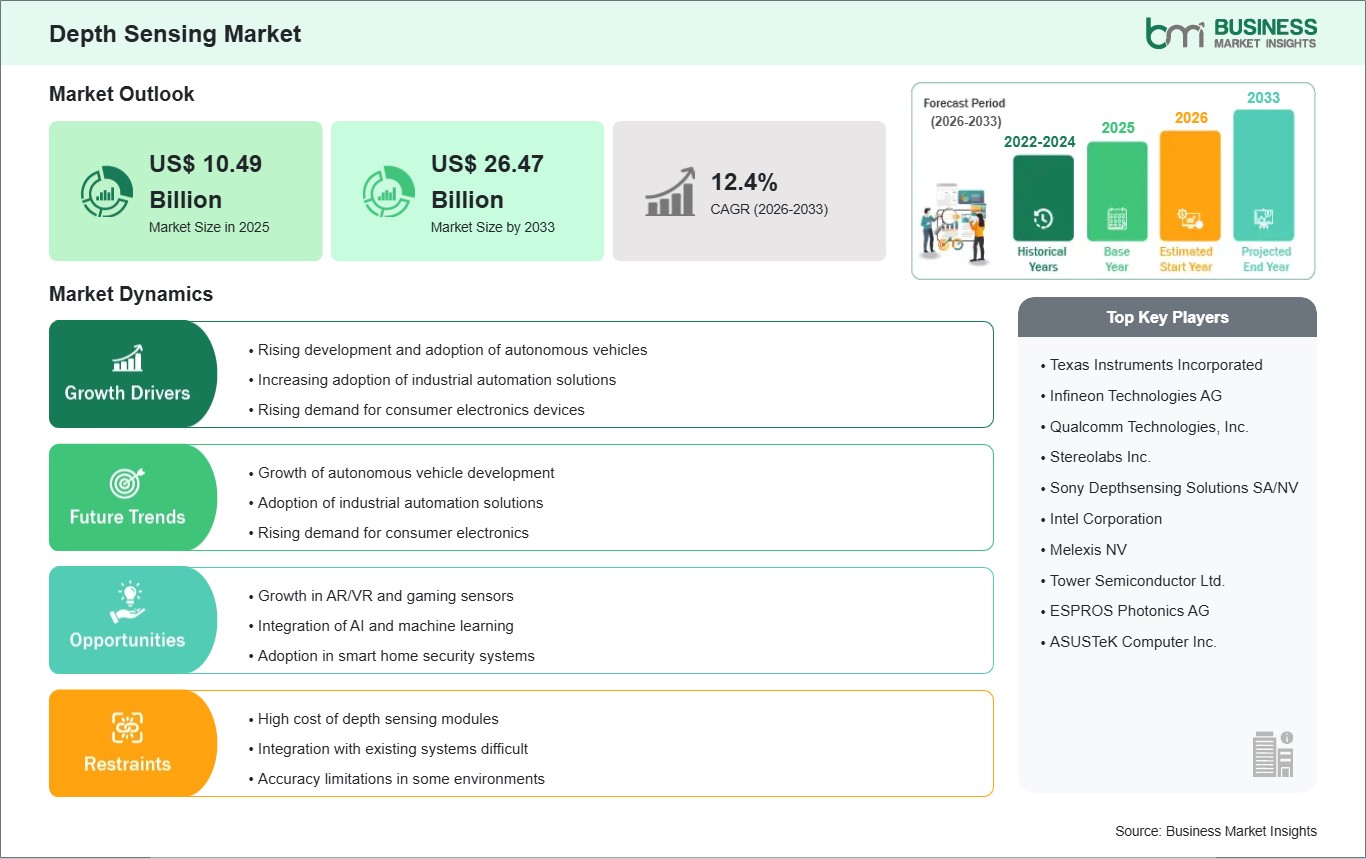
The Depth Sensing market size is expected to reach US$ 26.47 billion by 2033 from US$ 10.49 billion in 2025. The market is estimated to record a CAGR of 12.4% from 2026 to 2033.
The global Depth Sensing Market is experiencing significant growth, driven by rapid advancements in 3D imaging technologies and increasing demand across automotive, industrial, and consumer electronics sectors. Depth sensing enables accurate measurement of distance, spatial mapping, and object recognition, supporting applications such as autonomous navigation, robotics, quality inspection, and facial recognition. In 2025, the market was dominated by Active type depth sensing, which provides superior real-time performance compared to passive systems. Sensors, forming the core of depth measurement, accounted for the largest share among components, while Time-of-Flight technology led the market due to its capability to capture precise depth data over longer distances and in diverse lighting conditions. Among applications, Navigation Systems drove the market growth, reflecting the rising adoption of autonomous vehicles and robotic navigation solutions. By end-use, Industrial applications held the largest market share, fueled by automation, robotics, and quality control requirements in manufacturing.
Geographically, North America and Europe dominate the Depth Sensing Market due to the early adoption of advanced automotive technologies, industrial automation, and robust R&D infrastructure. Asia-Pacific is expected to register the fastest growth during the forecast period, driven by rapid industrialization, expansion of the electronics and robotics sectors, and increasing investments in autonomous mobility solutions. Latin America, the Middle East, and Africa are emerging markets, with growth supported by rising infrastructure development and adoption of advanced security and surveillance systems. The market’s expansion is further fueled by continuous innovations in sensor miniaturization, integration with AI and machine learning for real-time processing, and enhanced depth sensing capabilities across varied lighting and environmental conditions.

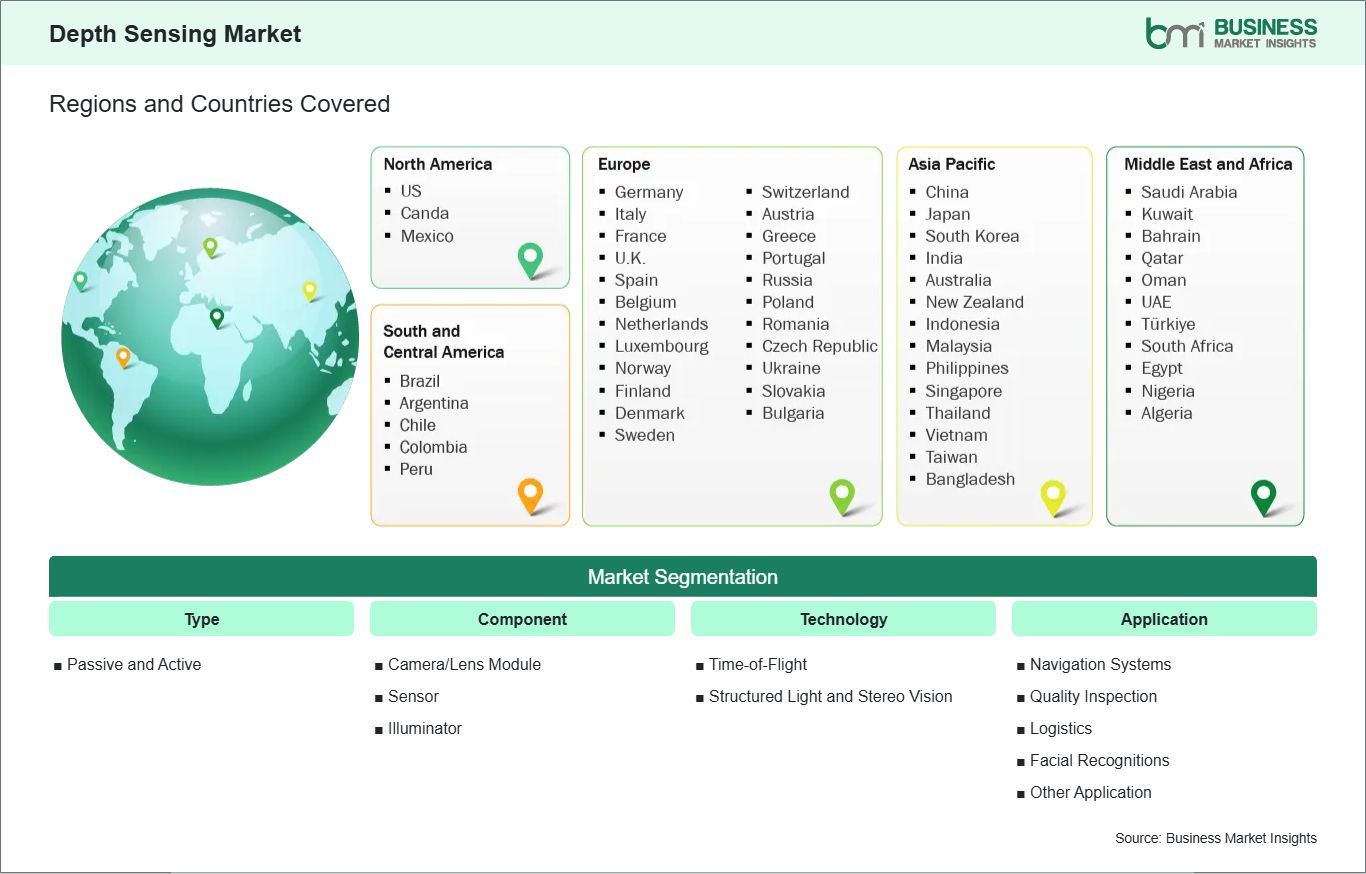
Key segments that contributed to the derivation of the Depth Sensing market analysis are type, component, technology, application, end-use.
The rapid growth of autonomous vehicles (AVs) and robotics is a key driver for the global Depth Sensing Market. Depth sensing technologies, including Time-of-Flight (ToF), Structured Light, and Stereo Vision, provide precise distance measurement, spatial mapping, and object detection—capabilities essential for safe navigation in real-time environments. In the automotive sector, depth sensors are integrated into Advanced Driver Assistance Systems (ADAS) to enhance lane detection, collision avoidance, and pedestrian recognition, which are critical for the adoption of semi-autonomous and fully autonomous vehicles. Similarly, in industrial robotics, depth sensing enables robotic arms and automated guided vehicles (AGVs) to interact safely with their environment, improving operational efficiency and reducing human error. The growing trend toward smart factories and Industry 4.0 further accelerates the demand for high-accuracy depth sensors, as they facilitate automated quality inspection, material handling, and assembly operations. Increasing government investments and regulatory support for autonomous mobility solutions across North America, Europe, and Asia-Pacific also drive market expansion. As industries seek to enhance automation, safety, and productivity, the adoption of advanced depth sensing technologies is expected to remain a primary growth driver for the market over the next decade.
The increasing integration of depth sensing technology into consumer electronics represents a significant growth opportunity for the market. Devices such as smartphones, tablets, gaming consoles, augmented reality (AR)/virtual reality (VR) headsets, and smart home systems are incorporating depth sensors to enable advanced functionalities like facial recognition, gesture control, 3D scanning, and immersive AR/VR experiences. The rising consumer demand for security, personalization, and interactive user interfaces is driving manufacturers to adopt high-precision depth sensing modules. For instance, smartphones equipped with Time-of-Flight or structured light sensors allow secure biometric authentication, improved camera autofocus, and enhanced AR applications, enhancing user engagement and convenience. Additionally, the growing popularity of AR/VR content in gaming, education, healthcare, and retail provides further avenues for depth sensing applications. The miniaturization of sensor modules and reductions in production costs have made it feasible to integrate depth sensing into a wider range of devices, broadening the addressable market. As technology evolves, the convergence of depth sensing with AI and machine learning will unlock more personalized and interactive experiences, creating long-term opportunities in the fast-growing consumer electronics and smart device segments.
Depth sensing market, by type, is segmented into Passive and Active. Among these, the Active type accounted for the largest share of the Depth Sensing market in 2025, driven by its higher accuracy and better performance in real-time 3D imaging applications.
Depth sensing market, by component, is divided into Camera/Lens Module, Sensor, and Illuminator, with the Sensor segment holding the largest market share in 2025, as sensors form the core of depth measurement and enable critical functionality across multiple applications.
Depth sensing market, by technology, is categorized into Time-of-Flight, Structured Light, and Stereo Vision, where Time-of-Flight dominated the market in 2025, owing to its ability to capture precise depth data over longer distances and in varying light conditions.
Depth sensing market, by application, includes Navigation Systems, Quality Inspection, Logistics, Facial Recognition, and Other Applications, with Navigation Systems leading the market in 2025, due to the increasing adoption of autonomous vehicles and robotic navigation solutions.
Depth sensing market, by end-use, is segmented into Industrial, Commercial, IT & Telecommunication, Government & Defense, Transportation, and Other End-Use, with Industrial applications accounting for the largest share in 2025, driven by the growing use of depth sensing in automation, quality control, and robotics within manufacturing sectors..
| Report Attribute | Details |
|---|---|
| Market size in 2025 | US$ 10.49 Billion |
| Market Size by 2033 | US$ 26.47 Billion |
| Global CAGR (2026 - 2033) | 12.4% |
| Historical Data | 2022-2024 |
| Forecast period | 2026-2033 |
| Segments Covered | By Type
|
|
Regions and Countries Covered
| |
| North America | US, Canada, Mexico |
| Europe | Belgium, Austria, Finland, Denmark, Greece, Poland, Romania, Russia, Ukraine, Czech Republic, Slovakia, Bulgaria, Italy, Luxembourg, Germany, Switzerland, France, Netherlands, Norway, Portugal, Spain, Sweden, United Kingdom |
| Asia-Pacific | Australia, China, India, Japan, South Korea, Indonesia, Malaysia, Philippines, Singapore, Thailand, Vietnam, Bangladesh, New Zealand, Taiwan |
| South and Central America | Brazil, Argentina, Peru, Chile, Colombia |
| Middle East and Africa | Bahrain, Kuwait, Oman, Qatar, Saudi Arabia, United Arab Emirates, Turkiye, South Africa, Egypt, Algeria, Nigeria |
| Market leaders and key company profiles |
|
The "Depth Sensing Market Size and Forecast (2022-2033)" report provides a detailed analysis of the market covering below areas:
The geographical scope of the Depth Sensing market report is divided into five regions: North America, Asia Pacific, Europe, Middle East & Africa, and South & Central America. The Depth Sensing market in Asia Pacific is expected to grow significantly during the forecast period.
The global Depth Sensing Market demonstrates strong regional variation, driven by technology adoption, industrial growth, and government initiatives. North America dominates the market, led by the United States and Canada, owing to the presence of major technology and semiconductor companies, robust R&D infrastructure, and early adoption of autonomous vehicles, robotics, and industrial automation solutions. High demand for advanced driver assistance systems (ADAS), facial recognition, and smart manufacturing applications further strengthens the market in this region. Europe is another significant market, with Germany, the United Kingdom, and France leading adoption. The region benefits from a strong automotive and industrial base, as well as government support for smart factories, Industry 4.0 initiatives, and automation technologies, boosting the demand for precision depth sensing systems.
Asia-Pacific is projected to grow at the fastest rate during the forecast period, driven by countries such as China, Japan, and South Korea, which have large consumer electronics markets, increasing investments in robotics, drones, AR/VR devices, and autonomous vehicle testing. Rapid industrialization and expansion of smart city projects further accelerate regional adoption. Emerging markets in South & Central America, the Middle East & Africa are gradually contributing to growth, supported by infrastructure development, security and surveillance adoption, and increasing awareness of automation technologies. Overall, regional growth is shaped by technological innovation, industrial priorities, and rising demand across consumer, commercial, and industrial sectors.

The Depth Sensing market is evaluated by gathering qualitative and quantitative data post primary and secondary research, which includes important corporate publications, association data, and databases. A few of the key developments in the Depth Sensing market are:
The Depth Sensing Market is valued at US$ 10.49 Billion in 2025, it is projected to reach US$ 26.47 Billion by 2033.
As per our report Depth Sensing Market, the market size is valued at US$ 10.49 Billion in 2025, projecting it to reach US$ 26.47 Billion by 2033. This translates to a CAGR of approximately 12.4% during the forecast period.
The Depth Sensing Market report typically cover these key segments-
The historic period, base year, and forecast period can vary slightly depending on the specific market research report. However, for the Depth Sensing Market report:
The Depth Sensing Market is populated by several key players, each contributing to its growth and innovation. Some of the major players include:
The Depth Sensing Market report is valuable for diverse stakeholders, including:
Essentially, anyone involved in or considering involvement in the Depth Sensing Market value chain can benefit from the information contained in a comprehensive market report.
Please tell us your area of interest
(Market Segments/ Regions and Countries/ Companies)