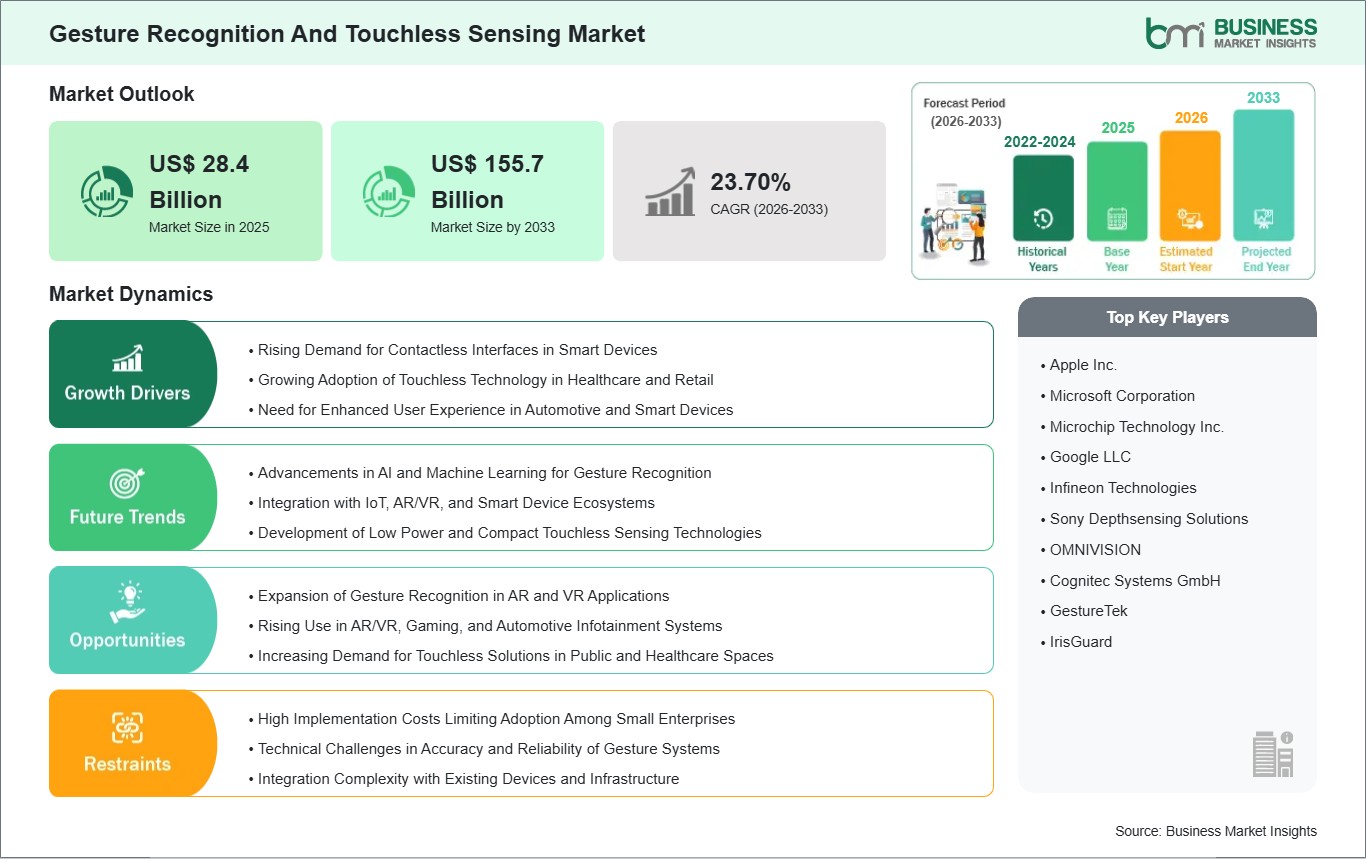
The Gesture Recognition And Touchless Sensing Market size is expected to reach US$ 155.7 Billion by 2033 from US$ 28.4 Billion in 2025. The market is estimated to record a CAGR of 23.70% from 2026 to 2033.
The global Gesture Recognition and Touchless Sensing Market is in an expansion phase due to the increasing rate of technology adoption in the consumer, industrial, automotive, and healthcare industries. Gesture recognition technology allows devices to "see" humans and respond to their movements in a way that is convenient and safe. The increasing need for smart devices and the rise of interconnected IoT technologies have become a key growth factor for the global Gesture Recognition and Touchless Sensing Market. The increasing use of touchless technology in smartphones, gaming consoles, smart TVs, wearable technology, infotainment systems in automobiles, smart home technologies, and others is also driven by the increasing need for convenient and safe user interfaces in the hands of consumers.
Advanced technologies such as infrared sensors, ultrasonic sensors, radar sensors, and 3D vision sensors are also helping to increase the accuracy and versatility of gesture recognition technology worldwide. The market is also being driven by the growing requirement for immersive experience in augmented reality, virtual reality, and mixed reality application development, where gesture recognition plays a vital role as a tool to facilitate navigation through such interfaces. Healthcare and industrial automation are also witnessing improved efficiency, safety, and hygiene through touchless sensing technology, particularly in scenarios where physical contact needs to be minimized. However, there are certain challenges associated with this technology as well, such as high development costs, integration complexities, and compatibility issues between device ecosystems.
In addition to this, there are also certain privacy and data security concerns related to vision-based gesture recognition technology that might act as a hindrance to the adoption of this technology in certain parts of the world. However, it can be safely asserted that this technology is expected to become an integral part of the future human machine interface landscape.

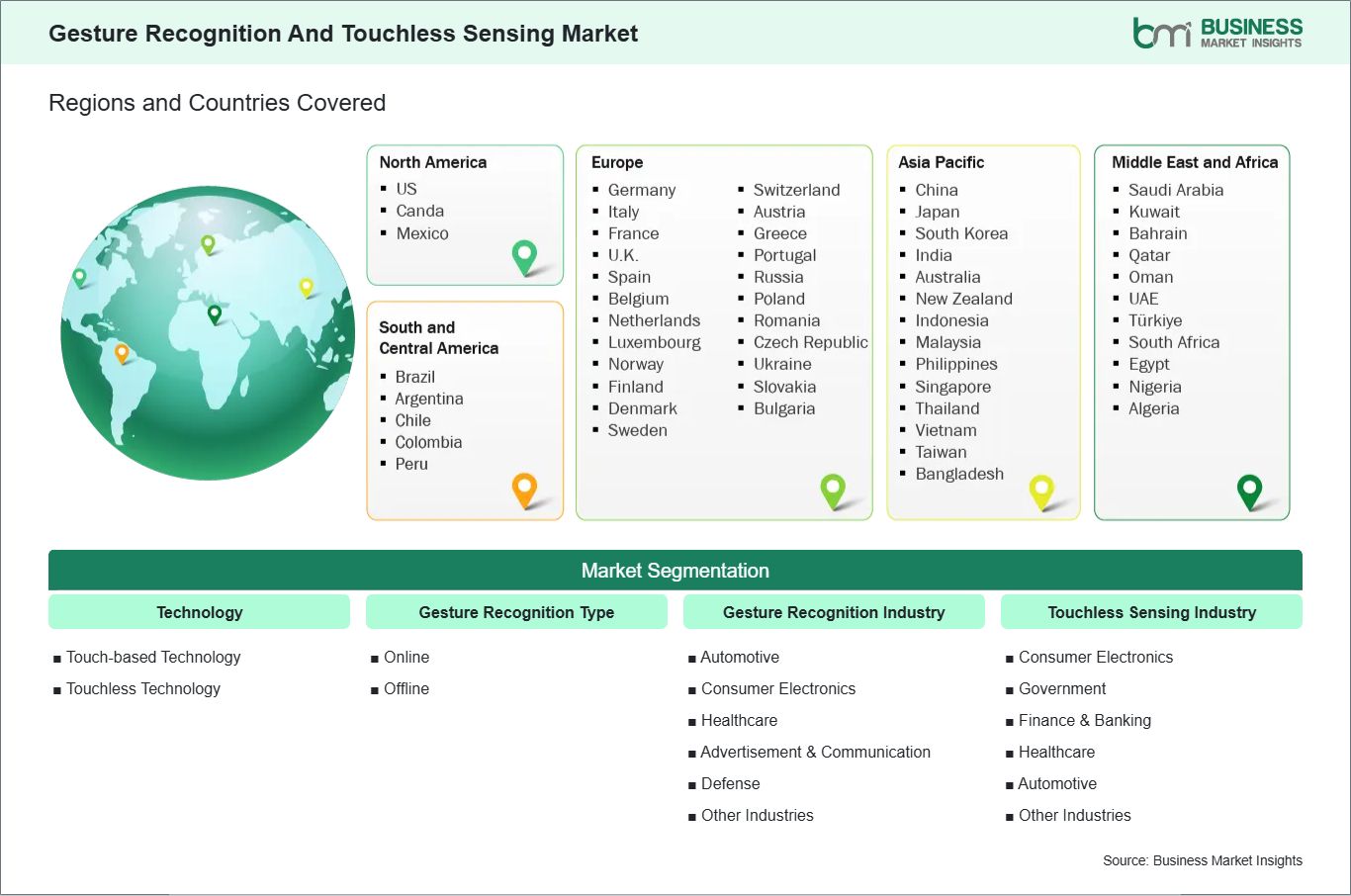
Key segments that contributed to the derivation of the gesture recognition and touchless sensing market analysis are technology, gesture recognition type, gesture recognition industry, touchless sensing industry and touchless sensing product.
The increasing adoption of smart devices worldwide is significantly driving the growth of the global Gesture Recognition and Touchless Sensing Market. Consumers are seeking more intuitive and convenient ways to interact with electronic devices, leading manufacturers to integrate gesture-based interfaces into smartphones, smart TVs, laptops, and smart home systems. These technologies allow users to control devices through simple hand movements or proximity sensing, eliminating the need for physical contact and improving user experience. As connected devices continue to expand across households and workplaces, gesture-based interaction is becoming an important feature in modern consumer electronics ecosystems.
Additionally, the growing awareness of hygiene and safety in public and shared environments has accelerated the demand for touchless technologies. Industries such as healthcare, retail, and hospitality are adopting gesture-enabled kiosks, digital displays, and medical equipment to minimize physical contact with surfaces. The integration of sensors, cameras, and artificial intelligence algorithms allows devices to accurately detect human gestures and movements, enabling seamless interaction in sterile or high-traffic environments. As organizations focus on improving operational efficiency and user convenience, touchless interfaces are becoming increasingly valuable across multiple sectors globally.
The rapid development of augmented reality (AR) and virtual reality (VR) technologies is creating new opportunities for gesture recognition systems. In immersive environments, gesture-based interaction enables users to control digital elements naturally without the need for traditional controllers or input devices. This technology enhances user engagement and allows more intuitive interaction with virtual objects, making it a key component of next-generation AR and VR platforms used in gaming, education, training, and simulation applications.
Advancements in computer vision, depth sensing, and artificial intelligence are improving the accuracy and responsiveness of gesture recognition in AR and VR systems. Motion tracking cameras, infrared sensors, and 3D sensing technologies allow precise monitoring of hand and body movements, enabling real-time interaction in virtual environments. As industries increasingly invest in immersive technologies for remote collaboration, product design, and training programs, gesture recognition is expected to become an essential interface technology supporting the global expansion of AR and VR ecosystems.
The gesture recognition and touchless sensing market demonstrates steady growth, with size and share analysis highlighting evolving trends and competitive dynamics among key players. The report examines subsegments categorized within technology, gesture recognition type, gesture recognition industry, touchless sensing industry and touchless sensing product, offering insights into their contribution to overall market performance.
By technology, the touch-based technology subsegment dominated the market in 2025, driven by its widespread adoption in smartphones, tablets, and interactive displays along with its mature and cost-effective implementation.
Based on gesture recognition type, the online subsegment dominated the market in 2025, driven by the growing demand for real-time gesture processing in applications such as gaming, smart devices, and automotive interfaces.
Based on gesture recognition industry, the consumer electronics subsegment dominated the market in 2025, driven by the high integration of gesture recognition technology in smartphones, smart TVs, gaming consoles, and wearable devices.
Based on touchless sensing industry, the automotive subsegment dominated the market in 2025, driven by increasing adoption of touchless controls in vehicle infotainment systems and advanced driver interaction technologies.
In terms of touchless sensing product, the touchless biometric equipment and others subsegment dominated the market in 2025, driven by rising demand for contactless authentication solutions in security, access control, and identity verification applications.
| Report Attribute | Details |
|---|---|
| Market size in 2025 | US$ 28.4 Billion |
| Market Size by 2033 | US$ 155.7 Billion |
| Global CAGR (2026 - 2033) | 23.70% |
| Historical Data | 2022-2024 |
| Forecast period | 2026-2033 |
| Segments Covered | By Technology
|
|
Regions and Countries Covered
| |
| North America | US, Canada, Mexico |
| Europe | Belgium, Austria, Finland, Denmark, Greece, Poland, Romania, Russia, Ukraine, Czech Republic, Slovakia, Bulgaria, Italy, Luxembourg, Germany, Switzerland, France, Netherlands, Norway, Portugal, Spain, Sweden, United Kingdom |
| Asia-Pacific | Australia, China, India, Japan, South Korea, Indonesia, Malaysia, Philippines, Singapore, Thailand, Vietnam, Bangladesh, New Zealand, Taiwan |
| South and Central America | Brazil, Argentina, Peru, Chile, Colombia |
| Middle East and Africa | Bahrain, Kuwait, Oman, Qatar, Saudi Arabia, United Arab Emirates, Turkiye, South Africa, Egypt, Algeria, Nigeria |
| Market leaders and key company profiles |
|
The "Gesture Recognition And Touchless Sensing Market Size and Forecast (2022 - 2033)" report provides a detailed analysis of the market covering below areas:
The geographical scope of the Gesture Recognition And Touchless Sensing Market report is divided into North America, Asia Pacific, Europe, Middle East & Africa, and South & Central America. North America held the largest share in 2025.
The Gesture Recognition and Touchless Sensing Market is characterized by unique growth patterns in the major global markets. The major markets in the Gesture Recognition and Touchless Sensing Market include North America, Europe, Asia-Pacific, and the Rest of the world. The Gesture Recognition and Touchless Sensing Market in North America is driven by the presence of advanced technology infrastructure in the region, coupled with the presence of major technology companies in this region. Moreover, this region is characterized by high adoption rates for innovative human-machine interface technologies. This region is also driven by high research and development activities in the United States and Canada, where gesture recognition technologies are widely adopted in consumer electronics, gaming consoles, infotainment systems in vehicles, healthcare devices, and smart home technologies.
The Europe region is another major market for the Gesture Recognition and Touchless Sensing Market. This region is driven by high demand for gesture recognition technologies in the automotive and industrial sectors in countries such as Germany, the United Kingdom, and France. Furthermore, the region’s strict safety standards, as well as the increased interest in advanced driver assistance systems, are contributing factors to the region’s steady uptake of touchless sensing systems.
The Asia Pacific region is the fastest-growing market, driven by the region’s rapid technological development, massive consumer electronics manufacturing, and the increased need for smart devices. The region’s key countries, including China, Japan, South Korea, and India, are witnessing the increased adoption of gesture recognition in smartphones, smart televisions, gaming systems, and automotive systems. The presence of key consumer electronics manufacturers, as well as the region’s massive investment in artificial intelligence technology, are contributing factors to the region’s market development.
The Middle East & Africa region is gradually emerging as a developing market, driven by the region’s increased investment in smart city development, digital technology, and advanced security systems. The countries in the region, including the Gulf region, are increasingly using touchless systems in airports, retail, healthcare, and hospitality sectors.
South & Central America is experiencing moderate growth driven by rising digitalization, expanding mobile device usage, and increasing adoption of biometric and contactless technologies across banking, retail, and transportation sectors, particularly in Brazil and Mexico.

The Gesture Recognition And Touchless Sensing Market is evaluated by gathering qualitative and quantitative data post primary and secondary research, which includes important corporate publications, association data, and databases. A few of the key developments in the gesture recognition and touchless sensing market are:
The Gesture Recognition And Touchless Sensing Market is valued at US$ 28.4 Billion in 2025, it is projected to reach US$ 155.7 Billion by 2033.
As per our report Gesture Recognition And Touchless Sensing Market, the market size is valued at US$ 28.4 Billion in 2025, projecting it to reach US$ 155.7 Billion by 2033. This translates to a CAGR of approximately 23.70% during the forecast period.
The Gesture Recognition And Touchless Sensing Market report typically cover these key segments-
The historic period, base year, and forecast period can vary slightly depending on the specific market research report. However, for the Gesture Recognition And Touchless Sensing Market report:
The Gesture Recognition And Touchless Sensing Market is populated by several key players, each contributing to its growth and innovation. Some of the major players include:
The Gesture Recognition And Touchless Sensing Market report is valuable for diverse stakeholders, including:
Essentially, anyone involved in or considering involvement in the Gesture Recognition And Touchless Sensing Market value chain can benefit from the information contained in a comprehensive market report.
Please tell us your area of interest
(Market Segments/ Regions and Countries/ Companies)