
Gesture Recognition Market Outlook: Size, Share, Trends, Growth Analysis, Competitive Landscape & Forecast, 2026-2033

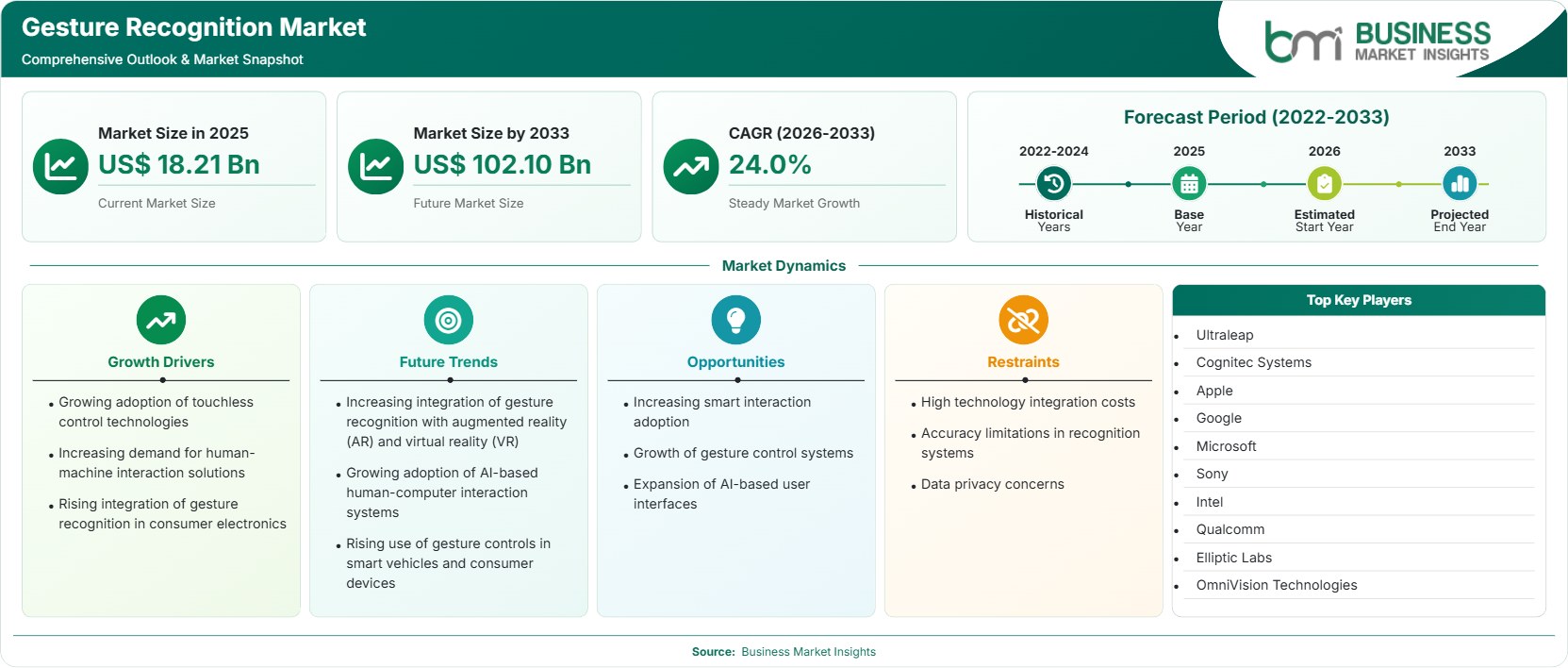
The Gesture Recognition Market size was valued at US$ 18.21 billion in 2025 and is projected to reach US$ 102.10 billion by 2033, growing at a CAGR of 24.0% during 2026–2033, driven by rising touchless interaction demand, artificial intelligence integration, human-machine interface development, and increasing adoption across consumer electronics, automotive, healthcare, and gaming sectors.

Report Coverage
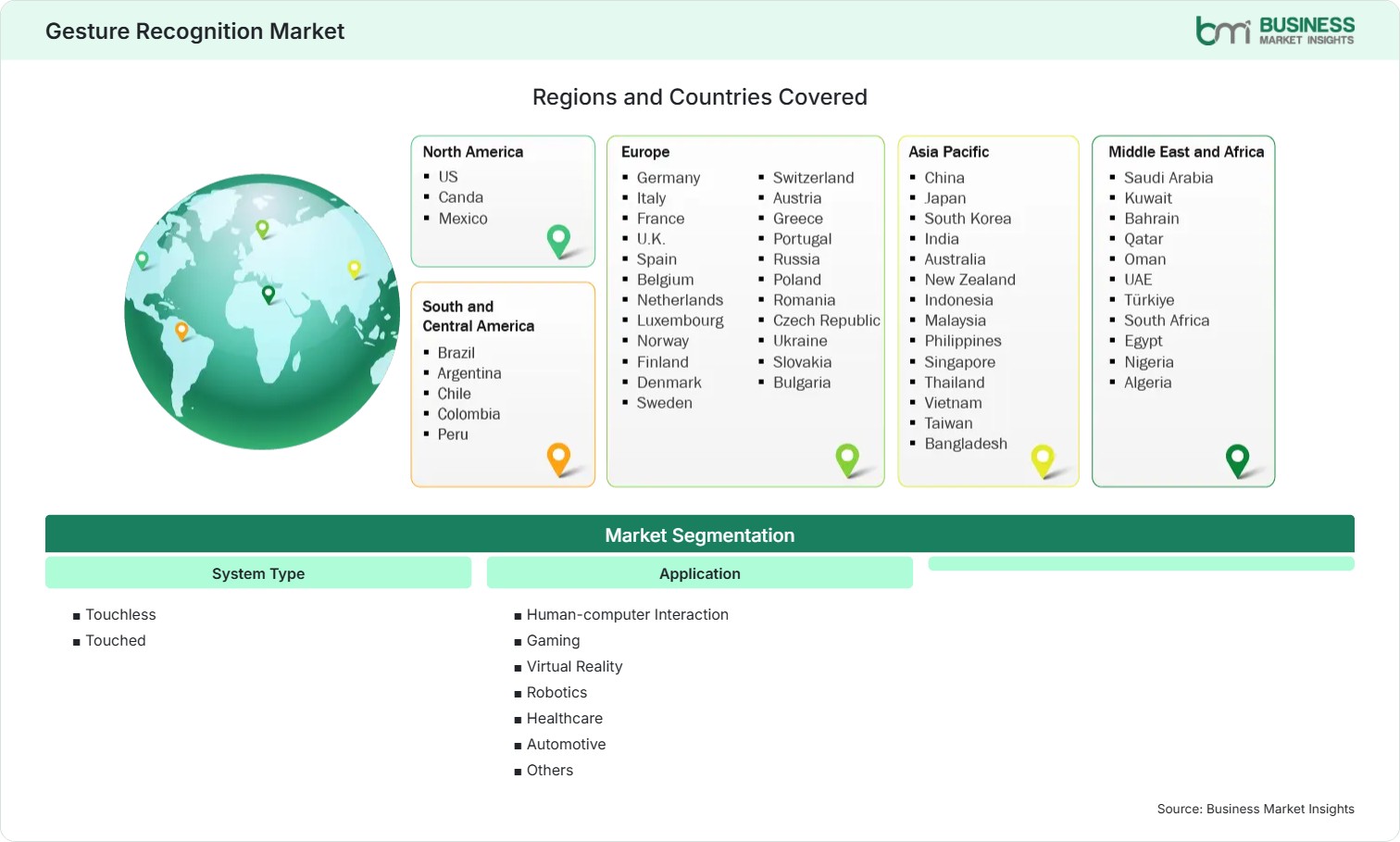
  • System Type: Touchless, Touched
  • Application: Human-computer Interaction, Gaming, Virtual Reality, Robotics, Healthcare, Automotive, Others
US$ 18.21 Bn Market size in 2025
US$ 102.10 Bn Market Size by 2033
24.0% CAGR, 2026 - 2033
2026-2033 Forecast Period

01 AI Overview

Gesture Recognition Market Summary

  • North America Region: North America holds a 34%–37% share in 2025 and is projected to grow at a CAGR of 22.5%–23.5% during 2026–2033, supported by advanced technology adoption, AI investments, consumer electronics innovation, and automotive applications. The US market is expected to expand at a 23.0%–24.0% CAGR, driven by technology companies, smart devices, and human-machine interface development.
  • Fastest Growing Region: Asia Pacific represents a 30%–33% share in 2025 and is forecast to achieve the fastest CAGR of 25.0%–26.0%, supported by expanding electronics manufacturing, artificial intelligence adoption, gaming growth, smart mobility development, and increasing digital transformation initiatives.
  • Leading Segment: Touchless systems account for a 58%–61% share in 2025 and are expected to grow at a CAGR of 24.0%–25.0%, supported by demand for hygienic interfaces, smart devices, automotive controls, and advanced user interaction technologies.
  • High Growth Segment: Virtual Reality applications are projected to grow at a CAGR of 27.0%–28.0%, driven by immersive entertainment, industrial simulation, training solutions, and increasing adoption of extended reality technologies.
  • Key Market Opportunity: AI-powered interfaces, smart devices, automotive automation, healthcare technologies, and immersive digital platforms are creating opportunities for gesture recognition providers to develop advanced interaction solutions.
  • Major Market Players: Ultraleap, Cognitec Systems, Apple, Google, Microsoft, Sony, Intel, Qualcomm, Elliptic Labs, OmniVision Technologies.
02 Strategic Insights

Gesture Recognition Market: Strategic Insights

Gesture Recognition Market Strategic Framework
FREE PDF
Request your free sample
Request free sample
03 Stakeholder View

Key Takeaways

  • The market ecosystem is shifting from conventional input methods toward AI-enabled interaction platforms combining sensors, software algorithms, and machine learning capabilities.
  • High-growth opportunities are emerging in automotive interfaces, virtual reality applications, healthcare systems, and smart consumer devices requiring intuitive user experiences.
  • Innovation is focused on improving recognition accuracy through advanced computer vision, depth sensing, edge computing, and AI-based interpretation models.
  • Asia Pacific offers strong investment potential due to electronics manufacturing expansion, technology adoption, gaming ecosystems, and smart device production capabilities.
  • Strategic collaborations between technology companies, semiconductor providers, and software developers are increasing to accelerate gesture-based interface development.
  • Companies are focusing on reducing latency, improving reliability, and developing energy-efficient gesture recognition solutions for mass-market applications.
04 Geographic Outlook

Gesture Recognition Market Regional Highlights

North America Gesture Recognition Market

North America accounted for a 34%–37% of the Gesture Recognition Market share in 2025 and is projected to grow at a CAGR of 22.5%–23.5% from 2026–2033. The region benefits from strong AI development, advanced consumer electronics adoption, automotive innovation, and significant investment in human-machine interaction technologies. The United States remains the leading contributor due to major technology companies and extensive adoption across multiple industries.

  • Technology companies are investing heavily in AI-based interaction solutions and computer vision systems.
  • Automotive manufacturers are integrating gesture controls into premium vehicle interfaces.
  • Healthcare organizations are exploring touchless systems for improved operational efficiency.
  • Gaming companies are adopting immersive interaction technologies for enhanced user experiences.
  • Smart device manufacturers are expanding gesture-enabled product portfolios.

US Gesture Recognition Market

The US accounted for 29%–32% of the market in 2025 and is forecast to grow at a CAGR of 23.0%–24.0% in the Gesture Recognition Market Forecasts. Growth is supported by strong technology infrastructure, AI innovation, consumer electronics development, and increasing adoption of advanced interfaces. Leading technology companies are accelerating commercialization of gesture recognition solutions across consumer and industrial applications.

  • AI research investments are improving gesture recognition algorithms and system performance.
  • Automotive companies are developing advanced cockpit interaction technologies.
  • Consumer electronics brands are integrating gesture controls into premium products.
  • Robotics applications are increasing demand for natural interaction methods.

Europe Gesture Recognition Market

Europe held a 22%–25% share in 2025 and is expected to grow at a CAGR of 23.0%–24.0% during 2026–2033. The region benefits from automotive innovation, industrial automation, healthcare technology adoption, and research activities in artificial intelligence. Germany, France, the United Kingdom, and other advanced economies are contributing to market development through smart manufacturing and mobility applications.

  • Germany is adopting gesture technologies across automotive and industrial automation sectors.
  • The United Kingdom is supporting AI-driven interface development through technology innovation.
  • France is expanding smart healthcare and digital interaction applications.
  • European automotive manufacturers are integrating gesture-based controls into vehicles.
  • Industrial automation is increasing demand for advanced human-machine interfaces.

Asia Pacific Gesture Recognition Market

Asia Pacific represented a 30%–33% share in 2025 and is projected to achieve the fastest CAGR of 25.0%–26.0% through 2033. Regional growth is driven by electronics manufacturing, smartphone adoption, gaming expansion, artificial intelligence development, and smart mobility investments. China, Japan, South Korea, and India are major contributors due to strong technology ecosystems.

  • China is expanding gesture technology adoption through electronics and AI development.
  • Japan is integrating gesture systems into robotics and automotive applications.
  • South Korea is supporting smart device innovation and digital interfaces.
  • India is experiencing growth through technology adoption and digital transformation.
  • Southeast Asian markets are increasing investment in smart consumer technologies.

Rest of World Gesture Recognition Market

Rest of World accounted for a 6%–9% share in 2025 and is expected to grow at a CAGR of 24.0%–25.0% between 2026–2033. Latin America, the Middle East, and Africa are slowly implementing gesture recognition via digital transformation programs, smart infrastructure projects, and increased access to technology. Increased need for automation is fuelling the adoption of gesture recognition systems in these regions.

  • Middle Eastern countries are investing in smart infrastructure and digital technologies.
  • Latin American markets are adopting advanced consumer electronics solutions.
  • African technology sectors are gradually integrating AI-based interaction systems.
  • Smart city initiatives are encouraging touchless technology deployment.
  • Digital transformation programs are supporting adoption across emerging economies.
Global Market Geography
FREE PDF
Request your free sample
Request free sample
05 Segment Analysis

Gesture Recognition Market Segmentation

System Type

The system type segment defines adoption based on interaction approach, sensing capability, and application requirements. Touchless systems accounted for the leading share in 2025 due to increasing demand for hygienic interfaces, advanced smart devices, and contact-free control solutions. The Gesture Recognition Market scope is growing as various industries incorporate gesture recognition technology into consumer electronics, automobiles, healthcare applications, and immersive applications. The development of AI, sensors, and computer vision technology is increasing system precision, thereby helping in its application in business environments. The companies are concentrating on building robust and fast systems for user interaction.

  • Touchless: Touchless gesture recognition systems are gaining adoption due to hygiene requirements, improved user convenience, and integration into smart devices, vehicles, healthcare equipment, and public interfaces.
  • Touched: Touched gesture systems continue supporting applications requiring physical interaction, precise control, and improved accuracy in consumer electronics and specialized industrial environments.

Application

The application segment is expanding as gesture recognition technology becomes integrated across multiple industries requiring intuitive and efficient interaction methods. Human-computer interaction remains a significant application area, while gaming, virtual reality, robotics, healthcare, and automotive sectors are increasingly adopting gesture-based controls. Growing demand for natural interfaces, automation, and immersive experiences is encouraging companies to develop advanced recognition systems. Artificial intelligence and machine learning improvements are enabling accurate interpretation of complex gestures, supporting broader commercialization across diverse applications.

  • Human-computer Interaction: Human-computer interaction applications are expanding through AI-powered interfaces that enable natural communication between users and digital systems across multiple platforms.
  • Gaming: Gaming applications are adopting gesture recognition to provide immersive experiences, enhanced motion control, and interactive gameplay through advanced sensing technologies.
  • Virtual Reality: Virtual reality platforms use gesture recognition to improve immersion, enable realistic interactions, and support advanced simulations across entertainment, training, and industrial environments.
  • Robotics: Robotics applications integrate gesture recognition for improved human-robot collaboration, intuitive commands, and efficient control in industrial and service environments.
  • Healthcare: Healthcare applications utilize gesture technology for touchless controls, rehabilitation solutions, and improved interaction with medical systems.
  • Automotive: Automotive applications are expanding through gesture-based infotainment controls, smart cabin technologies, and improved driver interaction experiences.
06 Market Forces

Gesture Recognition Market Dynamics

Key Market Drivers

Growing Adoption of Touchless Control Technologies

The Gesture Recognition Market growth is being accelerated by increasing adoption of touchless control technologies across consumer electronics, healthcare, automotive, and public environments. Businesses are implementing contact-free interfaces to improve convenience, hygiene, and user experience. Advances in sensors, computer vision, and artificial intelligence are improving gesture detection capabilities, enabling more accurate and responsive interactions.

The Gesture Recognition Market trends indicate that touchless technologies are becoming increasingly important in smart devices, digital kiosks, and automated systems. Companies are investing in advanced recognition solutions that reduce physical interaction requirements while improving accessibility and operational efficiency across multiple industries.

Increasing Demand for Human-machine Interaction Solutions

Growing demand for human-machine interaction solutions is driving adoption of gesture recognition technologies across industrial, automotive, and consumer applications. Organizations are seeking intuitive interfaces that improve productivity, reduce complexity, and enable seamless communication between humans and machines. Gesture-based systems allow users to control devices through natural movements, creating opportunities in robotics, smart manufacturing, and digital environments.

Increasing automation adoption is encouraging industries to develop more advanced interaction methods. Technology providers are focusing on improving recognition accuracy, reducing response time, and enhancing compatibility with artificial intelligence platforms to support next-generation interaction systems.

Rising Integration of Gesture Recognition in Consumer Electronics

Consumer electronics manufacturers are increasingly integrating gesture recognition features into smartphones, smart displays, wearable devices, and entertainment systems. Consumers are seeking more convenient and interactive digital experiences, encouraging brands to introduce advanced control mechanisms. Improved sensor technologies and AI algorithms are enabling compact and efficient gesture recognition solutions suitable for mass-market products.

The expansion of smart homes and connected devices is further increasing demand for intuitive interfaces. Manufacturers are focusing on enhancing reliability, personalization, and energy efficiency to improve user acceptance and differentiate products in competitive electronics markets.

Key Market Opportunities

Increasing Smart Interaction Adoption

The expansion of smart interaction technologies creates significant opportunities for gesture recognition providers across consumer, industrial, and commercial applications. Smart homes, connected vehicles, and intelligent devices are increasing demand for interfaces that enable simple and natural control methods. There is potential for companies to create technology solutions that integrate gesture recognition, artificial intelligence, voice, and connectivity.

The high customer demand for a personalized and convenient experience drives manufacturers to develop advanced ways to interact with their products. There are new opportunities for the industry as companies seek accessible, usable technologies.

Growth of Gesture Control Systems

As gesture controls continue to gain traction, there have been several applications across fields such as automotive, gaming, healthcare, and others. Corporations have begun adopting gesture technology to improve efficiency and enhance the user experience. The automotive industry has adopted gesture control in its infotainment system, while the gaming industry has embraced motion interactions.

Industrial applications are using gesture controls to improve machine operation and worker safety. Companies developing scalable and accurate gesture control technologies can benefit from expanding demand for intuitive interfaces across multiple industries.

Expansion of AI-based User Interfaces

AI-based user interfaces represent a major opportunity as organizations AI-based interfaces offer huge potential as intelligent interaction technology is adopted more widely across organizations. AI enhances gesture recognition through better pattern recognition, contextual analysis, and adaptation learning. By connecting to machine learning, it can recognize sophisticated gestures and create personalized experiences for users.

Technology companies have been creating AI-driven technologies that help in applications such as smart devices, robotics, and healthcare. With the growth in the number of intelligent interfaces, there will be new opportunities as different industries move towards more natural interaction in the digital world.

Market Restraints and Challenges

High Technology Integration Costs

Factor: Gesture recognition systems require advanced sensors, artificial intelligence algorithms, specialized hardware, and software development, increasing implementation costs.

Impact: High integration expenses can restrict adoption among small and medium-sized businesses with limited technology budgets. The use of gesture recognition systems can present difficulties with hardware upgrades, software customization, and compatibility issues. Cost considerations can hinder the process of commercialization of the technology in cost-conscious markets, even as demand for intelligent interfaces grows. The need to address scalability, efficient use of components, and cost consideration is key for increased usage of gesture recognition systems.

Accuracy Limitations in Recognition Systems

Factor: Gesture recognition systems can face challenges related to environmental conditions, complex movements, sensor limitations, and variations in user behavior.

Impact: Accuracy limitations may affect user acceptance and restrict deployment in applications requiring high reliability and precision. Poor recognition performance can reduce confidence in gesture-based interfaces and create usability concerns. Solutions to the above problems can be found in the development of more sophisticated artificial intelligence models, improved sensors, and enhanced data processing methods. The ability to recognize with greater accuracy under various environmental and user conditions is critical.

07 Company Analysis

Competitive Landscape

The Gesture Recognition Market analysis highlights a competitive environment driven by technology companies developing AI-powered interfaces, sensing technologies, and advanced human-machine interaction solutions. Market participants are focusing on improving recognition accuracy, expanding application areas, and integrating gesture technology with consumer electronics, automotive systems, robotics, and immersive platforms.

Company Name

Overview

Products and Services Relevant to this Market

Ultraleap

Technology company specializing in hand tracking solutions.

Hand tracking systems, gesture interaction platforms.

Cognitec Systems

Face and biometric recognition technology provider.

Recognition software, computer vision solutions.

Apple

Technology company developing consumer electronics ecosystems.

Gesture interfaces, smart devices, interaction technologies.

Google

Technology company focused on AI and digital platforms.

AI interfaces, computer vision, gesture technologies.

Microsoft

Technology company providing computing solutions.

Motion sensing, mixed reality, interaction platforms.

Sony

Electronics company serving entertainment and technology markets.

Gaming systems, motion interaction technologies.

Intel

Semiconductor company developing computing technologies.

AI processing, sensing, computer vision solutions.

Qualcomm

Semiconductor and wireless technology provider.

AI chips, edge processing, smart device solutions.

Elliptic Labs

AI software company specializing in virtual sensors.

Touchless sensing, AI-based interaction solutions.

OmniVision Technologies

Imaging technology provider.

Image sensors, computer vision components.

08 Industry Activity

Recent Developments

March 2026

Oura acquired Doublepoint, a Helsinki-based gesture recognition technology company, to integrate AI-powered gesture interaction capabilities into future wearable devices. Doublepoint’s technology uses motion sensing and AI to enable control of devices through natural hand movements, strengthening Oura’s plans for more intuitive wearable interfaces.

February 2026

Naqi Logix completed the acquisition of Wisear SAS, a French neurotechnology company specializing in biosignal-based gesture recognition for wearable devices. The acquisition expands Naqi’s intellectual property portfolio in biosignal processing, machine learning, and hands-free gesture control technologies for computers, wearables, and connected devices.

September 2025

Meta Platforms introduced its Meta Neural Band gesture-control wristband as part of its smart glasses ecosystem. The wristband uses electromyography (EMG) technology to interpret subtle muscle signals from the wrist, enabling users to interact with digital interfaces through hand and finger gestures.

March 2025

Researchers from Sony and partner institutions presented advancements in ultra-low-power gesture recognition for smart eyewear, including the Helios 2.0 system that enables real-time hand gesture control using event-based sensors. The technology targets future AR glasses and wearable human-computer interaction applications.

10 Trust & Transparency

Research Methodology

The market analysis combines proprietary research with secondary data from government agencies, company disclosures, regulatory filings, industry databases and expert interviews. Market estimates are validated through data triangulation, cross-market benchmarking and analyst review.

View Full Research Methodology

11 Questions Answered

Frequently Asked Questions

What challenges affect gesture recognition adoption?

Major challenges include high technology integration costs, recognition accuracy limitations, sensor performance issues, environmental interference, and the need for continuous algorithm improvement to support reliable operation.

Which industries are adopting gesture recognition solutions?

Industries including automotive, healthcare, gaming, robotics, consumer electronics, and virtual reality are adopting gesture recognition to improve user interaction, automate processes, and create immersive digital experiences.

How is artificial intelligence improving gesture recognition technology?

Artificial intelligence improves gesture recognition through advanced pattern analysis, machine learning algorithms, contextual understanding, and adaptive models that enhance accuracy, responsiveness, and usability across different operating environments.

Which system type is expected to dominate the Gesture Recognition Market?

Touchless systems are expected to maintain dominance due to rising demand for contact-free controls, improved hygiene requirements, smart device adoption, and integration across automotive, healthcare, and consumer electronics applications.

What is driving the Gesture Recognition Market Report growth?

The Gesture Recognition Report growth is driven by increasing adoption of touchless interfaces, artificial intelligence advancements, smart device integration, automotive applications, gaming expansion, and demand for natural human-machine interaction solutions.

Access the Full Gesture Recognition Market Report

Get segment-level forecasts, regional estimates, competitive benchmarking, company profiles and downloadable Excel datasets.

Access the full Gesture Recognition Market Report
350 pages PDF & Excel | 2026-07-28