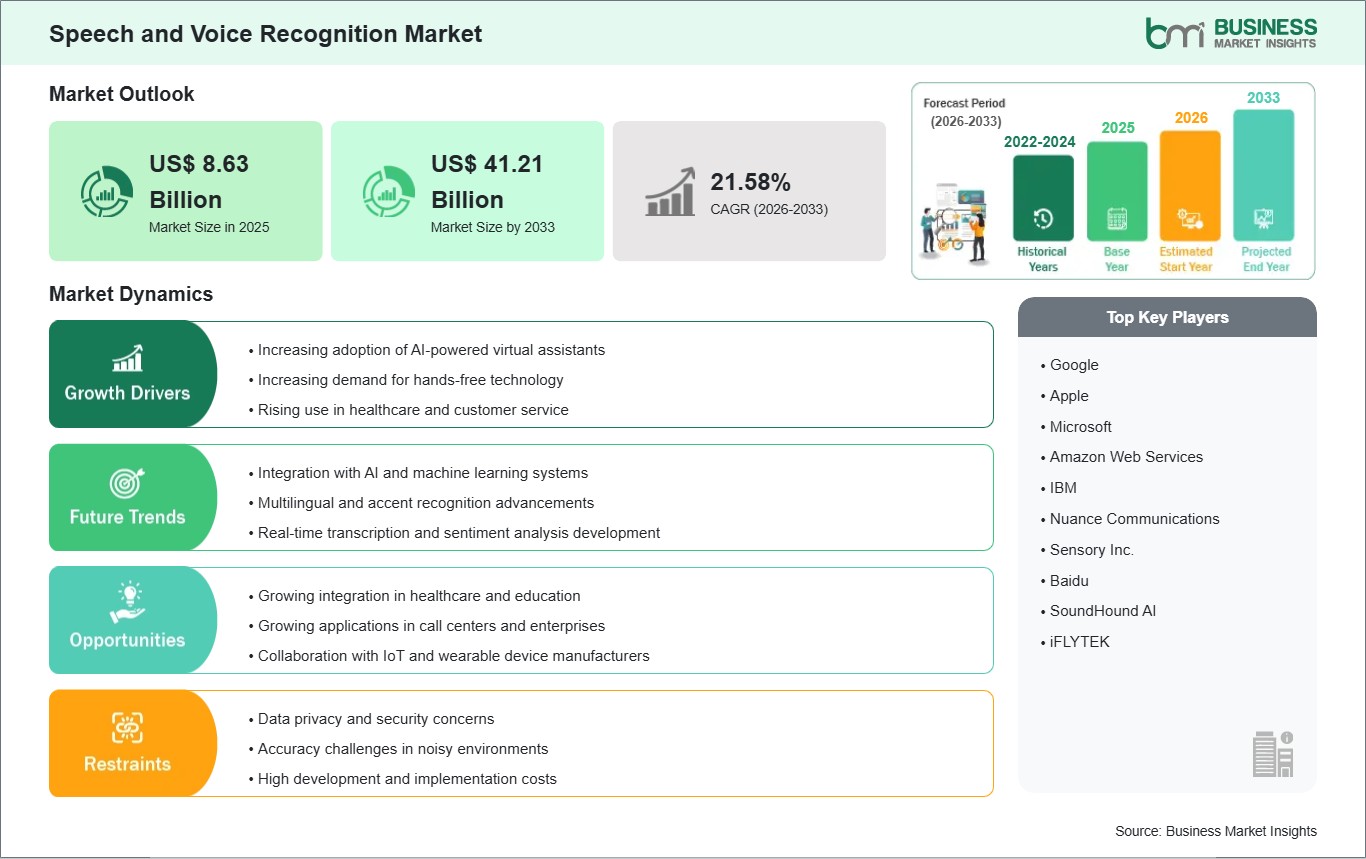
The Speech and Voice Recognition Market size is expected to reach US$ 41.21 billion by 2033 from US$ 8.63 billion in 2025. The market is estimated to record a CAGR of 21.58% from 2026 to 2033.
The global speech and voice recognition market is growing steadily. Organizations and consumers are increasingly using voice-enabled interfaces in various fields, including consumer electronics, automotive, healthcare, banking, and customer service. Speech recognition technology turns spoken language into text. Voice recognition identifies individual users based on vocal traits, allowing for personalized and secure interactions. The demand for hands-free operation, better accessibility, and improved user experience is driving the widespread use of these technologies in smartphones, smart speakers, virtual assistants, and call center automation. Advances in natural language processing (NLP), deep learning, and artificial intelligence (AI) are improving system accuracy, understanding of context, and real-time processing. Cloud-based voice services, multilingual recognition, and low-latency processing have further broadened the applications of voice-enabled solutions. Integrating voice recognition in automotive systems, smart homes, and IoT devices is creating new growth opportunities.
The healthcare and financial sectors are using these solutions for secure authentication, patient documentation, and workflow efficiency. Increasing investments in research and development and greater business adoption, along with rising awareness of digital assistants and AI-driven analytics, are fueling market growth. As industries work on automating operations and improving customer engagement, speech and voice recognition technologies are becoming vital tools for boosting productivity, improving efficiency, and creating personalized user experiences around the world.

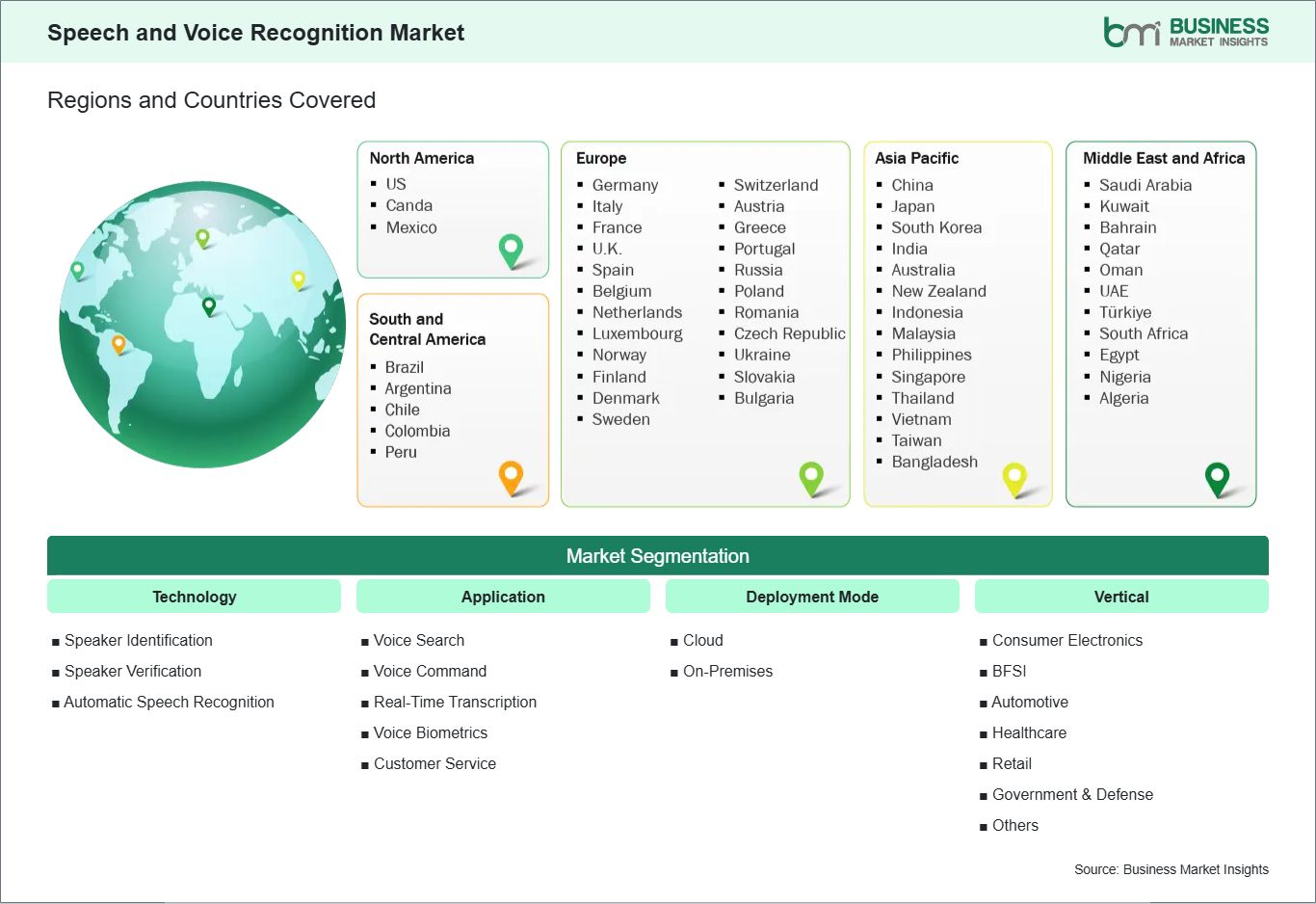
Key segments that contributed to the derivation of the speech and voice recognition market analysis are technology, application, deployment mode, and vertical.
The global speech and voice recognition market is experiencing strong growth due to widespread adoption of AI-powered virtual assistants. These assistants are increasingly integrated into smartphones, smart speakers, connected devices, and enterprise systems to automate routine tasks, improve user engagement, and enhance productivity. Advancements in natural language processing and machine learning are improving the accuracy and contextual understanding of virtual assistants, making them more effective for customer service, office automation, and personal use. As a result, businesses and consumers are adopting voice-enabled AI solutions to streamline operations, reduce response times, and provide personalized experiences. The continuous development of multilingual and context-aware voice recognition technologies is expanding the usability of virtual assistants across diverse user groups. With growing emphasis on hands-free interactions and digital convenience, AI-powered assistants are becoming a critical component of modern technology ecosystems, driving sustained demand for speech and voice recognition solutions.
Speech and voice recognition technologies are increasingly applied in healthcare and education to improve efficiency, accuracy, and accessibility. In healthcare, voice-enabled systems assist in recording patient data, transcribing medical notes, supporting telemedicine platforms, and reducing administrative workload, allowing providers to focus on patient care. In education, voice recognition is used to enhance learning experiences, support language development, and provide accessibility for students with special needs. Virtual teaching assistants, automated grading tools, and interactive learning platforms are leveraging voice interfaces to increase engagement and improve learning outcomes. The expansion of speech and voice recognition across these sectors highlights the technology’s potential to transform workflows, reduce human error, and provide personalized services. As healthcare and education continue to digitize, the adoption of voice-enabled solutions is expected to drive significant market growth globally.
The Speech and Voice Recognition Market demonstrates steady growth, with size and share analysis highlighting evolving trends and competitive dynamics among key players. The report examines subsegments categorized within technology, application, deployment mode, and vertical, offering insights into their contribution to overall market performance.
Technology, the automatic speech recognition subsegment dominated the market in 2025, driven by its widespread adoption in virtual assistants, transcription systems, and voice-enabled applications.
Based on Application, the voice search subsegment dominated the market in 2025, driven by increasing usage in smartphones, smart speakers, and AI-powered assistants.
Based on Deployment Mode, the cloud subsegment dominated the market in 2025, driven by scalability, real-time processing capabilities, and easy integration with AI services.
In terms of Vertical, the consumer electronics subsegment dominated the market in 2025, driven by rising integration of voice-enabled features in smartphones, smart speakers, and wearable devices.
| Report Attribute | Details |
|---|---|
| Market size in 2025 | US$ 8.63 Billion |
| Market Size by 2033 | US$ 41.21 Billion |
| Global CAGR (2026 - 2033) | 21.58% |
| Historical Data | 2022-2024 |
| Forecast period | 2026-2033 |
| Segments Covered | By Technology
|
|
Regions and Countries Covered
| |
| North America | US, Canada, Mexico |
| Europe | Belgium, Austria, Finland, Denmark, Greece, Poland, Romania, Russia, Ukraine, Czech Republic, Slovakia, Bulgaria, Italy, Luxembourg, Germany, Switzerland, France, Netherlands, Norway, Portugal, Spain, Sweden, United Kingdom |
| Asia-Pacific | Australia, China, India, Japan, South Korea, Indonesia, Malaysia, Philippines, Singapore, Thailand, Vietnam, Bangladesh, New Zealand, Taiwan |
| South and Central America | Brazil, Argentina, Peru, Chile, Colombia |
| Middle East and Africa | Bahrain, Kuwait, Oman, Qatar, Saudi Arabia, United Arab Emirates, Turkiye, South Africa, Egypt, Algeria, Nigeria |
| Market leaders and key company profiles |
|
The "Speech and Voice Recognition Market Size and Forecast (2022 - 2033)" report provides a detailed analysis of the market covering below areas:
The geographical scope of the Speech and Voice Recognition Market report is divided into North America, Asia Pacific, Europe, Middle East & Africa, and South & Central America. North America held the largest share in 2025.
Regional adoption of speech and voice recognition technologies is shaped by technological infrastructure, digital penetration, and industry adoption patterns. North America dominates the market, with the United States and Canada leading in AI-driven voice assistant adoption, enterprise voice analytics, and automotive voice control systems. The region benefits from advanced R&D capabilities, cloud infrastructure, and high consumer acceptance of digital assistants.
Asia Pacific is a high-growth region due to the rapid expansion of smartphone usage, smart home devices, and multilingual AI applications. China, Japan, South Korea, and India are implementing speech recognition in consumer electronics, automotive infotainment, and call centers, while governments are promoting AI-driven digital transformation initiatives.
Europe emphasizes secure and high-accuracy voice authentication systems across banking, healthcare, and enterprise applications. Germany, the United Kingdom, and France are integrating multilingual voice interfaces in smart devices, customer service, and accessibility solutions.
Middle East & Africa is adopting voice technologies in banking, public services, and telecommunications, with the UAE, Saudi Arabia, and South Africa deploying voice recognition in automated customer service and digital transformation programs.
South & Central America is gradually implementing voice-enabled solutions in financial services, retail, and healthcare sectors, with Brazil, Mexico, and Chile driving adoption to enhance digital interactions and operational efficiency.

The Speech and Voice Recognition Market is evaluated by gathering qualitative and quantitative data post primary and secondary research, which includes important corporate publications, association data, and databases. A few of the key developments in the spatial light Modulator market are:
The Speech and Voice Recognition Market is valued at US$ 8.63 Billion in 2025, it is projected to reach US$ 41.21 Billion by 2033.
As per our report Speech and Voice Recognition Market, the market size is valued at US$ 8.63 Billion in 2025, projecting it to reach US$ 41.21 Billion by 2033. This translates to a CAGR of approximately 21.58% during the forecast period.
The Speech and Voice Recognition Market report typically cover these key segments-
The historic period, base year, and forecast period can vary slightly depending on the specific market research report. However, for the Speech and Voice Recognition Market report:
The Speech and Voice Recognition Market is populated by several key players, each contributing to its growth and innovation. Some of the major players include:
The Speech and Voice Recognition Market report is valuable for diverse stakeholders, including:
Essentially, anyone involved in or considering involvement in the Speech and Voice Recognition Market value chain can benefit from the information contained in a comprehensive market report.
Please tell us your area of interest
(Market Segments/ Regions and Countries/ Companies)