
Distributed Fiber Optic Sensor Market Outlook (2022-2033)

Historic Data: 2022-2024   |   Base Year: 2025   |   Forecast Period: 2026-2033
Report Content: Market Scope, Market Segmentation, Market Dynamics, and Competitive Analysis

Report Coverage:
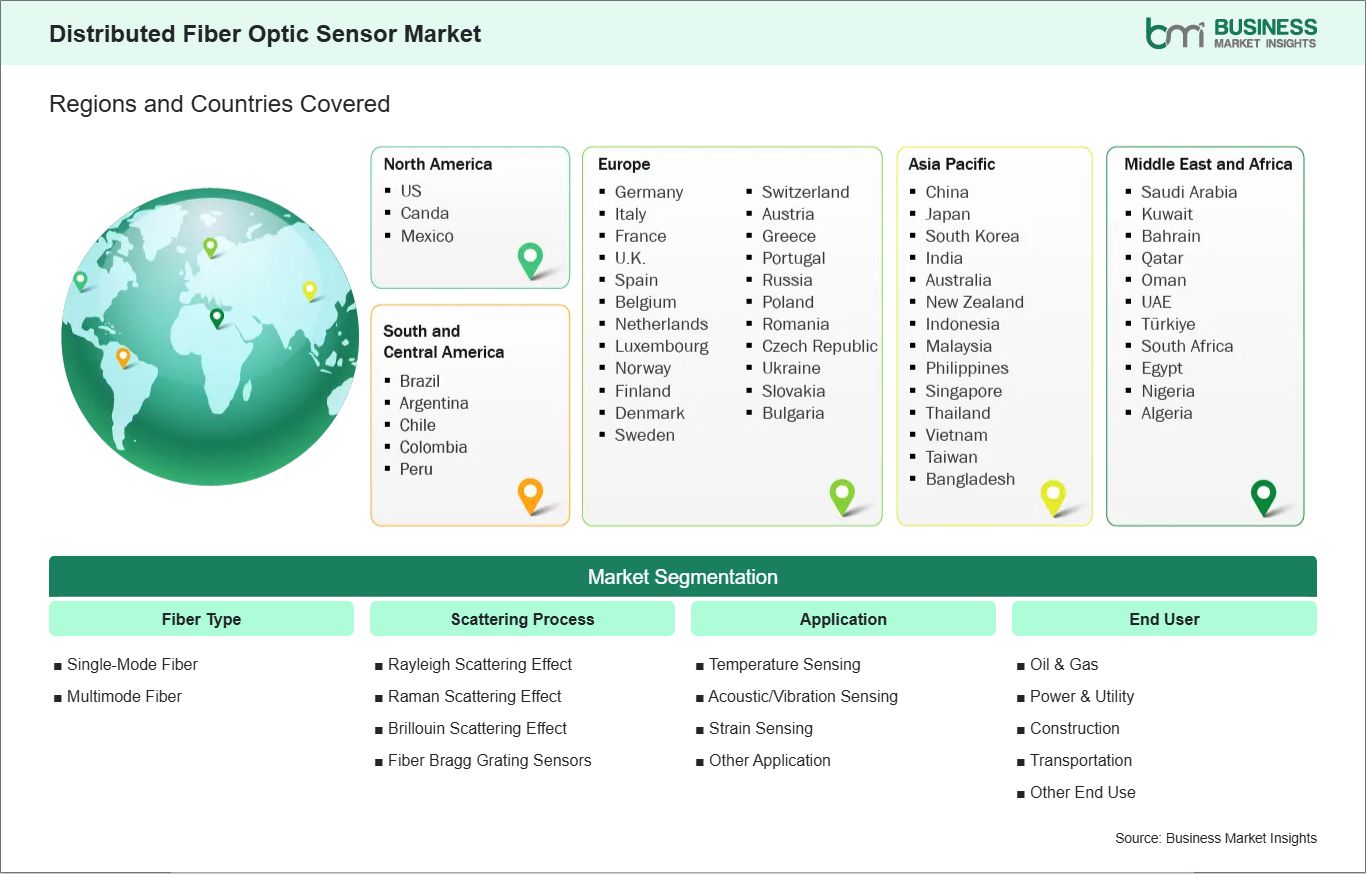
  • Fiber Type (Single-Mode Fiber, Multimode Fiber)
  • Scattering Process (Rayleigh Scattering Effect, Raman Scattering Effect, Brillouin Scattering Effect, Fiber Bragg Grating Sensors)
  • Application (Temperature Sensing, Acoustic/Vibration Sensing, Strain Sensing, Other Application)
  • End User (Oil & Gas, Power & Utility, Construction, Transportation, Other End Use)

No. of Pages: 400
Report Code: BMIPUB00033691
Category: Electronics and Semiconductor
Distributed Fiber Optic Sensor Market

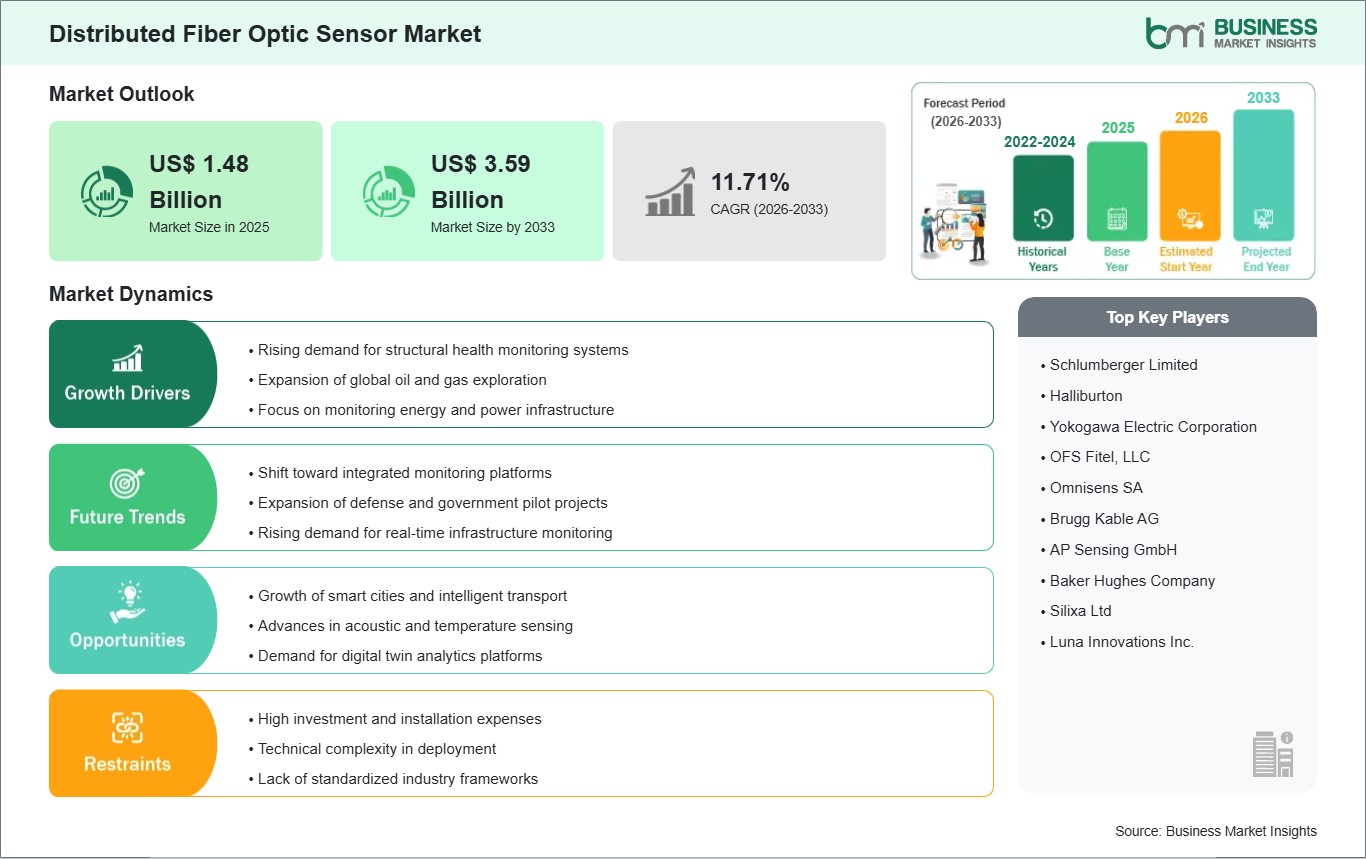
The Distributed Fiber Optic Sensor Market size is expected to reach US$ 3.59 Billion by 2033 from US$ 1.48 Billion in 2025. The market is estimated to record a CAGR of 11.71% from 2026 to 2033.

Executive Summary and Global Market Analysis:

A distributed fiber optic sensor (DFOS) is an advanced sensing technology that uses optical fibers as continuous sensing elements to monitor physical parameters such as temperature, strain, vibration, and acoustic signals over long distances. Unlike traditional point sensors, DFOS systems provide real-time, distributed measurements along the entire length of the fiber, often spanning tens of kilometers. Technologies such as Distributed Temperature Sensing (DTS), Distributed Acoustic Sensing (DAS), and Distributed Strain Sensing (DSS) are widely applied in industries including oil and gas, power and utilities, civil infrastructure, transportation, and security. These systems are used for pipeline leak detection, structural health monitoring, perimeter intrusion detection, and fire detection in tunnels. Growing demand for infrastructure safety, rising energy exploration activities, increasing investments in smart cities, and the need for reliable monitoring in harsh environments are key factors driving the distributed fiber optic sensor market. Additionally, advancements in fiber optic communication networks further support market expansion.

Distributed Fiber Optic Sensor Market - Strategic Insights:

global-market-strategic-framework
Get more information on this report

Distributed Fiber Optic Sensor Market Segmentation Analysis:

Key segments that contributed to the derivation of the distributed fiber optic sensor market analysis are fiber type, scattering process, application, and end user.

  • By fiber type, the market is segmented into single-mode fiber and multimode fiber. The single-mode fiber held the largest share of the market in 2025.
  • By scattering process, the market is segmented into Rayleigh scattering effect, Raman scattering effect, Brillouin scattering effect, and fiber Bragg grating sensors. The Raman scattering effect segment held the largest share of the market in 2025.
  • By application, the market is segmented into temperature sensing, acoustic/vibration sensing, strain sensing, and other application. The temperature sensing segment held the largest share of the market in 2025.
  • By end user, the market is segmented into oil & gas, power & utility, construction, transportation, other end use. The oil & gas segment held the largest share of the market in 2025.
Distributed Fiber Optic Sensor Market Drivers and Opportunities:

Rising Demand for Structural Health Monitoring (SHM)

One of the primary drivers of the distributed fiber optic sensor market is the growing need for structural health monitoring across critical infrastructure. Bridges, tunnels, dams, railways, and high-rise buildings require continuous monitoring to ensure safety, longevity, and regulatory compliance. Distributed fiber optic sensors enable real-time, long-distance measurement of strain, temperature, and vibration along the entire length of a fiber, offering a significant advantage over traditional point sensors. Governments and private operators increasingly prioritize preventive maintenance to reduce catastrophic failures and repair costs. Rapid urbanization and aging infrastructure in developed regions further intensify this demand. These sensors provide accurate, continuous data that supports predictive maintenance strategies and risk mitigation. Their immunity to electromagnetic interference and ability to operate in harsh environments make them particularly suitable for complex civil engineering applications, strengthening their adoption across transportation and construction sectors worldwide.

Growth in Smart Cities and Intelligent Transportation Systems

The development of smart cities presents substantial opportunities for distributed fiber optic sensor deployment. Urban planners increasingly integrate intelligent transportation systems, automated traffic monitoring, and infrastructure diagnostics into city designs. Fiber optic sensors can monitor road conditions, bridge stability, railway tracks, and tunnels in real time, enhancing safety and operational efficiency. As cities aim to reduce congestion and improve sustainability, data-driven infrastructure management becomes essential. Distributed sensing systems support this objective by providing continuous, accurate environmental and structural data across extensive networks. Furthermore, investments in metro rail projects and high-speed rail corridors create additional application areas. Governments worldwide are allocating significant budgets toward digital infrastructure and urban resilience programs, further expanding the addressable market. The scalability and long-distance monitoring capability of fiber optic sensors position them as critical enablers of future-ready urban ecosystems and intelligent mobility frameworks.

Distributed Fiber Optic Sensor Market Size and Share Analysis:

By fiber type, the market is segmented into single-mode fiber and multimode fiber. The single-mode fiber segment held the largest share of the market in 2025. Single-mode fiber is an optical fiber designed to carry light directly down the fiber with only one propagation mode, minimizing dispersion and signal loss over long distances. Its high bandwidth, low attenuation, and superior accuracy make it ideal for distributed sensing, driving adoption in energy, infrastructure, and industrial monitoring applications.

By scattering process, the market is segmented Rayleigh scattering effect, Raman scattering effect, Brillouin scattering effect, and fiber Bragg grating sensors. The Raman scattering effect segment held the largest share of the market in 2025, driven by its precise temperature measurement capabilities, long-distance monitoring performance, and reliability in harsh environments. Industries such as oil and gas, power transmission, and infrastructure leverage Raman-based systems for real-time, continuous asset monitoring.

By application, the market is segmented into temperature sensing, acoustic/vibration sensing, strain sensing, and other application. The temperature sensing segment held the largest share of the market in 2025, driven by rising safety regulations, growing demand for real-time monitoring, and the need to prevent equipment failures in industries such as oil and gas, power generation, and infrastructure.

By end user, the market is segmented oil & gas, power & utility, construction, transportation, other end use. The oil & gas segment held the largest share of the market in 2025. In the oil and gas industry, distributed fiber optic sensing enhances real-time monitoring of wells, pipelines, and refineries by detecting temperature, strain, and acoustic changes over long distances. This improves leak detection, reservoir management, and asset integrity, reducing downtime, environmental risks, and operational costs while increasing safety and production efficiency.

Distributed Fiber Optic Sensor Market Report Highlights:

Report Attribute Details
Market size in 2025 US$ 1.48 Billion
Market Size by 2033 US$ 3.59 Billion
Global CAGR (2026 - 2033)11.71%
Historical Data 2022-2024
Forecast period 2026-2033
Segments Covered By Fiber Type
  • Single-Mode Fiber
  • Multimode Fiber
By Scattering Process
  • Rayleigh Scattering Effect
  • Raman Scattering Effect
  • Brillouin Scattering Effect
  • Fiber Bragg Grating Sensors
By Application
  • Temperature Sensing
  • Acoustic/Vibration Sensing
  • Strain Sensing
  • Other Application
By End User
  • Oil & Gas
  • Power & Utility
  • Construction
  • Transportation
  • Other End Use
Regions and Countries Covered
North America US, Canada, Mexico
Europe Belgium, Austria, Finland, Denmark, Greece, Poland, Romania, Russia, Ukraine, Czech Republic, Slovakia, Bulgaria, Italy, Luxembourg, Germany, Switzerland, France, Netherlands, Norway, Portugal, Spain, Sweden, United Kingdom
Asia-Pacific Australia, China, India, Japan, South Korea, Indonesia, Malaysia, Philippines, Singapore, Thailand, Vietnam, Bangladesh, New Zealand, Taiwan
South and Central America Brazil, Argentina, Peru, Chile, Colombia
Middle East and Africa Bahrain, Kuwait, Oman, Qatar, Saudi Arabia, United Arab Emirates, Turkiye, South Africa, Egypt, Algeria, Nigeria
Market leaders and key company profiles
  • Schlumberger Limited
  • Halliburton
  • Yokogawa Electric Corporation
  • OFS Fitel, LLC
  • Omnisens SA
  • Brugg Kable AG
  • AP Sensing GmbH
  • Baker Hughes Company
  • Silixa Ltd
  • Luna Innovations Inc.
Get more information on this report

Distributed Fiber Optic Sensor Market Report Coverage and Deliverables:

The "Distributed Fiber Optic Sensor Market Size and Forecast (2022 - 2033)" report provides a detailed analysis of the market covering below areas:

  • Distributed fiber optic sensor market size and forecast at global, regional, and country levels for all the key market segments covered under the scope
  • Distributed fiber optic sensor market trends, as well as market dynamics such as drivers, restraints, and key opportunities
  • Distributed fiber optic sensor market analysis covering key market trends, global and regional framework, major players, regulations, and recent market developments
  • Industry landscape and competition analysis covering market concentration, heat map analysis, prominent players, and recent developments for the air circuit breaker market
  • Detailed company profiles, including SWOT analysis

Distributed Fiber Optic Sensor Market Geographic Insights:

The geographical scope of the distributed fiber optic sensor market report is divided into five regions: North America, Asia Pacific, Europe, Middle East & Africa, and South & Central America. The distributed fiber optic sensor market in North America is expected to grow significantly during the forecast period.

The North America distributed fiber optic sensor market is segmented into US, Canada, and Mexico. The North American distributed fiber optic sensor (DFOS) market is experiencing robust growth, driven by several key factors. Increasing demand for advanced monitoring and safety systems across critical infrastructure, including oil and gas pipelines, railways, and power grids, is a primary driver. DFOS technology enables real-time, continuous monitoring of strain, temperature, and vibrations over long distances, enhancing operational efficiency and reducing maintenance costs. Government initiatives promoting infrastructure modernization and stringent safety regulations further encourage adoption. Additionally, rising industrial automation and smart city projects in the United States and Canada are expanding the need for intelligent sensing solutions. Technological advancements, such as improved sensor accuracy, longer sensing ranges, and integration with Internet of Things (IoT) platforms, are also boosting market penetration. The oil and gas sector is leveraging DFOS for leak detection, structural health monitoring, and predictive maintenance, fueling demand. Furthermore, increased awareness of environmental monitoring and disaster prevention applications supports market expansion. Collectively, these factors position North America as a leading adopter of distributed fiber optic sensor technology, driving significant growth opportunities.

global-market-geography
Get more information on this report

Distributed Fiber Optic Sensor Market Research Report Guidance:

  • The report includes qualitative and quantitative data in the distributed fiber optic sensor market across fiber type, scattering process, application, end user, and geography.
  • The report starts with the key takeaways (chapter 2), highlighting the key trends and outlook of the distributed fiber optic sensor market.
  • Chapter 3 includes the research methodology of the study.
  • Chapter 4 further includes ecosystem analysis.
  • Chapter 5 highlights the major industry dynamics in the distributed fiber optic sensor market, including factors that are driving the market, prevailing deterrents, potential opportunities, as well as future trends. Impact analysis of these drivers and restraints is also covered in this section.
  • Chapter 6 discusses the distributed fiber optic sensor market scenario, in terms of historical market revenues, and forecast till the year 2033.
  • Chapters 7 to 10 cover distributed fiber optic sensor market segments by fiber type, scattering process, application, end user, and geography across North America, Europe, Asia Pacific, Middle East and Africa, and South and Central America. They cover the market volume revenue forecast and factors driving the market.
  • Chapter 11 describes the competitive analysis along with the heat map analysis for the key players operating in the market.
  • Chapter 12 describes the industry landscape analysis. It provides detailed descriptions of business activities such as market initiatives, new developments, mergers, and joint ventures globally, along with a competitive landscape.
  • Chapter 13 provides detailed profiles of the major companies operating in the distributed fiber optic sensor market. Companies have been profiled on the basis of their key facts, business descriptions, products and services, financial overview, SWOT analysis, and key developments.
  • Chapter 14, i.e., the appendix is inclusive of a brief overview of the company, list of abbreviations, and disclaimer.

Distributed Fiber Optic Sensor Market News and Key Development:

The distributed fiber optic sensor market is evaluated by gathering qualitative and quantitative data post primary and secondary research, which includes important corporate publications, association data, and databases. A few of the key developments in the distributed fiber optic sensor market are:

  • In January 2025, Baker Hughes launched SureCONNECT FE, the industry`s first field-proven downhole fiber-optic wet-mate system that enables real-time, optimized reservoir performance in high-pressure, high-temperature environments. The next-generation technology utilizes a unique fiber-optic solution that connects the lower and upper completion of wells, significantly decreasing rig time, maintenance costs, and health, safety and environmental risks.
  • In January 2025, OFS announce the debut of DataSens Enhanced Sensing Optical Fiber, a groundbreaking advancement in distributed fiber optic sensing (DFOS), at the prestigious Photonics West event. DataSens allows more signals to be distinguished from noise in a DFOS installation, without the high attenuation that often accompanies enhanced fibers and limits the range of systems.

Key Sources Referred:

  • World Bank - Global Trade Indicators
  • World Trade Organization (WTO)
  • International Monetary Fund (IMF)
  • International Trade Administration (ITA)
  • Company website
  • Company annual reports
  • Company investor presentations
The List of Companies - Distributed Fiber Optic Sensor Market
  • Schlumberger Limited
  • Halliburton
  • Yokogawa Electric Corporation
  • OFS Fitel, LLC
  • Omnisens SA
  • Brugg Kable AG
  • AP Sensing GmbH
  • Baker Hughes Company
  • Silixa Ltd
  • Luna Innovations Inc.
Frequently Asked Questions
How big is the Distributed Fiber Optic Sensor Market?

The Distributed Fiber Optic Sensor Market is valued at US$ 1.48 Billion in 2025, it is projected to reach US$ 3.59 Billion by 2033.

What is the CAGR for Distributed Fiber Optic Sensor Market by (2026 - 2033)?

As per our report Distributed Fiber Optic Sensor Market, the market size is valued at US$ 1.48 Billion in 2025, projecting it to reach US$ 3.59 Billion by 2033. This translates to a CAGR of approximately 11.71% during the forecast period.

What segments are covered in this report?

The Distributed Fiber Optic Sensor Market report typically cover these key segments-

  • Fiber Type (Single-Mode Fiber, Multimode Fiber)
  • Scattering Process (Rayleigh Scattering Effect, Raman Scattering Effect, Brillouin Scattering Effect, Fiber Bragg Grating Sensors)
  • Application (Temperature Sensing, Acoustic/Vibration Sensing, Strain Sensing, Other Application)
  • End User (Oil & Gas, Power & Utility, Construction, Transportation, Other End Use)

What is the historic period, base year, and forecast period taken for Distributed Fiber Optic Sensor Market?

The historic period, base year, and forecast period can vary slightly depending on the specific market research report. However, for the Distributed Fiber Optic Sensor Market report:

  • Historic Period : 2022-2024
  • Base Year : 2025
  • Forecast Period : 2026-2033
  • Who are the major players in Distributed Fiber Optic Sensor Market?

    The Distributed Fiber Optic Sensor Market is populated by several key players, each contributing to its growth and innovation. Some of the major players include:

  • Schlumberger Limited
  • Halliburton
  • Yokogawa Electric Corporation
  • OFS Fitel, LLC
  • Omnisens SA
  • Brugg Kable AG
  • AP Sensing GmbH
  • Baker Hughes Company
  • Silixa Ltd
  • Luna Innovations Inc.
  • Who should buy this report?

    The Distributed Fiber Optic Sensor Market report is valuable for diverse stakeholders, including:

    • Investors: Provides insights for investment decisions pertaining to market growth, companies, or industry insights. Helps assess market attractiveness and potential returns.
    • Industry Players: Offers competitive intelligence, market sizing, and trend analysis to inform strategic planning, product development, and sales strategies.
    • Suppliers and Manufacturers: Helps understand market demand for components, materials, and services related to concerned industry.
    • Researchers and Consultants: Provides data and analysis for academic research, consulting projects, and market studies.
    • Financial Institutions: Helps assess risks and opportunities associated with financing or investing in the concerned market.

    Essentially, anyone involved in or considering involvement in the Distributed Fiber Optic Sensor Market value chain can benefit from the information contained in a comprehensive market report.

    Available Report Formats

    pdf-format excel-format pptx-format
    Buy Now
    Sales Assistance
    +1 646 791 7070 (US & UK)
    Customization Form

    Please tell us your area of interest
    (Market Segments/ Regions and Countries/ Companies)