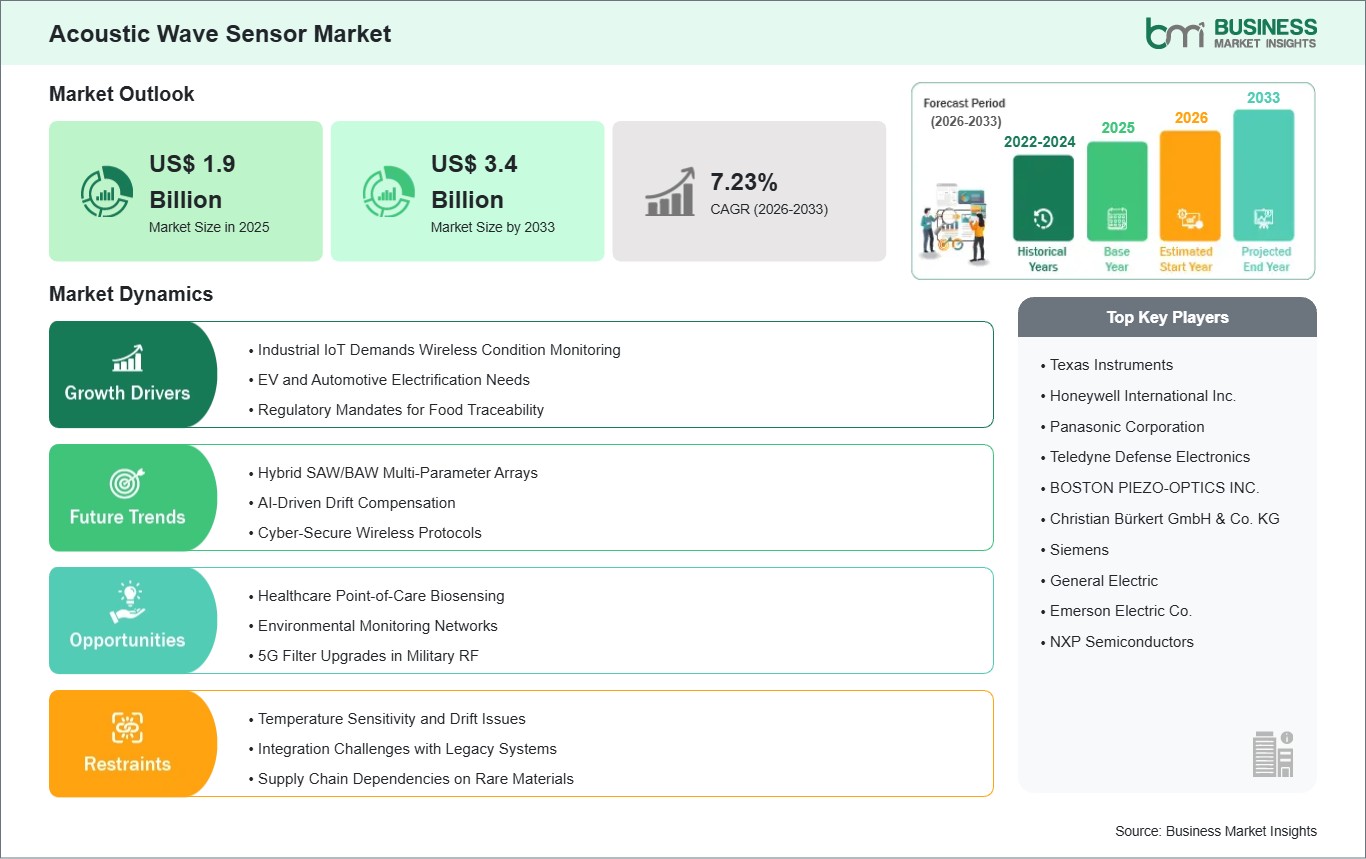
The 3D radar market size is expected to reach US$ 3.40 billion by 2033 from US$ 1.90 billion in 2025. The market is estimated to record a CAGR of 7.23% from 2026 to 2033.
The global acoustic wave sensor market provides highly accurate sensing at the level of piezoelectric wave propagation, enabling real, time detection even in harsh environments. These devices utilize surface or bulk acoustic waves to determine different parameters, such as mass, viscosity, temperature, and pressure, which has made structural health monitoring and biosensing just some of the broad array of applications. Among the greatest features of these devices are their ability to freely operate over, the, air and their extreme sensitivity at micro, scale, as well as their ruggedness without the use of high, power chemistry, thus becoming a must, have for IoT, predictive maintenance, and point, of, care diagnostics markets. The market growth is becoming faster due to Industry 4.0 digitization, EV battery management, and food safety regulations in the context of supply chain traceability demands.Integrating automotive ADAS and healthcare wearables are the main drivers of volume, whereas the military RF filters make excellent use of miniaturization. The falling fabrication costs of SAW/BAW resonators bring about the implementation of edge computing. The issues faced are the need for temperature drift compensation and the integration with Si CMOS. The potential for development lies in AI, calibrated multi, parameter arrays, 5G filter upgrades, and sustainability monitoring for smart cities and precision agriculture.

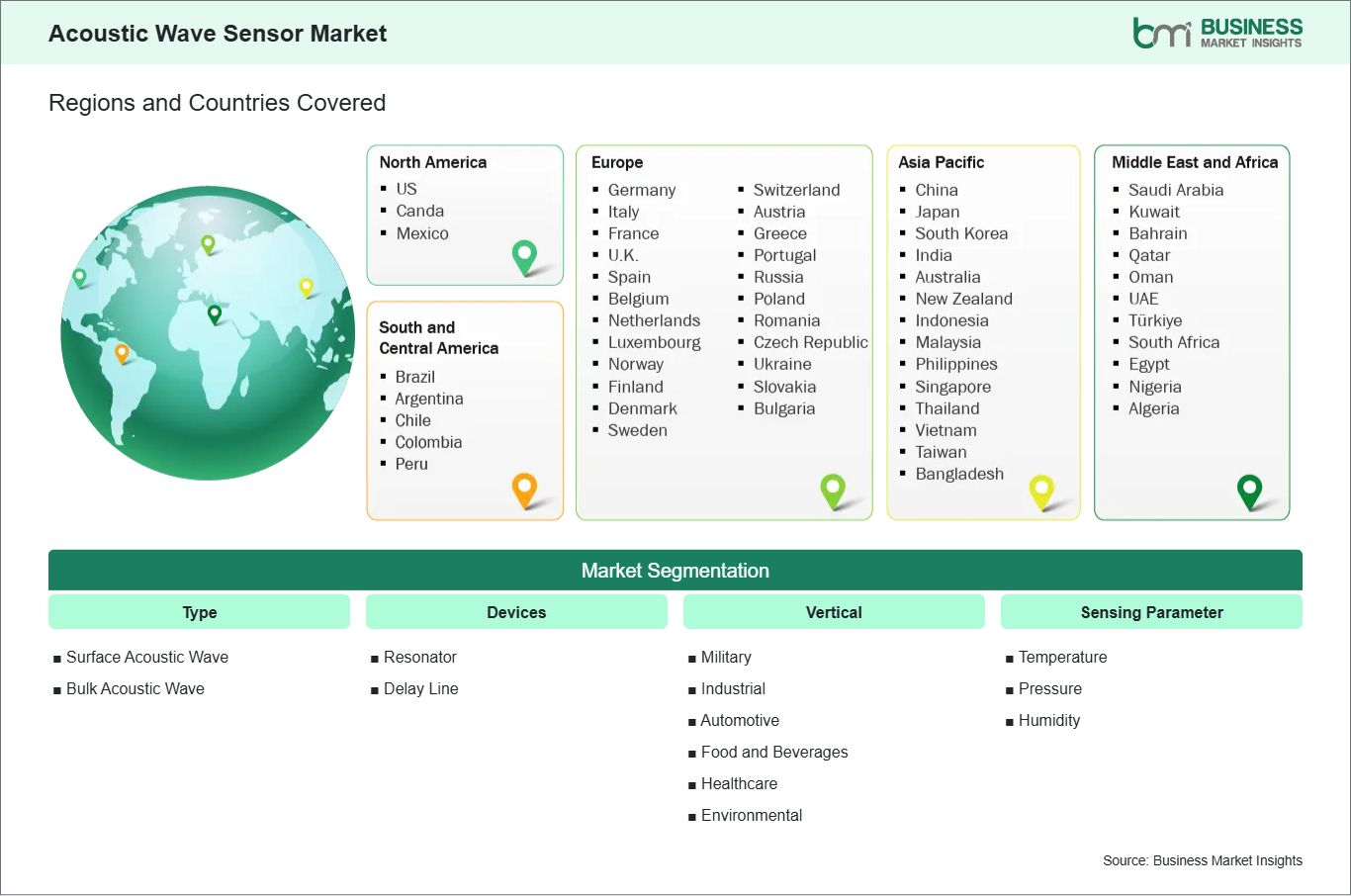
Key segments that contributed to the derivation of the acoustic wave sensor market analysis are type, devices, vertical, and sensing parameter.
The advent of Industry 4.0 and the explosive growth of IIoT adoption globally, coupled with the shift toward electric vehicle (EV) sensor suites, are 2 powerful factors that keep the acoustic wave sensor market on an upward track. Factories, refineries, and fleets of vehicles for transportation purposes are routinely looking for monitoring solutions that are ultra, reliable, resistant to vibrations, and totally wireless so that they can minimize the unplanned downtimes and also optimize the asset life cycles. Surface Acoustic Wave (SAW) delay lines are amazing at offshore wind turbines and remote oil rigs where they detect micro, fractures in blades and casings with sub, millisecond accuracy and, at the same time, Bulk Acoustic Wave (BAW) resonators are perfect for being part of the tire pressure monitoring systems (TPMS) of the original equipment manufacturers (OEMs) Bosch and Continental, hence, in real, time, predictive alerts against the tread wear or puncture can be delivered. Asia, Pacific is witnessing the smart manufacturing take, off due to government policies such as China's Made in China 2025 and India's PLI schemes. Over 50, 000+ facilities are having equipment that is being updated/retrofitted at the rate of 20, 25% annually leading to backlog nudging 2, 000 units by 2030 as the semiconductor supply is normalizing.The Ukraine energy crises further unveil the ground realities of energy crises and hence revolve around the issue of urgent grid stability. Hybrid SAW arrays, through the combination of humidity, pressure, and vibration sensors, help ensure pipeline integrity thereby, leakages in the pipelines used for transporting gas in the regions which are under the control of adversaries are prevented. Gallium Nitride (GaN) based transducers are pretty much at home in the high, electromagnetic interference (EMI) environments such as those created by electric arc furnaces where they turn out signal, to, noise ratios of above 30% compared to the standard quartz crystals.
Point, of, care diagnostics, wearable health technology, and large, scale climate monitoring networks open up a wide range of opportunities for hybrid SAW/BAW sensor arrays in the next generation of wearables, implantable devices, and autonomous drone swarms. Open architecture standards such as IEEE 1451 make it easy to integrate with edge AI processors, thereby allowing biomarker detection of, for instance, glucose or pathogens, in Covid, era field labs and remote clinics, cutting assay times by 40, 50% and at the same time raising accuracy to 99% for NATO medical logistics and disaster response teams.The food and beverages industry faces stringent EU traceability regulations (e.g., Farm, to, Fork Strategy) and US FDA mandates which strengthen demand for passive humidity/temperature SAW tags on perishables, thus ensuring cold, chain compliance across 1 billion shipments annually and resulting in reducing spoilage losses by 25%. Automotive Level 4/5 autonomy is asking for ultra, compact pressure resonators that cost less than $5/unit for brake, by, wire and cabin air quality, thus integrating with V2X networks for fleet, wide anomaly detection. The combination of MEMS, driven miniaturization reducing footprints to 1mmand 3D IC packaging, slashes BOM costs by 60%, thereby making scaling, up feasible for consumer electronics and agritech soil probes.

By type, the global acoustic wave sensor market segments into Surface Acoustic Wave (SAW) and Bulk Acoustic Wave (BAW). The SAW segment dominated in 2024. SAW offers passive, battery-free operation ideal for remote harsh-condition deployments.
By devices, segments are Resonator and Delay Line. The Resonator segment led in 2024. Resonators provide stable Q-factors for precise frequency-based measurements.
By vertical, divisions include Military, Industrial, Automotive, Food and Beverages, Healthcare, Environmental. The Industrial segment held the largest share in 2024. Process control demands high-reliability sensing for uptime.
By sensing parameter, categories are Temperature, Pressure, Humidity. The Temperature segment topped in 2024. Thermal profiling suits broad predictive maintenance needs.
| Report Attribute | Details |
|---|---|
| Market size in 2025 | US$ 1.9 Billion |
| Market Size by 2033 | US$ 3.4 Billion |
| Global CAGR (2026 - 2033) | 7.23% |
| Historical Data | 2022-2024 |
| Forecast period | 2026-2033 |
| Segments Covered | By Type
|
| Regions and Countries Covered | North America
|
| Market leaders and key company profiles |
|
The "Acoustic Wave Sensor Market Size and Forecast (2022–2033)" report provides a detailed analysis of the market covering below areas:
The geographical scope of the acoustic wave sensor market report is divided into five regions: North America, Asia Pacific, Europe, Middle East & Africa, and South & Central America. The acoustic wave sensor market in North America registered the highest market share in 2024.
North America leads through defense R&D and shale gas monitoring, which is further divided among the US, Canada, and Mexico. The US DoD is installing BAW sensors for hypersonic telemetry on platforms like ARRW missiles while Permian oilfields are using rugged SAW pressure arrays for leak detection. Europe has major breakthroughs in automotive innovation with Germany and France leading BAW deployments in ADAS for BMW and Renault EVs, in parallel with UK industrial resonators for predictive maintenance.The Middle East speeds up oil/gas humidity sensing with the help of Qorvo offsets in Saudi Aramco fields. Asia Pacific is charging through Chinas EV battery oversight and India’s smart factories, upgrading low, cost SAW while lagging in premium BAW. South & Central America concentrates on portable environmental kits for Brazils ag/food chains. All regions have scalability and cybersecurity of modules for UAVs and Industry 5.0 transitions as top priorities.

The acoustic wave sensor market is evaluated by gathering qualitative and quantitative data post primary and secondary research, which includes important corporate publications, association data, and databases. A few of the key developments in the acoustic wave sensor market are:
The Acoustic Wave Sensor Market is valued at US$ 1.9 Billion in 2025, it is projected to reach US$ 3.4 Billion by 2033.
As per our report Acoustic Wave Sensor Market, the market size is valued at US$ 1.9 Billion in 2025, projecting it to reach US$ 3.4 Billion by 2033. This translates to a CAGR of approximately 7.23% during the forecast period.
The Acoustic Wave Sensor Market report typically cover these key segments-
The historic period, base year, and forecast period can vary slightly depending on the specific market research report. However, for the Acoustic Wave Sensor Market report:
The Acoustic Wave Sensor Market is populated by several key players, each contributing to its growth and innovation. Some of the major players include:
The Acoustic Wave Sensor Market report is valuable for diverse stakeholders, including:
Essentially, anyone involved in or considering involvement in the Acoustic Wave Sensor Market value chain can benefit from the information contained in a comprehensive market report.
Please tell us your area of interest
(Market Segments/ Regions and Countries/ Companies)