
Optical Sensors Market Outlook: Size, Share, Trends, Growth Analysis, Competitive Landscape & Forecast, 2026-2033

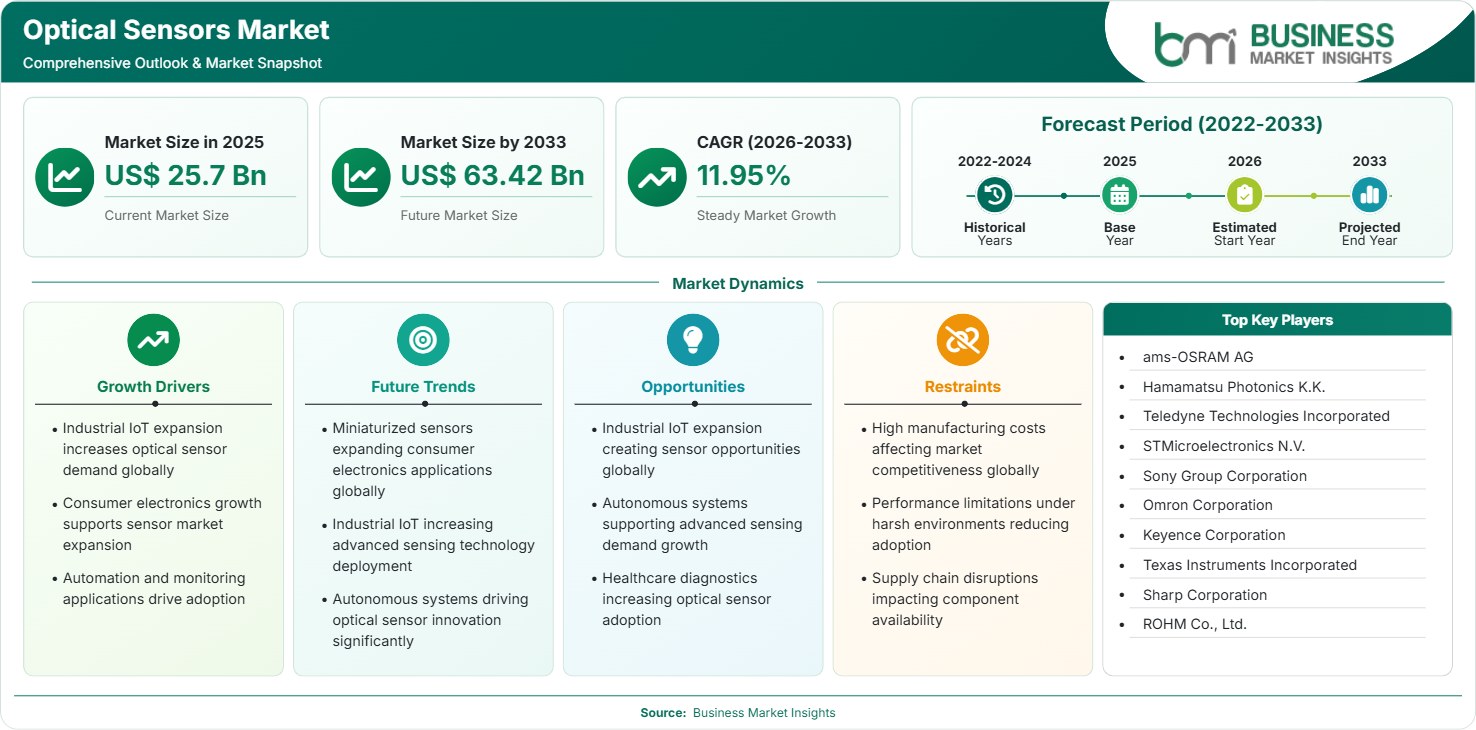
The Optical Sensors Market size was valued at US$ 25.7 Billion in 2025 and is projected to reach US$ 63.42 Billion by 2033, growing at a CAGR of 11.95% during 2026–2033. Rising adoption of autonomous systems, industrial automation, advanced healthcare imaging, smart consumer electronics, and LiDAR-enabled sensing technologies is creating substantial opportunities across emerging digital and connected ecosystems.

Report Coverage
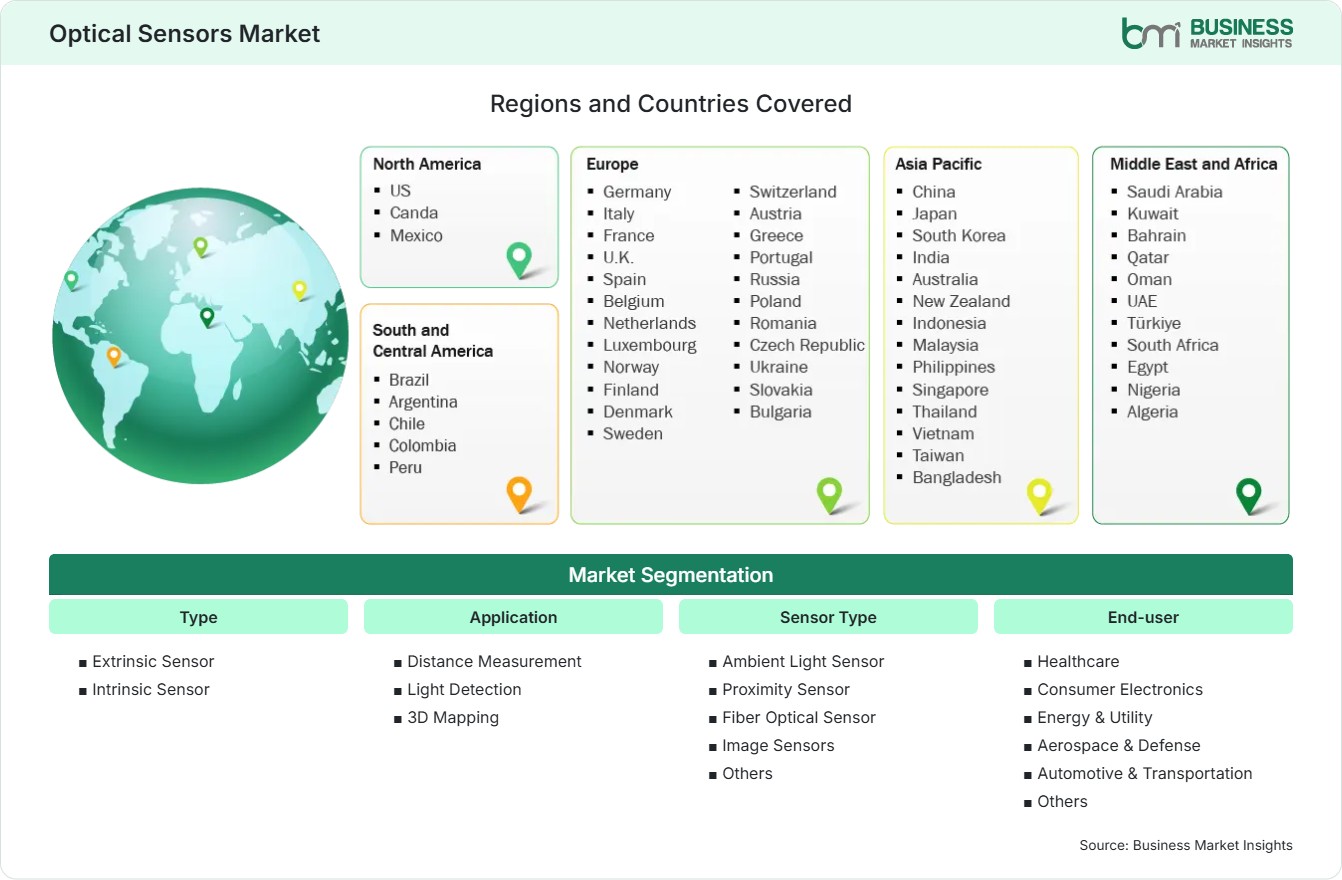
  • Type: Extrinsic Sensor, Intrinsic Sensor
  • Application: Distance Measurement, Light Detection, 3D Mapping
  • Sensor Type: Ambient Light Sensor, Proximity Sensor, Fiber Optical Sensor, Image Sensors, Others
  • End-user: Healthcare, Consumer Electronics, Energy & Utility, Aerospace & Defense, Automotive & Transportation, Others
US$ 25.7 Bn Market size in 2025
US$ 63.42 Bn Market Size by 2033
11.95% CAGR, 2026 - 2033
2026-2033 Forecast Period

AI Overview

Optical Sensors Market Summary

  • North America Region: North America holds a market share of 34%–37% in 2025, growing with a CAGR of 10.5%–11.5% during 2026–2033, driven by growing LiDAR deployment, defense modernization programs, semiconductor innovation, and increasing healthcare diagnostics adoption. Opportunities emerge from autonomous mobility and industrial digitalization. Brief U.S. market analysis: The U.S. leads regional demand through defense innovation, automotive sensing adoption, and medical imaging investments, advancing at a CAGR of 10.8%–11.8%.
  • Fastest Growing Region: Asia Pacific accounts for 28%–31% of the Optical Sensors Market share in 2025 and is expected to grow at a CAGR of 13.5%–14.5%, supported by electronics manufacturing expansion, smart city investments, EV production growth, and industrial automation. Opportunities arise from semiconductor fabrication and advanced sensing infrastructure.
  • Leading Segment: Image Sensors represent a 32%–35% share in 2025 and are anticipated to grow at 11.0%–12.0% CAGR, supported by smartphone imaging upgrades, machine vision systems, automotive vision technologies, and healthcare diagnostic equipment expansion across global markets.
  • High Growth Segment: 3D Mapping accounts for 18%–21% share in 2025 and is forecast to expand at 14.5%–15.5% CAGR, supported by increased deployment of LiDAR, robotics navigation, autonomous driving platforms, digital twins, and high-precision geospatial applications.
  • Key Market Opportunity: Expansion of AI-enabled sensing platforms combining optical components, edge analytics, and real-time monitoring capabilities presents substantial opportunities across healthcare diagnostics, intelligent manufacturing, predictive maintenance, and autonomous navigation environments.
  • Major Market Players: ams-OSRAM AG, Hamamatsu Photonics K.K., Teledyne Technologies Incorporated, STMicroelectronics N.V., Sony Group Corporation, Omron Corporation, Keyence Corporation, Texas Instruments Incorporated, Sharp Corporation, and ROHM Co., Ltd.
Strategic Insights

Optical Sensors Market: Strategic Insights

Optical Sensors Market Strategic Framework
FREE PDF
Request your free sample
Request free sample
Stakeholder View

Key Takeaways

  • The chain of value is becoming more integrated since semiconductor manufacturers are working with photonics specialists, software developers, and system integrators to provide intelligent sensing solutions that have improved analytical capabilities.
  • The greatest commercial potential is in the areas of 3D mapping, machine vision, autonomous mobility, and healthcare diagnostics, since demand for highly accurate real-time sensing is still increasing.
  • Innovation is now moving in the direction of image processing made possible by AI, integrated photonic circuits, compact sensor packages, and detection systems powered by edge computing that are capable of functioning in complex environments.
  • The Asia Pacific region offers the most attractive opportunity for regional investment because of the rapid pace of industrial automation, the expansion of electronics manufacturing, and the government-supported initiatives for semiconductor development.
  • Strategic acquisitions and technology partnerships are now concentrating on photonics, autonomous mobility sensing, industrial robotics, and advanced imaging applications to speed up commercialization and achieve greater market penetration.
  • Sustainability requirements are promoting the use of energy-efficient sensing systems since they increase the accuracy of monitoring and at the same time lower the operational and maintenance costs in industrial facilities.
Geographic Outlook

Optical Sensors Market Regional Highlights

North America Optical Sensors Market

North America accounted for approximately 34%–37% of global revenue in 2025 and is expected to expand at a CAGR of 10.5%–11.5% through 2033. Strong semiconductor capabilities, advanced defense programs, healthcare digitization, and autonomous mobility initiatives support regional leadership. The region benefits from substantial research investments across photonics and machine-vision technologies. The Optical Sensors Market share remains highest in North America due to early technology adoption and substantial demand from industrial automation, aerospace, and medical imaging applications across major economies and technology clusters.

  • Automakers are still carrying out the integration of LiDAR, imaging, and proximity sensing systems to enhance autonomous navigation, advanced driver assistance features, and real-time environmental monitoring in both passenger and commercial vehicles.
  • Healthcare providers are now using optical sensing technologies in diagnostic imaging, in patient monitoring, in minimally invasive surgical systems, and in laboratory automation to achieve better precision and improved efficiency of their work processes.
  • Industrial facilities are speeding up the adoption of machine vision to improve quality inspection, predictive maintenance, inventory monitoring, and production-line optimization within smart manufacturing ecosystems.
  • The modernization of the defense sector places a strong focus on surveillance, targeting, and situational-awareness systems that make use of advanced imaging and optical sensing techniques to enhance operational performance and mission effectiveness.
  • Investment in semiconductor innovation and photonics research is still helping to develop compact and energy-efficient sensing systems for next-generation commercial and industrial applications.

US Optical Sensors Market

The United States represented approximately 74%–78% of North American Optical Sensors Market demand in 2025 and is estimated to grow at a CAGR of 10.8%–11.8% through 2033. Strong domestic semiconductor design capabilities, defense spending, healthcare innovation, and industrial automation activity strengthen market expansion.

  • The federal government's support of advanced semiconductor manufacturing is leading to local developments in sensing technologies in the automotive, healthcare, and industrial automation sectors.
  • The leading technology companies are still making investments in vision systems that incorporate AI, with the aim of supporting applications in robotics, autonomous mobility, logistics optimization, and intelligent infrastructure.
  • Manufacturers of medical imaging equipment are expanding the use of high-performance optical components to improve diagnostic capabilities, surgical precision, and the efficiency of healthcare workflows.
  • Sensing systems are incorporated by aerospace and defense organizations into various applications relating to intelligence, surveillance, navigation, and targeting to achieve greater operational accuracy.

Europe Optical Sensors Market

Europe captured approximately 24%–27% of the Optical Sensors Market share in 2025 and is projected to grow at a CAGR of 10.8%–11.8% through 2033. Strong automotive engineering capabilities, industrial automation leadership, and environmental monitoring requirements support continuous technology deployment.

  • Germany is leading regional adoption as a result of its advanced automotive manufacturing, its investments in smart factories, and the thorough integration of machine-vision technologies into industrial production environments.
  • France is increasingly using sensing technologies in its healthcare, aerospace, transportation, and projects aimed at modernizing infrastructure to support expanding long-term demand.
  • The UK gains the advantages of outstanding research in photonics and is seeing an increasing number of commercialization efforts focused on healthcare diagnostics, defense applications, and the high-value manufacturing sectors.
  • Spain, together with a number of economies in Eastern Europe, offers high levels of growth due to industrial modernization programs and the expansion of electronics manufacturing.
  • Sustainability regulations promote the use of monitoring and automation technologies to enhance resource efficiency and give better operational visibility in both utilities and manufacturing facilities.

Asia Pacific Optical Sensors Market

Asia Pacific accounted for approximately 28%–31% of global revenue in 2025 and is forecast to register the fastest expansion, achieving a CAGR of 13.5%–14.5% through 2033. The Optical Sensors Market growth across Asia Pacific is supported by increasing EV production, smart infrastructure projects, and continued expansion of consumer electronics manufacturing ecosystems.

  • China is leading in terms of demand due to its large-scale production of electronics, its development of autonomous mobility, its investments in industrial automation, and its widespread use of machine-vision technologies.
  • Japan retains a great deal of influence due to its expertise in photonics, its ability to carry out precise manufacturing, and the strength of its research activities, which support innovation in sensing technologies.
  • India's rapid expansion is being driven by industrial digitization, the growth of domestic electronics manufacturing, its smart city projects, and greater commitments to semiconductor investment.
  • South Korea enhances its regional competitiveness by innovating in image sensing technologies used in consumer electronics, in the automotive sector, and in industrial applications.
  • Manufacturing investment is being drawn to the economies of Southeast Asia as businesses work to diversify their global supply chains and increase their regional production capacity.

Rest of World Optical Sensors Market

The Rest of World region accounted for approximately 10%–13% of the Optical Sensors Market share in 2025 and is expected to grow at a CAGR of 11.8%–12.8% through 2033. Demand across South and Central America is supported by industrial modernization, resource-sector monitoring, and infrastructure investments.

  • Brazil is benefiting from increasing investments in industrial automation and from the growing use of monitoring technologies in the mining, agricultural, and manufacturing sectors.
  • Mexico is continuing to boost demand by expanding its automotive production and by incorporating more sensing technologies into its industrial operations.
  • Saudi Arabia is supporting the adoption of new technologies through its digital transformation initiatives, by means of its industrial diversification strategies, and as a result of its major infrastructure modernization programs.
  • The United Arab Emirates is increasingly using advanced sensing technologies in its smart-city developments, intelligent transportation systems, and utility management projects.
  • The modernization of the energy sector in the Middle East offers opportunities for predictive monitoring, improved safety, and optimization of operations.
Global Market Geography
FREE PDF
Request your free sample
Request free sample
Segment Analysis

Optical Sensors Market Segmentation

Type

The Type segment represents a fundamental classification of sensing architectures used across industrial, healthcare, automotive, and telecommunications applications. Growing requirements for precision measurement, harsh-environment monitoring, and intelligent sensing capabilities continue broadening the Optical Sensors Market scope across diverse operational environments.

  • Extrinsic Sensor: Utilizes external modulation mechanisms to detect physical changes, making it suitable for industrial process monitoring, aerospace systems, and hazardous environments requiring reliable long-distance signal transmission capabilities.
  • Intrinsic Sensor: Integrates sensing functionality directly within the optical medium, supporting highly accurate measurements in healthcare diagnostics, structural monitoring, and telecommunications applications requiring enhanced sensitivity and compact design.

Application

Application-based demand is expanding as industries seek real-time monitoring capabilities and automated decision-making systems. This segment represented approximately 29%–32% of the Optical Sensors Market share in 2025 and is expected to expand at a CAGR of 12.0%–13.0% through 2033.

  • Distance Measurement: Widely utilized in automotive safety systems, industrial robotics, logistics automation, and infrastructure monitoring where accurate object positioning and real-time spatial awareness improve operating efficiency and safety.
  • Light Detection: Supports environmental monitoring, healthcare instrumentation, consumer electronics, and industrial automation applications by enabling accurate detection of light intensity variations and associated operational parameters.
  • 3D Mapping: Benefits from expanding deployment of autonomous vehicles, digital twin platforms, advanced robotics, and geospatial intelligence systems requiring highly accurate environmental modeling and navigation capabilities.

Sensor Type

Sensor Type remains the largest category within the industry due to extensive deployment across consumer electronics, automotive systems, industrial automation, and healthcare equipment. Emerging Optical Sensors Market trends, including AI-enabled vision systems and advanced imaging platforms, continue to strengthen demand.

  • Ambient Light Sensor: Increasingly integrated into smartphones, wearable electronics, automotive displays, and smart lighting systems to improve energy efficiency, display visibility, and user experience.
  • Proximity Sensor: Supports touchless interaction, obstacle detection, industrial automation, and automotive safety functions where accurate object recognition contributes to enhanced operational performance and reliability.
  • Fiber Optic Sensor: Widely adopted in energy, utility, defense, and infrastructure monitoring applications requiring long-range, corrosion-resistant, and high-sensitivity measurement solutions.
  • Image Sensors: Maintains leadership across consumer electronics, machine vision, medical imaging, and intelligent transportation systems due to increasing requirements for high-resolution visual data collection.

End-user

End-user demand patterns are evolving alongside digital transformation initiatives, advanced manufacturing adoption, and healthcare modernization efforts. This segment represented approximately 31%–34% of the Optical Sensors Market share in 2025 and is forecast to register a CAGR of 11.5%–12.5% during 2026–2033.

  • Healthcare: Increasing use within diagnostic imaging systems, surgical platforms, patient monitoring equipment, and laboratory automation solutions supports improved clinical accuracy and operational efficiency.
  • Consumer Electronics: Strong demand from smartphones, tablets, wearables, AR/VR devices, and smart home technologies continues driving innovation in miniaturized sensing solutions.
  • Energy & Utility: Utilities deploy optical sensing technologies for grid monitoring, asset management, predictive maintenance, and operational optimization across power generation and distribution networks.
  • Aerospace & Defense: Growing requirements for surveillance, navigation, intelligence gathering, and targeting systems are accelerating adoption of advanced sensing technologies.
  • Automotive & Transportation: Expanding deployment of autonomous driving technologies, advanced driver-assistance systems, vehicle safety platforms, and smart transportation infrastructure drives sustained investment.
Market Forces

Optical Sensors Market Dynamics

Key Market Drivers

Rising Adoption of ADAS, LiDAR, and Autonomous Mobility

The automotive industry is quickly incorporating optical sensing technologies to enhance vehicle safety, navigation precision, and autonomous features. Nowadays, advanced driver-assistance systems make use of image sensors, proximity sensors, and optical components based on LiDAR for the purposes of detecting objects, recognizing lanes, and avoiding collisions. Because of the growing trend towards electrifying vehicles, there is a greater integration of highly sophisticated sensing systems that can function in a variety of environmental conditions. With the expansion of autonomous and semi-autonomous vehicle programs in North America, Europe, China, Japan, and South Korea, demand for accurate optical components is rising.

Expansion of Industrial Automation and Smart Manufacturing

There is a great demand being created by Industry 4.0 initiatives for vision-based sensing and automated monitoring systems. Manufacturers are now using machine vision systems, optical inspection technologies, and intelligent monitoring platforms to improve the quality of production, reduce downtime, and optimize the use of resources. Optical sensors are important in applications such as robotic guidance, precise measurement, defect detection, and predictive maintenance.

Growing Healthcare Imaging and Diagnostic Applications

Healthcare providers are now using advanced imaging and sensing technologies to enhance diagnostic accuracy, patient monitoring, and treatment results. Optical sensing solutions have become essential elements in endoscopy, medical imaging, laboratory automation, biosensing, and systems for minimally invasive surgery. The continuous rise in healthcare costs, the increasing prevalence of chronic diseases, and the growing demand for precision medicine are all helping to drive the deployment of these technologies. The expansion of digital healthcare transformation programs is leading to greater demands for real-time monitoring and more advanced diagnostic systems.

Key Market Opportunities

AI-Integrated Photonics and Intelligent Sensing Platforms

The convergence of artificial intelligence, integrated photonics, and edge computing represents one of the most promising growth areas for industry participants. Organizations increasingly require sensing systems capable of not only collecting data but also generating actionable insights through real-time analytics. AI-enabled sensing platforms improve operational efficiency, predictive maintenance, pattern recognition, and automated decision-making capabilities. Optical Sensors Market Forecasts increasingly indicate strong demand for integrated hardware-software ecosystems that deliver enhanced performance, lower latency, and greater operational intelligence across multiple industry verticals.

Smart City Infrastructure and Intelligent Transportation

All governments around the world are putting a great deal of money into smart infrastructure projects which aim at improving transportation efficiency, environmental monitoring, energy management, and public safety. Optical sensing technologies are used to assist with traffic monitoring, intelligent lighting systems, surveillance networks, and the evaluation of infrastructure conditions. The trend towards urbanization in the Asia Pacific region, the Middle East, and Latin America is promoting the installation of connected monitoring systems. With local authorities embracing more advanced digital infrastructure strategies, there is a growing need for highly reliable sensing solutions that can enable the collection and analysis of data in real time.

Emerging Opportunities in Quantum and Fiber Sensing Systems

Progress in the fields of fiber-optic sensing and quantum photonics is opening up a wide range of possibilities in scientific research, in defense, in the energy sector, and in industrial applications. There is a growing need among various organizations for highly accurate monitoring technologies capable of operating in harsh environments and over long distances. Fiber optic sensors are used for structural health monitoring, for inspecting pipelines, for the management of utility infrastructure, and for defense surveillance operations.

Market Restraints and Challenges

High Development Costs and Complex Manufacturing Requirements

The development and production of advanced sensing technologies demand sophisticated semiconductor fabrication plants, specialized knowledge in the field of photonics, and a great deal of research investment. As a result, the high costs involved make it more difficult for new companies to enter the market and have a negative effect on their profitability, especially among smaller manufacturers. They are therefore obliged to keep on making investments in improvements to performance, in their ability to miniaturize, and in integration technologies while at the same time remaining competitive in markets that are changing rapidly.

Performance Limitations in Challenging Operating Environments

Optical sensing technologies may suffer performance limitations when exposed to adverse environmental conditions such as fog, dust, heavy rain, extreme temperatures, and changing lighting environments. As a result, their accuracy or reliability could be reduced in these situations, and this might mean that they cannot be used in certain applications where continuous performance is required.

Company Analysis

Competitive Landscape

The competitive environment remains highly dynamic as companies focus on innovation, product miniaturization, AI integration, and advanced photonics capabilities. Optical Sensors Market analysis indicates that established semiconductor companies and specialized photonics providers are strengthening their positions through strategic partnerships, product launches, and R&D investments.

Company Name

Overview

Products and Services relevant to this market

ams-OSRAM AG

Global photonics and semiconductor provider serving automotive, industrial, medical, and consumer technology sectors.

Ambient light sensors, proximity sensors, optical modules, automotive LiDAR components, and advanced imaging technologies.

Hamamatsu Photonics K.K.

Leading photonics company known for high-performance optical and measurement technologies.

Photodetectors, image sensors, photomultiplier tubes, optical measurement devices, and scientific sensing solutions.

Teledyne Technologies Incorporated

Diversified technology company providing advanced imaging and sensing systems globally.

Industrial imaging sensors, machine vision products, infrared cameras, and aerospace sensing technologies.

STMicroelectronics N.V.

Major semiconductor manufacturer supporting industrial, automotive, and consumer applications.

Ambient light sensors, proximity sensors, imaging components, MEMS solutions, and integrated sensing platforms.

Sony Group Corporation

Global leader in imaging technologies and high-performance semiconductor solutions.

CMOS image sensors, automotive imaging systems, machine vision technologies, and consumer electronics sensing platforms.

Omron Corporation

Industrial automation specialist with broad sensing and control technology expertise.

Photoelectric sensors, machine vision systems, industrial automation sensing devices, and inspection solutions.

Keyence Corporation

Provider of factory automation and precision measurement technologies worldwide.

Machine vision systems, laser sensors, optical inspection equipment, and industrial measurement solutions.

Texas Instruments Incorporated

Semiconductor company supporting automotive, industrial, and consumer electronics markets.

Optical sensing ICs, proximity detection solutions, signal processing technologies, and integrated sensing devices.

Sharp Corporation

Electronics manufacturer with expertise in display and sensing technologies.

Optical modules, image sensing components, consumer electronics sensing solutions, and display-integrated devices.

ROHM Co., Ltd.

Semiconductor supplier serving industrial, automotive, and consumer electronics industries.

Optical sensors, infrared devices, photoelectric components, sensing ICs, and industrial sensing products.

Trust & Transparency

Research Methodology

The market analysis combines proprietary research with secondary data from government agencies, company disclosures, regulatory filings, industry databases and expert interviews. Market estimates are validated through data triangulation, cross-market benchmarking and analyst review.

View Full Research Methodology

Questions Answered

Frequently Asked Questions

What does an Optical Sensors Market Report typically evaluate?

An Optical Sensors Market Report generally examines market size, competitive positioning, technological developments, growth drivers, investment opportunities, regional outlooks, segment performance, regulatory influences, and future demand patterns across key end-use industries.

How is artificial intelligence influencing future market development?

Artificial intelligence enhances image interpretation, predictive maintenance, object recognition, and automated decision-making capabilities. This integration enables sensing platforms to generate actionable insights rather than merely collecting raw operational data.

Why are image sensors leading the industry?

Image sensors support smartphones, industrial machine vision, autonomous vehicles, surveillance infrastructure, and medical imaging applications. Their broad applicability and continuous resolution improvements sustain their leadership position across global markets.

Which end-user industries generate the highest demand for optical sensors?

Consumer electronics, automotive and transportation, healthcare, aerospace and defense, industrial automation, and energy utilities collectively account for the majority of global demand because of their increasing reliance on precision monitoring and imaging systems.

What factors are accelerating adoption of optical sensing technologies worldwide?

Growing deployment of automation, machine vision, autonomous vehicles, advanced healthcare diagnostics, and smart infrastructure projects is increasing demand for accurate, real-time, non-contact sensing solutions across multiple industries.

Access the Full Optical Sensors Market Report

Get segment-level forecasts, regional estimates, competitive benchmarking, company profiles and downloadable Excel datasets.

Access the full Optical Sensors Market Report
350 pages PDF & Excel | 2026-11-03
Similar Research

Related Market Reports