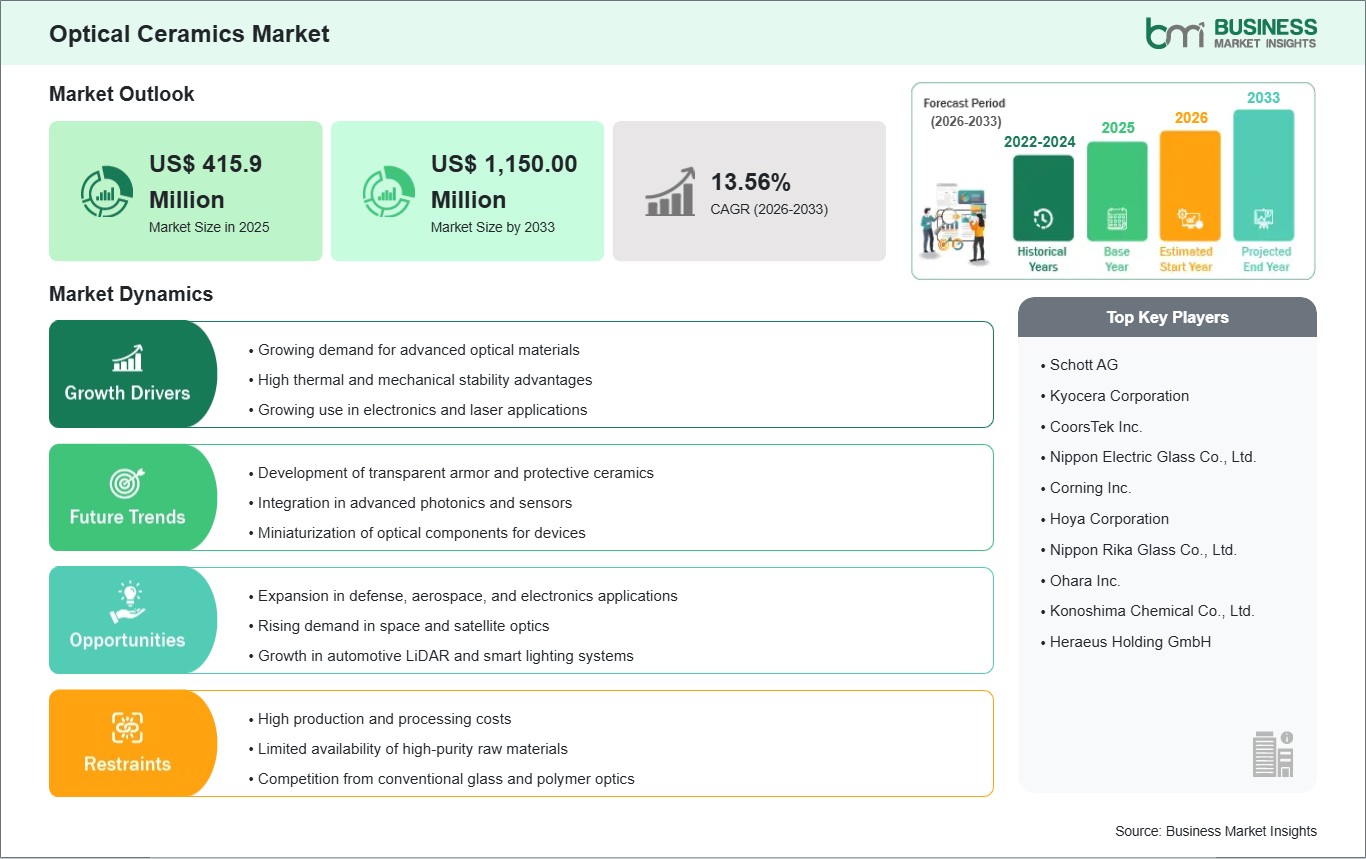
The Optical Ceramics Market size is expected to reach US$ 1,150.00 Million by 2033 from US$ 415.9 Million in 2025. The market is estimated to record a CAGR of 13.56% from 2026 to 2033.
The optical ceramics market is showing a steady growth rate as it is increasingly being demanded by the defense, aerospace, electronics, and medical industries. Optical ceramics are usually made up of transparent or translucent polycrystalline materials such as alumina or yttria. These materials show exceptional optical clarity, thermal resistance, and mechanical strength compared to traditional glass. These characteristics make optical ceramics suitable for a range of applications, including laser technology, infrared window materials, night vision devices, and high-performance optical components. The growth of the market is mainly due to the increasing investment in defense and aerospace technologies, particularly high-energy laser systems and sensor components. These optical ceramics must have refractive indices, low scattering, and improved durability.
The market is being driven by the developments taking place in sintering and powder processing, as well as surface finishing. The optical ceramics market is differentiated by developments such as anti-reflective coatings and unique geometries and composites for high-temperature and high-radiation resistance. Strategic alliances with research organizations, defense organizations, and industrial OEMs are helping expand market opportunities and application development. However, the high production cost, complex production process, and stringent quality control are some of the key challenges faced by the market. Nevertheless, the growing demand for medical imaging, laser machining, and photonics applications, along with rising investments in research and development for future-generation materials, are expected to drive the market in a positive direction.

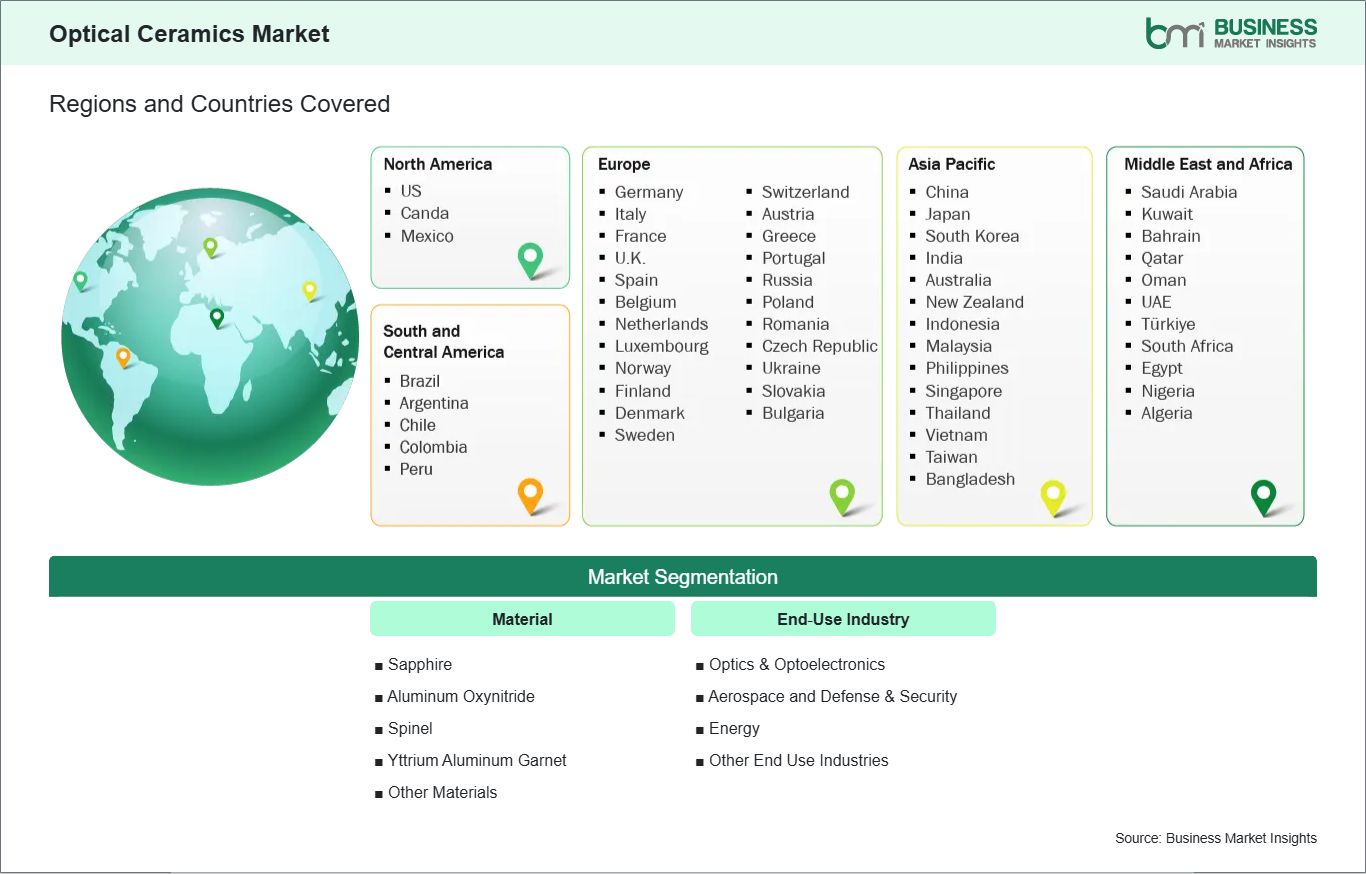
Key segments that contributed to the derivation of the optical ceramics market analysis are material and end‑use industry.
The growing need for advanced optical products is one of the key factors fueling the growth of the optical ceramics market. Optical ceramics are considered an ideal option for various applications owing to their high transparency, thermal stability, and strength. They are primarily used for applications related to the defense sector, aerospace, electronics, and medical devices. Optical ceramics are commonly utilized for lenses, windows, laser components, and protective components where high-performance capabilities under harsh conditions are required.
Moreover, the need for sustainability and performance is further contributing to the growth of the optical ceramics market. Optical ceramics are considered an ideal option for various applications compared to other alternatives such as glass and polymers owing to their high performance and long lifespan. This has resulted in the growing demand for optical ceramics as a reliable option for various applications where high-performance capabilities are required. In addition, their high resistance to wear and corrosion is further contributing to the growth of the optical ceramics market.
Advancements in manufacturing and material processing technologies have expanded the potential applications of optical ceramics. Techniques such as sintering, hot pressing, and transparent ceramic fabrication enable precise control over material properties, including transparency, density, and refractive index. As industries continue to require high-performance, durable, and reliable optical materials, the demand for optical ceramics is expected to grow steadily.
However, the market for optical ceramics is also growing, driven by the increased need for them in defense, aerospace, and electronics sectors. In the defense industry, optical ceramics are used for protective windows, domes, and sensors, owing to their transparency, impact resistance, and thermal properties. This enables the equipment used in extreme conditions to perform optimally, yet provide transparency, which is critical for surveillance, targeting, and communication.
In the aerospace industry, optical ceramics are used for laser systems, satellites, and aircraft sensors. This is because they are able to withstand extreme conditions, including temperature, mechanical, and environmental factors. Additionally, the lightweight aspect of optical ceramics is advantageous for the optimization of aircraft and aerospace systems.
Electronics applications are increasingly adopting optical ceramics in lasers, display technologies, and photonics devices. High optical performance, coupled with thermal and chemical stability, allows for improved device efficiency and lifespan. Innovations in fabrication techniques have enabled customized optical properties and complex shapes, expanding design possibilities. As industries continue to demand high-performance, durable, and precision optical materials, the adoption of optical ceramics is expected to grow steadily across defense, aerospace, and electronics sectors worldwide.

The optical ceramics market demonstrates steady growth, with size and share analysis highlighting evolving trends and competitive dynamics among key players. The report examines subsegments categorized within material and end‑use industry, offering insights into their contribution to overall market performance.
By Material, the Sapphire subsegment dominated the market in 2025, driven by its exceptional optical transparency, hardness, and thermal stability.
Based on End‑Use Industry, the Optics & Optoelectronics subsegment dominated the market in 2025, owing to increasing demand for high-performance optical components in cameras, lasers, and sensors.
| Report Attribute | Details |
|---|---|
| Market size in 2025 | US$ 415.9 Million |
| Market Size by 2033 | US$ 1,150.00 Million |
| Global CAGR (2026 - 2033) | 13.56% |
| Historical Data | 2022-2024 |
| Forecast period | 2026-2033 |
| Segments Covered | By Material
|
|
Regions and Countries Covered
| |
| North America | US, Canada, Mexico |
| Europe | Belgium, Austria, Finland, Denmark, Greece, Poland, Romania, Russia, Ukraine, Czech Republic, Slovakia, Bulgaria, Italy, Luxembourg, Germany, Switzerland, France, Netherlands, Norway, Portugal, Spain, Sweden, United Kingdom |
| Asia-Pacific | Australia, China, India, Japan, South Korea, Indonesia, Malaysia, Philippines, Singapore, Thailand, Vietnam, Bangladesh, New Zealand, Taiwan |
| South and Central America | Brazil, Argentina, Peru, Chile, Colombia |
| Middle East and Africa | Bahrain, Kuwait, Oman, Qatar, Saudi Arabia, United Arab Emirates, Turkiye, South Africa, Egypt, Algeria, Nigeria |
| Market leaders and key company profiles |
|
The "Optical Ceramics Market Size and Forecast (2022 - 2033)" report provides a detailed analysis of the market covering below areas:
The geographical scope of the Optical Ceramics Market report is divided into North America, Asia Pacific, Europe, Middle East & Africa, and South & Central America. North America held the largest share in 2025.
the optical ceramics market exhibits varied growth trajectories shaped by industrial development, defense expenditure, and technological adoption. North America dominates the market, driven by the U.S. and Canada`s strong defense, aerospace, and medical device sectors. High adoption in laser systems, infrared sensors, and precision optics, combined with supportive government research funding, reinforces regional leadership.
Europe shows steady growth, particularly in Germany, France, and the U.K., where advanced manufacturing, aerospace, and photonics industries drive demand. Strict quality standards and investment in research and development for optical technologies support the adoption of specialized optical ceramics.
Asia Pacific is the fastest-growing region, led by China, Japan, and South Korea, due to rapid industrialization, expansion in electronics and automotive sectors, and investments in defense and high-tech optics. Government initiatives to promote advanced materials and innovation are accelerating market growth.
Middle East & Africa demonstrates moderate growth, supported by military modernization programs and investments in industrial automation and high-performance optical sensors.
South & Central America shows gradual expansion, with Brazil and Argentina leading demand through aerospace, defense, and scientific research applications. Growing awareness of high-performance optical materials is encouraging broader adoption across industrial and medical sectors.

The Optical Ceramics Market is evaluated by gathering qualitative and quantitative data post primary and secondary research, which includes important corporate publications, association data, and databases. A few of the key developments in the optical ceramics market are:
The Optical Ceramics Market is valued at US$ 415.9 Million in 2025, it is projected to reach US$ 1,150.00 Million by 2033.
As per our report Optical Ceramics Market, the market size is valued at US$ 415.9 Million in 2025, projecting it to reach US$ 1,150.00 Million by 2033. This translates to a CAGR of approximately 13.56% during the forecast period.
The Optical Ceramics Market report typically cover these key segments-
The historic period, base year, and forecast period can vary slightly depending on the specific market research report. However, for the Optical Ceramics Market report:
The Optical Ceramics Market is populated by several key players, each contributing to its growth and innovation. Some of the major players include:
The Optical Ceramics Market report is valuable for diverse stakeholders, including:
Essentially, anyone involved in or considering involvement in the Optical Ceramics Market value chain can benefit from the information contained in a comprehensive market report.
Please tell us your area of interest
(Market Segments/ Regions and Countries/ Companies)