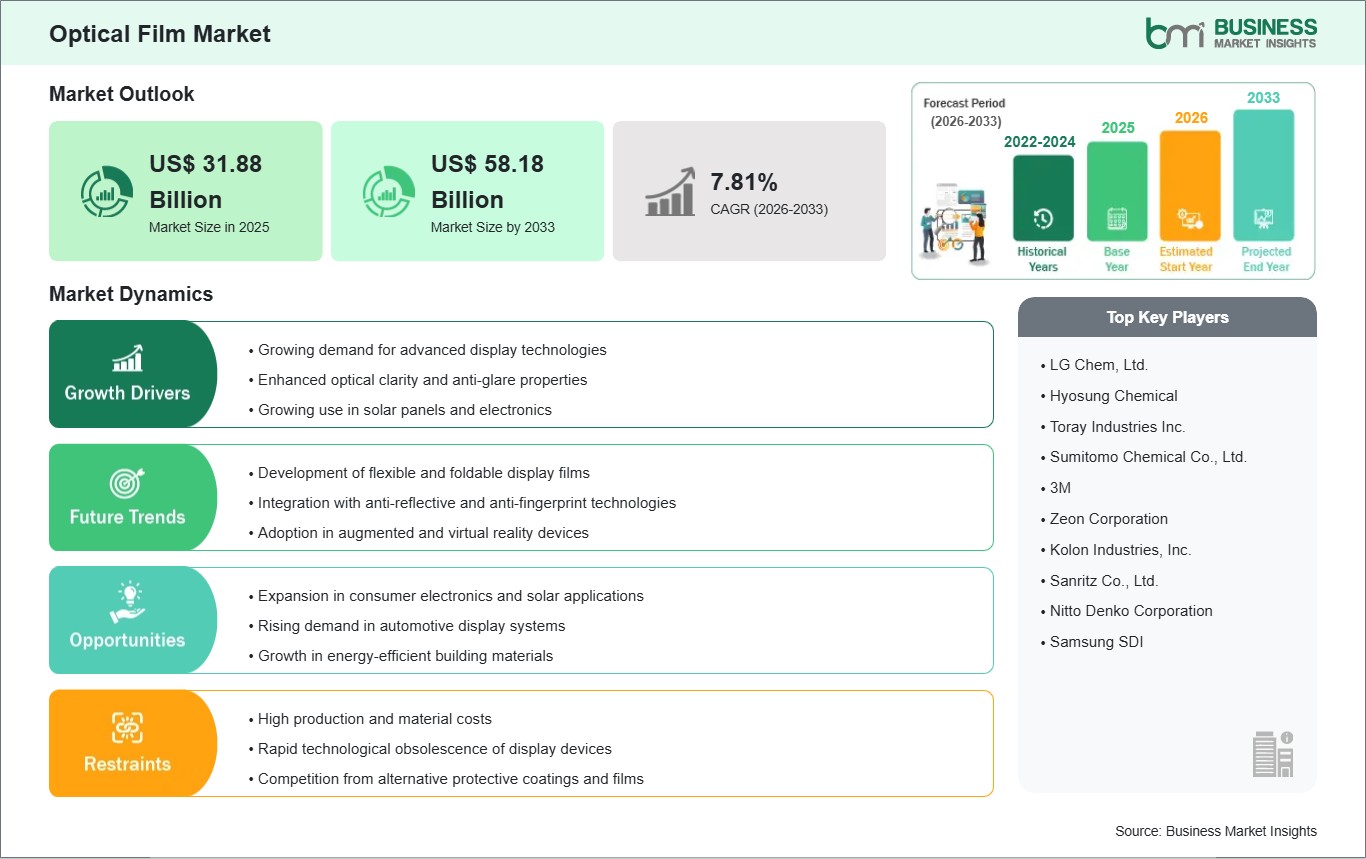
The Optical Film Market size is expected to reach US$ 58.18 Billion by 2033 from US$ 31.88 Billion in 2025. The market is estimated to record a CAGR of 7.81% from 2026 to 2033.
The optical films market is growing at a rapid rate, driven by the increasing demand for high-performance display and lighting solutions in the consumer electronics, automotive, and industrial spaces. Optical films, including polarizers, brightness enhancement films, diffusion sheets, and anti-reflective coatings, are essential components of liquid crystal displays, organic light-emitting displays, touch sensors, and LED lighting systems. These films are essential for increasing the display brightness, color, and contrast of displays, making them critical components of smartphones, TVs, tablets, and automotive infotainment systems. The increasing trend of using 4K/8K display resolutions, flexible displays, and energy-efficient lighting systems is creating a significant demand for high-performance optical films with excellent light management properties.
The optical films market is influenced by the increasing developments in multi-layered coatings, nanostructured films, and advanced polymers, providing excellent optical, thermal, and durability properties to the films. Instead, firms are focusing on product customization such as polarization and anti-glare coating to meet the requirements of device manufacturers. Strategic partnerships with OEMs, material suppliers, and research organizations help in the swift development of high-performance products, especially for next-generation display devices. The challenges faced in the display film market are high raw material costs, complex manufacturing processes, and obsolescence due to high innovation rates in display devices. However, continuous investment in energy-saving products, flexible displays, and automotive display markets provides a good market outlook for display film products.

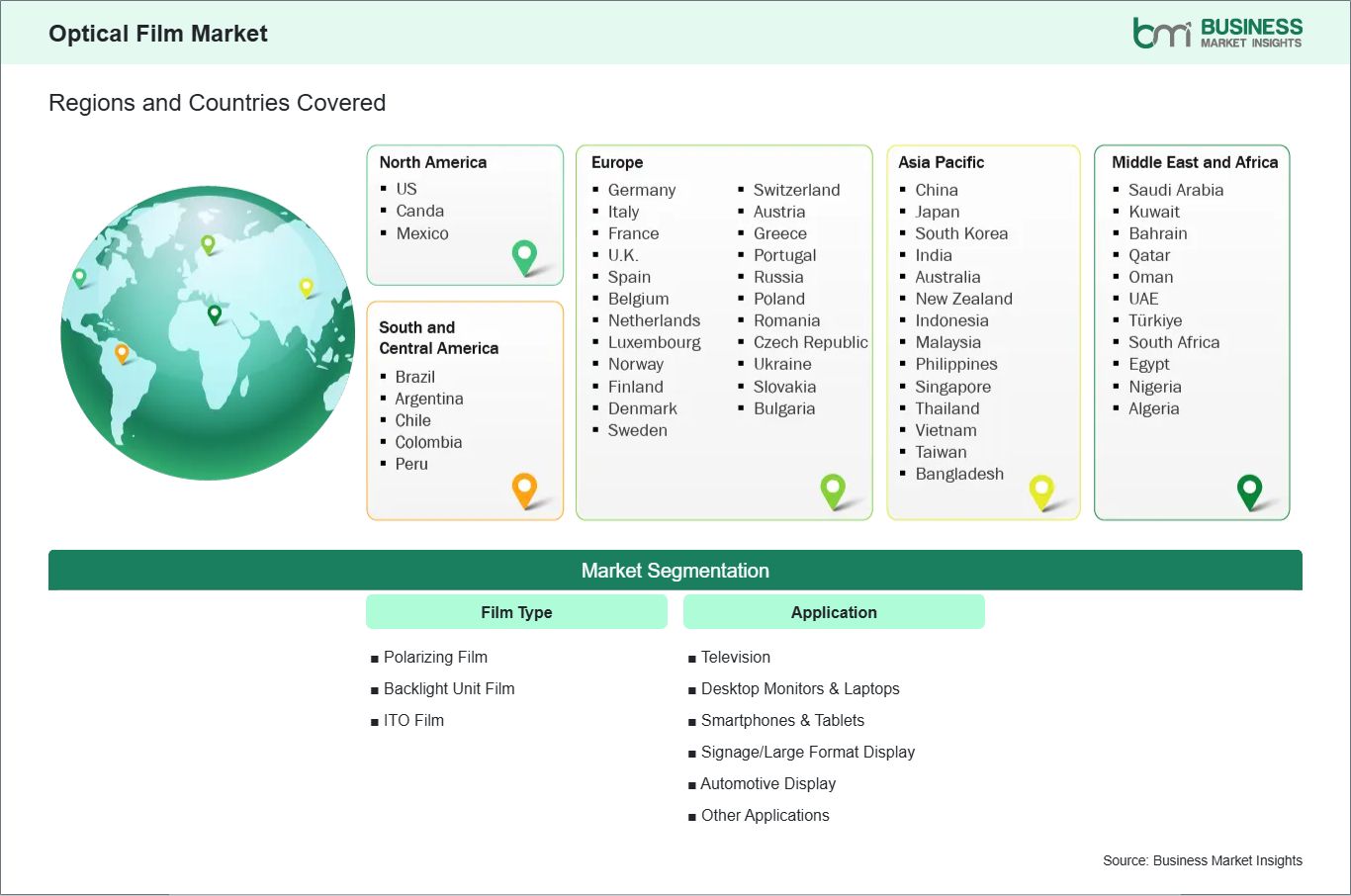
Key segments that contributed to the derivation of the optical film market analysis are film type and application.
Increased demand for high-end display technologies also represents a significant driver for the market for optical films. Optical films are an integral part of many electronic devices, for example, in smartphones, tablets, laptops, TVs, monitors, among others, where they are used for improving display brightness, contrast, and color quality. They are also used for improving energy efficiency in portable devices by optimizing light management, reducing power consumption, and improving battery life in these devices. Their ability to improve display performance without compromising on thin and lightweight designs makes them a necessity in today's electronic devices.
Also, the increase in consumer demands for the best image quality and miniaturized devices is fueling the market growth. Optical films, which include polarizers, diffusers, and brightness enhancement films, are critical components that provide the best image clarity, brightness, and viewing angles. As display devices become thinner, lighter, and more energy-efficient through innovations in display design, optical films help manufacturers achieve this.
Advancements in film materials and production technologies have expanded their applications and performance capabilities. Multi-layer coatings, anti-reflective surfaces, and high-transmittance materials allow optical films to provide precise light control and durability. As demand for enhanced display quality and energy-efficient devices continues to rise, the global market for optical films is expected to grow steadily across consumer electronics and industrial applications.
The optical film industry is growing because of increasing usage in consumer electronics and solar energy. In consumer electronics, optical films are employed in display panels, touchscreens, and flexible electronics for better display quality, glare reduction, and increased efficiency. The use of optical films for increasing display panel brightness and uniformity, along with their thin profiles, makes them a popular choice for manufacturers of consumer electronics who want to deliver high-performance products.
In solar energy, optical films are employed in photovoltaic panels for increased efficiency in light transmission. The efficiency of optical films in increasing light transmission and distribution helps in increasing the efficiency of solar energy conversion, thus contributing to increased usage of solar energy. The environmental durability of optical films ensures their usage in outdoor settings for increased efficiency.
Innovation in film technologies has also enabled new functionalities, such as anti-reflective coatings, diffusion layers, and brightness enhancement layers. These features allow for more versatile applications across displays, lighting systems, and energy devices. As industries continue to prioritize performance, efficiency, and sustainability, the adoption of optical films is expected to increase steadily, supporting growth in both consumer electronics and solar energy sectors worldwide.

The optical film market demonstrates steady growth, with size and share analysis highlighting evolving trends and competitive dynamics among key players. The report examines subsegments categorized within film type and application, offering insights into their contribution to overall market performance.
By Film Type, the Polarizing Film subsegment dominated the market in 2025, driven by its critical role in enhancing display clarity, contrast, and viewing performance on LCD and OLED screens.
Based on Application, the television subsegment dominated the market in 2025, owing to increasing consumer demand for larger-screen TVs with high‑quality displays.
| Report Attribute | Details |
|---|---|
| Market size in 2025 | US$ 31.88 Billion |
| Market Size by 2033 | US$ 58.18 Billion |
| Global CAGR (2026 - 2033) | 7.81% |
| Historical Data | 2022-2024 |
| Forecast period | 2026-2033 |
| Segments Covered | By Film Type
|
|
Regions and Countries Covered
| |
| North America | US, Canada, Mexico |
| Europe | Belgium, Austria, Finland, Denmark, Greece, Poland, Romania, Russia, Ukraine, Czech Republic, Slovakia, Bulgaria, Italy, Luxembourg, Germany, Switzerland, France, Netherlands, Norway, Portugal, Spain, Sweden, United Kingdom |
| Asia-Pacific | Australia, China, India, Japan, South Korea, Indonesia, Malaysia, Philippines, Singapore, Thailand, Vietnam, Bangladesh, New Zealand, Taiwan |
| South and Central America | Brazil, Argentina, Peru, Chile, Colombia |
| Middle East and Africa | Bahrain, Kuwait, Oman, Qatar, Saudi Arabia, United Arab Emirates, Turkiye, South Africa, Egypt, Algeria, Nigeria |
| Market leaders and key company profiles |
|
The "Optical Film Market Size and Forecast (2022 - 2033)" report provides a detailed analysis of the market covering below areas:
The geographical scope of the Optical Film Market report is divided into North America, Asia Pacific, Europe, Middle East & Africa, and South & Central America. North America held the largest share in 2025.
The optical film market exhibits varied growth patterns influenced by display manufacturing capacity, technological adoption, and industrial development. North America dominates, supported by high adoption in consumer electronics, automotive displays, and advanced lighting systems in the U.S. and Canada. Strong R&D infrastructure, high consumer awareness, and regulatory incentives for energy-efficient technologies drive regional leadership.
Europe demonstrates steady growth, particularly in Germany, France, and the U.K., due to the strong presence of automotive and electronics manufacturing, coupled with investment in energy-efficient and high-performance display technologies.
Asia Pacific is the fastest-growing region, led by China, Japan, South Korea, and Taiwan. Rapid industrialization, expansion of display and electronics manufacturing, and increasing adoption of smartphones, tablets, and large-screen TVs drive regional demand. Government incentives for technological innovation and domestic production capacity further accelerate market growth.
Middle East & Africa shows moderate growth, with the GCC countries leveraging optical films for LED lighting, signage, and automotive display applications, driven by urbanization and infrastructure development.
South & Central America demonstrates gradual expansion, with Brazil and Argentina leading demand through consumer electronics, automotive, and industrial lighting applications. Growing awareness of energy-efficient display and lighting solutions is encouraging wider adoption of optical films.

The Optical Film Market is evaluated by gathering qualitative and quantitative data post primary and secondary research, which includes important corporate publications, association data, and databases. A few of the key developments in the optical film market are:
The Optical Film Market is valued at US$ 31.88 Billion in 2025, it is projected to reach US$ 58.18 Billion by 2033.
As per our report Optical Film Market, the market size is valued at US$ 31.88 Billion in 2025, projecting it to reach US$ 58.18 Billion by 2033. This translates to a CAGR of approximately 7.81% during the forecast period.
The Optical Film Market report typically cover these key segments-
The historic period, base year, and forecast period can vary slightly depending on the specific market research report. However, for the Optical Film Market report:
The Optical Film Market is populated by several key players, each contributing to its growth and innovation. Some of the major players include:
The Optical Film Market report is valuable for diverse stakeholders, including:
Essentially, anyone involved in or considering involvement in the Optical Film Market value chain can benefit from the information contained in a comprehensive market report.
Please tell us your area of interest
(Market Segments/ Regions and Countries/ Companies)