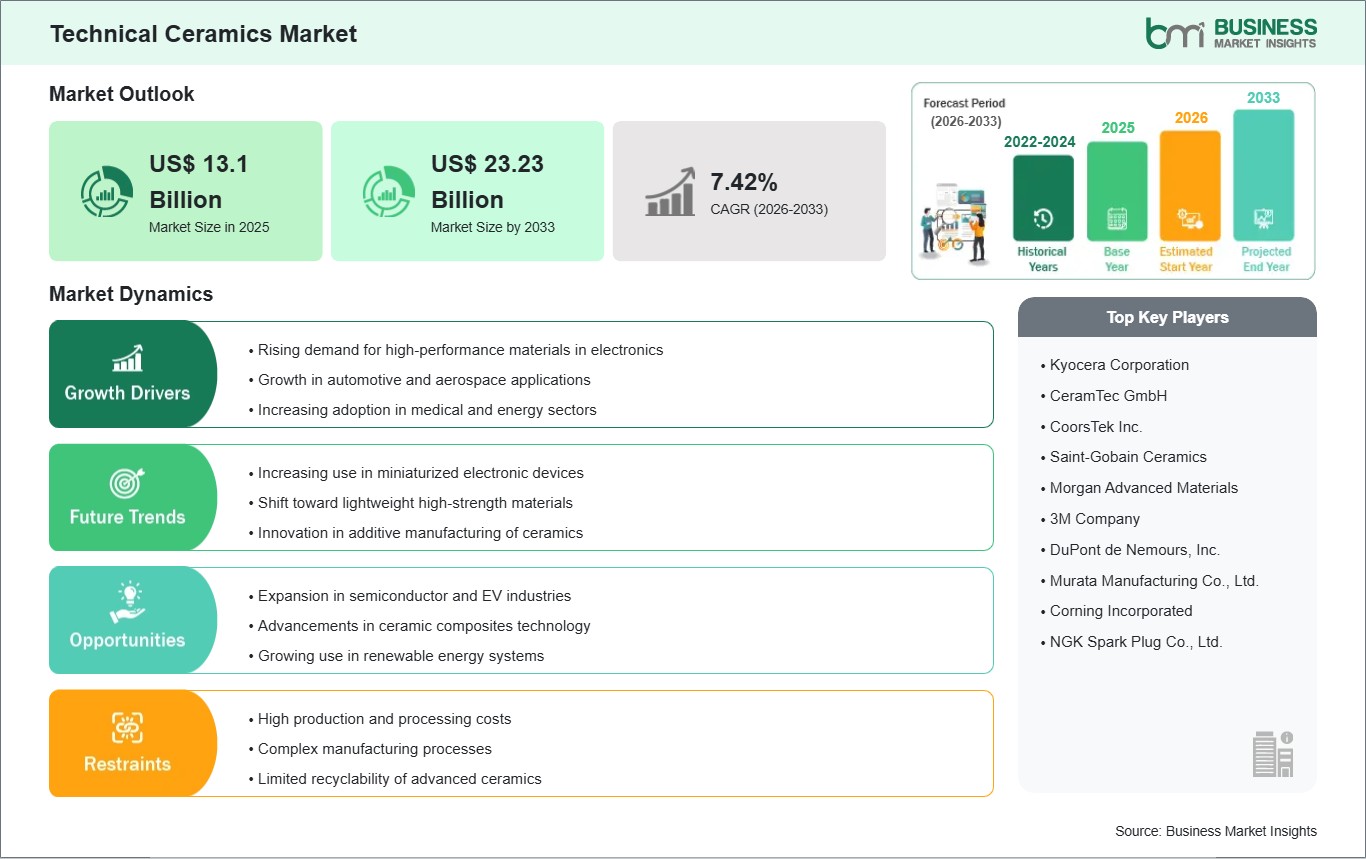
The Technical Ceramics Market size is expected to reach US$ 23.23 billion by 2033 from US$ 13.1 billion in 2025. The market is estimated to record a CAGR of 7.42% from 2026 to 2033.
The technical ceramics market is witnessing a steady increase in market growth, and this is attributed to the rising need for high-performance materials in industries such as electronics, automotive, and healthcare. These materials possess excellent properties such as thermal resistance, mechanical strength, and electrical insulation, among others, and this makes them very suitable for high-end industries. Alumina is leading in the material segment of technical ceramics owing to its cost-effectiveness and versatility, while monolithic is leading in the product segment of technical ceramics owing to its reliability and durability.
The electrical and electronics segment is the largest end-user segment for technical ceramics and is driven by the rapid technological advancements in the manufacturing of semiconductor devices and electronics. Although the end-user segment faces challenges such as high production costs and complex processing techniques, the market for technical ceramics is expanding due to the constant technological innovations in the field. Moreover, the research and development activities aimed at improving the properties of the materials and reducing the production costs are increasing the competitiveness of the market for technical ceramics. Thus, the market for technical ceramics is expected to grow steadily with the increasing end-user applications and the need for the materials.

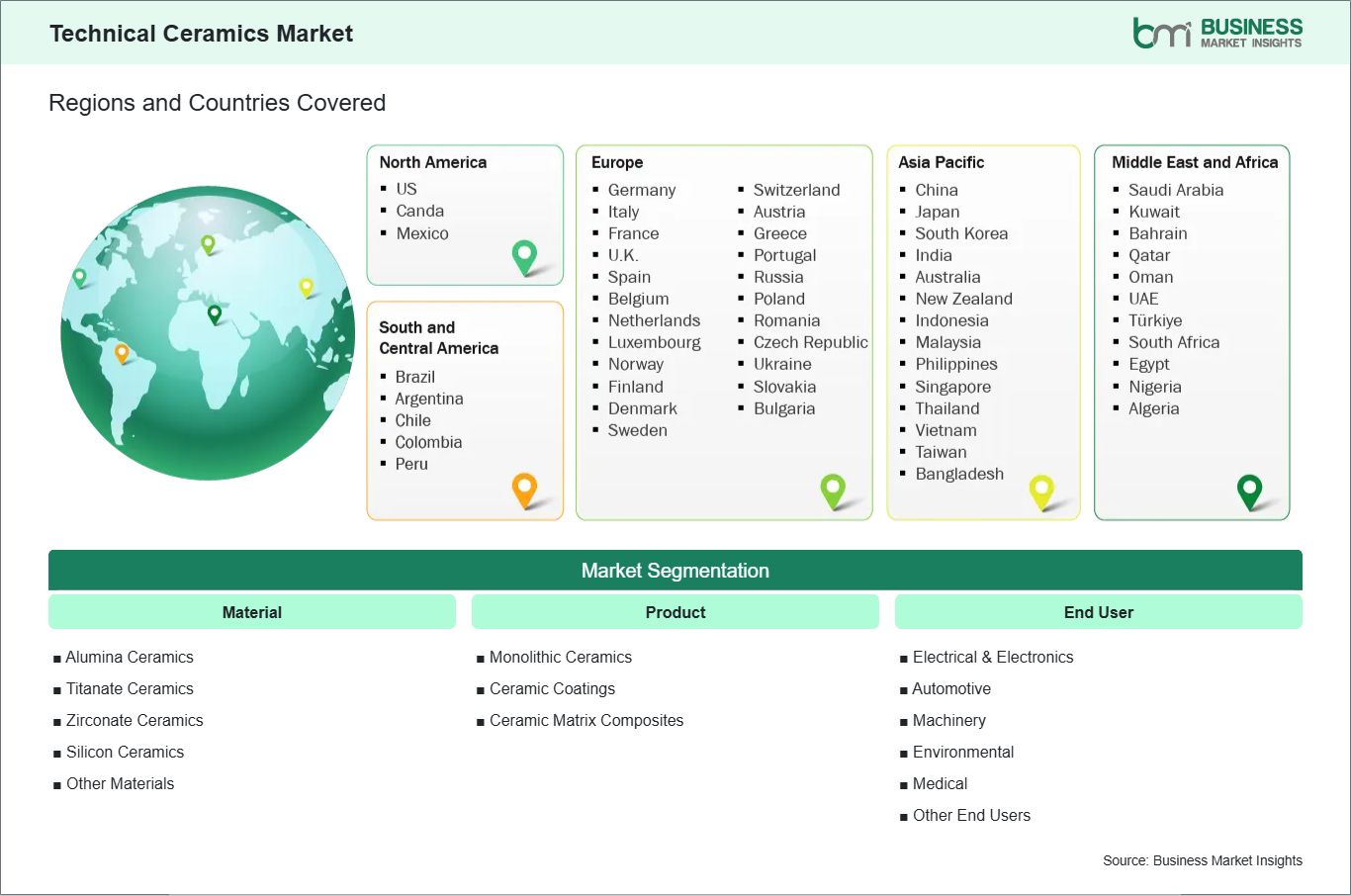
Key segments that contributed to the derivation of the Technical Ceramics market analysis are material, product, and end user.
The electronics industry is increasingly relying on high-performance materials, driving significant growth in the technical ceramics market. Technical ceramics are valued for their exceptional electrical insulation, high thermal stability, and superior mechanical strength, making them indispensable in the production of substrates, insulators, capacitors, and semiconductor devices. As electronic products continue to evolve toward smaller, faster, and more efficient designs, the need for materials that can maintain stability under extreme thermal and electrical conditions has become critical. This demand spans across advanced applications worldwide, from consumer electronics to industrial systems.
Technological developments in the form of the deployment of 5G technology, the development of AI, and the widespread use of IoT devices are increasingly promoting the use of advanced electronic parts. Technical ceramics are playing a vital role in improving thermal dissipation, reliability, and performance in miniaturized designs. Moreover, the development of semiconductor processes and the increasing global demand for consumer electronics are also promoting the use of technical ceramics. With industries increasingly looking to provide durable, efficient, and innovative products, the use of advanced materials like technical ceramics is likely to increase steadily. This shows that technical ceramics are going to be the key to future electronics in terms of technological development and market development.
As the semiconductor and EV markets continue to experience explosive growth, there are tremendous opportunities for the technical ceramics industry. The semiconductor and EV industries both rely upon high-performance materials that provide thermal resistance, electrical insulation and mechanical strength so that they maintain reliable performance in harsh environments. Technical ceramics provide all of these characteristics and therefore make excellent candidates for next generation applications which require high efficiency, safety and dependable performance over the long term.
Technical ceramics are a major material class used in semiconductor manufacturing. They are the basis of many wafer processing equipment, insulating components, and high-temperature systems requiring precision and stability. Like in semiconductor manufacturing, technical ceramics are being employed in EVs for battery systems, sensors, power electronics, etc., mainly because these materials are lightweight and can tolerate high heat. The worldwide movement toward electrification and digitalization is the main reason behind investments in both sectors, which led to an increased demand for high-performance materials. While manufacturers increase production and technology advances further, experts forecast that technical ceramics will be the cornerstone of innovation, help sustainability and reliability without a hitch. Wholesale fences this extension makes the market outlook stronger, but at the same time it places technical ceramics as the main driver of future industrial and technological progress

The global Technical Ceramics market is experiencing steady growth, with market size and share analysis reflecting evolving treatment preferences and competitive dynamics among key players. The report evaluates important subsegments categorized within material, product, and end user, highlighting their respective contributions to overall market performance.
By material, the Alumina Ceramics subsegment dominated the market in 2025 due to its excellent electrical insulation, high thermal stability, corrosion resistance, and cost-effectiveness, making it widely used across electronics, automotive, and industrial machinery applications requiring durable and reliable material performance.
By product, the Monolithic Ceramics subsegment dominated the market in 2025 due to their superior mechanical strength, wear resistance, and structural integrity, enabling extensive use in demanding environments such as aerospace, automotive engines, and industrial components requiring high durability and long operational life.
By end user, the Electrical & Electronics subsegment dominated the market in 2025 due to increasing demand for semiconductors, electronic devices, and components requiring materials with high dielectric strength, thermal resistance, and reliability, supporting widespread adoption of technical ceramics in advanced electronic applications.
| Report Attribute | Details |
|---|---|
| Market size in 2025 | US$ 13.1 Billion |
| Market Size by 2033 | US$ 23.23 Billion |
| Global CAGR (2026 - 2033) | 7.42% |
| Historical Data | 2022-2024 |
| Forecast period | 2026-2033 |
| Segments Covered | By Material
|
|
Regions and Countries Covered
| |
| North America | US, Canada, Mexico |
| Europe | Belgium, Austria, Finland, Denmark, Greece, Poland, Romania, Russia, Ukraine, Czech Republic, Slovakia, Bulgaria, Italy, Luxembourg, Germany, Switzerland, France, Netherlands, Norway, Portugal, Spain, Sweden, United Kingdom |
| Asia-Pacific | Australia, China, India, Japan, South Korea, Indonesia, Malaysia, Philippines, Singapore, Thailand, Vietnam, Bangladesh, New Zealand, Taiwan |
| South and Central America | Brazil, Argentina, Peru, Chile, Colombia |
| Middle East and Africa | Bahrain, Kuwait, Oman, Qatar, Saudi Arabia, United Arab Emirates, Turkiye, South Africa, Egypt, Algeria, Nigeria |
| Market leaders and key company profiles |
|
The "Technical Ceramics Market Size and Forecast (2022 - 2033)" report provides a detailed analysis of the market covering below areas:
The geographical scope of the Technical Ceramics market report is divided into: North America, Asia Pacific, Europe, Middle East & Africa, and South & Central America. North America held the largest share in 2025.
North America dominates the technical ceramics market due to strong demand from industries such as electronics, aerospace, automotive, and healthcare. The region benefits from advanced manufacturing infrastructure and significant investment in research and development, enabling the production of high-performance ceramic materials. The presence of leading technology companies and semiconductor manufacturers further drives demand for technical ceramics in electronic components and devices.
Additionally, the growing adoption of electric vehicles and renewable energy technologies is contributing to increased utilization of advanced ceramics in the region. Regulatory standards promoting high-quality and durable materials also support market growth. Continuous innovation and technological advancements are enhancing product capabilities and expanding application areas. The increasing focus on lightweight, energy-efficient, and high-strength materials across industries is further driving demand. Overall, North America maintains its leading position due to strong industrial base, technological leadership, and continuous advancements in material science.

The Technical Ceramics market is evaluated by gathering qualitative and quantitative data post primary and secondary research, which includes important corporate publications, association data, and databases. A few of the key developments in the Technical Ceramics market are:
The Technical Ceramics Market is valued at US$ 13.1 Billion in 2025, it is projected to reach US$ 23.23 Billion by 2033.
As per our report Technical Ceramics Market, the market size is valued at US$ 13.1 Billion in 2025, projecting it to reach US$ 23.23 Billion by 2033. This translates to a CAGR of approximately 7.42% during the forecast period.
The Technical Ceramics Market report typically cover these key segments-
The historic period, base year, and forecast period can vary slightly depending on the specific market research report. However, for the Technical Ceramics Market report:
The Technical Ceramics Market is populated by several key players, each contributing to its growth and innovation. Some of the major players include:
The Technical Ceramics Market report is valuable for diverse stakeholders, including:
Essentially, anyone involved in or considering involvement in the Technical Ceramics Market value chain can benefit from the information contained in a comprehensive market report.
Please tell us your area of interest
(Market Segments/ Regions and Countries/ Companies)