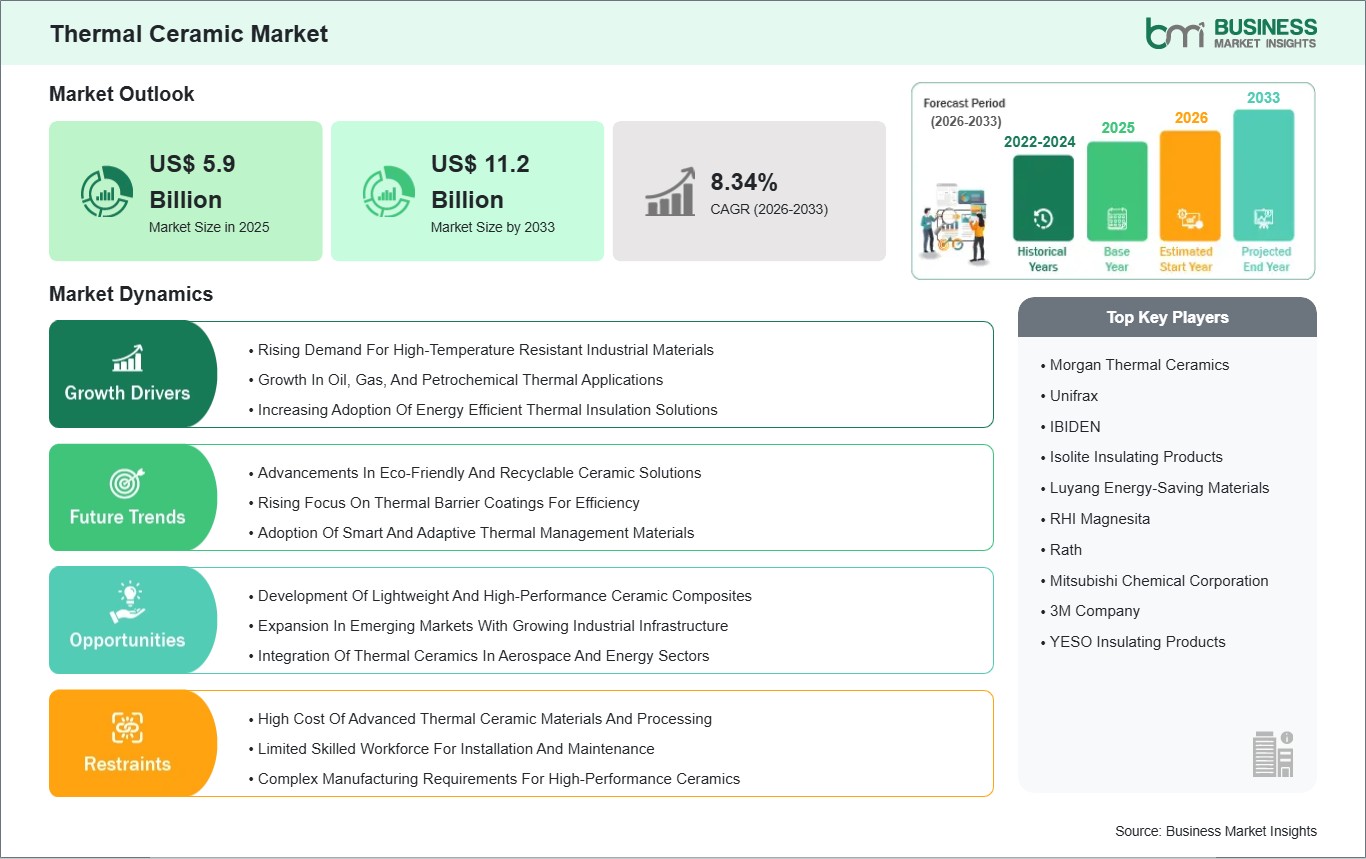
The Thermal Ceramic Market size is expected to reach US$ 11.2 billion by 2033 from US$ 5.9 billion in 2025. The market is estimated to record a CAGR of 8.34% from 2026 to 2033.
The global thermal ceramic market includes engineered ceramic materials that maintain high temperature conditions while providing excellent thermal insulation, chemical durability, and mechanical strength for hot environments. The industrial facilities which operate in oil and gas, power generation, metallurgy, aerospace, automotive and industrial manufacturing sectors utilize these materials, which include refractory bricks and ceramic fibers, insulating boards and coatings and advanced monolithic ceramics. Thermal ceramics function as critical components that enhance energy efficiency while decreasing heat loss and protecting vital equipment, and improving safety measures throughout operations that require precise temperature management.
North America leads the worldwide thermal ceramic market because it possesses developed industrial facilities and technology-based manufacturing industries, and multiple essential industries that require specialized insulation and refractory products. The oil and gas sector and petrochemical industry and the power generation sector of the region use thermal ceramics to improve their operations at high temperatures while extending equipment durability and achieving better energy savings. The aerospace and automotive sectors of North America use advanced ceramic insulators and heat management systems to comply with rigorous performance standards and safety regulations, which increases demand for these products in the region.
The global market experiences multiple driving forces, which include increased demand for energy-efficient solutions and reduced emissions, together with industrial infrastructure growth and rising use of high-temperature materials in new technology developments. Thermal ceramics function as vital components that enable equipment to achieve optimal efficiency by reducing heat loss and providing better thermal management systems in industries that need to control their energy expenses and operational effectiveness. The market experiences two main obstacles, which include expensive advanced ceramic materials and the challenges that arise during the processes of production and installation.
The connection between these obstacles and project costs will deter implementation in developing regions, which prefer to use different insulation solutions. The manufacturing process in specific areas faces obstacles because of strict material processing and disposal regulations, which create additional compliance requirements for production companies. The development of lightweight ceramic composites together with advanced thermal barrier coatings and customized solutions for upcoming energy and aerospace technologies provides businesses with valuable growth possibilities. Thermal ceramic materials will maintain their vital role in driving worldwide industrial expansion as companies strive to achieve better thermal performance, increased durability, and environmentally friendly operations.

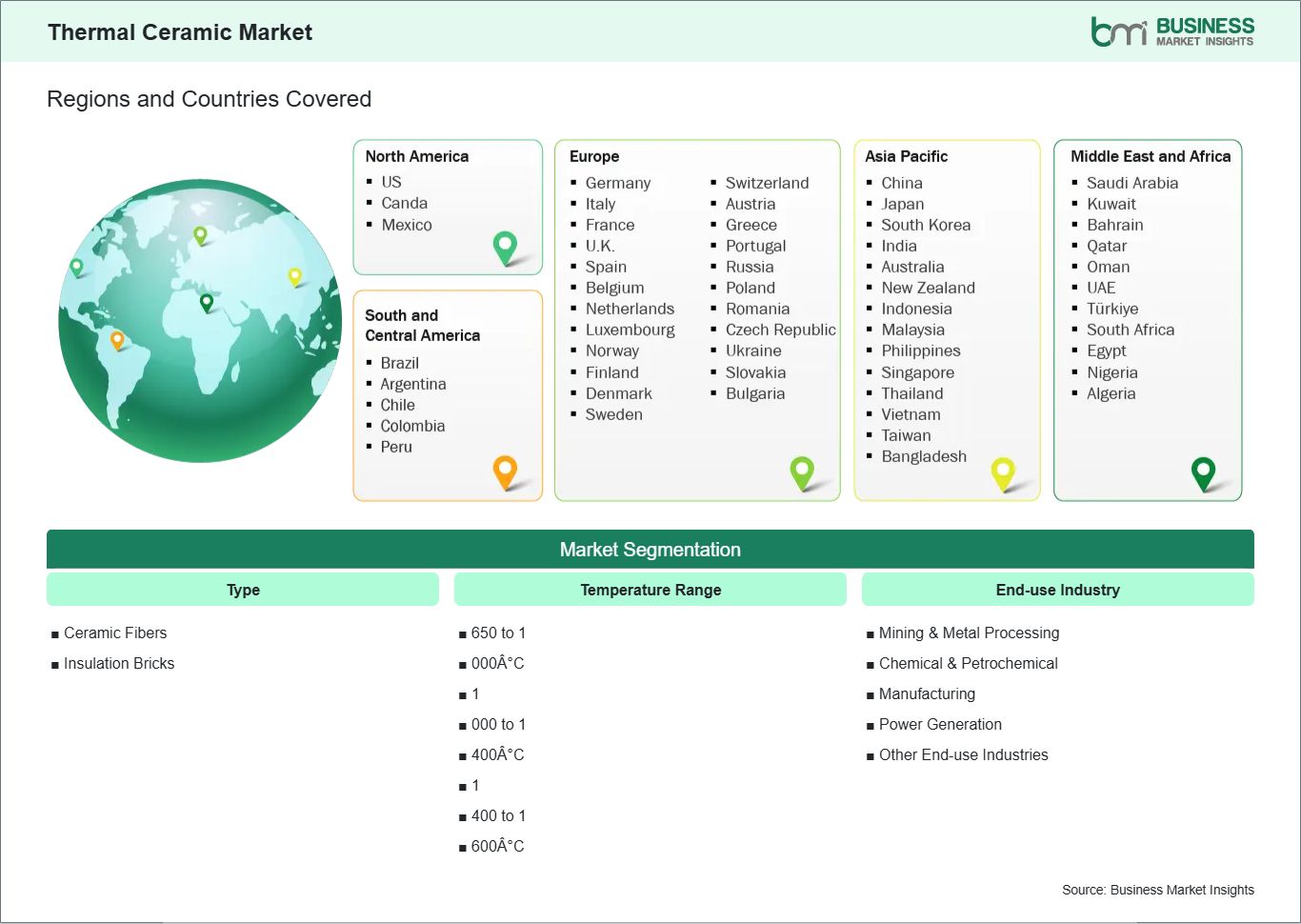
Key segments that contributed to the derivation of the thermal ceramic market analysis are type, temperature range and end‑use industry.
The ceramic materials used for thermal insulation purposes are essential to high-temperature industrial processes because they deliver insulation properties and maintain structural integrity and equipment protection capabilities which regular materials cannot provide. Worldwide industrial operations in sectors such as oil and gas refining and petrochemical processing and metallurgy and power generation now use thermal ceramic products to achieve operational efficiency and protect their equipment.
The materials find application in furnaces and reactors and reformers and boilers and exhaust systems which need to maintain high thermal resistance and chemical stability. The demand for refractory bricks and ceramic fibers has surged because petrochemical facilities in the Middle East and Asia Pacific have increased their refining capacity which requires materials that can endure high temperatures for extended periods.
The aerospace sector drives material demand because jet engines and spacecraft thermal protection systems need materials that can withstand extreme heat while maintaining low thermal conductivity. North American and European manufacturers maintain their commitment to developing thermal ceramic solutions which improve safety and performance capabilities for extreme environments. Global industrial furnace manufacturers use our advanced insulating firebrick and ceramic board products to enhance energy efficiency and minimize heat loss during extended thermal cycle operations.
The demand for lightweight and high‑performance ceramic composites is reshaping the thermal ceramic market as industries seek materials that offer superior performance without compromising on weight or durability. Traditional thermal ceramics were often heavy and difficult to integrate into advanced applications; however, newer composite formulations blend ceramic fibers with binders and reinforcements to achieve reduced density and enhanced mechanical properties. In automotive and aerospace sectors, these composites are increasingly used for components that require both thermal resistance and weight savings, such as thermal barriers in next‑generation engines and heat shields in aircraft structures.
North America and Europe lead in the development and adoption of these innovative materials, supported by robust research programs and collaborations between ceramic manufacturers and end‑use industries. Advanced thermal ceramic composites are tailored for specific performance criteria, including thermal shock resistance, abrasion resistance, and resilience under cyclic thermal loads. These attributes are critical in applications such as turbine components, exhaust systems, and high‑efficiency industrial ovens where performance reliability is paramount.
Asia Pacific manufacturers are rapidly adopting lightweight ceramic composites as local automotive and aerospace production expands, driving regional innovation and competitive differentiation. The development of additive manufacturing techniques for processing ceramic composites further accelerates customization and rapid prototyping. As industries worldwide prioritize energy efficiency, weight reduction, and durability, the role of lightweight, high‑performance thermal ceramic composites is expected to grow, meeting evolving engineering and sustainability objectives across sectors.
The thermal ceramic market demonstrates steady growth, with size and share analysis highlighting evolving trends and competitive dynamics among key players. The report examines subsegments categorized within type, temperature range and end‑use industry, offering insights into their contribution to overall market performance.
By type, the ceramic fibers subsegment dominated the market in 2025, driven by their superior thermal insulation, lightweight nature, and versatility in high-temperature applications.
Based on temperature range, the 1,000 to 1,400 °C subsegment dominated the market in 2025, driven by its suitability for a wide range of industrial processes requiring moderate to high-temperature resistance.
In terms of end‑use industry, the mining & metal processing subsegment dominated the market in 2025, driven by the high demand for thermal ceramics in kilns, furnaces, and heat-intensive metal production processes.
| Report Attribute | Details |
|---|---|
| Market size in 2025 | US$ 5.9 Billion |
| Market Size by 2033 | US$ 11.2 Billion |
| Global CAGR (2026 - 2033) | 8.34% |
| Historical Data | 2022-2024 |
| Forecast period | 2026-2033 |
| Segments Covered | By Type
|
|
Regions and Countries Covered
| |
| North America | US, Canada, Mexico |
| Europe | Belgium, Austria, Finland, Denmark, Greece, Poland, Romania, Russia, Ukraine, Czech Republic, Slovakia, Bulgaria, Italy, Luxembourg, Germany, Switzerland, France, Netherlands, Norway, Portugal, Spain, Sweden, United Kingdom |
| Asia-Pacific | Australia, China, India, Japan, South Korea, Indonesia, Malaysia, Philippines, Singapore, Thailand, Vietnam, Bangladesh, New Zealand, Taiwan |
| South and Central America | Brazil, Argentina, Peru, Chile, Colombia |
| Middle East and Africa | Bahrain, Kuwait, Oman, Qatar, Saudi Arabia, United Arab Emirates, Turkiye, South Africa, Egypt, Algeria, Nigeria |
| Market leaders and key company profiles |
|
The "Thermal Ceramic Market Size and Forecast (2022 - 2033)" report provides a detailed analysis of the market covering below areas:
The geographical scope of the Thermal Ceramic Market report is divided into North America, Asia Pacific, Europe, Middle East & Africa, and South & Central America. North America held the largest share in 2025.
The global thermal ceramic market is dominated by North America because its industrial infrastructure and oil and gas, petrochemical, power generation, aerospace and manufacturing sectors require advanced thermal insulation and refractory solutions. The United States and Canada show particular expertise in using ceramic fiber products and insulating firebricks and thermal barrier coatings for equipment that needs to endure extreme temperatures while ensuring energy efficiency and equipment durability.
Europe represents a mature market that demands sustainable thermal solutions because it enforces strict environmental regulations, which currently apply to Germany, France and the UK and their advanced manufacturing and automotive engineering and industrial furnace technology sectors.
The Asia Pacific region experiences strong demand for thermal ceramic products because China, India, Japan and South Korea develop their industrial and power generation, steel and metallurgical production and refinery and petrochemical infrastructure sectors, while local manufacturers begin using high-temperature resistant materials to boost their operational efficiency and lower their production expenses.
The Middle East and African markets derive their primary drivers from oil and gas operations and petrochemical industry growth, which occurs in Saudi Arabia UAE and South Africa because thermal ceramics serve critical functions in high-temperature industrial processes, yet their usage remains limited due to changing patterns of industrial funding and the existing gaps in regional infrastructure.
South and Central America demonstrate steady development through industrial sector upgrades, which Brazilian Mexican, and Argentine markets lead, while companies increasingly spend on thermal protection products for their furnaces and boilers and automotive parts because of rising energy efficiency needs.
The international market for thermal ceramics remains dominated by North America because its industrial sector offers various products, while companies prioritize research and development, which drives continuous market expansion.

The Thermal Ceramic Market is evaluated by gathering qualitative and quantitative data post primary and secondary research, which includes important corporate publications, association data, and databases. A few of the key developments in the thermal ceramic market are:
The Thermal Ceramic Market is valued at US$ 5.9 Billion in 2025, it is projected to reach US$ 11.2 Billion by 2033.
As per our report Thermal Ceramic Market, the market size is valued at US$ 5.9 Billion in 2025, projecting it to reach US$ 11.2 Billion by 2033. This translates to a CAGR of approximately 8.34% during the forecast period.
The Thermal Ceramic Market report typically cover these key segments-
The historic period, base year, and forecast period can vary slightly depending on the specific market research report. However, for the Thermal Ceramic Market report:
The Thermal Ceramic Market is populated by several key players, each contributing to its growth and innovation. Some of the major players include:
The Thermal Ceramic Market report is valuable for diverse stakeholders, including:
Essentially, anyone involved in or considering involvement in the Thermal Ceramic Market value chain can benefit from the information contained in a comprehensive market report.
Please tell us your area of interest
(Market Segments/ Regions and Countries/ Companies)