
Oilfield Integrity Management Market Outlook: Size, Share, Trends, Growth Analysis, Competitive Landscape & Forecast, 2026-2033

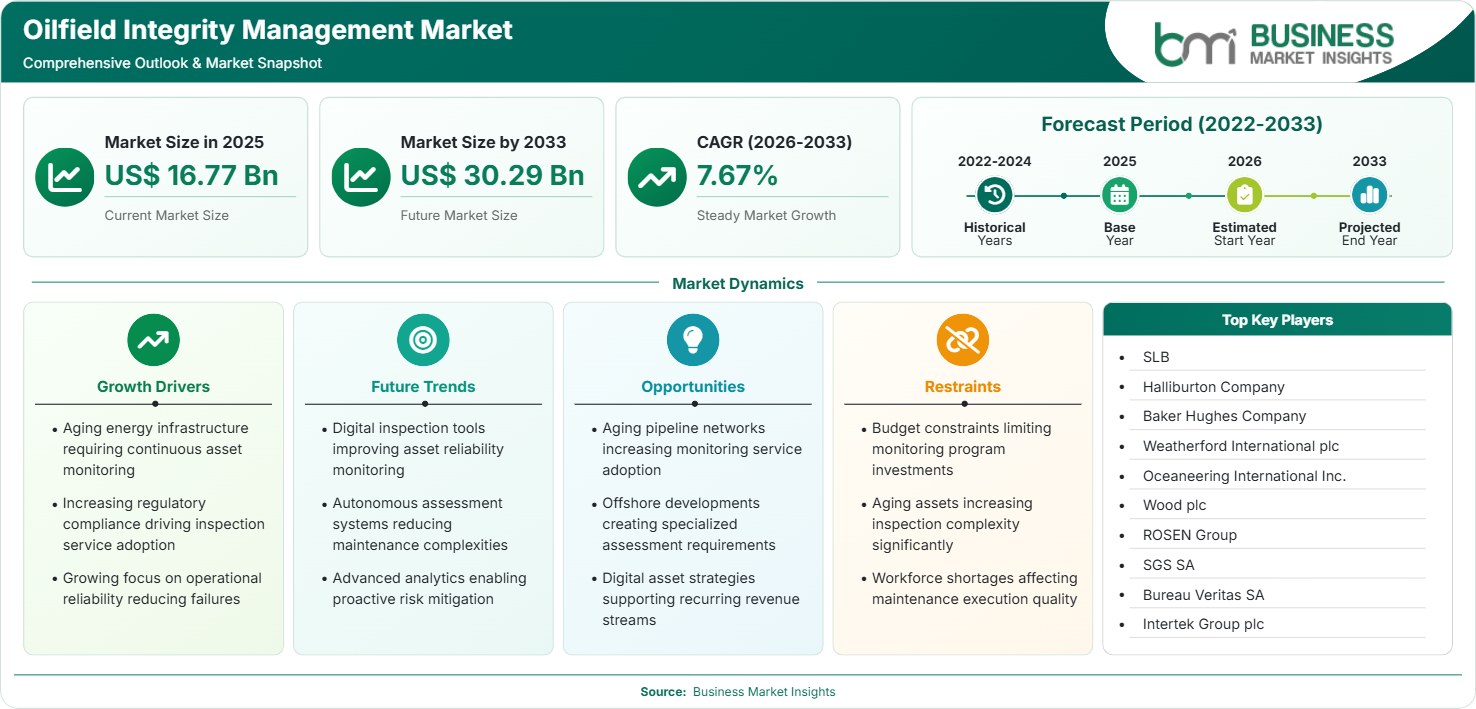
The Oilfield Integrity Management Market size was valued at US$ 16.77 Billion in 2025 and is projected to reach US$ 30.29 Billion by 2033, growing at a CAGR of 7.67% during 2026–2033. Rising asset-life extension programs, digital monitoring adoption, corrosion control investments, predictive maintenance deployment, offshore field modernization, and integrity-focused regulatory frameworks are creating substantial opportunities across global energy infrastructure.

Report Coverage
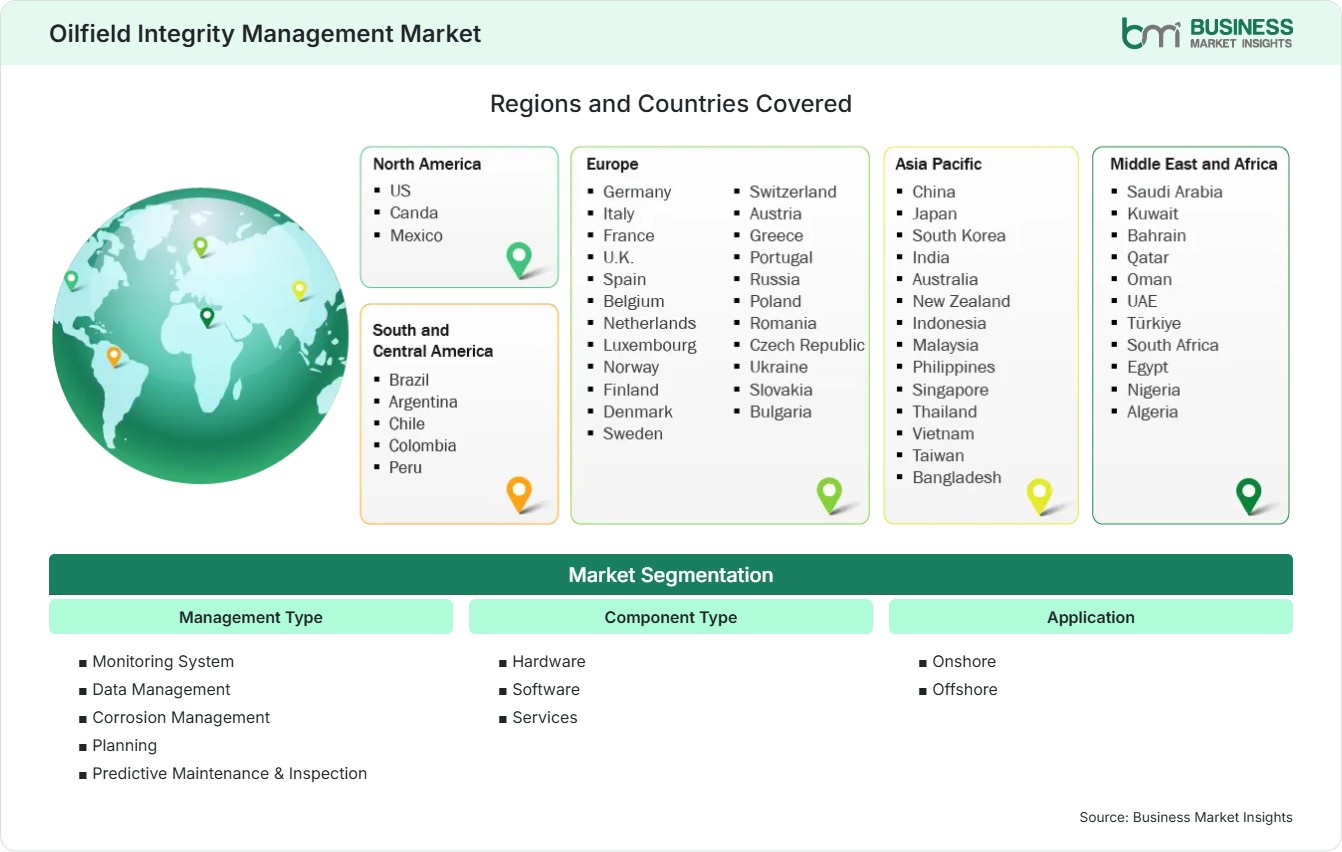
  • Management Type: Monitoring System, Data Management, Corrosion Management, Planning, Predictive Maintenance & Inspection
  • Component Type: Hardware, Software, Services
  • Application: Onshore, Offshore
US$ 16.77 Bn Market size in 2025
US$ 30.29 Bn Market Size by 2033
7.67% CAGR, 2026 - 2033
2026-2033 Forecast Period

AI Overview

Oilfield Integrity Management Market Summary

  • North America Region: North America holds a market share of 34%–37% in 2025, growing at a CAGR of 6.8%–7.3% during 2026–2033, supported by shale asset optimization, aging infrastructure upgrades, predictive maintenance investments, regulatory compliance requirements, advanced sensor deployment, digital asset management adoption, offshore production reliability initiatives, corrosion mitigation strategies, data-driven decision-making frameworks, and integrity monitoring expansion. The U.S. benefits from extensive upstream assets and advanced analytics adoption, with a CAGR of 6.9%–7.4%.
  • Fastest Growing Region: Asia Pacific accounts for 24%–27% share in 2025 and advances at 8.8%–9.4% CAGR during 2026–2033, driven by offshore investments, expanding exploration activity, deepwater developments, digital oilfield deployment, government-backed energy security programs, integrity compliance mandates, predictive inspection technologies, advanced corrosion management platforms, pipeline monitoring systems, and increasing regional production efficiency initiatives.
  • Leading Segment: Monitoring System represents 31%–34% share in 2025 and grows at 7.2%–7.8% CAGR, supported by real-time surveillance, sensor integration, equipment condition tracking, operational risk reduction, digital asset visibility, maintenance scheduling optimization, integrity assurance requirements, production continuity objectives, remote monitoring expansion, and advanced analytics deployment.
  • High Growth Segment: Predictive Maintenance & Inspection captures 18%–21% share in 2025 and records 9.1%–9.8% CAGR, fueled by machine learning integration, risk-based inspection programs, asset reliability enhancement, downtime reduction targets, maintenance cost optimization, digital twins, condition-based monitoring expansion, workforce productivity improvements, operational efficiency goals, and long-term field life extension strategies.
  • Key Market Opportunity: Expanding deployment of AI-enabled integrity platforms integrating inspection records, corrosion analytics, predictive diagnostics, and operational workflows creates opportunities for lifecycle optimization, reduced failures, enhanced compliance, lower maintenance spending, and improved production reliability.
  • Major Market Players: SLB, Halliburton Company, Baker Hughes Company, Weatherford International plc, Oceaneering International Inc., Wood plc, ROSEN Group, SGS SA, Bureau Veritas SA, and Intertek Group plc.
Strategic Insights

Oilfield Integrity Management Market: Strategic Insights

Oilfield Integrity Management Market Strategic Framework
FREE PDF
Request your free sample
Request free sample
Stakeholder View

Key Takeaways

  • The ecosystem is increasingly bringing together inspection providers, software developers, sensor manufacturers, engineering contractors, and energy operators in unified asset-performance networks which are aimed at ensuring operational continuity and minimizing risk.
  • Because of the high costs of replacing assets, the strict safety requirements and the increasing need to maximize recovery from mature offshore fields, offshore applications have great potential.
  • Artificial intelligence, digital twins, edge computing, and condition-based monitoring are now reshaping maintenance models and enabling faster identification of asset deterioration patterns.
  • The Asia Pacific region offers a highly attractive investment environment since the national oil companies are expanding their production capacity and, at the same time, introducing modern integrity standards to their offshore infrastructure.
  • Acquisition activity increasingly targets specialist inspection software, industrial analytics platforms, and predictive maintenance providers capable of strengthening digital integrity portfolios.
  • Operators are increasingly adopting service-oriented business models so that they can obtain external expertise in the areas of integrity planning, monitoring, compliance reporting, and the management of assets over their lifecycle.
Geographic Outlook

Oilfield Integrity Management Market Regional Highlights

North America Oilfield Integrity Management Market

North America accounted for approximately 34%–37% of global revenue in 2025 and is projected to expand at a 6.8%–7.3% CAGR through 2033. The region benefits from extensive shale production infrastructure, mature upstream assets, and high digitalization levels. Oilfield Integrity Management Market share remains significant due to continual investments in reliability programs, asset monitoring, and regulatory compliance. Operators increasingly deploy predictive analytics and remote inspection technologies to improve operational efficiency while reducing equipment failures and unplanned shutdowns across production environments.

  • The shale operators in the United States are expanding the use of condition-monitoring systems to improve the reliability of their equipment, cut down on maintenance costs, enhance their awareness of their assets, and help achieve their goals regarding the continuous operation of their older infrastructure networks.
  • The offshore operations in the Gulf of Mexico are still creating a demand for advanced inspection and corrosion management solutions as operators seek to extend the life of their fields and improve operational safety in complicated production environments.
  • Monitoring platforms that are integrated with the cloud are allowing for centralised oversight of assets, enhancing the efficiency of maintenance scheduling and aiding organisation-wide integrity governance efforts in geographically scattered operations.
  • The expectations regarding environmental compliance are leading to greater investment in leak detection technologies, pipeline inspection schemes, and proactive integrity measures which reduce operational risks.

US Oilfield Integrity Management Market

The United States represents approximately 76%–80% of North American revenue and is anticipated to grow at 6.9%–7.4% CAGR during the forecast period. Strong upstream activity, extensive shale assets, and widespread adoption of industrial analytics underpin market expansion. Energy operators continue prioritizing asset-life extension strategies to improve capital efficiency. Investments in digital oilfields, autonomous inspection systems, and predictive maintenance programs are creating favorable conditions for long-term integrity technology deployment across production facilities, gathering systems, and offshore operations.

  • The developments in the Permian Basin are leading to a faster acceptance of monitoring solutions that are equipped with sensors to increase reliability and make the most of production uptime while at the same time reducing the need for maintenance disruptions.
  • The digital transformation programmes carried out by large operators enable the integration of integrity data with their operational and financial systems, thus improving the quality of decision-making and the effectiveness of risk management.
  • Pipeline operators are still stressing the importance of corrosion mitigation and inspection technologies to enhance the resilience of the infrastructure and meet regulatory compliance objectives.
  • The greater the use of drones and other robotic inspection tools, the less humans are exposed to dangerous environments and at the same time the accuracy of data collection and operational efficiency are improved.

Europe Oilfield Integrity Management Market

Europe maintains approximately 22%–25% share in 2025 and is expected to register a 6.4%–6.9% CAGR through 2033. Mature North Sea assets require continuous integrity assessments to sustain production efficiency and regulatory compliance. Norway leads regional adoption, while the United Kingdom demonstrates notable modernization investments. Digital inspection tools, corrosion-management systems, and predictive asset strategies are increasingly deployed to reduce operational risks. Industry collaboration between operators and technology providers remains an important driver supporting long-term infrastructure reliability throughout regional upstream operations.

  • Norway represents the leading country, supported by advanced offshore asset management practices and ongoing investment in digital monitoring solutions for high-value production infrastructure.
  • The United Kingdom is one of the fastest-growing regional markets, its growth reaching between 6.8% and 7.2% compound annual growth rate as a result of modernisation and field-life extension programmes.
  • The requirements relating to sustainability are prompting operators to boost the efficiency of their assets and improve their environmental performance by using advanced integrity monitoring technologies and predictive maintenance programs.
  • As digital twins are increasingly deployed, operators gain better visibility into the condition of their equipment, which in turn helps them make informed decisions regarding maintenance and leads to improvements in operational reliability.

Asia Pacific Oilfield Integrity Management Market

Asia Pacific generates approximately 24%–27% market share in 2025 and records the fastest regional growth at 8.8%–9.4% CAGR through 2033. Oilfield Integrity Management Market growth across the region is supported by offshore exploration programs, expanding production infrastructure, and government-backed energy security strategies. China leads regional revenue generation, while India emerges as a high-growth market. Investments in intelligent asset management solutions, predictive inspection technologies, and advanced monitoring platforms are strengthening integrity frameworks across mature and newly developed upstream assets.

  • China remains the largest regional market due to extensive exploration and production activities, expanding offshore investments, and growing implementation of digital asset management systems.
  • India is one of the fastest-growing countries, with growth amounting to between 9.3% and 9.8% per year as operators modernise their infrastructure and enhance operational reliability.
  • The demand for risk-based inspection strategies and corrosion management technologies aimed at supporting long-term production performance is increasing among offshore developments in Southeast Asia.
  • National oil companies are strengthening digital transformation initiatives to improve equipment visibility, lower downtime, and optimize maintenance planning effectiveness.

Rest of World Oilfield Integrity Management Market

The Rest of World region accounts for approximately 16%–19% Oilfield Integrity Management Market share in 2025 and is projected to grow at a 7.8%–8.4% CAGR through 2033. Middle East producers continue investing heavily in large-scale integrity programs supporting production expansion and infrastructure modernization.

South & Central America is also witnessing increasing deployment of predictive asset-management technologies, particularly within offshore developments. Brazil leads regional demand, while Saudi Arabia remains a major market in the Middle East through investment in advanced inspection, monitoring, and reliability-enhancement initiatives.

  • Saudi Arabia continues deploying comprehensive integrity management frameworks aligned with upstream expansion objectives and long-term infrastructure optimization strategies.
  • Brazil leads South & Central America due to offshore investments requiring sophisticated inspection, monitoring, and predictive maintenance capabilities.
  • Regional operators increasingly adopt integrated digital platforms combining inspection records, risk assessment data, and maintenance workflows into centralized environments.
  • Expansion of offshore production projects is increasing requirements for corrosion control technologies, remote inspections, and asset reliability solutions across challenging operating conditions.
Global Market Geography
FREE PDF
Request your free sample
Request free sample
Segment Analysis

Oilfield Integrity Management Market Segmentation

Management Type

Management Type accounts for the largest solution framework within the market, with Monitoring System holding the leading position at 31%–34% share in 2025 and expanding at 7.2%–7.8% CAGR through 2033. The Oilfield Integrity Management Market scope continues widening as operators shift from reactive maintenance toward integrated monitoring, planning, and predictive integrity strategies that support reliability, compliance, lifecycle optimization, and production continuity.

  • Monitoring System: Real-time equipment surveillance technologies help operators identify degradation patterns early, improve visibility across assets, reduce downtime risks, and support effective maintenance prioritization decisions.
  • Data Management: Data aggregation and analytics platforms centralize integrity records, streamline compliance reporting, support informed decision-making, and improve coordination across field operations and engineering teams.
  • Corrosion Management: Corrosion-focused programs enhance infrastructure longevity through risk assessments, mitigation planning, coating strategies, and monitoring systems designed for harsh production environments.
  • Planning: Integrity planning solutions assist organizations in scheduling inspections, allocating resources efficiently, prioritizing asset risks, and maintaining operational continuity through structured workflows.
  • Predictive Maintenance & Inspection: Advanced analytics and machine-learning tools support condition-based strategies that improve reliability, reduce maintenance expenditure, and optimize asset performance over time.

Component Type

Component Type reflects the technological foundation of integrity programs, with Software representing approximately 38%–41% market share in 2025 and achieving the highest CAGR of 8.5%–9.1% during the forecast period. Adoption continues rising as organizations pursue integrated analytics, automation, and digital asset visibility strategies aligned with evolving Oilfield Integrity Management Market trends.

  • Hardware: Sensors, inspection equipment, communication devices, and monitoring instruments provide essential operational data supporting risk identification and asset performance management.
  • Software: Digital platforms enable analytics, predictive diagnostics, workflow automation, compliance tracking, and centralized management of integrity-related operational information across complex infrastructures.
  • Services: Consulting, inspection, engineering, and maintenance services help operators implement integrity frameworks, address operational risks, and strengthen lifecycle asset management capabilities.

Application

Application demand remains concentrated in Onshore operations, which account for 58%–62% Oilfield Integrity Management Market share in 2025 and expand at 6.9%–7.4% CAGR through 2033. Extensive land-based production infrastructure, asset density, and maintenance requirements support segment leadership. Offshore projects, however, continue attracting higher-value integrity investments due to operational complexity and elevated risk profiles.

  • Onshore: Extensive pipelines, production facilities, and processing assets drive ongoing requirements for monitoring, inspection, maintenance planning, and reliability optimization solutions.
  • Offshore: Challenging operating conditions and significant asset values increase demand for advanced corrosion management, predictive analytics, and remote inspection technologies.
Market Forces

Oilfield Integrity Management Market Dynamics

Key Market Drivers

Growing Need to Extend Lifecycle of Mature Oilfield Assets

A large proportion of global upstream production originates from mature fields that require continuous monitoring and reliability improvement programs. Asset operators increasingly prioritize integrity management because replacing critical infrastructure often requires substantially higher capital expenditure than extending operational life through maintenance and inspection. Aging pipelines, flowlines, pressure vessels, and production facilities are driving stronger adoption of monitoring systems and predictive asset strategies. Oilfield Integrity Management Market growth is increasingly linked to lifecycle extension spending, especially in North America, the North Sea, and the Middle East.

Expansion of Digital Oilfield and Industrial Analytics Platforms

Digitalization is reshaping upstream asset management practices through the integration of cloud computing, industrial IoT sensors, machine learning, and advanced visualization technologies. Operators are deploying connected monitoring platforms that provide continuous visibility into equipment condition and asset performance. Oilfield Integrity Management Market trends increasingly reflect the shift toward predictive and condition-based maintenance models enabled by real-time operational intelligence. These technologies reduce manual inspection dependency, improve maintenance planning accuracy, and support earlier identification of asset degradation.

Increasing Regulatory Focus on Safety and Environmental Protection

Worldwide regulators are now applying more stringent requirements in the areas of operational safety, emissions control, prevention of spills, and the reliability of infrastructure. If assets fail, this can lead to environmental harm, the need for operational shutdowns, financial fines, and damage to reputation. As a result, operators are giving priority to systematic integrity programs which aim at achieving regulatory compliance and enhancing operational resilience. Monitoring technologies, systems for managing corrosion, and risk-based inspection methods have become essential components of the governance structures in the upstream sector. The increased demands regarding reporting are also leading companies to invest in digital recordkeeping and data management solutions.

Key Market Opportunities

AI-Enabled Predictive Integrity Platforms Across Production Assets

Artificial intelligence presents a major opportunity for operators seeking higher asset reliability and lower maintenance costs. Modern integrity platforms increasingly utilize machine learning algorithms to evaluate inspection records, sensor signals, and operational data. These systems identify deterioration patterns before critical failures occur, enabling proactive intervention strategies. Oilfield Integrity Management Market Forecasts indicate that predictive technologies will receive growing investment as operators pursue efficiency objectives amid volatile energy price environments. Integrated AI platforms also improve maintenance scheduling, workforce deployment, and risk prioritization.

Growing Investment in Offshore Megaprojects and Deepwater Fields

Offshore assets are among the most complicated and expensive forms of infrastructure in the energy sector. If integrity fails, this can result in huge financial losses, interruptions in production, and environmental repercussions. The fact that there is increasing investment in deepwater projects in areas including Brazil, the Gulf of Mexico, West Africa, and the Asia Pacific is leading to a greater need for advanced monitoring and inspection technologies. The operators need sophisticated integrity systems that are able to deal with corrosion, structural deterioration, equipment fatigue, and operational risk. Digital monitoring systems, autonomous inspection devices, and intelligent asset analytics are now essential elements of offshore asset-management strategies. Vendor companies providing integrated solutions designed for offshore operating conditions are likely to gain significantly from the rising level of capital expenditure.

Expansion of Integrity-as-a-Service Business Models

A growing number of operators are turning to specialist engineering and service companies to carry out their integrity functions. This situation opens up chances for firms that provide full lifecycle support, such as inspections, data analytics, maintenance planning, compliance management, and reliability consulting. By adopting an integrity-as-a-service approach, companies are able to decrease their need for in-house staff while at the same time gaining access to specialist knowledge and advanced technologies. Service providers can build steady revenue streams by means of long-term contracts and enduring partnerships. The model is especially appealing to smaller and mid-sized operators who want cost-effective access to sophisticated asset management capabilities. Since energy companies are concentrating on operational efficiency and capital discipline, outsourced integrity programs are likely to become more widely accepted in the global upstream sector.

Market Restraints and Challenges

High Deployment Costs and Complex System Integration

Factor: Advanced integrity management programs often require substantial investment in sensors, software platforms, analytics systems, connectivity infrastructure, and specialized expertise. Impact: The high cost of implementation may restrict smaller players from implementing the practice and may also hinder the process of modernization. Another problem that can be faced during the process is that of integration. This happens when organizations try to integrate their legacy infrastructure with new technology. Facilities use equipment from a variety of vendors in many cases for several decades. Interoperability between this equipment makes the task difficult. Although the benefits of the proactive integrity management approach are very well known, there are some issues in its implementation due to the above reasons.

Shortage of Integrity Management and Data Analytics Expertise

Factor: Effective integrity programs increasingly depend on multidisciplinary expertise encompassing engineering, corrosion science, risk assessment, industrial analytics, and regulatory compliance. Impact: The shortage of skilled labor can hamper the effective implementation of sophisticated integrity tools and systems. It is difficult for the sector to find experts who not only have the capability of analyzing big data sets but also know how operational assets work. With further development of digitalization, the need for data-driven decision-making capabilities will keep on increasing. The training needs and the competitiveness of talent can lead to an increase in operational expenses as well as longer implementation times.

Company Analysis

Competitive Landscape

The competitive environment is characterized by established oilfield service providers, inspection specialists, engineering firms, and digital technology vendors. Oilfield Integrity Management Market analysis indicates increasing competition around predictive analytics, remote monitoring, risk-based inspection, and integrated asset-reliability platforms.

Company Name

Overview

Products and Services relevant to this market

SLB

Global energy technology company with extensive digital and production optimization expertise supporting upstream operators worldwide.

Integrity management software, production monitoring systems, digital oilfield platforms, inspection solutions, and predictive asset analytics.

Halliburton Company

Major oilfield services provider delivering engineering, operational efficiency, and lifecycle asset-management capabilities.

Asset monitoring, integrity consulting, predictive maintenance technologies, digital solutions, and field optimization services.

Baker Hughes Company

Energy technology provider focused on industrial analytics, reliability improvement, and operational performance enhancement.

Integrity monitoring platforms, inspection technologies, corrosion analytics, sensors, and asset-performance solutions.

Weatherford International plc

Global provider of production technologies and upstream operational support services.

Asset monitoring, production optimization systems, integrity planning, inspection services, and digital workflow solutions.

Oceaneering International Inc.

Specialist in offshore engineering, subsea operations, and inspection technologies.

Robotic inspections, subsea integrity services, asset monitoring, remote intervention systems, and inspection analytics.

Wood plc

Global consulting and engineering company serving upstream infrastructure and energy assets.

Asset integrity management, engineering services, risk assessment, maintenance planning, and lifecycle optimization consulting.

ROSEN Group

International integrity specialist focused on inspection and infrastructure reliability.

Pipeline inspection, risk assessment, corrosion management, monitoring technologies, and asset-integrity analytics.

SGS SA

Global testing, inspection, and certification leader operating across industrial sectors.

Inspection services, compliance verification, asset condition assessment, and integrity assurance programs.

Bureau Veritas SA

International testing, certification, and risk-management organization.

Technical inspections, safety verification, integrity audits, compliance services, and infrastructure monitoring support.

Intertek Group plc

Quality assurance and industrial risk-management provider serving energy markets worldwide.

Integrity assessments, inspection programs, engineering support, operational risk analysis, and asset reliability services.

Trust & Transparency

Research Methodology

The market analysis combines proprietary research with secondary data from government agencies, company disclosures, regulatory filings, industry databases and expert interviews. Market estimates are validated through data triangulation, cross-market benchmarking and analyst review.

View Full Research Methodology

Questions Answered

Frequently Asked Questions

What does the Oilfield Integrity Management Market Report typically evaluate?

The Oilfield Integrity Management Market Report assesses market size, technology adoption, competitive positioning, integrity strategies, regional demand patterns, growth opportunities, investment trends, and forecast developments across applications and segments.

How are artificial intelligence technologies influencing the industry?

Artificial intelligence improves failure prediction accuracy, supports condition-based maintenance, enhances inspection prioritization, reduces downtime risks, and enables more efficient management of operational assets.

Which region is expected to expand the fastest?

Asia Pacific is projected to record the fastest growth owing to expanding offshore exploration, energy security initiatives, digitalization investments, and increasing deployment of advanced reliability technologies.

What application area generates the highest demand?

Onshore operations account for the largest demand because of extensive production networks, pipeline infrastructure, and ongoing maintenance requirements across mature producing regions.

What is driving demand for integrity management solutions in oilfields?

Growing infrastructure age, regulatory requirements, digital oilfield adoption, and the need to maximize production uptime are increasing investment in advanced monitoring, inspection, and predictive maintenance technologies.

Access the Full Oilfield Integrity Management Market Report

Get segment-level forecasts, regional estimates, competitive benchmarking, company profiles and downloadable Excel datasets.

Access the full Oilfield Integrity Management Market Report
350 pages PDF & Excel | 2026-09-18
Similar Research

Related Market Reports