
Digital Oilfield Market Outlook: Size, Share, Trends, Growth Analysis, Competitive Landscape & Forecast, 2026-2033

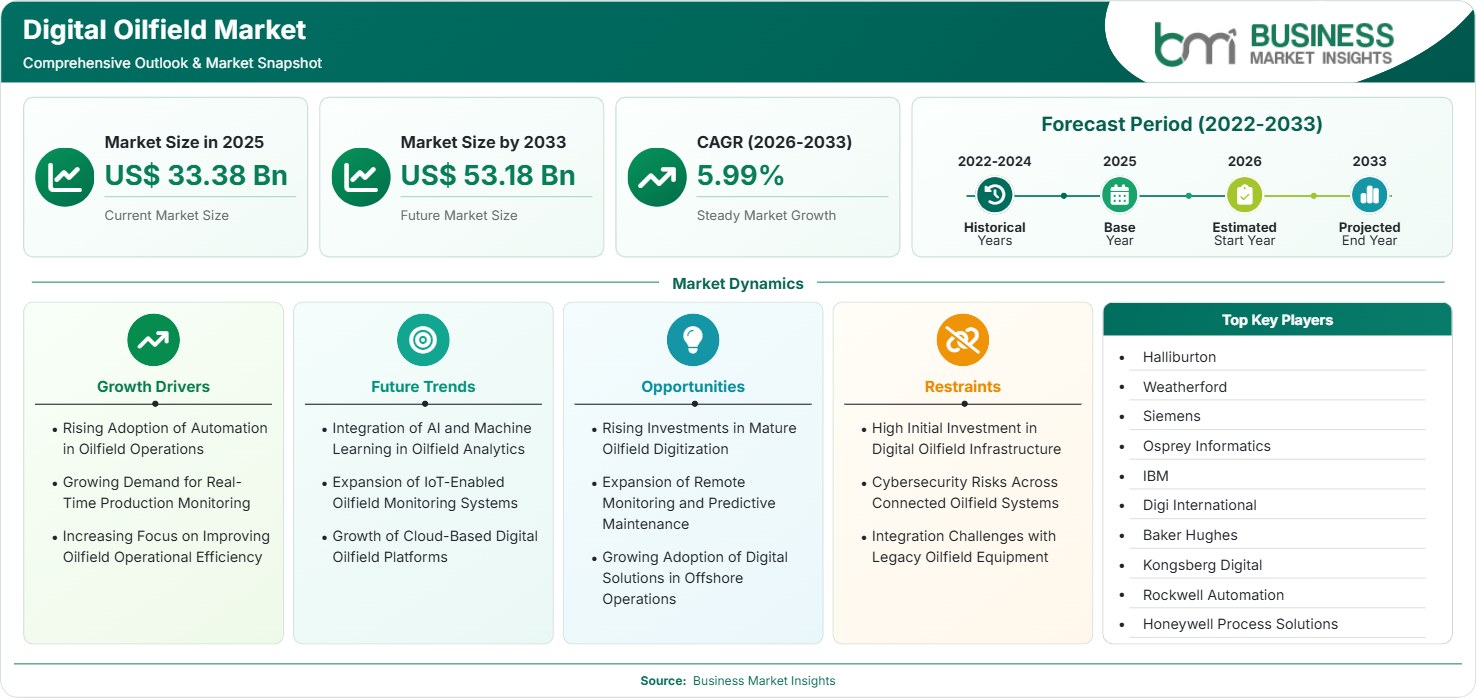
The Digital Oilfield Market size was valued at US$ 33.38 Billion in 2025 and is projected to reach US$ 53.18 Billion by 2033, growing at a CAGR of 5.99% during 2026–2033. Rising adoption of automation and data analytics technologies, increasing focus on production efficiency, growing deployment of IoT-enabled monitoring solutions, and expanding digital transformation initiatives across oil and gas operations are supporting market growth globally.

Report Coverage
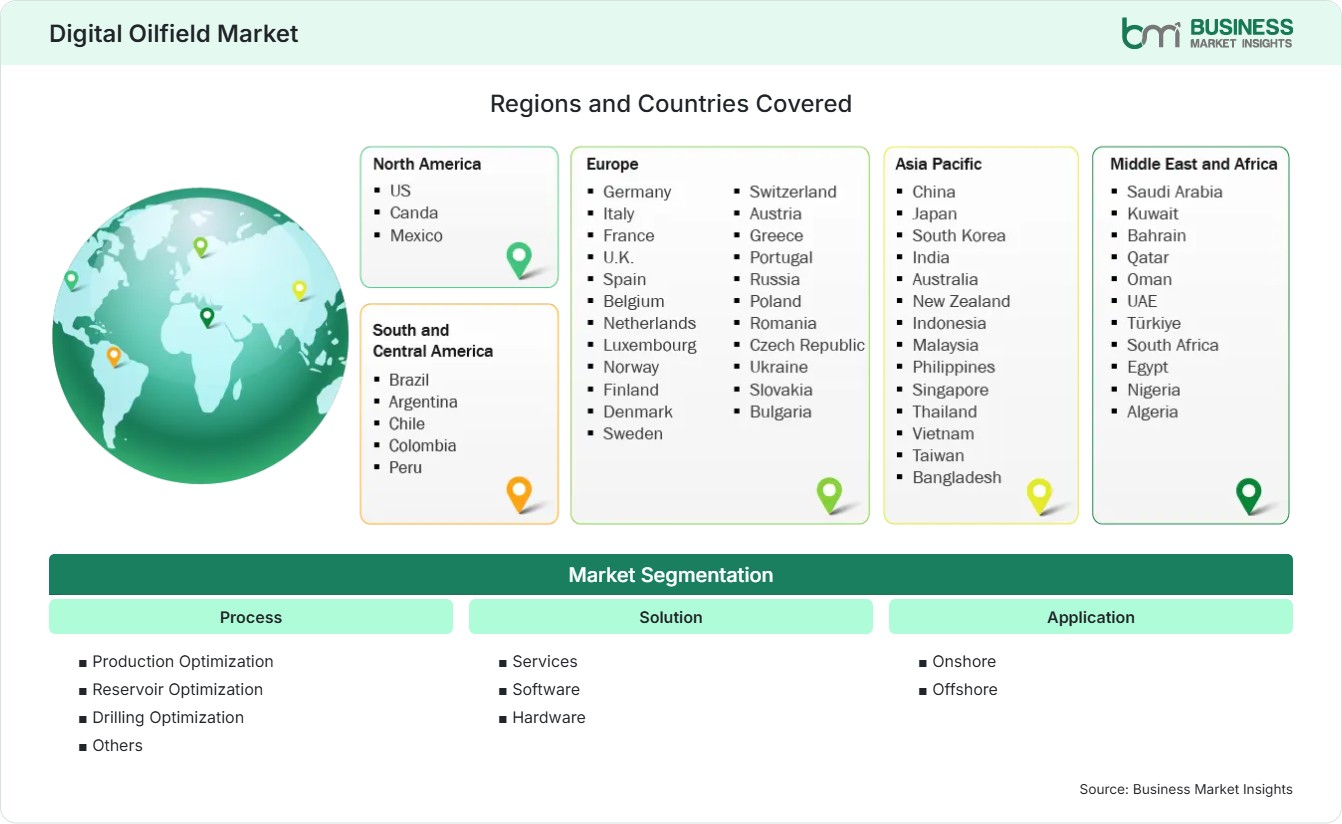
  • Process: Production Optimization, Reservoir Optimization, Drilling Optimization, Others
  • Solution: Services, Software, Hardware
  • Application: Onshore, Offshore
US$ 33.38 Bn Market size in 2025
US$ 53.18 Bn Market Size by 2033
5.99% CAGR, 2026 - 2033
2026-2033 Forecast Period

01 AI Overview

Digital Oilfield Market Summary

  • North America Region: North America holds a market share of 35%–38% in 2025, growing with a CAGR of 5.6%–6.3% during 2026–2033. Strong technological adoption, advanced shale operations, and increasing investments in operational efficiency continue supporting regional leadership. The U.S. market is expected to register a CAGR of 5.8%–6.5%.
  • Fastest Growing Region: Asia Pacific accounts for 27%–30% share in 2025 and is projected to grow at a CAGR of 6.7%–7.4% through 2033. Increasing energy demand, growing upstream investments, and rising adoption of digital technologies continue driving regional growth.
  • Leading Segment: Production Optimization represents 36%–39% share in 2025 and is expected to grow at a CAGR of 6.1%–6.8% through 2033. Growing focus on maximizing hydrocarbon recovery and operational efficiency continues supporting segment dominance.
  • High Growth Segment: Onshore accounts for 63%–66% share in 2025 and is forecast to grow at a CAGR of 6.3%–7.0% during 2026–2033. Increasing deployment of digital technologies across onshore oil and gas assets continues accelerating segment growth.
  • Key Market Opportunity: Expansion of AI-driven analytics, predictive maintenance platforms, real-time reservoir monitoring, and integrated digital oilfield ecosystems is creating substantial growth opportunities.
  • Major Market Players: Halliburton, Weatherford, Siemens, Osprey Informatics, IBM, Digi International, Baker Hughes, Kongsberg Digital, Rockwell Automation, and Honeywell Process Solutions.
02 Strategic Insights

Digital Oilfield Market: Strategic Insights

Digital Oilfield Market Strategic Framework
FREE PDF
Request your free sample
Request free sample
03 Stakeholder View

Key Takeaways

  • Digital oilfield technologies are becoming critical for improving operational efficiency and production optimization.
  • Production optimization continues dominating due to its direct impact on output and profitability.
  • Onshore applications account for the largest share of deployment globally.
  • IoT-enabled monitoring and predictive analytics are transforming field operations.
  • Automation technologies continue improving operational reliability and safety.
  • North America remains the leading market due to advanced oilfield technology adoption.
  • Asia Pacific is projected to witness the fastest growth owing to rising upstream investments.
  • AI-driven oilfield analytics are expected to create significant future opportunities.
04 Geographic Outlook

Digital Oilfield Market Regional Highlights

North America Digital Oilfield Market

North America accounts for 35%–38% Digital Oilfield Market share in 2025 and is projected to grow at a CAGR of 5.6%–6.3% through 2033. The region benefits from advanced upstream operations, extensive shale production, and strong adoption of digital technologies across oilfields.

  • Shale operators are increasingly implementing digital oilfield platforms to improve productivity, reduce downtime, and enhance asset performance.
  • Real-time monitoring systems are being deployed extensively to improve drilling efficiency and operational decision-making capabilities.
  • Oil and gas companies continue investing in predictive maintenance technologies to reduce equipment failure and maintenance costs.
  • Cloud-based analytics platforms are gaining wider acceptance for centralized asset management and performance optimization.
  • Automation technologies are improving operational safety while reducing manual intervention across field operations.
  • Continuous investments in digital transformation initiatives remain supportive of long-term market growth.

US Digital Oilfield Market

The United States contributes approximately 89%–93% of North American revenue and is expected to register a CAGR of 5.8%–6.5% through 2033. The country remains the largest market due to extensive upstream activities and strong technology adoption.

  • Exploration and production companies are increasingly leveraging advanced analytics to improve reservoir performance and production efficiency.
  • Growing integration of IoT devices is enhancing connectivity and real-time asset monitoring capabilities.
  • Major operators continue expanding investments in automation and intelligent well management systems.
  • Data-driven operational strategies are helping reduce costs and improve overall profitability.
  • Predictive analytics technologies are supporting proactive asset maintenance and equipment reliability.
  • Ongoing digital transformation efforts continue strengthening market demand across the energy sector.

Europe Digital Oilfield Market

Europe represents 22%–25% of global revenue in 2025 and is anticipated to expand at a CAGR of 6.0%–6.7% through 2033. Increasing focus on operational efficiency, sustainability initiatives, and offshore asset optimization continue supporting regional growth. Germany remains the leading market while Norway demonstrates stronger growth momentum.

  • Norway continues to drive digital oilfield adoption, supported by its advanced offshore operations, mature energy infrastructure, and increasing use of digital asset management technologies.
  • Germany remains a significant regional contributor, benefiting from strong industrial automation capabilities, technological expertise, and continued investments in digital energy solutions.
  • Offshore operators are increasingly deploying predictive analytics and real-time data solutions to enhance production reliability, identify potential equipment failures, and reduce operational risks.
  • Advanced monitoring and data analytics solutions are improving reservoir management by enabling operators to optimize production performance, resource utilization, and asset efficiency.
  • Growing sustainability targets are encouraging energy companies to adopt digital technologies that improve operational efficiency, reduce resource consumption, and support emissions management.
  • Modernization of mature oil and gas assets continues generating demand for innovative digital oilfield solutions, particularly across aging offshore and onshore infrastructure..

Asia Pacific Digital Oilfield Market

Asia Pacific accounts for 27%–30% of global revenue in 2025 and is expected to achieve the fastest CAGR of 6.7%–7.4% through 2033. Increasing energy demand, expanding upstream exploration activities, and growing digitalization efforts continue supporting strong regional growth.

  • China remains the largest regional market, supported by extensive investments in oil and gas production modernization, digital infrastructure, and advanced field management technologies.
  • India is projected to register a CAGR of approximately 7.6%–8.3%, driven by rising energy demand, expanding exploration activities, and growing digital transformation initiatives across the oil and gas sector.
  • Exploration and production companies are increasingly adopting smart oilfield solutions to enhance operational visibility, optimize resource utilization, and improve overall productivity.
  • Automation systems are helping operators improve drilling efficiency, reduce downtime, enhance safety, and strengthen production reliability across oilfield operations.
  • Increasing investments in offshore and onshore oil and gas projects are creating new opportunities for digital technology and solution providers.
  • Government support for energy modernization and digitalization initiatives continues to encourage technology adoption and support long-term regional market expansion.

Rest of World Digital Oilfield Market

Rest of World accounts for 8%–11% of global revenue in 2025 and is projected to expand at a CAGR of 5.0%–5.7% through 2033. Increasing investments in energy infrastructure, rising focus on operational efficiency, and growing technology adoption are supporting market growth across Latin America, the Middle East, and Africa.

  • Brazil continues generating demand through offshore oilfield development and production optimization initiatives.
  • The UAE is witnessing increasing deployment of advanced digital oilfield technologies to improve asset performance.
  • Saudi Arabia is expected to achieve approximately 5.9%–6.6% CAGR through 2033, supported by energy sector modernization programs.
  • National oil companies are increasingly investing in intelligent monitoring and automation platforms.
  • Real-time operational analytics are helping improve production management and cost efficiency.
  • Digital transformation programs continue creating long-term growth opportunities across regional energy markets.
Global Market Geography
FREE PDF
Request your free sample
Request free sample
05 Segment Analysis

Digital Oilfield Market Segmentation

Process

The process segment represents the primary operational areas where digital technologies are deployed to improve efficiency, asset performance, and production output across oil and gas operations. This segment accounts for approximately 36%–39% share in 2025 and is projected to grow at a CAGR of 6.1%–6.8% through 2033. The expanding Digital Oilfield Market Scope is supported by increasing adoption of automation technologies, real-time monitoring platforms, and advanced analytics solutions across upstream operations.

  • Production Optimization: Production optimization dominates the market due to its direct impact on maximizing hydrocarbon recovery, enhancing output efficiency, and reducing operational costs.
  • Reservoir Optimization: Reservoir optimization solutions help operators improve resource utilization through advanced analytics, simulation models, and real-time reservoir monitoring.
  • Drilling Optimization: Drilling optimization technologies support better well planning, reduced non-productive time, and improved drilling efficiency.
  • Others: Other processes include asset management, well integrity monitoring, field surveillance, and predictive maintenance applications.

Solution

The solution segment highlights the primary offerings utilized by oil and gas operators to enable digital transformation across field operations. This segment accounts for approximately 42%–45% share in 2025 and is expected to register a CAGR of 6.2%–6.9% through 2033. Current Digital Oilfield Market Trends indicate growing investments in analytics platforms, intelligent automation systems, cloud-based monitoring tools, and integrated operational management solutions.

  • Services: Services dominate the market due to increasing demand for consulting, implementation, integration, maintenance, and managed digital oilfield solutions.
  • Software: Software platforms continue witnessing strong adoption for data analytics, visualization, production monitoring, predictive maintenance, and decision-support applications.
  • Hardware: Hardware includes sensors, controllers, communication systems, field instruments, and IoT-enabled monitoring equipment.

Application

The application segment reflects the major operational environments where digital oilfield technologies are deployed. This segment accounts for approximately 63%–66% share in 2025 and is forecast to grow at a CAGR of 6.3%–7.0% through 2033.

  • Onshore: Onshore operations dominate the market due to the large number of producing fields, extensive infrastructure networks, and increasing deployment of automation technologies.
  • Offshore: Offshore applications continue gaining traction as operators increasingly utilize digital technologies to improve safety, efficiency, and remote asset management capabilities.
06 Market Forces

Digital Oilfield Market Dynamics

Key Market Drivers

Rising Adoption of Automation in Oilfield Operations

Automation technologies are revolutionizing oilfield operations by enabling greater efficiency and consistency, reducing the need for manual operations, and increasing overall efficiency. Automated systems that can monitor assets, control equipment, and manage operations in real time are being used by oil and gas producers. They not only cut operating expenses but also increase the safety and reliability of operations. The development of industrial automation technologies, artificial intelligence, and connected devices will further drive their adoption in upstream assets. It is likely to become one of the key factors fueling the growth of the digital oilfield market.

Growing Demand for Real-Time Production Monitoring

Operators increasingly require immediate access to production data to improve decision-making and optimize resource utilization. Digital oilfield solutions provide real-time visibility into well performance, equipment conditions, and operational metrics through connected monitoring platforms. Access to accurate and timely information enables faster responses to production challenges while minimizing downtime. Real-time monitoring also supports improved reservoir management and predictive maintenance strategies. As oil and gas companies continue emphasizing data-driven operations, demand for advanced monitoring technologies is expected to grow steadily across global energy markets.

Increasing Focus on Improving Oilfield Operational Efficiency

The oil and gas industry continues facing pressure to maximize production while reducing operating expenses and improving profitability. Digital oilfield technologies enable operators to streamline workflows, enhance asset utilization, and identify performance improvement opportunities. Advanced analytics, automation systems, and predictive tools help optimize production processes while reducing inefficiencies across field operations. Companies are increasingly investing in intelligent operational management solutions that support lower costs and improved production outcomes. As efficiency remains a strategic priority, adoption of digital oilfield platforms is expected to increase further.

Key Market Opportunities

Rising Investments in Mature Oilfield Digitization

Many mature oilfields continue to offer significant production potential when supported by modern digital technologies. Operators are increasingly investing in digitization projects to improve asset visibility, optimize production rates, and extend field life. Advanced analytics and monitoring tools enable more effective management of aging infrastructure and declining reservoirs. These technologies help maximize recovery while minimizing operating costs. As energy companies seek to improve returns from existing assets, digitization of mature oilfields is expected to create substantial opportunities for technology providers.

Expansion of Remote Monitoring and Predictive Maintenance

Remote monitoring and predictive maintenance solutions are becoming essential components of modern oilfield operations. These technologies enable operators to monitor equipment performance continuously, identify potential failures, and schedule maintenance activities proactively. Reduced downtime and improved reliability contribute significantly to operational efficiency and cost savings. Growing deployment of IoT devices and cloud-based analytics platforms is strengthening adoption across both onshore and offshore assets. This trend is expected to generate long-term growth opportunities for digital oilfield solution providers.

Growing Adoption of Digital Solutions in Offshore Operations

Offshore oil and gas facilities increasingly require advanced digital technologies to address complex operational challenges and remote asset management requirements. Digital oilfield solutions improve safety, performance monitoring, production optimization, and communication capabilities across offshore operations. Operators are investing in intelligent platforms capable of delivering real-time insights and supporting autonomous decision-making. Growing emphasis on operational reliability and cost control is accelerating technology deployment across offshore assets. Long-term Digital Oilfield Market Forecast projections remain favorable as offshore operators continue expanding digital transformation initiatives.

Market Restraints and Challenges

High Initial Investment in Digital Oilfield Infrastructure

Factor: Implementation of digital oilfield technologies often requires substantial investment in sensors, communication networks, automation systems, software platforms, cloud infrastructure, and workforce training. Large-scale integration projects can involve significant capital expenditure and long deployment timelines.

Impact: High upfront costs may delay adoption among smaller operators and budget-constrained organizations. Investment requirements can also influence project prioritization and reduce the speed of technology implementation across certain operational environments.

Cybersecurity Risks Across Connected Oilfield Systems

Factor: Digital oilfield platforms rely on interconnected devices, cloud-based systems, remote communications, and extensive operational data networks. These connected environments can be vulnerable to cyber threats, unauthorized access attempts, and data security challenges.

Impact: Cybersecurity concerns may increase implementation complexity, operational risks, and compliance requirements for operators. Companies often need to invest significantly in security infrastructure, monitoring tools, and risk management strategies to protect critical assets and maintain system integrity.

07 Company Analysis

Competitive Landscape

The Digital Oilfield Market Analysis is characterized by strong competition among oilfield service providers, industrial automation companies, digital technology developers, and software platform providers. Market participants are focusing on real-time monitoring systems, predictive analytics, artificial intelligence solutions, remote asset management platforms, and integrated oilfield automation technologies to strengthen their market positions. Rising demand for operational efficiency, increasing deployment of IoT-enabled oilfield infrastructure, and growing investments in digital transformation initiatives continue driving innovation across the market. Companies are investing in cloud computing, advanced data analytics, machine learning technologies, and intelligent field operations to address evolving oil and gas industry requirements.

Company Name

Overview

Products and Services relevant to this market

Halliburton

Global oilfield services company providing technology and digital solutions for energy operations.

Digital oilfield platforms, production optimization solutions, drilling analytics, and reservoir management technologies.

Weatherford

Oilfield technology and services provider focused on production and asset optimization.

Digital oilfield software, automation systems, well monitoring solutions, and predictive analytics platforms.

Siemens

Industrial technology company specializing in automation and digital transformation solutions.

Industrial automation systems, digital twin technologies, monitoring platforms, and oilfield control solutions.

Osprey Informatics

Industrial analytics company focused on visual intelligence solutions.

Remote monitoring platforms, video analytics solutions, operational intelligence tools, and asset management technologies.

IBM

Global technology company providing enterprise software and AI solutions.

Artificial intelligence platforms, cloud analytics, predictive maintenance solutions, and industrial data management systems.

Digi International

IoT connectivity and industrial networking solutions provider.

IoT gateways, remote monitoring systems, connected field devices, and industrial communication platforms.

Baker Hughes

Energy technology company serving upstream and downstream operations.

Digital oilfield solutions, intelligent production systems, asset performance management tools, and analytics platforms.

Kongsberg Digital

Industrial software company focused on energy and asset-intensive industries.

Digital twin solutions, simulation software, asset performance platforms, and operational analytics tools.

Rockwell Automation

Automation and industrial control systems provider.

Process automation solutions, industrial software, monitoring platforms, and operational intelligence systems.

Honeywell Process Solutions

Industrial technology company serving energy and process industries.

Process control systems, digital oilfield platforms, predictive analytics solutions, and industrial automation technologies.

10 Trust & Transparency

Research Methodology

The market analysis combines proprietary research with secondary data from government agencies, company disclosures, regulatory filings, industry databases and expert interviews. Market estimates are validated through data triangulation, cross-market benchmarking and analyst review.

View Full Research Methodology

11 Questions Answered

Frequently Asked Questions

How is artificial intelligence influencing the digital oilfield market?

Artificial intelligence is enhancing oilfield operations through predictive maintenance, production forecasting, reservoir analysis, automated decision-making, and real-time operational optimization capabilities.

What does this Digital Oilfield Market Report cover?

This report covers process analysis, solution assessment, application evaluation, regional trends, competitive landscape analysis, market drivers, opportunities, restraints, challenges, and future growth prospects through 2033.

Why does Onshore lead the market?

Onshore applications lead the market because of the large number of operating fields, extensive infrastructure networks, and increasing implementation of automation and monitoring technologies.

Which process segment dominates the market?

Production Optimization dominates the market due to its significant role in maximizing hydrocarbon output, improving operational performance, and reducing production costs.

What is driving growth in the Digital Oilfield market?

Rising adoption of automation in oilfield operations, growing demand for real-time production monitoring, increasing focus on improving oilfield operational efficiency, and expanding deployment of IoT-enabled technologies are major factors driving market growth.

Access the Full Digital Oilfield Market Report

Get segment-level forecasts, regional estimates, competitive benchmarking, company profiles and downloadable Excel datasets.

Access the full Digital Oilfield Market Report
350 pages PDF & Excel | 2026-08-20