
Pipeline Integrity Management Market Outlook: Size, Share, Trends, Growth Analysis, Competitive Landscape & Forecast, 2026-2033

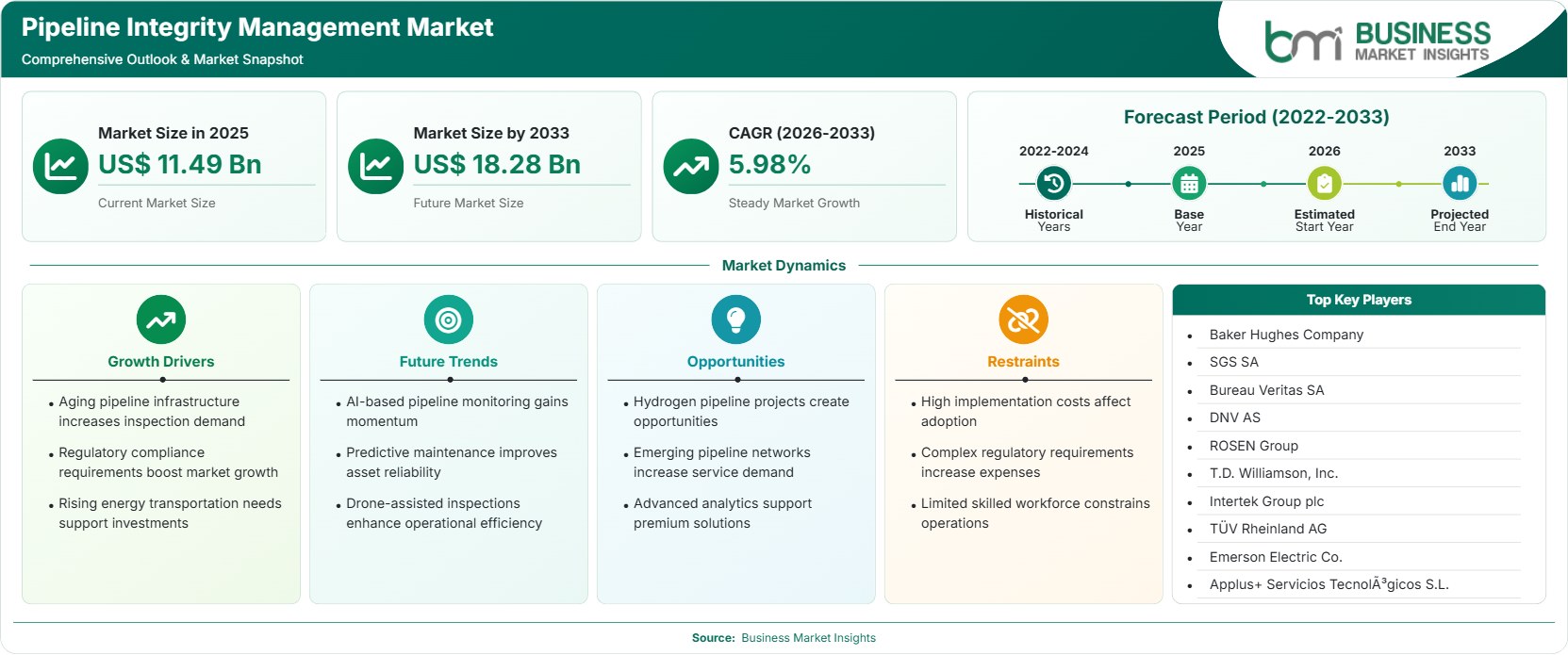
The Pipeline Integrity Management Market size was valued at US$ 11.49 Billion in 2025 and is projected to reach US$ 18.28 Billion by 2033, growing at a CAGR of 5.98% during 2026–2033, driven by aging pipeline infrastructure, stricter safety regulations, digital monitoring adoption, predictive maintenance investments, and expanding energy transportation networks worldwide.

Report Coverage
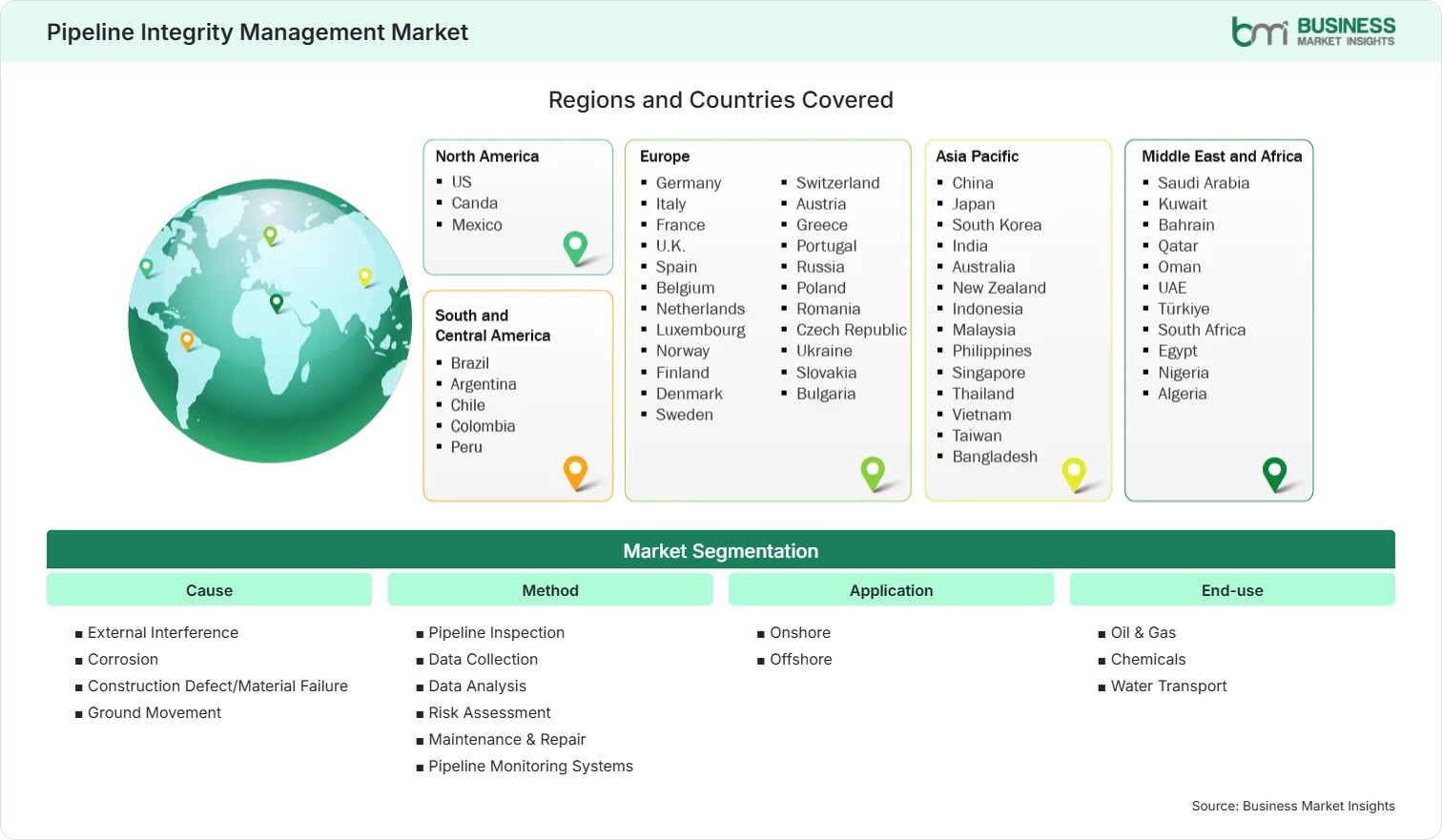
  • Cause: External Interference, Corrosion, Construction Defect/Material Failure, Ground Movement
  • Method: Pipeline Inspection , Data Collection, Data Analysis, Risk Assessment, Maintenance & Repair, Pipeline Monitoring Systems
  • Application: Onshore, Offshore
  • End-use: Oil & Gas, Chemicals, Water Transport
US$ 11.49 Bn Market size in 2025
US$ 18.28 Bn Market Size by 2033
5.98% CAGR, 2026 - 2033
2026-2033 Forecast Period

AI Overview

Pipeline Integrity Management Market Summary

  • North America Region: North America holds a 35%–38% share in 2025, growing at a CAGR of 5.2%–5.8% during 2026–2033. Key drivers include aging transmission assets, regulatory compliance requirements, integrity verification programs, and digital monitoring investments supporting operational resilience and risk reduction. US market benefits from extensive interstate networks, advanced inspection spending, and a projected CAGR of 5.3%–5.9%.
  • Fastest Growing Region: Asia Pacific holds a 24%–27% share in 2025 and advances at a CAGR of 6.8%–7.4% through 2033. Expansion of energy infrastructure, urbanization, industrialization, and cross-border transmission projects continue creating strong inspection and monitoring demand.
  • Leading Segment: Onshore accounts for 69%–72% share in 2025 and grows at 5.6%–6.1% CAGR through 2033. Large network lengths, aging assets, mandatory inspections, and cost-effective deployment environments sustain substantial demand across major economies.
  • High Growth Segment: Pipeline Monitoring Systems captures 16%–19% share in 2025 and expands at 7.1%–7.8% CAGR. Real-time visibility, leak detection requirements, digital twins, and predictive maintenance programs continue accelerating technology adoption globally.
  • Key Market Opportunity: Deployment of AI-enabled integrity platforms integrating inspection records, risk assessment models, remote sensing data, and maintenance planning can improve reliability, reduce downtime, optimize spending, and strengthen regulatory compliance.
  • Major Market Players: Baker Hughes Company, SGS SA, Bureau Veritas SA, DNV AS, ROSEN Group, T.D. Williamson, Inc., Intertek Group plc, TÜV Rheinland AG, Emerson Electric Co., Applus+ Servicios Tecnológicos S.L.
Strategic Insights

Pipeline Integrity Management Market: Strategic Insights

Pipeline Integrity Management Market Strategic Framework
FREE PDF
Request your free sample
Request free sample
Stakeholder View

Key Takeaways

  • The value chain is becoming increasingly data-centric, integrating inspection providers, software vendors, sensor developers, engineering consultants, and asset owners into continuous integrity ecosystems.
  • Offshore expansion remains steady, but the strongest upside is emerging in monitoring systems and analytics-driven maintenance services that improve lifecycle economics.
  • Remote sensing, AI-assisted anomaly detection, digital twins, and advanced ultrasonic inspection technologies are directing research priorities throughout the industry.
  • India, China, Saudi Arabia, and Indonesia present attractive investment cases due to extensive pipeline construction and strengthening regulatory oversight.
  • Strategic acquisitions increasingly focus on data analytics, inspection technologies, and monitoring platforms to broaden service portfolios and recurring revenue streams.
  • Operators are shifting from periodic inspection models toward continuous risk management frameworks supported by cloud-enabled asset intelligence systems.
Geographic Outlook

Pipeline Integrity Management Market Regional Highlights

North America Pipeline Integrity Management Market

North America represented 35%–38% of global revenue in 2025 and is projected to record a CAGR of 5.2%–5.8% during 2026–2033. Extensive crude oil, natural gas, and liquid transmission infrastructure creates sustained demand for inspection, monitoring, and repair services. The Pipeline Integrity Management Market share remains highest in this region due to mature energy networks and stringent regulatory oversight. Growing replacement programs, digital inspection adoption, and integrity management investments support long-term market stability.

  • PHMSA compliance requirements continue driving investments in advanced inline inspection, corrosion monitoring, and risk-based maintenance frameworks across major transmission operators.
  • Natural gas infrastructure modernization generates recurring inspection demand and supports deployment of predictive maintenance technologies.
  • Cloud-connected integrity platforms improve decision-making efficiency and asset visibility across geographically dispersed networks.
  • Carbon dioxide and hydrogen transportation projects encourage development of specialized monitoring and material assessment capabilities.

US Pipeline Integrity Management Market

The United States accounted for 78%–82% of regional Pipeline Integrity Management Market revenue in 2025 and is expected to expand at a CAGR of 5.3%–5.9%. Thousands of miles of interstate transmission infrastructure require ongoing integrity assessments. Continuous investments in digital asset management, environmental risk mitigation, and regulatory compliance contribute significantly to market development. Large midstream operators increasingly adopt integrated inspection and analytics technologies.

  • Aging transmission lines encourage increased non-destructive testing and corrosion management expenditures.
  • Advanced leak detection systems receive higher adoption across natural gas and liquids transportation networks.
  • Federal safety frameworks support investment in continuous monitoring technologies and risk management programs.
  • Energy security priorities sustain long-term maintenance budgets despite commodity price fluctuations.

Europe Pipeline Integrity Management Market

Europe held 26%–29% Pipeline Integrity Management Market revenue share in 2025 and is forecast to grow at 5.6%–6.2% CAGR through 2033. Emphasis on energy security, environmental protection, and infrastructure reliability supports consistent spending. Germany remains the leading market, while Eastern European countries demonstrate faster expansion. Operators are increasingly investing in digital integrity systems to manage aging assets and support energy transition strategies.

  • Germany leads regional spending through extensive gas infrastructure and advanced industrial safety standards.
  • Poland and Romania exhibit higher growth rates supported by infrastructure upgrades and transmission investments.
  • Emissions reduction objectives accelerate adoption of advanced leak detection technologies.
  • Hydrogen pipeline readiness assessments create new engineering and inspection opportunities.
  • Cross-border energy infrastructure increases demand for harmonized integrity management solutions.

Asia Pacific Pipeline Integrity Management Market

Asia Pacific captured 24%–27% share in 2025 and records the fastest CAGR of 6.8%–7.4% through 2033. Rapid industrialization, urban energy demand, and large pipeline projects support expansion. China leads regional revenue, while India demonstrates the strongest growth momentum. The region benefits from significant investments in gas transmission systems, refinery connectivity, and industrial infrastructure modernization.

  • China maintains regional leadership through large-scale transmission networks and asset monitoring investments.
  • India exhibits accelerated growth fueled by natural gas infrastructure expansion and city gas development.
  • Southeast Asian projects increase demand for inspection, risk assessment, and monitoring services.
  • Adoption of smart sensing technologies supports operational efficiency improvements.
  • Government-backed infrastructure programs encourage long-term integrity management spending.

Rest of World Pipeline Integrity Management Market

Rest of World accounted for 10%–12% market share in 2025 and is anticipated to advance at a CAGR of 6.1%–6.7%. The Middle East benefits from extensive hydrocarbon transportation infrastructure requiring integrity optimization. South and Central America continue investing in transmission reliability and asset modernization. National energy expansion programs support broader deployment of inspection and monitoring technologies.

  • Saudi Arabia leads regional expenditure through large transmission networks and advanced asset reliability initiatives.
  • UAE demonstrates strong investment in digital inspection platforms and predictive maintenance technologies.
  • Brazil remains a major Latin American market supported by offshore and onshore infrastructure requirements.
  • Argentina shows robust growth linked to expanding energy transportation projects.
  • Environmental compliance expectations increase monitoring and leak detection adoption rates.
Global Market Geography
FREE PDF
Request your free sample
Request free sample
Segment Analysis

Pipeline Integrity Management Market Segmentation

Cause

This segment accounts for 28%–31% market share in 2025 and grows at a CAGR of 5.7%–6.3%. Integrity programs increasingly prioritize threat identification and root-cause mitigation. Expanding regulatory scrutiny, aging infrastructure, and operational risk management requirements continue supporting demand. Pipeline Integrity Management Market scope within this segment extends across risk prevention, asset reliability, and compliance-driven maintenance activities.

  • External Interference: Third-party excavation activities and accidental damage remain important risk factors, encouraging monitoring technologies, mapping integration, and protective asset management programs.
  • Corrosion: Internal and external corrosion management drives extensive inspection activity, coating evaluation, cathodic protection monitoring, and predictive maintenance planning.
  • Construction Defect/Material Failure: Material degradation analysis and weld quality assessment support early detection strategies and long-term operational reliability.
  • Ground Movement: Geohazard monitoring addresses landslides, soil shifts, and seismic influences affecting pipeline stability and safety.

Method

Method-based solutions represented 40%–43% of revenue in 2025 and are projected to expand at 6.1%–6.7% CAGR. Increasing digitization, risk-based inspection strategies, and automated data evaluation tools strengthen adoption. Operators focus on integrated workflows combining inspection, monitoring, and analytics to optimize maintenance outcomes.

  • Pipeline Inspection: Comprehensive inspection programs support regulatory compliance and identify structural defects before operational consequences emerge.
    • Visual Inspection: Field assessments help identify visible defects, coating issues, and environmental changes affecting asset conditions.
    • Non-Destructive Testing: Widely used to evaluate structural integrity without interrupting operations, improving maintenance efficiency.
    • In-Line Inspection Tools: Smart pigging technologies generate detailed condition data supporting integrity assessments and maintenance prioritization.
    • Ultrasonic Testing: High-resolution defect characterization enhances crack detection, wall thickness evaluation, and condition verification.
  • Data Collection: Expanding sensor deployment improves operational visibility and provides continuous insight into infrastructure performance.
  • Data Analysis: Advanced analytics transform inspection information into actionable maintenance and risk management strategies.
  • Risk Assessment: Quantitative evaluation models support prioritization of inspection resources and mitigation planning.
  • Maintenance & Repair: Targeted interventions reduce operational risk while extending useful asset life.
  • Pipeline Monitoring Systems: Pipeline Integrity Management Market trends increasingly favor continuous and intelligent monitoring approaches.
    • Real-Time Monitoring: Continuous operational visibility enables faster incident response and integrity verification.
    • Remote Sensing Technologies: Satellite, aerial, and sensor-based monitoring expands surveillance coverage across extensive networks.

Application

Application-based demand shows onshore dominance with 69%–72% share during 2025, expanding at a CAGR of 5.6%–6.1%. Network scale, maintenance accessibility, and regulatory requirements sustain leadership. Offshore activity remains strategically important due to asset complexity and high consequence environments.

  • Onshore: Long transmission distances and dense network deployment generate recurring inspection, monitoring, and maintenance requirements.
  • Offshore: Harsh environments and elevated operational risks increase demand for advanced integrity technologies and specialized engineering support.

End-use

End-use industries contribute diversified demand sources, collectively growing at 5.9%–6.5% CAGR. Asset reliability, environmental compliance, and operational continuity remain common priorities. Energy transportation continues representing the largest revenue contributor.

  • Oil & Gas: Extensive transmission and distribution assets create sustained need for inspection, monitoring, and repair solutions.
  • Chemicals: Hazardous material transportation requirements encourage rigorous integrity management and risk control programs.
  • Water Transport: Aging utility infrastructure drives monitoring investments focused on leakage reduction and service reliability.
Market Forces

Pipeline Integrity Management Market Dynamics

Key Market Drivers

Expansion of Aging Pipeline Asset Rehabilitation Programs

Significant portions of the pipeline systems that exist in North America and Europe have been in service for many years, which means more frequent inspections are needed, as well as higher costs for rehabilitation works. There is still a focus on preventive integrity management by regulators to avoid environmental accidents and other issues. Pipeline Integrity Management Market growth is increasingly connected to asset life extension programs that prioritize reliability and maintenance optimization. Aging infrastructure creates recurring demand for engineering, monitoring, and repair services. Utilities and energy companies are allocating greater capital toward predictive maintenance frameworks that reduce unplanned downtime and improve safety performance.

Stricter Safety and Environmental Compliance Standards

Governments and industry regulators continue strengthening requirements related to spill prevention, emissions reduction, and operational transparency. Integrity verification, leak detection, and risk assessment systems help operators meet compliance obligations. Greater penalty consequences related to infrastructure failures contribute to the proactive adoption of monitoring technologies. Digital records and traceability contribute to regulatory compliance. Greater demand for sophisticated inspection technologies emerges as operators require information about the conditions. Public pressure with respect to environmental performance further contributes to increased investments in reliability programs. This adds to the growth in long-term market demand and promotes innovation in technology.

Digitalization of Integrity Management Workflows

The integration of cloud computing, artificial intelligence, remote sensing, and advanced analytics is transforming asset management practices. Centralized platforms aggregate operational data, inspection records, and maintenance histories to support informed decision-making. Pipeline Integrity Management Market trends indicate that there is a move towards using predictive measures, as opposed to being reactive. Current technology helps in real-time monitoring, thereby allowing for quicker identification of problems and planning for their resolution. With the increasing need to maximize asset utilization and minimize life-cycle costs, digital integrity ecosystems are vital for managing pipelines.

Key Market Opportunities

AI-Driven Predictive Integrity Platforms

AI technologies offer the ability to leverage large amounts of data from inspections and monitoring activities, thereby increasing defect prediction accuracy. Integrating technologies that will cover the detection of anomalies, planning of maintenance activities, and risk modeling has become essential for operators. Software and service providers that can develop scalable analytics platforms will gain predictable revenue streams. Pipeline Integrity Management Market Forecasts increasingly highlight the potential of the use of digital means as a value creation opportunity. Cloud usage and enterprise asset management are becoming more pronounced, enhancing commercialization chances. Companies that invest in advanced analytics will be well positioned to gain a competitive advantage.

Hydrogen and Carbon Capture Infrastructure Development

Hydrogen transportation networks and carbon capture utilization projects require specialized integrity assessments due to unique material and operational considerations. Infrastructure expansion creates demand for inspection systems, corrosion studies, and integrity validation techniques. The operators need to consider the compatibility of existing infrastructure as well as ensure adherence to regulations. Technology providers may consider designing technologies that meet the changing needs of the transportation industry. There are increased decarbonization efforts in various regions, and this increases the number of projects in the pipeline.

Growth of Remote Monitoring Across Emerging Economies

Expanding transmission infrastructure across Asia, the Middle East, Africa, and Latin America is driving demand for cost-effective monitoring solutions. The remote sensing and real-time monitoring capabilities allow the operator to control its geographically distributed assets with minimal need for field intervention. Funding for industrial digitalization enables greater technology penetration. Programs for national energy infrastructure development usually focus on operational efficiency and protection of the environment, thus providing incentives for using systems with continuous monitoring. Companies with scalable products adapted for different conditions have great potential for growth.

Market Restraints and Challenges

High Capital Requirements for Advanced Integrity Systems

Factor: Deployment of sophisticated inline inspection tools, sensor networks, data management platforms, and engineering services requires significant investment.

Impact: In some cases, smaller companies may postpone the adoption of new technology, conduct inspections at a more extended cycle, or apply less detailed methods of integrity management. Financial considerations will be one of the factors hindering the implementation of innovative solutions, even though their value for operations is already known. It will be more important during times when commodity prices are unstable or funding is limited. The costs of integration, staff training, and lengthy implementation processes only add to the challenge.

Data Integration Complexity Across Legacy Infrastructure

Factor: Many operators manage information from multiple inspection systems, historical records, and monitoring platforms that lack interoperability.

Impact: Inaccurate analytics, delays, and inefficiencies can be some of the problems caused by fragmented data environments. Implementation of sophisticated predictive maintenance tools can also become more difficult due to standardization issues. In the case of legacy infrastructure, much effort may be required to cleanse and validate data before benefits from the modernization program can be fully realized. Organizations will have to deal with a number of issues at the same time.

Company Analysis

Competitive Landscape

Pipeline Integrity Management Market analysis indicates competition is driven by technology leadership, inspection capabilities, digital analytics expertise, and global service delivery networks.

Company Name

Overview

Products and Services relevant to this market

Baker Hughes Company

Global energy technology provider with extensive asset integrity and inspection expertise.

Inline inspection, ultrasonic testing, integrity analytics, monitoring and engineering services.

SGS SA

International testing and certification specialist serving infrastructure operators globally.

Integrity assessment, inspection, verification, compliance and risk management services.

Bureau Veritas SA

Global conformity assessment and industrial assurance company.

Asset integrity, inspection, certification, corrosion management and engineering solutions.

DNV AS

Independent assurance and risk management organization.

Digital integrity management, risk assessment, monitoring and technical advisory services.

ROSEN Group

Specialist in pipeline integrity technologies and inspection systems.

Smart pigging, integrity assessments, monitoring and analytics platforms.

T.D. Williamson, Inc.

Long-standing pipeline services leader focused on operational reliability.

Inline inspection, integrity engineering, maintenance and intervention services.

Intertek Group plc

Testing and assurance company supporting industrial infrastructure assets.

Inspection, condition assessment, certification and technical compliance services.

TÜV Rheinland AG

Technical services provider with strong industrial safety expertise.

Asset verification, integrity testing, risk analyses and compliance evaluations.

Emerson Electric Co.

Industrial automation specialist supporting digital operations.

Sensors, monitoring systems, control technologies and predictive maintenance tools.

Applus+ Servicios Tecnológicos S.L.

Inspection and non-destructive testing specialist for energy infrastructure.

NDT services, integrity management, engineering assessments and monitoring support.

Trust & Transparency

Research Methodology

The market analysis combines proprietary research with secondary data from government agencies, company disclosures, regulatory filings, industry databases and expert interviews. Market estimates are validated through data triangulation, cross-market benchmarking and analyst review.

View Full Research Methodology

Questions Answered

Frequently Asked Questions

How does this Pipeline Integrity Management Market Report help stakeholders?

It provides insight into regional opportunities, technology evolution, competitive positioning, growth segments, investment priorities, and strategic risks influencing future industry development.

Which region offers the most attractive growth opportunities?

Asia Pacific provides the strongest growth outlook because of infrastructure expansion, industrialization, natural gas network development, and increasing regulatory oversight.

What role does artificial intelligence play in integrity management?

AI supports anomaly detection, maintenance prioritization, risk modeling, and inspection data interpretation, helping operators improve reliability while optimizing operational spending.

Why are monitoring systems growing faster than traditional inspection services?

Continuous visibility, predictive maintenance benefits, faster incident response, and integration with digital asset platforms provide measurable operational and compliance advantages.

Which industries generate the strongest demand for integrity management solutions?

Oil & gas remains the largest user due to extensive transmission assets, while chemical transportation and water infrastructure are increasingly adopting monitoring and inspection technologies to improve safety and reliability.

Access the Full Pipeline Integrity Management Market Report

Get segment-level forecasts, regional estimates, competitive benchmarking, company profiles and downloadable Excel datasets.

Access the full Pipeline Integrity Management Market Report
350 pages PDF & Excel | 2026-08-28