Market Summary
Executive Summary and Global Market Analysis
Pipeline transportation systems encompass fixed infrastructure networks designed to move fluids and gases over long distances efficiently. These systems integrate advanced monitoring, automation, and safety technologies to ensure continuous flow management and operational reliability across complex terrains. Energy consumption patterns are evolving, requiring secure and uninterrupted supply channels.
Expanding demand for oil, natural gas, water distribution, and industrial materials has accelerated infrastructure development. Regulatory requirements emphasizing environmental safety and leakage prevention further encourage the modernization of existing pipeline networks.
Segmentation highlights the dominance of transmission pipelines due to their long-distance capacity. Automation and control solutions are being prioritized to improve reliability and operational efficiency. Maintenance and managed services are gaining attention as operators focus on reducing downtime and extending asset lifespan. Technological advancements are reshaping the sector through the integration of smart sensors, predictive maintenance tools, and real-time tracking systems. Digital monitoring platforms allow operators to detect faults early and optimize throughput, enhancing overall system performance.
Competition within the industry remains defined by infrastructure capabilities, technological integration, and service quality. Market participants concentrate on expanding network coverage, strengthening operational resilience, and embracing digital transformation to maintain strategic positioning.
Segment Analysis
Pipeline Transportation Market Segmentation
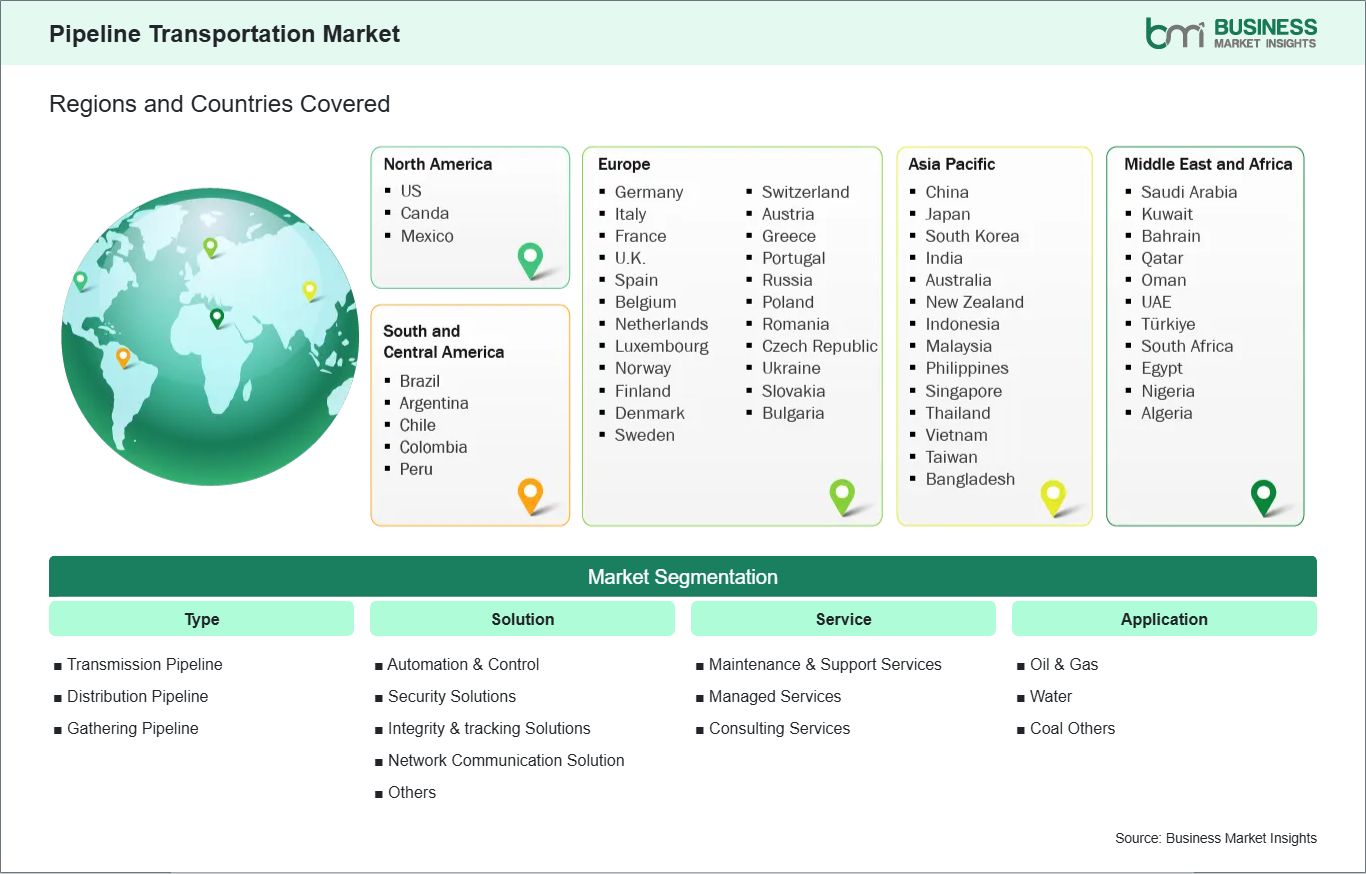
The pipeline transportation market is segmented based on type, solution, service, and application, highlighting distinct operational priorities and evolving deployment strategies across pipeline infrastructure.
By Type
- Transmission Pipeline: Facilitates long-distance transport of bulk resources across regions
- Distribution Pipeline: Supports localized delivery networks for end-user consumption
- Gathering Pipeline: Connects production sites to central processing facilities
By Solution
- Automation & Control: Enhances operational precision through advanced system management
- Security Solutions: Protects infrastructure against physical and cyber threats
- Integrity & Tracking Solutions: Enables continuous monitoring of pipeline conditions
- Network Communication Solution: Ensures seamless data exchange across infrastructure
- Others: Addresses specialized operational requirements
By Service
- Maintenance & Support Services: Ensures consistent system performance and reliability
- Managed Services: Outsources operational management for efficiency optimization
- Consulting Services: Provides strategic planning and compliance guidance
By Application
- Oil & Gas: Dominates due to extensive infrastructure and continuous demand
- Water: Expands with urban infrastructure development initiatives
- Coal: Supports industrial supply chains with dedicated transport networks
- Others: Includes niche industrial and chemical transport applications
Market Forces
Pipeline Transportation Market Drivers and Opportunities
Expansion of Energy Infrastructure Networks
Global energy demand continues to require extensive transport infrastructure capable of meeting supply continuity. Pipeline systems offer cost-effective and safe movement of hydrocarbons compared to alternate logistics methods. This need drives investment in both new installations and upgrades of aging pipeline networks.
Infrastructure expansion influences industrial development and cross-border trade integration. Governments and private operators prioritize pipeline deployment to secure energy distribution channels. The relevance of these systems strengthens as energy transition strategies incorporate diversified fuel sources requiring efficient transport mechanisms.
Digitalization and Smart Pipeline Integration
Emerging digital technologies are transforming pipeline operations by introducing intelligent monitoring systems. Integration of IoT sensors, AI-based analytics, and predictive maintenance tools improves operational transparency and reduces risk exposure. Real-time diagnostics enable proactive intervention, preventing disruptions.
Future developments indicate broader adoption of fully automated systems and remote management capabilities. Expanding digital infrastructure enhances scalability and supports complex pipeline networks. This shift creates opportunities for advanced solution providers and drives long-term efficiency improvements across the sector.
Size and Share Analysis
Pipeline Transportation Market Size and Share Analysis
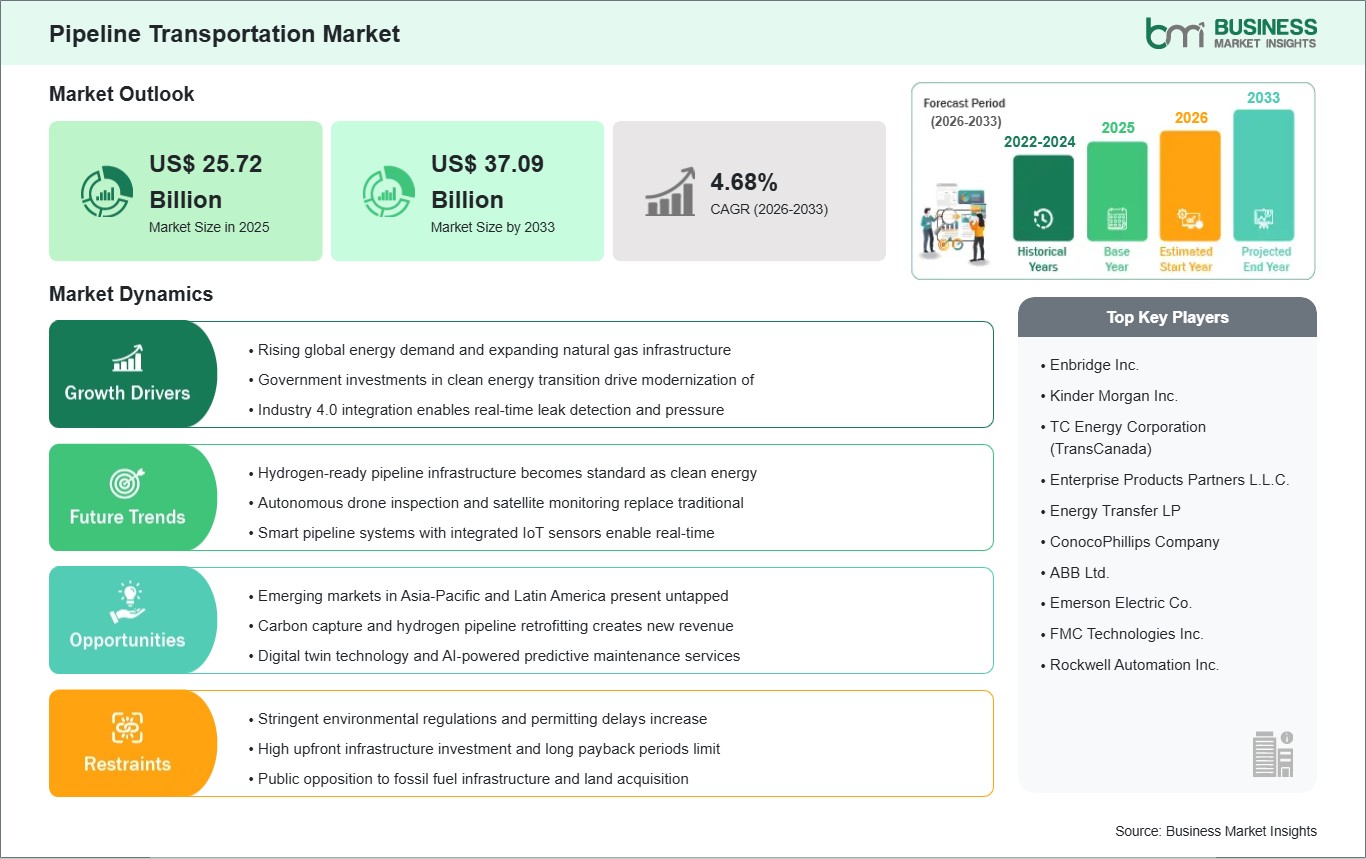
The pipeline transportation market is projected to grow from US$ 25.72 billion in 2025 to US$ 37.09 billion by 2033. The market is estimated to record a CAGR of 4.68% from 2026 to 2033.
This progression reflects steady infrastructure investment and modernization initiatives across global energy networks, supporting consistent expansion.
Transmission pipelines maintain leading share due to their essential role in long-distance energy transport. Automation and integrity solutions continue expanding deployment as operators prioritize operational reliability and monitoring efficiency. Service-based offerings are also gaining traction alongside infrastructure expansion.
Oil and gas applications dominate the sector, supported by established pipeline networks and continuous resource demand. Water transportation is witnessing gradual advancement driven by urbanization, while other applications continue to evolve within specialized industrial use cases.
Report Coverage
Pipeline Transportation Market Report Coverage and Deliverables
The "Pipeline Transportation Market Size and Forecast (2022–2033)" report provides a detailed analysis of the market covering below areas:
- Market size and forecast at global, regional, and country levels for all the key market segments covered under the scope
- Market trends, as well as market dynamics such as drivers, restraints, and key opportunities
- Market analysis covering key market trends, global and regional framework, major players, regulations, and recent market developments
- Industry landscape and competition analysis covering market concentration, heat map analysis, prominent players, and recent developments for the market
- Detailed company profiles, including SWOT analysis
Geographic Insights
Pipeline Transportation Market Geographic Insights
The Pipeline Transportation market shows diverse regional adoption patterns influenced by infrastructure maturity, regulatory frameworks, and resource distribution. Developed economies emphasize modernization of aging systems, while emerging regions focus on expanding network coverage to support industrial growth.
North America demonstrates strong infrastructure integration supported by established oil and gas transport systems. Technological advancements in monitoring and safety systems are widely deployed, enhancing operational efficiency. Regulatory oversight ensures compliance with environmental standards, prompting continuous upgrades.
Asia Pacific reflects rapid infrastructure expansion driven by industrialization and urban development. Governments are investing in pipeline projects to strengthen energy security and improve water distribution networks. Increasing demand for efficient transport systems supports broader deployment across multiple applications.
Europe prioritizes sustainability and safety improvements within existing networks, focusing on integrity management systems. Emerging markets in the Middle East, Africa, and South America are expanding pipeline infrastructure to support resource extraction and export activities, shaping regional growth trajectories.
Industry Activity
Recent Developments
The pipeline transportation market is evaluated by gathering qualitative and quantitative data post primary and secondary research, which includes important corporate publications, association data, and databases. Recent developments and news in the market include:
- In April 2026, Enbridge Inc. (Enbridge or the Company) (TSX: ENB) (NYSE: ENB) announced today that the Canadian Government has approved the Sunrise Expansion Program (the Project), a $4 billion natural gas expansion of Enbridge's Westcoast pipeline system in B.C. The Project is an essential energy infrastructure project that has been found to be in the public interest.
- In November 2025, Oleoductos del Valle (Oldelval) and Trafigura inaugurated on Tuesday, November 4, the new pipeline connection to the Bahía Blanca Refinery - a strategic project for the country’s crude oil transportation system that enhances operational flexibility and export capacity from the Neuquén Basin. The new 14-inch-diameter, 11-kilometer-long pipeline connects Oldelval’s main Allen-Puerto Rosales system with Trafigura’s refinery in Bahía Blanca. The project required an investment of over 30 million dollars and was executed under the highest quality, safety, and environmental standards.
Trust & Transparency
Research Methodology
The market analysis combines proprietary research with secondary data from government agencies, company disclosures, regulatory filings, industry databases and expert interviews. Market estimates are validated through data triangulation, cross-market benchmarking and analyst
review.
View Full Research Methodology
Key Sources Referred:
World Bank – Global Trade IndicatorsWorld Trade Organization (WTO)International Monetary Fund (IMF)International Energy Agency (IEA)International Trade Administration (ITA)Company WebsitesCompany Annual ReportsCompany Investor Presentations