
Ocular Implants Market Outlook: Size, Share, Trends, Growth Analysis, Competitive Landscape & Forecast, 2026–2033

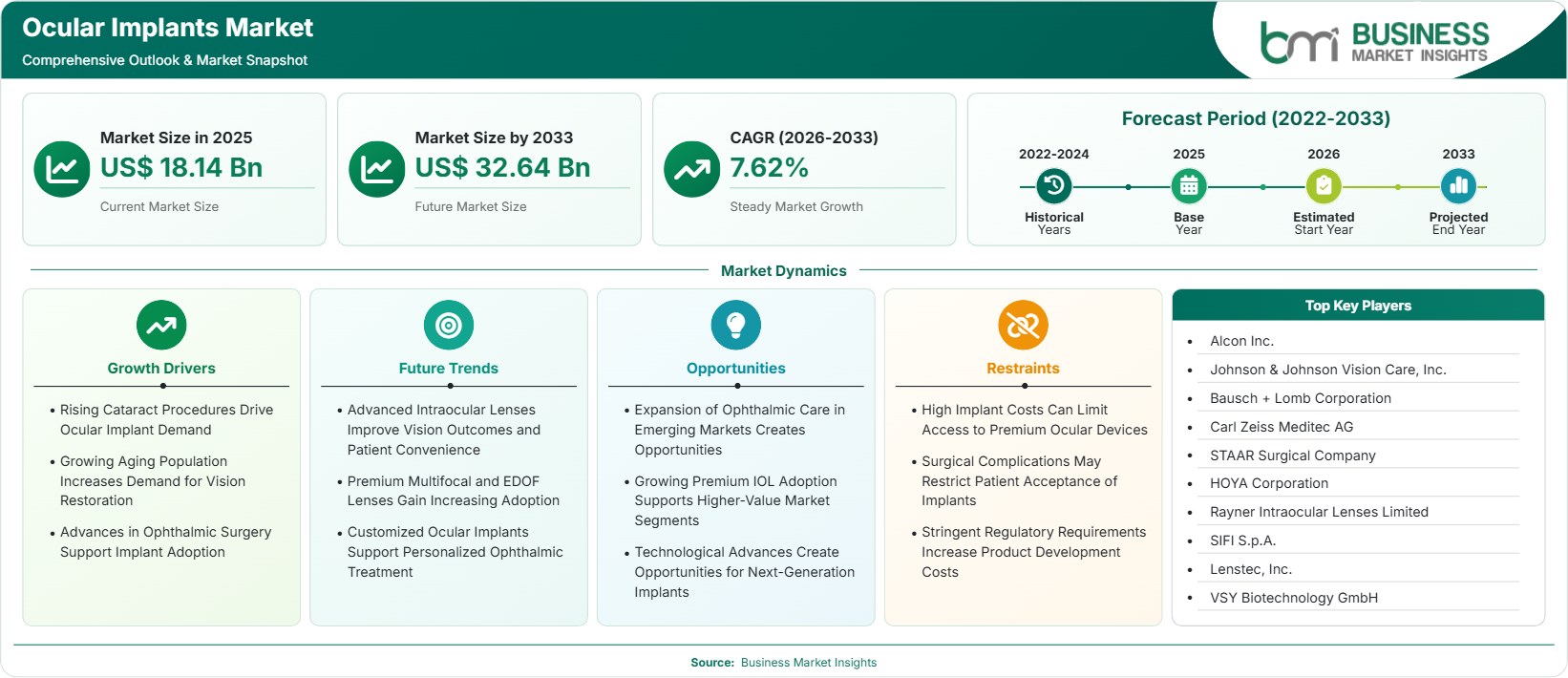
The Ocular Implants Market size was valued at US$ 18.14 Billion in 2025 and is projected to reach US$ 32.64 Billion by 2033, growing at a CAGR of 7.62% during 2026–2033, driven by cataract surgery volumes, aging demographics, advanced lenses, glaucoma treatment, and expanding ophthalmic care access.

Report Coverage
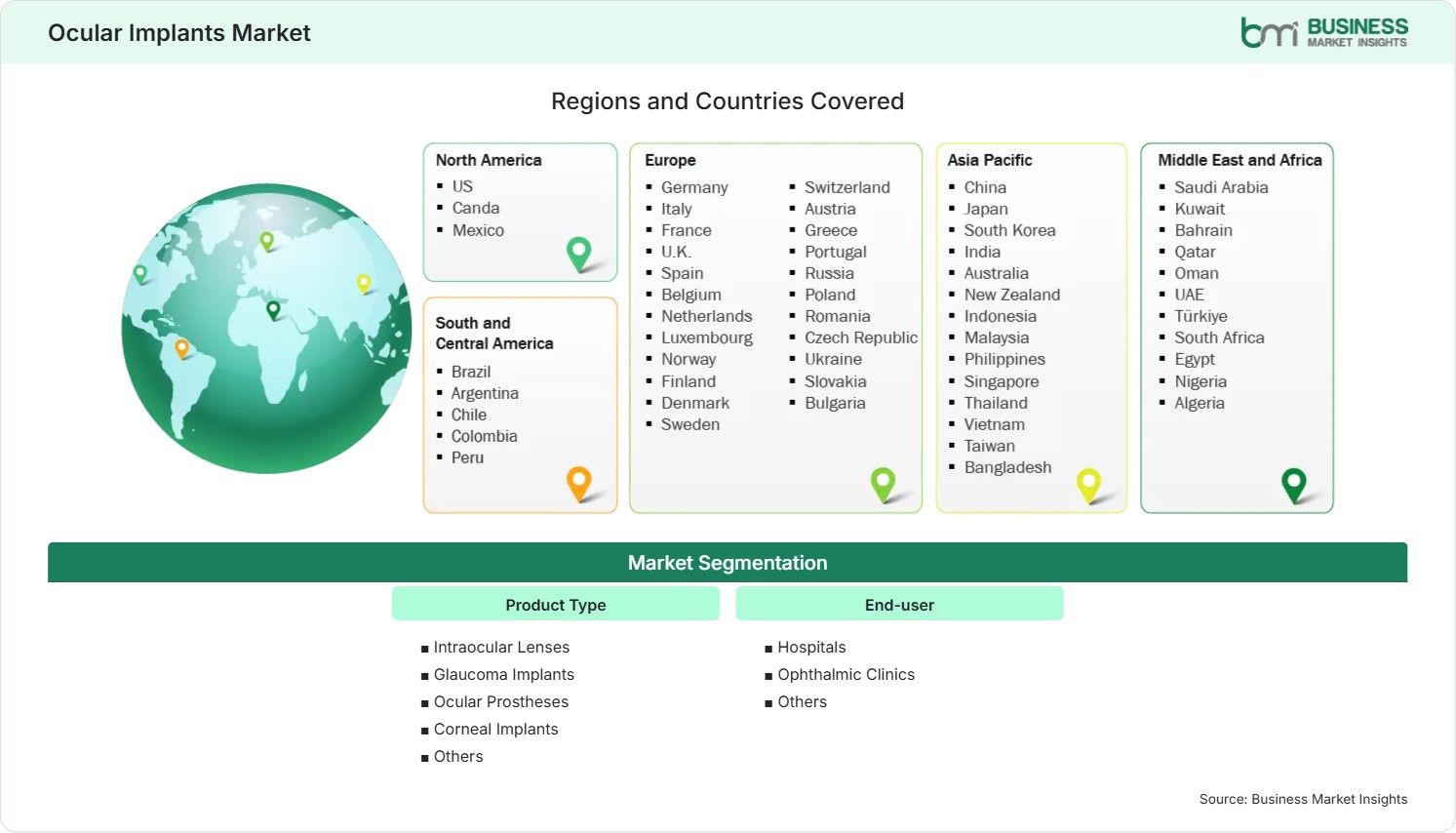
  • Product Type: Intraocular Lenses, Glaucoma Implants, Ocular Prostheses, Corneal Implants, Others
  • End-user: Hospitals, Ophthalmic Clinics, Others
US$ 18.14 Bn Market size in 2025
US$ 32.64 Bn Market Size by 2033
7.62% CAGR, 2026 - 2033
2026-2033 Forecast Period

AI Overview

Ocular Implants Market Summary

  • North America: holds 29%–32% Ocular Implants Market share in 2025, growing at a CAGR of 6.8%–7.5% during 2026–2033, supported by cataract procedures, premium lens adoption, advanced ophthalmic infrastructure, reimbursement coverage, and surgical technology. The US accounts for 80%–84% of regional demand and is projected to grow at 6.9%–7.6% CAGR through 2033, supported by cataract treatment, premium IOL adoption, glaucoma care, and technology upgrades.
  • Fastest Growing Region: Asia Pacific holds 32%–35% share in 2025, expanding at a CAGR of 8.5%–9.3% during 2026–2033, supported by aging populations, rising cataract burden, expanding ophthalmic infrastructure, improving surgical access, increasing healthcare expenditure, and broader adoption of advanced implants.
  • Leading Segment: Intraocular Lenses hold 63%–67% share in 2025, growing at a CAGR of 7.8%–8.5% during 2026–2033, supported by cataract surgery volumes, aging populations, premium lens adoption, improved optical performance, better delivery systems, and increasing patient preference for reduced spectacle dependence.
  • High Growth Segment: Glaucoma Implants hold 11%–15% share in 2025, growing at a CAGR of 9.0%–9.8% during 2026–2033, supported by rising glaucoma burden, minimally invasive procedures, pressure-control requirements, surgical innovation, improved implant designs, and expanding specialist ophthalmology services globally.
  • Key Market Opportunity: Expansion of ophthalmic care in emerging economies, premium IOL adoption, improved implant materials, minimally invasive glaucoma treatment, and advanced optical designs are widening commercial opportunities across ophthalmic surgery.
  • Major Market Players: Alcon Inc., Johnson & Johnson Vision Care, Inc., Bausch + Lomb Corporation, Carl Zeiss Meditec AG, STAAR Surgical Company, HOYA Corporation, Rayner Intraocular Lenses Limited, SIFI S.p.A., Lenstec, Inc., VSY Biotechnology GmbH.
Strategic Insights

Ocular Implants Market: Strategic Insights

Ocular Implants Market Strategic Framework
FREE PDF
Request your free sample
Request free sample
Stakeholder View

Key Takeaways

  • The value chain extends from biomaterials to optical engineering, precision machining, sterilization, delivery, regulation qualification, ophthalmic distribution, and finally surgeon-selection, thus making manufacturing quality and scientific efficacy key determinants of competition.
  • IOLs continue to be the main revenue stream, but there is greater scope for diversification through glaucoma devices and high-end optics.
  • Product development is moving toward improved optical quality, extended visual ranges, toric correction, preloaded systems, enhanced stability, and minimally invasive implantation approaches.
  • Asia Pacific presents the strongest regional investment case because procedure access remains below clinical need in several markets while aging populations and ophthalmic infrastructure continue expanding.
  • Consolidation and portfolio expansion are becoming important competitive tools as established eye-care companies seek complementary technologies spanning cataract, refractive, glaucoma, and corneal treatment.
  • Access remains a major commercial variable because implant demand depends not only on disease burden but also on diagnosis, surgical capacity, reimbursement, affordability, and specialist availability.
Geographic Outlook

Ocular Implants Market Regional Highlights

North America Ocular Implants Market

North America Ocular Implants Market holds 29%–32% share in 2025 and is projected to grow at 6.8%–7.5% CAGR through 2033. The US accounts for 80% to 84% of the regional demand due to its strong ophthalmic infrastructure, cataract surgery capability, premium lens adoption, and availability of specialists. The contribution from Canada comes from its aging population and increasing number of ophthalmic procedures. Regional demand has been increasingly driven by innovations in lens technology, surgical efficiency, and preference for better post-operative vision results.

  • The need for cataract surgeries constitutes another important demand area, whereas premium lenses provide an opportunity for adding value through products that correct astigmatism and presbyopia.
  • Existing ophthalmic clinics contribute to quicker integration of innovations in terms of implant design owing to better access to special training, diagnostics equipment, and procedures.
  • Treatment of glaucoma becomes another demand driver, as doctors start thinking about the use of implants for people who need a long-term pressure control in the eye.
  • Product competition moves from basic implant availability to optical qualities, ease of implantation, clinical results, and patient satisfaction.

US Ocular Implants Market

The US Ocular Implants Market accounts for 80%–84% of North American demand in 2025 and is projected to grow at 6.9%–7.6% CAGR through 2033. Demand benefits from advanced cataract surgery infrastructure, specialist ophthalmology networks, established reimbursement pathways, and relatively strong adoption of premium implants.

  • Premium IOL adoption supports higher-value demand as patients and surgeons increasingly consider visual quality, range of vision, astigmatism correction, and reduced spectacle dependence.
  • Advanced glaucoma implants provide additional growth opportunities as treatment strategies emphasize effective pressure reduction alongside less invasive procedural approaches.
  • Strong specialist infrastructure allows manufacturers to introduce differentiated technologies efficiently through surgeon education, clinical evidence, and established ophthalmic distribution networks.

Europe Ocular Implants Market

Europe Ocular Implants Market holds 24%–27% share in 2025 and is projected to grow at 6.2%–6.9% CAGR through 2033. Germany, France, Italy, the UK, and Spain are leading markets, while Spain is projected to grow at 7.0%–7.7% CAGR. Aging populations, established cataract surgery systems, ophthalmic specialization, and technology adoption support demand.

  • Germany represents a major ophthalmic market supported by substantial cataract treatment capacity, specialist infrastructure, and demand for advanced surgical products.
  • Spain provides relatively strong growth at 7.0%–7.7% CAGR, supported by aging demographics, cataract treatment demand, and increasing use of advanced ophthalmic technologies.
  • France and Italy maintain established procedure volumes while healthcare systems increasingly assess clinical outcomes and economic value when adopting higher-cost implants.
  • European regulatory requirements create high entry barriers but also strengthen confidence in products that demonstrate safety, performance, and manufacturing consistency.

Asia Pacific Ocular Implants Market

Asia Pacific Ocular Implants Market holds 32%–35% share in 2025 and is projected to grow at 8.5%–9.3% CAGR through 2033. China, Japan, India, South Korea, and Australia comprise some of the key markets, with India forecasted to experience a growth rate of 9.3%-10.1%. Aging population and cataract prevalence drive demand, while increasing number of hospitals, ophthalmic facilities, diagnostics capability and surgery options increase the target population.

  • China offers significant opportunities for procedures owing to aging population, prevalence of cataracts, expanding healthcare infrastructure, and growing expertise.
  • India offers the strongest growth opportunity at 9.3%–10.1% CAGR as ophthalmic infrastructure expands and unmet cataract treatment needs remain substantial.
  • Japan and South Korea cater to increased-value demand through advanced eye care facilities, surgery skills, and higher penetrance of technology-based implants.
  • Markets in Southeast Asia offer incremental value in terms of health-care spending, private eye clinics, diagnostics, and surgeries becoming more prevalent in urban areas.

Rest of World Ocular Implants Market

The South and Central Americas are sources of growing demand with the development of ophthalmology services and the capacity for treating cataracts increasing. The key markets are Brazil and Mexico, with other potential markets including Colombia and Chile. The premium implants have less penetration than in developed countries.

Middle East and Africa offer opportunities through healthcare infrastructure development, specialist ophthalmology expansion, and growing attention to avoidable vision impairment. Rest of World holds 10%–13% share in 2025 and is projected to grow at 6.4%–7.2% CAGR through 2033.

  • Brazil supports regional demand through its large population, established ophthalmic services, and expanding access to cataract treatment and specialist procedures.
  • Mexico offers opportunities through private healthcare expansion, ophthalmology networks, and increasing availability of advanced surgical technologies.
  • Gulf markets are developing specialist healthcare infrastructure, supporting greater availability of advanced ophthalmic surgery and differentiated implant technologies.
  • South Africa remains an important African market because specialist services and private healthcare capacity support adoption of advanced ophthalmic products.
Global Market Geography
FREE PDF
Request your free sample
Request free sample
Segment Analysis

Ocular Implants Market Segmentation

Product Type

Intraocular Lenses hold 63%–67% share in 2025 and are projected to grow at a CAGR of 7.8%–8.5% through 2033. Cataract surgery volumes underpin demand, while premium, toric, multifocal, and extended-depth optical designs support value expansion. Glaucoma, corneal, and prosthetic implants diversify applications and address specialized ophthalmic treatment requirements across hospitals and clinics.

  • Intraocular Lenses: Cataract surgery creates the largest implant requirement, while premium optical designs, toric correction, extended visual ranges, and improved delivery systems support continued product development.
  • Glaucoma Implants: Growing glaucoma treatment requirements support implant adoption, with minimally invasive designs and improved pressure-control approaches strengthening demand among specialist ophthalmic providers.
  • Ocular Prostheses: Prosthetic devices address functional and cosmetic rehabilitation needs, with individualized fitting, anatomical compatibility, material quality, and patient comfort influencing product selection.
  • Corneal Implants: Corneal procedures create specialized demand for implants addressing structural and visual requirements, with biocompatibility, surgical precision, and tissue compatibility shaping adoption.

End-user

Hospitals hold 58%–62% share in 2025 and are projected to grow at a CAGR of 7.3%–8.0% through 2033. Hospitals maintain high procedure volumes and possess broader surgical infrastructure, while ophthalmic clinics increasingly capture routine and specialized procedures.

  • Hospitals: High surgical volumes, multidisciplinary infrastructure, specialist availability, and centralized procurement make hospitals the principal end-user base for ocular implants across multiple procedures.
  • Ophthalmic Clinics: Specialized clinics support outpatient ophthalmic procedures and increasingly adopt advanced implants as diagnostic capabilities, surgical equipment, and specialist networks expand.
Market Forces

Ocular Implants Market Dynamics

Key Market Drivers

Rising Cataract Procedures Drive Ocular Implant Demand

The cataract procedure is still the key demand factor because surgery involves replacing the damaged natural lens with a replacement. The increase in surgical capacity will lead to an increase in the potential implant recipients. This is due to aging demographics, which contribute to higher cataracts in older individuals. Companies gain from both increases in procedure volumes and the shift towards premium lenses that provide differentiated results. The Ocular Implants Market growth will be associated with the presence of cataracts and health-care spending.

Growing Aging Population Increases Demand for Vision Restoration

Population aging increases the incidence of cataract and other age-associated ocular disorders, creating a durable need for surgical intervention and vision restoration. Aging therefore influences both procedure volumes and the complexity of ophthalmic care requirements. Older patients may present with multiple ocular conditions, increasing demand for appropriate lens selection and specialized surgical planning. Healthcare systems must consequently expand diagnostic capacity, surgical infrastructure, and specialist availability alongside implant supply.

Advances in Ophthalmic Surgery Support Implant Adoption

Ophthalmic surgery is becoming more precise through improved diagnostics, surgical planning, optical design, delivery mechanisms, and minimally invasive approaches. These advances increase the ability of surgeons to tailor implants to patient-specific visual requirements. Product design therefore influences clinical decision-making beyond basic lens replacement. Manufacturers are investing in optical engineering, biomaterials, stability, delivery systems, and procedural compatibility to improve outcomes and simplify implantation. The Ocular Implants Market trends increasingly reflect this movement toward procedure-specific technologies rather than standardized implant designs.

Key Market Opportunities

Expansion of Ophthalmic Care in Emerging Markets Creates Opportunities

Emerging markets present a substantial opportunity because access to cataract and other ophthalmic procedures remains below clinical need. Expanding hospitals, ophthalmic clinics, diagnostic services, surgical training, and healthcare financing can increase procedure volumes. Manufacturers can address these markets through differentiated product tiers, efficient manufacturing, regional distribution, and surgeon education. The Ocular Implants Market forecast will be widening as treatment access expands from major specialist centers into secondary cities and regional healthcare networks.

Growing Premium IOL Adoption Supports Higher-Value Market Segments

Premium IOLs provide manufacturers with an avenue to increase value per procedure by addressing visual requirements beyond basic distance correction. Extended-depth, multifocal, toric, and other advanced designs can reduce dependence on spectacles for selected patients while addressing specific refractive needs. Adoption depends on surgeon confidence, patient awareness, clinical outcomes, affordability, and the availability of appropriate diagnostic assessment. Mature markets provide the strongest immediate opportunity because surgical infrastructure and specialist expertise support premium lens selection.

Technological Advances Create Opportunities for Next-Generation Implants

Next-generation implants can create opportunities through improved biomaterials, optical engineering, delivery systems, and procedure-specific designs. Product developers are increasingly focused on minimizing optical disturbances, improving stability, simplifying implantation, and providing predictable postoperative results. Preloaded systems can streamline surgical preparation, while advanced optical profiles can broaden functional vision. Glaucoma implants similarly offer opportunities for smaller, less invasive, and more controllable treatment approaches. Corneal and prosthetic technologies provide additional avenues for specialized applications.

Market Restraints and Challenges

High Implant Costs Can Limit Access to Premium Ocular Devices

Factor: Premium ocular implants require advanced optical engineering, specialized materials, clinical development, regulatory compliance, precision manufacturing, and controlled sterilization, increasing production and procurement costs. Impact: Higher prices can restrict adoption among patients with limited insurance coverage or healthcare purchasing capacity and may encourage providers to prioritize standard implants. Premium products can therefore experience uneven penetration across markets despite clinical differentiation.

Surgical Complications May Restrict Patient Acceptance of Implants

Factor: Ocular implantation involves surgical intervention and can carry risks associated with infection, inflammation, positioning, visual disturbances, pressure changes, or other postoperative complications depending on the implant and procedure. Impact: Concerns about adverse outcomes can influence patient willingness, surgeon selection, product adoption, and regulatory scrutiny. Reliable manufacturing, clinical evidence, surgeon training, patient screening, and postoperative monitoring are therefore essential to maintaining confidence.

Company Analysis

Competitive Landscape

The Ocular Implants Market analysis shows competition across diversified eye-care manufacturers, specialist IOL developers, ophthalmic technology companies, and companies focused on refractive or glaucoma solutions. Competitive positioning depends on optical performance, biomaterials, clinical evidence, surgeon relationships, regulatory reach, manufacturing precision, product breadth, and distribution.

Company Name

Overview

Products and Services relevant to this market

Alcon Inc.

Global eye-care company with a broad surgical ophthalmology portfolio and substantial IOL capabilities.

Intraocular lenses, cataract surgery technologies, glaucoma solutions, refractive surgery products, and ophthalmic surgical systems.

Johnson & Johnson Vision Care, Inc.

Ophthalmic business focused on vision correction, surgical technologies, and eye-care products.

IOLs, cataract surgery products, refractive solutions, surgical systems, and vision correction technologies.

Bausch + Lomb Corporation

Diversified eye-health company with surgical and pharmaceutical capabilities across ophthalmology.

IOLs, cataract surgery products, glaucoma technologies, ophthalmic surgical devices, and related eye-care products.

Carl Zeiss Meditec AG

Ophthalmic technology company combining surgical devices, diagnostics, and implant technologies.

IOLs, ophthalmic surgical systems, diagnostic platforms, and precision eye-care technologies.

STAAR Surgical Company

Specialist ophthalmic device company focused on implantable lens technologies and refractive correction.

Implantable Collamer Lenses, refractive implants, lens-based vision correction technologies, and supporting surgical solutions.

HOYA Corporation

Japanese technology company with established medical and ophthalmic product capabilities.

Intraocular lenses, ophthalmic optics, surgical products, and specialized eye-care technologies.

Rayner Intraocular Lenses Limited

Specialist IOL manufacturer focused on ophthalmic lenses and surgical delivery technologies.

Monofocal, toric, enhanced vision IOLs, delivery systems, and related ophthalmic products.

SIFI S.p.A.

Italian ophthalmology company developing surgical and therapeutic products for eye disorders.

IOLs, ophthalmic surgical products, glaucoma solutions, and other eye-care technologies.

Lenstec, Inc.

Ophthalmic device manufacturer specializing in intraocular lens technologies.

Monofocal and premium IOL products, lens delivery systems, and cataract surgery solutions.

VSY Biotechnology GmbH

Ophthalmic medical-device company focused on lens technologies and surgical applications.

Intraocular lenses, ophthalmic implants, delivery systems, and surgical ophthalmology products.

Trust & Transparency

Research Methodology

The market analysis combines proprietary research with secondary data from government agencies, company disclosures, regulatory filings, industry databases and expert interviews. Market estimates are validated through data triangulation, cross-market benchmarking and analyst review.

View Full Research Methodology

Questions Answered

Frequently Asked Questions

Which factor can most affect access in emerging markets?

Access depends on the combination of surgical capacity, ophthalmologist availability, diagnosis, and patient awareness rather than implant availability alone.

What role does clinical evidence play in implant adoption?

Clinical evidence helps surgeons and healthcare providers assess safety, visual outcomes, durability, and complication profiles.

How does glaucoma influence implant demand?

Glaucoma creates demand for devices designed to manage intraocular pressure when medication or conventional treatment is insufficient.

Why are preloaded IOL delivery systems gaining attention in Ocular Implants Market report?

Preloaded systems can simplify lens preparation, reduce handling steps, support procedural consistency, and potentially improve operating-room efficiency.

What determines the choice between standard and premium IOLs?

Selection depends on ocular measurements, refractive requirements, lifestyle expectations, comorbidities, surgeon assessment, affordability, and the patient's desired balance between visual range and optical quality.

Access the Full Ocular Implants Market Report

Get segment-level forecasts, regional estimates, competitive benchmarking, company profiles and downloadable Excel datasets.

Access the full Ocular Implants Market Report
350 pages PDF & Excel | 2026-08-24
Similar Research

Related Market Reports