
Brain Implants Market Outlook: Size, Share, Trends, Growth Analysis, Competitive Landscape & Forecast, 2026-2033

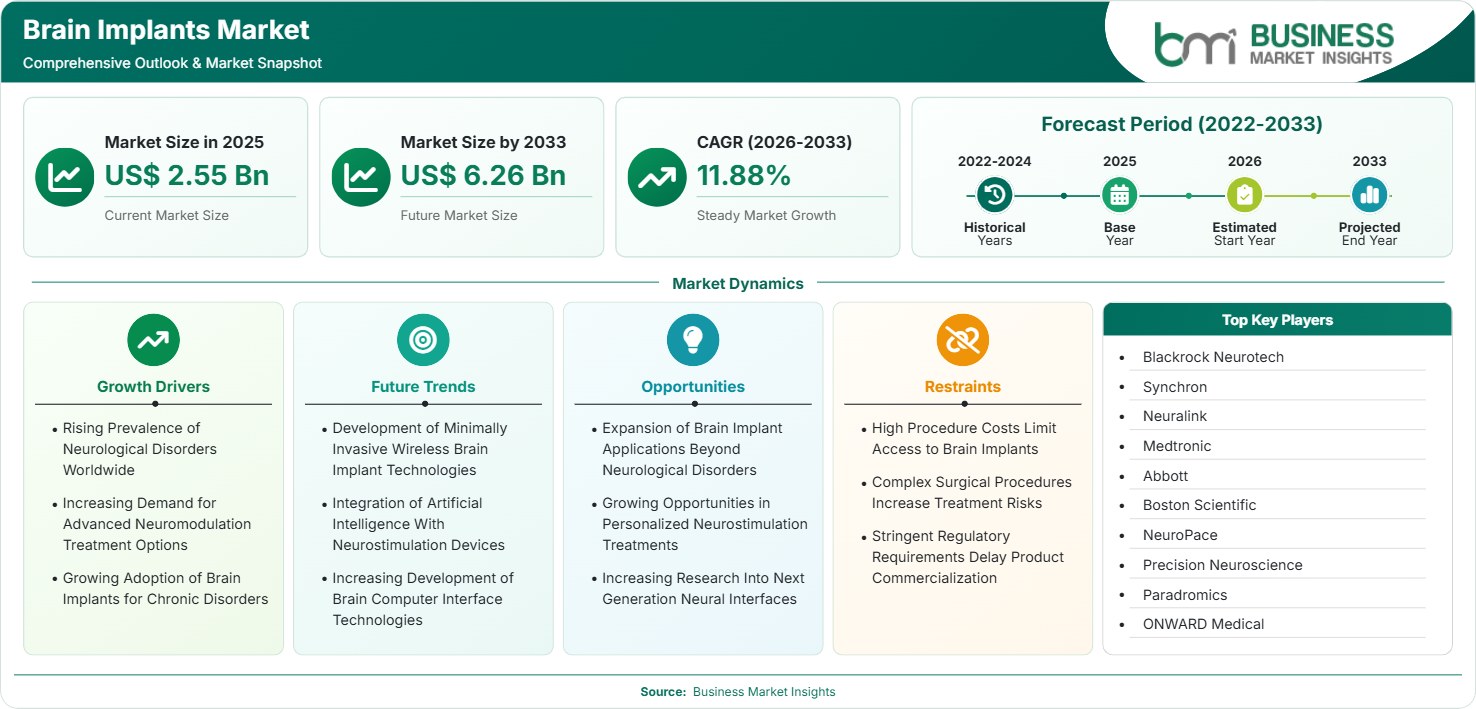
The Brain Implants Market size was valued at US$ 2.55 billion in 2025 and is projected to reach US$ 6.26 billion by 2033, growing at a CAGR of 11.88% during 2026–2033, driven by rising neurological disorders, advances in neuromodulation, and growing demand for implantable therapies for chronic conditions.

Report Coverage
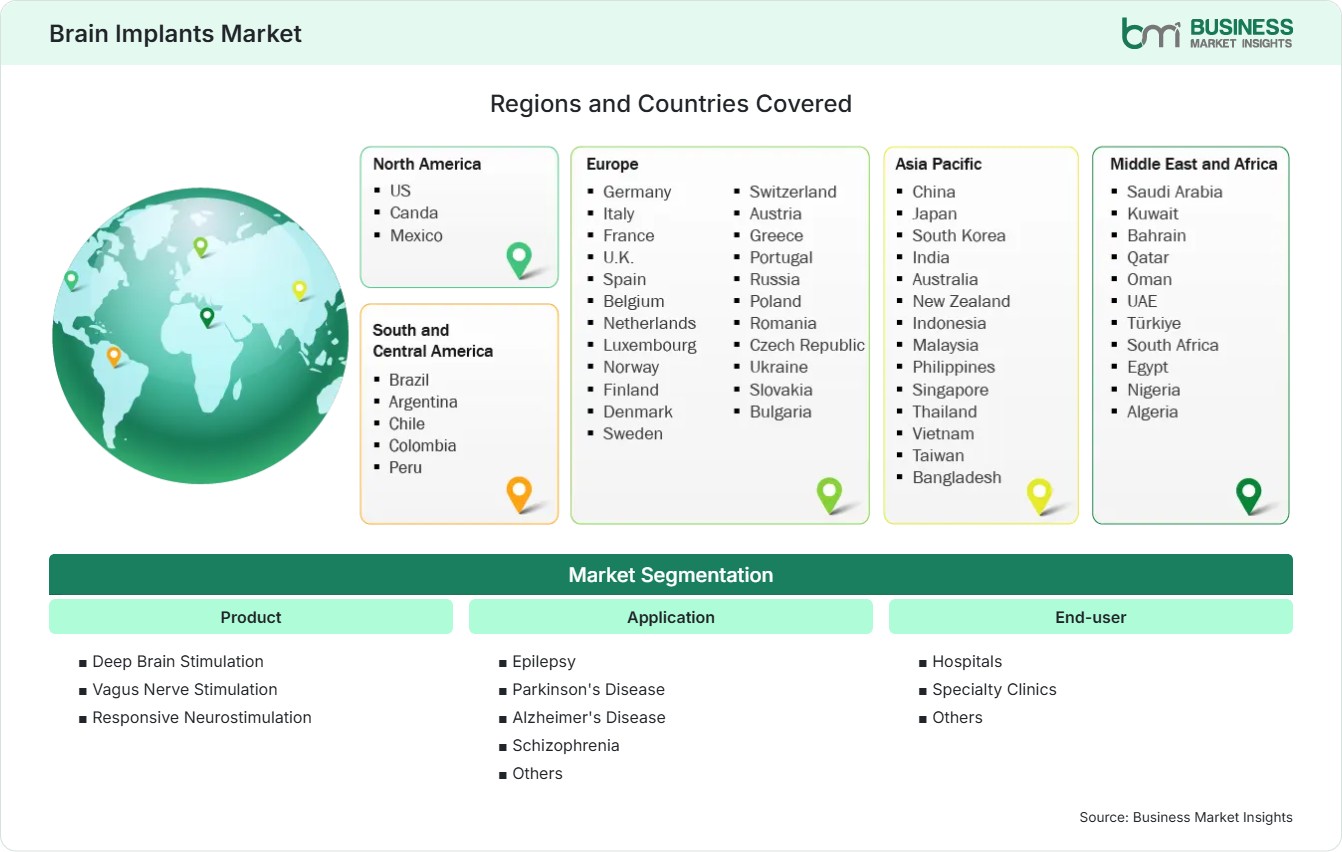
  • Product: Deep Brain Stimulation, Vagus Nerve Stimulation, Responsive Neurostimulation
  • Application: Epilepsy, Parkinson's Disease, Alzheimer's Disease, Schizophrenia, Others
  • End-user: Hospitals, Specialty Clinics, Others
US$ 2.55 Bn Market size in 2025
US$ 6.26 Bn Market Size by 2033
11.88% CAGR, 2026 - 2033
2026-2033 Forecast Period

01 AI Overview

Brain Implants Market Summary

  • North America Region: North America · 42%–46% share (2025) · 10.8%–11.8% CAGR (2026–2033) · Established neuromodulation infrastructure, specialist expertise, advanced reimbursement pathways, and strong investment in neural-interface technologies support adoption.
  • Fastest Growing Region: Asia Pacific · 13.0%–14.5% CAGR (2026–2033) · Expanding healthcare infrastructure, rising neurological disease burden, improving specialist access, and increasing adoption of advanced neuromodulation therapies create significant opportunities.
  • Leading Segment: Deep Brain Stimulation · 48%–52% share (2025) · 10.8%–11.8% CAGR (2026–2033) · Established clinical use, physician familiarity, and application across movement disorders support demand, while technological improvements expand treatment capabilities.
  • High Growth Segment: Responsive Neurostimulation · 13.5%–15.0% CAGR (2026–2033) · Personalized stimulation, closed-loop treatment approaches, and increasing interest in epilepsy management create opportunities for intelligent implantable neuromodulation systems.
  • Key Market Opportunity: Advances in neural interfaces, personalized stimulation, and applications beyond traditional neurological disorders can expand the addressable population while creating opportunities for innovative implantable systems and specialized treatment platforms.
  • Major Market Players: Blackrock Neurotech, Synchron, Neuralink, Medtronic, Abbott, Boston Scientific, NeuroPace, Precision Neuroscience, Paradromics, ONWARD Medical
02 Strategic Insights

Brain Implants Market: Strategic Insights

brain-implants-market-market-strategic-framework
FREE PDF
Request your free sample
Request free sample
03 Stakeholder View

Key Takeaways

  • The ecosystem includes implant manufacturers, neuromodulation specialists, neural-interface developers, surgical centers, neurologists, neurosurgeons, rehabilitation providers, and research institutions.
  • Responsive neurostimulation and advanced brain-computer interfaces offer opportunities for companies developing systems that can personalize treatment according to individual neural activity.
  • The field is shifting toward adaptive stimulation, miniaturized implants, wireless communication, improved sensing, and more precise interaction between devices and neural tissue.
  • Asia Pacific offers an attractive expansion opportunity as healthcare infrastructure improves and neurological disease management becomes more accessible.
  • Strategic investment is increasingly directed toward neural interfaces, implantable technologies, artificial intelligence, and platforms capable of translating neural signals into useful therapeutic or functional outcomes.
  • Clinical evidence and regulatory approval remain critical competitive differentiators because healthcare providers require demonstrated safety, efficacy, reliability, and long-term patient outcomes before adopting emerging implant technologies.
04 Geographic Outlook

Brain Implants Market Regional Highlights

North America Brain Implants Market

North America holds a 42%–46% share in 2025 and is projected to grow at a 10.8%–11.8% CAGR through 2033. The Brain Implants Market share reflects established neurosurgical infrastructure, strong specialist expertise, and early adoption of advanced neuromodulation technologies. The US remains the primary contributor, supported by leading medical device companies, research institutions, and clinical trial activity. Canada provides additional opportunities through specialized neurological care and increasing interest in innovative treatment approaches.

  • Strong clinical infrastructure supports adoption of established neuromodulation procedures while providing a foundation for emerging neural-interface technologies.
  • Major medical device companies maintain extensive physician networks, enabling commercialization of innovative implantable technologies through established healthcare channels.
  • Research institutions and technology companies are advancing brain-computer interfaces, creating opportunities beyond conventional therapeutic neuromodulation.
  • Increasing attention to personalized medicine is encouraging development of stimulation systems capable of adapting to individual patient needs.

US Brain Implants Market

The US represents approximately 38%–42% of global market value in 2025 and is projected to expand at a 10.9%–11.9% CAGR through 2033. The market benefits from advanced neurosurgical capabilities, established reimbursement systems, and strong research activity. Deep brain stimulation and responsive neurostimulation have established clinical applications, while emerging brain-computer interfaces are expanding the competitive landscape. Leading technology companies and academic institutions continue to support innovation in neural sensing and implantable devices.

  • Established neuromodulation programs support access to implant-based treatment for appropriately selected patients with chronic neurological disorders.
  • Strong research capabilities encourage development of adaptive stimulation and brain-computer interfaces that could broaden future therapeutic applications.
  • Advanced specialist networks facilitate clinical adoption and provide infrastructure for evaluating innovative implantable technologies.

Europe Brain Implants Market

Europe accounts for a 27%–31% share in 2025 and is expected to record a 10.0%–11.0% CAGR through 2033. Germany, France, the UK, and Italy represent leading markets because of established neurological care and specialist treatment infrastructure. Switzerland and the Netherlands provide additional opportunities through strong medical research ecosystems. European growth is supported by increasing demand for advanced neuromodulation, clinical research, and investment in technologies addressing complex neurological conditions and rehabilitation needs.

  • Germany's established neurosurgical infrastructure supports continued adoption of implantable neuromodulation systems and advanced neurological treatment approaches.
  • The UK benefits from strong academic research capabilities and growing interest in neural interfaces, supporting technology development and clinical investigation.
  • France and Italy provide opportunities through established specialty care networks and increasing attention to innovative neurological treatment options.
  • European research collaborations are supporting advances in neural engineering, rehabilitation technologies, and personalized approaches to neuromodulation.

Asia Pacific Brain Implants Market

Asia Pacific represents a 18%–22% share in 2025 and is projected to grow at a 13.0%–14.5% CAGR through 2033. Japan, China, South Korea, and Australia are leading contributors, while India and Southeast Asia offer strong expansion potential. Increasing neurological disease awareness, improving healthcare infrastructure, and growing specialist capacity are supporting adoption. The Brain Implants Market growth opportunity is particularly strong where investments in advanced hospitals and medical technology are improving access to complex neurological care.

  • China's expanding medical technology ecosystem is supporting development and adoption of advanced neuromodulation and neural-interface technologies.
  • Japan's sophisticated healthcare infrastructure and aging demographic profile support demand for innovative neurological treatment solutions.
  • India's expanding specialty healthcare network creates opportunities as awareness of neurological disorders and advanced treatment options increases.
  • Australia benefits from established clinical research capabilities and specialist healthcare infrastructure supporting neurological device innovation.

Rest of World Brain Implants Market

South and Central America account for an estimated 6%–9% share in 2025, while the Middle East and Africa contribute approximately 4%–7%. Combined growth is projected at a 10.5%–12.5% CAGR through 2033. Brazil and Mexico lead Latin American demand, while Saudi Arabia, the UAE, and South Africa provide important opportunities. Healthcare modernization and specialty hospital development are improving access to advanced neurological treatments.

The Brain Implants Market trend across these regions is influenced by specialist availability, hospital infrastructure, affordability, and access to neurosurgical expertise. Gulf countries offer strong opportunities through healthcare investment and advanced medical facilities, while Latin America provides potential through expanding specialty care. Longer-term opportunities in Africa depend on improved infrastructure, specialist training, and broader access to complex neurological procedures.

  • Brazil's established private healthcare infrastructure supports opportunities for advanced neuromodulation therapies, particularly through specialized neurological and neurosurgical centers.
  • Mexico offers potential as healthcare providers expand specialty services and improve access to advanced neurological treatment technologies.
  • Saudi Arabia and the UAE are developing advanced healthcare ecosystems that can support adoption of innovative implantable neurological technologies.
  • South Africa provides a regional center for specialized care, although affordability and uneven access remain important adoption considerations.
global-market-geography
FREE PDF
Request your free sample
Request free sample
05 Segment Analysis

Brain Implants Market Segmentation

Product

The Product segment is led by Deep Brain Stimulation, which held an estimated 48%–52% share in 2025 and is projected to grow at a 10.8%–11.8% CAGR through 2034. The Brain Implants Market scope is expanding through established neuromodulation applications and emerging responsive technologies. Product development increasingly emphasizes precision, programmability, miniaturization, and personalized stimulation.

  • Deep Brain Stimulation: Deep brain stimulation provides targeted electrical modulation for neurological conditions and remains an established approach, with continued innovation focused on precision, programming, and patient-specific therapy.
  • Vagus Nerve Stimulation: Vagus nerve stimulation offers an implant-based neuromodulation approach for selected neurological conditions, supporting demand for minimally invasive stimulation technologies and long-term symptom management.
  • Responsive Neurostimulation: Responsive neurostimulation detects neural activity and delivers stimulation based on individualized patterns, supporting personalized approaches to epilepsy management and advancing closed-loop neuromodulation.

Application

The Application segment is projected to grow at a 10.5%–12.5% CAGR through 2034 as neuromodulation expands across neurological conditions. Parkinson's disease and epilepsy remain important applications, while research is evaluating broader opportunities. The Brain Implants Market share reflects established clinical indications alongside emerging applications. Future adoption depends on clinical evidence, safety, regulatory progress, and physician acceptance.

  • Epilepsy: Brain implants can provide neuromodulation options for patients whose seizures remain inadequately controlled, supporting demand for responsive and targeted stimulation technologies.
  • Parkinson’s Disease: Implantable neuromodulation can help manage motor symptoms in selected patients, creating continued demand for advanced stimulation systems and improved programming capabilities.
  • Alzheimer’s Disease: Research into neural stimulation is exploring potential approaches to cognitive and neurological impairment, creating a developing opportunity for innovative implant technologies.
  • Schizophrenia: Emerging research is evaluating neural modulation approaches for complex psychiatric conditions, although clinical validation and regulatory development remain important considerations.
  • Others: Other applications include neurological rehabilitation, sensory restoration, communication support, and emerging brain-computer interface use cases that could broaden future market opportunities.

End-user

The End-user segment is projected to grow at a 10.5%–12.0% CAGR through 2034, supported by increasing demand for specialized neurological care. Hospitals remain central to implantation because procedures require multidisciplinary teams and advanced surgical capabilities. Specialty clinics provide follow-up and programming services, while emerging care models may improve long-term monitoring. The Brain Implants Market analysis reflects growing integration between surgical treatment, device management, and rehabilitation.

  • Hospitals: Hospitals provide neurosurgical infrastructure, multidisciplinary teams, imaging capabilities, and postoperative care required for complex brain implant procedures and patient monitoring.
  • Specialty Clinics: Specialty clinics support neurological assessment, device programming, follow-up, and long-term treatment management for patients receiving implantable neuromodulation therapies.
  • Others: Other end-users include research institutions, rehabilitation facilities, and specialized technology centers involved in clinical investigation, device evaluation, and emerging neural-interface applications.
06 Market Forces

Brain Implants Market Dynamics

Key Market Drivers

Rising Prevalence of Neurological Disorders Worldwide

The rise of neurological conditions is leading to an increased need for state-of-the-art treatments in health care systems dealing with an ever-increasing number of patients suffering from chronic and disabling ailments. There are many individuals with ongoing complaints even after receiving treatment via standard drug therapy; therefore, there is a need for solutions that would enable modulation of neural functioning. Implantation of brain devices is an option for certain individuals requiring an advanced level of treatment. With the increasing multidisciplinary nature of neurological care, neuromodulation has been incorporated into the treatment plan alongside other treatments.

Increasing Demand for Advanced Neuromodulation Treatment Options

Patients and health care professionals alike feel the need for better treatment strategies when the conventional method fails to yield desired results. Neuromodulation technology can change nervous system behavior through precise stimulation, offering another option for the chosen diseases. New advances in technology related to electrode design, programming, sensors, and even smaller devices will help to customize treatment for every patient. Adaptive and responsive strategies have emerged owing to these advances, and they can make use of feedback from neural activity to change stimulation accordingly. Health care professionals are now better versed in neuromodulation as part of neurological care, owing to a deeper understanding of clinical practice.

Growing Adoption of Brain Implants for Chronic Disorders

Brain implants have been receiving increasing focus among health practitioners as they try to look for more durable means of treating their patients who suffer from chronic brain disorders. Implant treatments can provide consistent or programmed stimulation, eliminating the need for repetitive procedures and ensuring that long-term treatment occurs in a controlled environment under expert supervision. Programming to adjust treatment based on individual changes in patient requirements will further facilitate individualized treatment methods. Recent innovations in device technology are improving implantation techniques, programming features, and clinical monitoring integration. Brain implant developers are exploring technologies that would allow them to sense physiological information in addition to delivering therapy.

Key Market Opportunities

Expansion of Brain Implant Applications Beyond Neurological Disorders

The advancements in neural interfaces are presenting avenues beyond the conventional treatment of neurological diseases. Research organizations and technology firms have begun investigating areas such as communication, motor control, sensory replacement, rehabilitation, and others, where direct interaction with brain signals could have potential applications. Such emerging applications have the potential to increase the addressable market considerably if they prove safe and effective in clinical trials. The integration of artificial intelligence and sensor technologies can enhance the ability of implant devices to interpret neural signals. Firms with skills in neural engineering can form partnerships with medical organizations and technology firms to speed up innovations in this field.

Growing Opportunities in Personalized Neurostimulation Treatments

Individualized neurostimulation is a promising area because neurological disorders can vary widely from one patient to another. The technology that would allow stimulation to be customized to the patient’s neural activity would yield better results than current approaches that use the same stimulation type for all patients. New developments in the field of sensing technologies would help to get more data about the patient's physiological condition to use in further programming of the device. In addition, software and analytics could help clinicians make the therapy even more effective over time.

Increasing Research Into Next Generation Neural Interfaces

The study of next-generation neural interface technologies is opening up possibilities for interfaces that can interact with the nervous system more effectively. Innovations in this area include new electrode materials, flexible interfaces, wireless systems, signal processing, and techniques to simplify implantation. All of these technologies might broaden the scope of possible applications for brain implants. Growing cooperation among medical device companies, technology firms, universities, and research organizations is accelerating the adoption of engineering advances in medicine. The development of brain-computer interfaces is opening new possibilities for rehabilitating the lost ability to communicate.

Market Restraints and Challenges

High Procedure Costs Limit Access to Brain Implants

Factor: Brain implant treatment requires specialized devices, neurosurgical expertise, advanced hospital infrastructure, and long-term follow-up, creating substantial healthcare costs. Impact: High overall treatment expenses can restrict access for patients without adequate reimbursement and limit adoption in healthcare systems with constrained budgets. The cost of implantation is also influenced by preoperative evaluation, surgical resources, postoperative monitoring, device programming, and potential replacement requirements. These factors can make implantable therapies less accessible than conventional treatment approaches. Manufacturers and healthcare providers may need to demonstrate long-term clinical value to support reimbursement decisions and broader adoption. Expanding insurance coverage, improving health-economic evidence, and developing cost-efficient technologies could help reduce barriers and support wider availability.

Complex Surgical Procedures Increase Treatment Risks

Factor: Brain implant procedures require precise surgical techniques and specialized multidisciplinary expertise, creating risks associated with implantation, infection, device positioning, and postoperative management. Impact: Procedural complexities may affect patient selection, physicians’ acceptance, and health care system readiness, especially in areas where specialty neurosurgical expertise is scarce. Patients may also need prolonged monitoring and device programming in order to obtain optimal treatment results. This may limit the implementation of neuromodulation procedures in areas that lack neuromodulation centers. Medical technology companies are now developing small devices, advanced surgery tools, more precise imaging, and systems that will make implantation simpler. Education and standard operating procedures may be used to improve the procedure’s quality.

07 Company Analysis

Competitive Landscape

The Brain Implants Market analysis indicates increasing competition between established medical device companies and emerging neural-interface specialists. Competitive differentiation is increasingly based on clinical evidence, device precision, implant design, adaptive stimulation, neural sensing, and the ability to support emerging brain-computer interface applications.

Company Name

Overview

Products and Services relevant to this market

Blackrock Neurotech

Neural technology company developing brain-computer interfaces and implantable neural technologies.

Implantable neural interfaces, brain-computer interface systems, and neural signal technologies.

Synchron

Neurotechnology company focused on minimally invasive brain-computer interface development.

Stentrode brain-computer interface technology designed to translate neural signals into digital control.

Neuralink

Neurotechnology company developing implantable brain-computer interfaces and neural recording systems.

Implantable neural interfaces, neural signal recording, and brain-computer interface technologies.

Medtronic

Global medical device company with extensive expertise in neuromodulation and implantable therapies.

Deep brain stimulation systems and advanced neuromodulation technologies for neurological disorders.

Abbott

Global healthcare company offering medical devices across cardiovascular and neurological applications.

Neuromodulation technologies and implantable stimulation systems supporting neurological treatment.

Boston Scientific

Medical device company with a broad neuromodulation portfolio and global clinical presence.

Deep brain stimulation and neuromodulation systems for movement disorders and related applications.

NeuroPace

Medical device company specializing in responsive neurostimulation for epilepsy.

RNS System, designed to detect abnormal brain activity and provide responsive stimulation.

Precision Neuroscience

Neural interface company developing minimally invasive brain-computer interface technologies.

High-resolution neural interfaces designed for brain signal recording and potential therapeutic applications.

Paradromics

Neurotechnology company developing high-bandwidth brain-computer interface systems.

Implantable neural interfaces designed to support high-fidelity neural signal communication.

ONWARD Medical

Medical technology company developing neurostimulation solutions for neurological rehabilitation.

Neurostimulation technologies supporting restoration of movement and function following neurological injury.

10 Trust & Transparency

Research Methodology

The market analysis combines proprietary research with secondary data from government agencies, company disclosures, regulatory filings, industry databases and expert interviews. Market estimates are validated through data triangulation, cross-market benchmarking and analyst review.

View Full Research Methodology

11 Questions Answered

Frequently Asked Questions

What factors influence adoption of brain implants?

Adoption depends on clinical evidence, safety, surgical expertise, reimbursement, device reliability, patient selection, long-term follow-up requirements, and the availability of specialized neurological treatment centers.

How are brain-computer interfaces changing the market?

Brain-computer interfaces are expanding the field beyond conventional neuromodulation by enabling direct interaction between neural signals and external devices. Potential applications include communication, motor assistance, rehabilitation, and functional restoration.

What is the Brain Implants Market forecast?

The market forecast is supported by continued investment in neuromodulation, neural interfaces, personalized stimulation, and emerging applications. Growth will depend on clinical validation, regulatory approvals, reimbursement, and healthcare infrastructure.

Which product segment offers strong growth potential?

Responsive neurostimulation offers strong potential because it can respond to detected neural activity, supporting more personalized treatment approaches and creating opportunities for advanced closed-loop neuromodulation.

What is the primary driver of the Market?

According to the Brain Implants Market report, the primary driver is increasing demand for advanced treatment options for chronic neurological disorders. Patients who do not achieve sufficient symptom control through conventional approaches may be evaluated for neuromodulation and implantable therapies.

Access the Full Brain Implants Market Report

Get segment-level forecasts, regional estimates, competitive benchmarking, company profiles and downloadable Excel datasets.

Access the full Brain Implants Market Report
350 pages PDF & Excel | 2026-08-06