
Breast Implants Market Outlook: Size, Share, Trends, Growth Analysis, Competitive Landscape & Forecast, 2026-2033

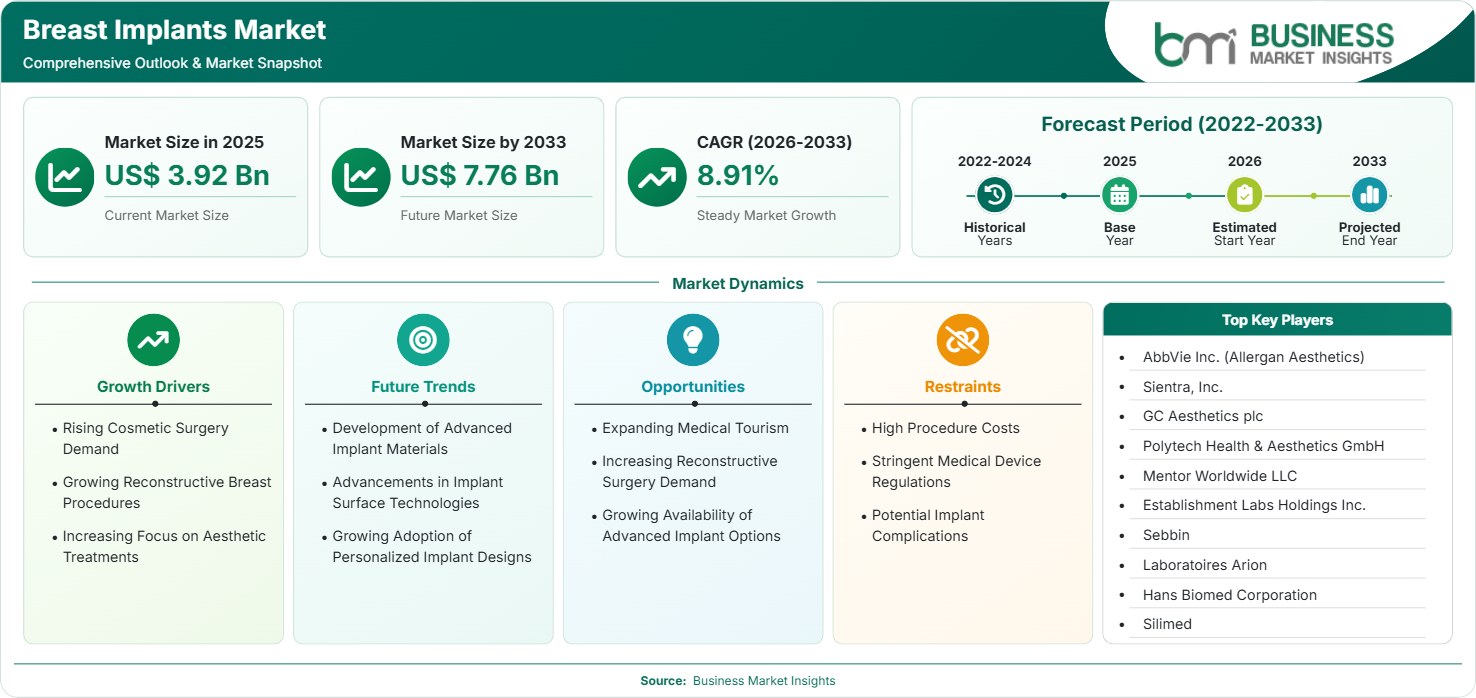
The Breast Implants Market size was valued at US$ 3.92 Billion in 2025 and is projected to reach US$ 7.76 Billion by 2033, growing at a CAGR of 8.91% during 2026–2033. Rising demand for aesthetic procedures, reconstructive surgery, implant innovation, personalized treatment options, and broader specialty-clinic access are shaping market expansion.

Report Coverage
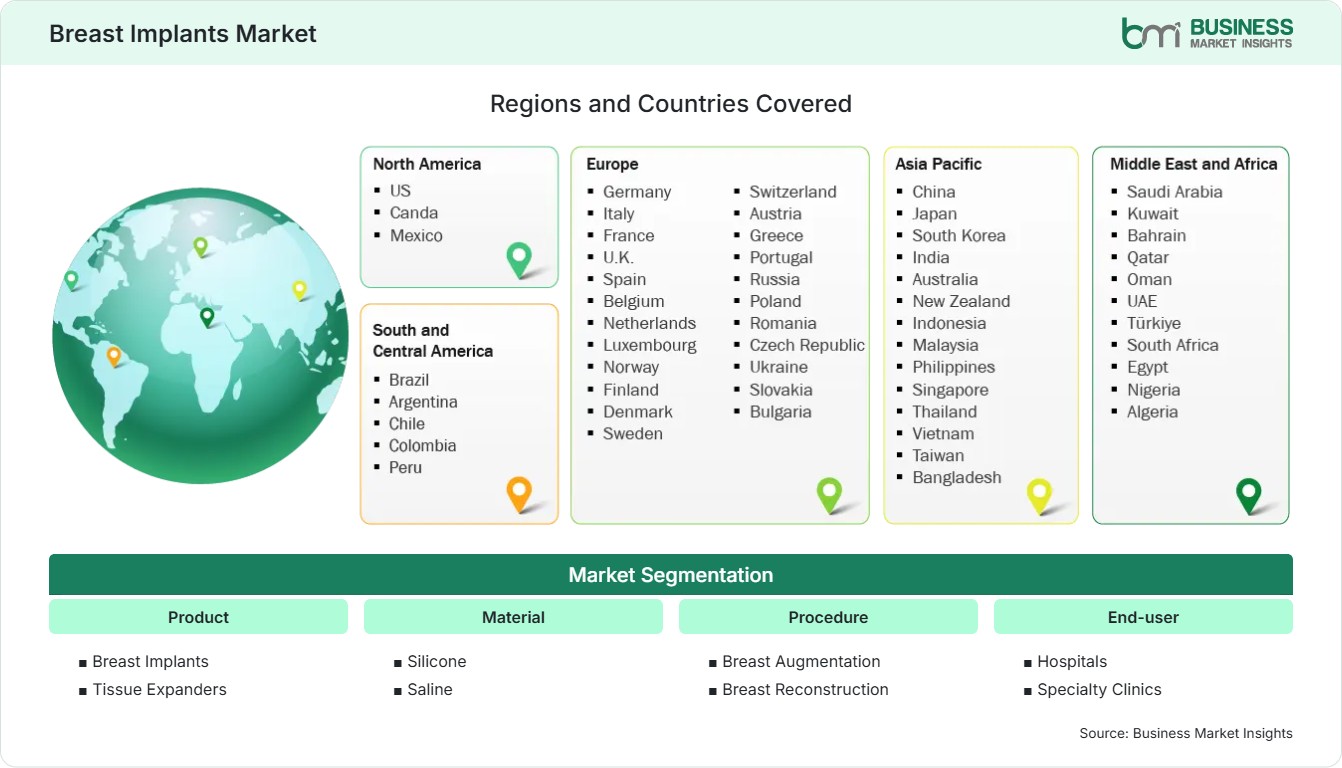
  • Product: Breast Implants, Tissue Expanders
  • Material: Silicone, Saline
  • Procedure: Breast Augmentation, Breast Reconstruction
  • End-user: Hospitals, Specialty Clinics
US$ 3.92 Bn Market size in 2025
US$ 7.76 Bn Market Size by 2033
8.91% CAGR, 2026 - 2033
2026-2033 Forecast Period

AI Overview

Breast Implants Market Summary

  • North America Region: North America holds 34%–37% share in 2025 and is projected to grow at a CAGR of 8.2%–8.8% during 2026–2033, supported by established aesthetic-care infrastructure, reconstructive procedures, specialist availability, product innovation, and patient preference for personalized outcomes. The US remains the regional leader, with a CAGR of 8.3%–8.9%, supported by established surgical networks and advanced implant choices.
  • Fastest Growing Region: Asia Pacific holds 22%–25% share in 2025 and is projected to register a CAGR of 9.7%–10.4% during 2026–2033, supported by expanding aesthetic-care access, increasing specialist capacity, improving healthcare infrastructure, growing consumer awareness, and wider availability of implant procedures.
  • Leading Segment: Breast Implants under the Product segment represents 68%–72% share in 2025 and is projected to expand at a CAGR of 8.6%–9.2%, supported by aesthetic augmentation demand, reconstructive applications, product personalization, surgeon familiarity, and continued development of implant designs.
  • High Growth Segment: Breast Reconstruction under the Procedure segment represents 28%–32% share in 2025 and is projected to grow at a CAGR of 9.4%–10.1%, supported by reconstructive treatment demand, improved surgical planning, specialist capabilities, and increasing emphasis on post-treatment quality of life.
  • Key Market Opportunity: Product personalization, specialized implant profiles, reconstructive applications, digitally supported surgical planning, and expanding access through specialty clinics create attractive opportunities for manufacturers and healthcare providers.
  • Major Market Players: AbbVie Inc. (Allergan Aesthetics), Sientra, Inc., GC Aesthetics plc, Polytech Health & Aesthetics GmbH, Mentor Worldwide LLC, Establishment Labs Holdings Inc., Sebbin, Laboratoires Arion, Hans Biomed Corporation, and Silimed.
Strategic Insights

Breast Implants Market: Strategic Insights

Breast Implants Market Strategic Framework
FREE PDF
Request your free sample
Request free sample
Stakeholder View

Key Takeaways

  • The value chain extends from medical-grade material suppliers and implant manufacturers to distributors, surgeons, hospitals, specialty clinics, and post-procedure care providers, making quality assurance and channel relationships strategically important.
  • Product customization represents a major growth opportunity as surgeons require broader implant profiles and tissue-expansion solutions suited to different anatomical requirements, procedure objectives, and reconstruction pathways.
  • Innovation is increasingly focused on implant design, material performance, procedural compatibility, and manufacturing consistency rather than simple portfolio expansion, encouraging manufacturers to differentiate through clinically relevant product attributes.
  • Asia Pacific offers a compelling expansion opportunity because improving specialist availability and private healthcare infrastructure can broaden access to elective and reconstructive procedures while supporting local distribution development.
  • Competition is increasingly influenced by portfolio breadth, surgeon relationships, regulatory capabilities, manufacturing quality, and the ability to support hospitals and specialty clinics throughout product selection and procedure planning.
  • Reconstructive applications provide manufacturers with an important diversification pathway because tissue expanders and implant solutions can address clinical requirements beyond elective aesthetic augmentation.
Geographic Outlook

Breast Implants Market Regional Highlights

North America Breast Implants Market

North America represents 34%–37% Breast Implants Market share in 2025 and is projected to grow at a CAGR of 8.2%–8.8% during 2026–2033. The region benefits from established specialist networks, developed private healthcare infrastructure, broad product availability, and strong surgeon familiarity with implant procedures. The United States remains the principal contributor, while Canada provides additional demand through established reconstructive and aesthetic treatment capabilities. Market development is supported by product choice, procedural specialization, and increasing emphasis on individualized treatment planning.

  • Established specialty clinics provide manufacturers with concentrated distribution opportunities and direct access to surgeons experienced in augmentation and reconstruction procedures.
  • Product differentiation remains important as clinicians evaluate implant characteristics according to patient anatomy, procedure objectives, surgical approach, and desired aesthetic outcomes.
  • Reconstructive procedures provide an important demand base, supporting tissue expander and implant portfolios alongside elective augmentation products.
  • Manufacturers can strengthen regional positions through surgeon education, reliable distribution, consistent product quality, and responsive clinical support.

US Breast Implants Market

The United States represents 84%–87% of North American demand and is projected to grow at a CAGR of 8.3%–8.9% during 2026–2033. Its established surgical infrastructure, extensive specialist base, broad implant availability, and developed private healthcare ecosystem support continued demand. Manufacturers compete through portfolio breadth, clinical positioning, product availability, and relationships with surgeons and healthcare providers serving both elective and reconstructive patient groups.

  • Specialty clinics remain important channels because they provide concentrated access to surgeons performing elective augmentation and related aesthetic procedures.
  • Hospitals support reconstruction demand and require implant and tissue-expansion portfolios aligned with varied surgical pathways.
  • Product selection increasingly emphasizes anatomical compatibility, implant profile, procedure objectives, and patient-specific considerations.
  • Manufacturers with dependable distribution and clinical support can strengthen relationships across established healthcare networks.

Europe Breast Implants Market

Europe accounts for 26%–29% Breast Implants Market share in 2025 and is projected to expand at a CAGR of 7.8%–8.5% during 2026–2033. Germany, France, and the United Kingdom represent leading demand centers, while Spain and Italy offer continued opportunities through established aesthetic and reconstructive services. Regional purchasing decisions emphasize product quality, clinical suitability, regulatory compliance, specialist expertise, and long-term provider relationships across hospitals and specialty clinics.

  • Germany provides a strong opportunity through established healthcare infrastructure, specialist surgical capacity, and demand for differentiated medical-device portfolios.
  • France combines aesthetic and reconstructive procedure demand, creating opportunities for manufacturers offering broad implant and tissue-expander selections.
  • The United Kingdom supports demand through specialist surgical networks and continued emphasis on reconstructive treatment pathways.
  • Spain and Italy provide attractive growth opportunities where private aesthetic-care services complement established clinical capabilities.

Asia Pacific Breast Implants Market

Asia Pacific holds 22%–25% Breast Implants Market share in 2025 and is projected to register the fastest 9.7%–10.4% CAGR during 2026–2033. Japan, China, South Korea, Australia, and India represent important demand centers, while developing healthcare markets provide additional expansion potential. Increasing specialist availability, improving private healthcare infrastructure, broader consumer awareness, and expanding access to aesthetic procedures support regional adoption and encourage manufacturers to strengthen local distribution capabilities.

  • China offers substantial portfolio-development potential as specialist services, private healthcare facilities, and awareness of aesthetic treatment options continue expanding.
  • South Korea provides a specialized aesthetic-care environment where product differentiation and surgeon familiarity can influence purchasing decisions.
  • India offers growth opportunities through expanding specialty clinics, improving healthcare access, and increasing availability of elective and reconstructive procedures.
  • Japan and Australia provide established healthcare environments where quality, clinical suitability, and provider confidence remain important purchasing considerations.

Rest of World Breast Implants Market

Rest of World represents 10%–13% Breast Implants Market share in 2025 and is projected to grow at a CAGR of 8.0%–8.7% during 2026–2033. South America, the Middle East, and selected African markets offer opportunities through developing private healthcare infrastructure, specialist clinic expansion, medical tourism, and increasing awareness of aesthetic and reconstructive procedures. Brazil, Mexico, the United Arab Emirates, and Saudi Arabia provide notable commercial opportunities within the broader regional landscape.

  • Brazil and Mexico provide attractive opportunities through established aesthetic-care services and broader access to specialized surgical providers.
  • Middle Eastern markets are developing premium healthcare capabilities that can support differentiated implant portfolios and specialist-focused distribution strategies.
  • The United Arab Emirates and Saudi Arabia provide opportunities for manufacturers targeting specialized private healthcare and elective procedure demand.
  • African markets remain selective, with growth concentrated where specialist capacity, private healthcare investment, and reliable distribution infrastructure are available.
Global Market Geography
FREE PDF
Request your free sample
Request free sample
Segment Analysis

Breast Implants Market Segmentation

Product

The Product segment remains central to purchasing decisions because implants and tissue expanders serve distinct aesthetic and reconstructive requirements. It represented 68%–72% share in 2025 and is projected to grow at a CAGR of 8.6%–9.2% during 2026–2033. The Breast Implants scope increasingly reflects product personalization, surgeon preference, procedure objectives, and expanding reconstruction applications across healthcare settings.

  • Breast Implants: Breast implants remain the core product category, supported by augmentation demand, reconstructive applications, diverse implant profiles, and continued manufacturer emphasis on product differentiation and clinical suitability.
  • Tissue Expanders: Tissue expanders support staged reconstruction by preparing tissue for subsequent implant placement, making them important within reconstructive pathways and hospital-based surgical care.

Material

The Material segment reflects the clinical and product-performance differences between silicone and saline solutions. It represented 72%–76% share in 2025 and is projected to expand at a CAGR of 8.4%–9.0% during 2026–2033. Material choice is influenced by surgeon preference, patient considerations, procedure objectives, product availability, and manufacturer portfolio strategy.

  • Silicone: Silicone products remain widely positioned for aesthetic and reconstructive applications because manufacturers offer varied profiles, shapes, and configurations suited to different procedure requirements.
  • Saline: Saline implants provide an alternative product pathway, with their adoption influenced by clinical preference, patient considerations, procedural planning, and available product configurations.

Procedure

The Procedure segment captures elective augmentation and reconstructive interventions with different clinical objectives. It represented 68%–72% share in 2025 and is projected to grow at a CAGR of 8.8%–9.4% during 2026–2033. The Breast Implants trends indicate increasing segmentation between aesthetic procedures and reconstruction-focused treatment pathways.

  • Breast Augmentation: Breast augmentation remains an important elective procedure, supported by aesthetic preferences, specialist availability, individualized implant selection, and broader access to cosmetic surgical services.
  • Breast Reconstruction: Breast reconstruction provides a clinically focused application supported by tissue expanders, implant solutions, specialist surgical expertise, and treatment pathways designed around individual patient requirements.

End-user

The End-user segment determines how implant products reach surgeons and patients across organized healthcare settings. It represented 74%–78% share in 2025 and is projected to grow at a CAGR of 8.5%–9.1% during 2026–2033. Hospitals and specialty clinics remain important procurement and procedure environments, with product selection influenced by clinical capabilities and provider preferences.

  • Hospitals: Hospitals support complex reconstructive procedures and require dependable implant portfolios, tissue expanders, specialist surgical teams, and structured procurement processes for clinical applications.
  • Specialty Clinics: Specialty clinics support elective procedures through focused surgical expertise, personalized consultations, dedicated infrastructure, and direct relationships between manufacturers, surgeons, and patients.
Market Forces

Breast Implants Market Dynamics

Key Market Drivers

Rising Cosmetic Surgery Demand

Rising interest in aesthetic procedures is strengthening demand for implant-based augmentation as consumers increasingly seek personalized appearance-related treatments. Development of specialized clinics and availability of more experienced surgeons will contribute to procedure availability in mature healthcare markets. This will be reflected by manufacturer strategies aimed at offering more diverse portfolio of implants based on anatomical needs, profiles and aesthetic goals. Breast Implants Market growth will remain dependent on providers, patient preferences and product differentiation. Increasing demand will also stimulate attention to consultation process, procedure planning and post-surgery assistance. All of this contributes to market trends of personalization, product selection and decision making of providers rather than treatment standards. Companies with diversified portfolio and strong relations with providers can cover different aesthetic needs and enhance their channel penetration.

Growing Reconstructive Breast Procedures

Reconstructive procedures provide an important clinical demand base because implant solutions and tissue expanders support staged treatment pathways following breast tissue loss or other reconstructive needs. The hospitals need consistent availability and specialist know-how in order to handle these treatments well. In this regard, the competing manufacturers rely on implant designs, tissue expansion products, product portfolio size, and provider support. The reconstruction category provides additional growth prospects to the companies to move into other areas from aesthetics by developing products that fit into the needs of the hospitals. More focus on treatment planning with patient-centric approach is driving the demand for the products which can cater to various needs.

Increasing Focus on Aesthetic Treatments

Greater emphasis on individualized aesthetic outcomes is influencing how patients and surgeons evaluate implant solutions. Instead of standardizing the product selection process, consultations are now focused on anatomical considerations, required shape, method of operation, and projected result. Customized consultations can help specialty clinics to plan procedures better and build confidence in their patients. The Breast Implants Market Trends take into account more customization, the experience of surgeons, and the product selection. Companies that assist clinicians through well-diversified portfolios and good product information can create competitive advantage. Such demand environment is favorable for firms that combine product differentiation, consistent manufacturing, dependable distribution, and strong healthcare specialist network.

Key Market Opportunities

Expanding Medical Tourism

Medical tourism can create opportunities for implant manufacturers where specialized healthcare facilities attract patients seeking elective or reconstructive procedures. International patients need reliable product availability, skilled surgical staff, efficient consultation process, and clinical support. For manufacturers, there is an opportunity to expand the network of distributors at healthcare destinations and help clinics that have wider range of implants. Opportunity creation will depend upon the local regulations, reputation of the providers, product availability, and expectations of patients. For companies that are adaptable in terms of channel strategy, there is a chance to offer differentiated products at the premium healthcare destination centers.

Increasing Reconstructive Surgery Demand

Reconstructive surgery creates an opportunity for manufacturers to deepen hospital relationships by supplying both tissue expanders and implant solutions across staged procedures. Hospitals prefer portfolios that can meet the diverse needs of surgery and anatomy. Companies can further cement their market positions by assisting surgeons in gaining knowledge about their products as well as providing reliable supplies to them. It is a unique opportunity that also inspires product development based on reconstruction needs rather than being limited to just elective augmentations. The Breast Implants Market Forecasts also facilitate a larger perspective of opportunity where reconstruction is a significant way of diversifying their portfolio.

Growing Availability of Advanced Implant Options

Broader availability of differentiated implant options can expand patient and surgeon choice while encouraging manufacturers to compete through product configuration and specialized applications. Advanced features will be able to accommodate different anatomical needs, procedure goals, and methods of reconstruction. In order for manufacturers to take advantage of this, they create a portfolio of products with different profiles, sizes, and materials without compromising on their manufacturing process. Digital consultations and surgical planning will help in achieving greater success by allowing providers to assess options even before the surgery. As a result, Breast Implants Market Forecasts reveal the potential future for manufacturers who provide both a wide portfolio and clinical support along with proper distribution.

Market Restraints and Challenges

High Procedure Costs

High procedure costs can limit access to implant-based treatments, particularly where procedures are predominantly paid for privately. Factor: Surgical fees, implant costs, facility charges, anesthesia, consultations, and follow-up requirements can create a substantial combined financial commitment. Impact: Increased procedure cost will delay the elective treatments, reduce the number of patients that can be addressed, and increase sensitivity to both product and provider prices. There could be some pressure on manufacturers to show the value of their products without compromising on quality and clinical positioning. Costs could also affect distribution policies, purchasing decisions, and movement of patients to other service providers.

Stringent Medical Device Regulations

Regulatory requirements can create barriers to product commercialization and portfolio expansion across different markets. Factor: Implant manufacturers must address product documentation, quality systems, safety requirements, manufacturing controls, and market-specific approval processes. Impact: Compliance issues can lead to higher time periods for development, increased administrative expenses, and commercialization complications for firms exploring novel geographic regions. Regulatory capability thus continues to be an essential competitive skill along with product development skills. The manufacturers need to document themselves well while at the same time adapting to varied requirements of the market. Small firms will be under more pressure than big, established manufacturers in this regard.

Company Analysis

Competitive Landscape

The competitive structure includes implant manufacturers, aesthetic-care specialists, medical-device companies, and organizations with established surgical product portfolios. Breast Implants analysis indicates that competition is shaped by product breadth, material options, surgeon relationships, manufacturing consistency, regulatory capabilities, and distribution reach.

Company Name

Overview

Products and Services relevant to this market

AbbVie Inc. (Allergan Aesthetics)

Medical aesthetics business with an established position in aesthetic treatment solutions and breast implant products.

Breast implant solutions, aesthetic procedure support, implant portfolio options, and related provider resources.

Sientra, Inc.

Specialist medical aesthetics company focused on breast implant and reconstruction-related solutions.

Silicone breast implants, tissue expanders, reconstructive products, and supporting clinical resources.

GC Aesthetics plc

Aesthetic medical-device company specializing in breast implant technologies and related products.

Breast implants, reconstruction-focused solutions, implant configurations, and surgical support resources.

Polytech Health & Aesthetics GmbH

Specialist manufacturer focused on breast implants and aesthetic medical-device applications.

Breast implants, customized implant configurations, and products serving aesthetic and reconstructive procedures.

Mentor Worldwide LLC

Medical aesthetics company providing implant solutions for augmentation and reconstruction procedures.

Breast implants, tissue expanders, implant configurations, and provider-focused product support.

Establishment Labs Holdings Inc.

Medical technology company specializing in breast health and implant-based aesthetic and reconstructive solutions.

Breast implants, breast health products, implant technologies, and supporting clinical solutions.

Sebbin

Specialist European manufacturer focused on implants for aesthetic and reconstructive surgery.

Breast implants, implant configurations, reconstruction products, and surgical application support.

Laboratoires Arion

Medical-device manufacturer serving aesthetic and reconstructive surgical applications through specialized implant products.

Breast implants, tissue-related solutions, product configurations, and specialist surgical applications.

Hans Biomed Corporation

Medical technology company serving aesthetic and reconstructive treatment applications through specialized medical products.

Breast implant solutions, aesthetic medical products, surgical products, and related clinical applications.

Silimed

Medical-device manufacturer focused on implant products for aesthetic and reconstructive surgical applications.

Breast implants, silicone-based implant solutions, reconstructive applications, and procedure-oriented product portfolios.

Trust & Transparency

Research Methodology

The market analysis combines proprietary research with secondary data from government agencies, company disclosures, regulatory filings, industry databases and expert interviews. Market estimates are validated through data triangulation, cross-market benchmarking and analyst review.

View Full Research Methodology

Questions Answered

Frequently Asked Questions

What does the Breast Implants Market Report examine?

The report examines product, material, procedure, and end-user segmentation, regional dynamics, market drivers, opportunities, restraints, competitive positioning, recent developments, and strategic factors influencing industry expansion.

What role does personalization play in product development?

Personalization encourages manufacturers to provide multiple implant profiles, sizes, shapes, and configurations so surgeons can select products according to anatomy, procedure objectives, and desired treatment outcomes.

How can manufacturers strengthen reconstruction opportunities?

Manufacturers can expand reconstruction opportunities through tissue expanders, implant portfolios, hospital relationships, surgeon education, dependable supply, and products designed around staged surgical pathways and varied patient requirements.

Why are specialty clinics important to manufacturers?

Specialty clinics provide focused access to surgeons and patients undergoing elective procedures. Their concentrated expertise makes them important channels for product education, consultation, procedure planning, and implant selection.

How does product selection influence breast implant procedures?

Product selection depends on patient anatomy, procedure objectives, surgeon preference, implant material, profile, and whether treatment is intended for augmentation or reconstruction.

Access the Full Breast Implants Market Report

Get segment-level forecasts, regional estimates, competitive benchmarking, company profiles and downloadable Excel datasets.

Access the full Breast Implants Market Report
350 pages PDF & Excel | 2026-08-19
Similar Research

Related Market Reports