
Breast Imaging Technologies Market Outlook: Size, Share, Trends, Growth Analysis, Competitive Landscape & Forecast, 2026-2033

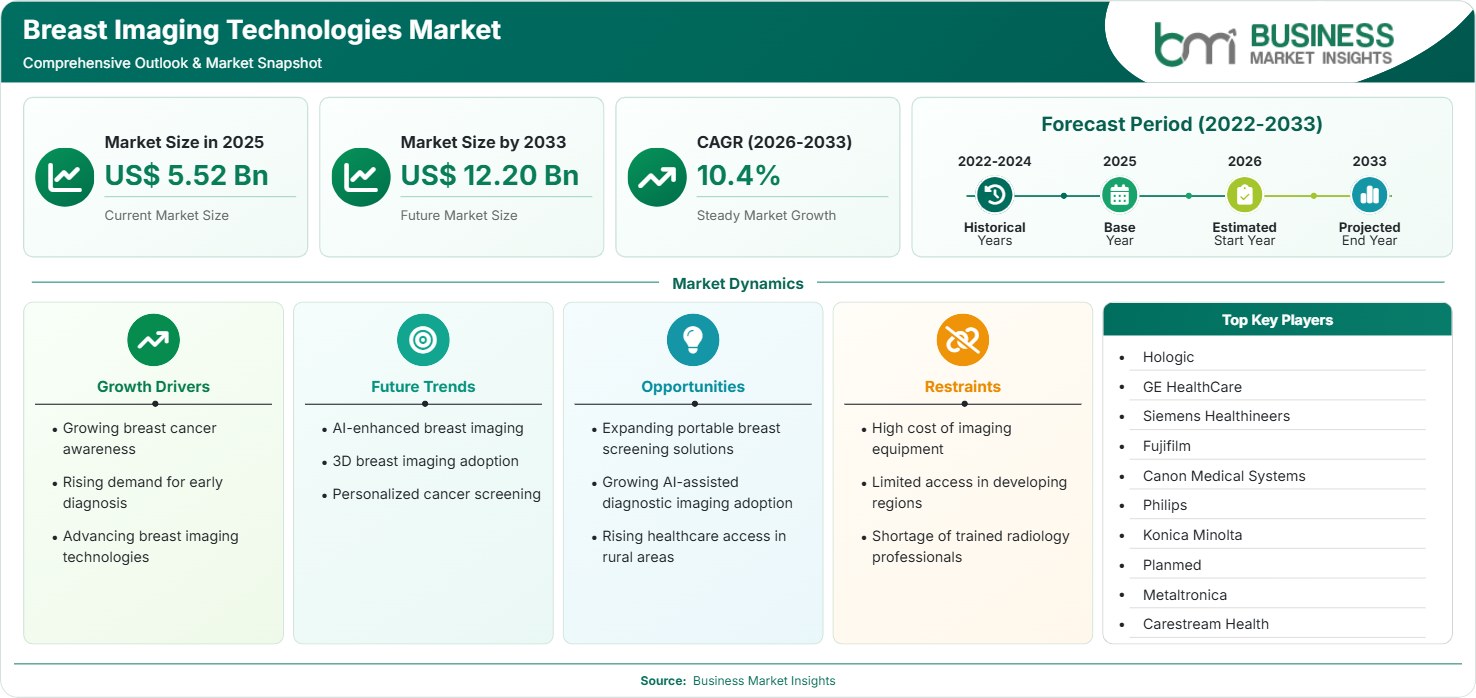
The Breast Imaging Technologies Market size was valued at US$ 5.52 Billion in 2025 and is projected to reach US$ 12.20 Billion by 2033, growing at a CAGR of 10.4% during 2026–2033. Market expansion is driven by increasing breast cancer awareness, rising demand for early diagnosis, technological advancements in breast imaging, expanding AI-assisted diagnostics, portable screening solutions, and improved healthcare accessibility.

Report Coverage
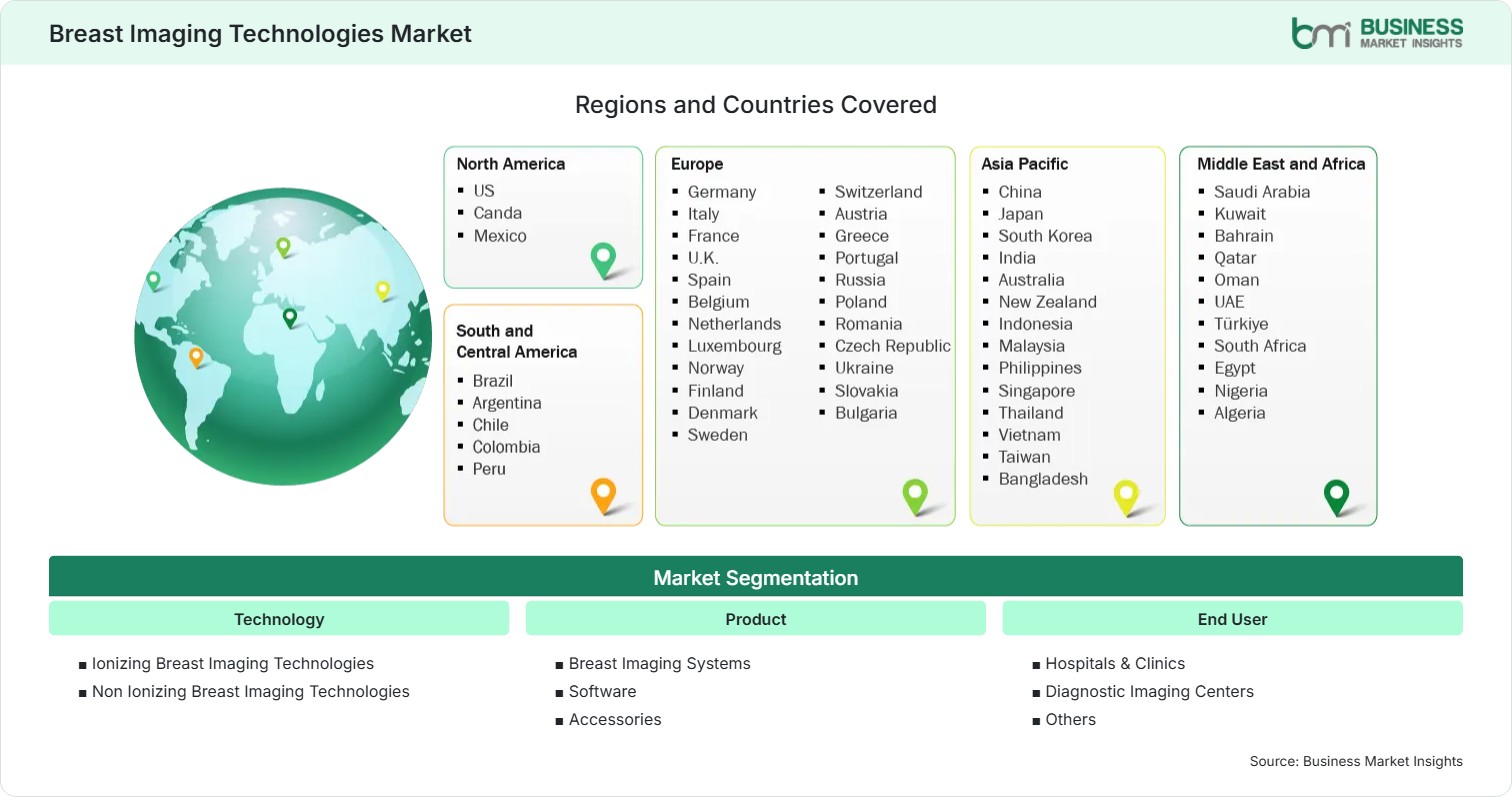
  • Technology: Ionizing Breast Imaging Technologies, Non Ionizing Breast Imaging Technologies
  • Product: Breast Imaging Systems, Software, Accessories
  • End User: Hospitals & Clinics, Diagnostic Imaging Centers, Others
US$ 5.52 Bn Market size in 2025
US$ 12.20 Bn Market Size by 2033
10.4% CAGR, 2026 - 2033
2026-2033 Forecast Period

AI Overview

Breast Imaging Technologies Market Summary

  • North America Region: North America accounts for 38%–41% market share in 2025 and is projected to expand at a CAGR of 9.8%–10.3% during 2026–2033, supported by organized screening programs, favorable reimbursement, AI adoption, and continuous technology upgrades. The United States market is expected to grow at a 9.9%–10.4% CAGR owing to widespread mammography screening, advanced healthcare infrastructure, and strong investment in diagnostic imaging.
  • Fastest Growing Region: Asia Pacific holds 24%–27% market share in 2025 while registering a CAGR of 11.8%–12.5%, driven by expanding healthcare infrastructure, increasing breast cancer screening initiatives, rising healthcare expenditure, and growing adoption of digital imaging technologies.
  • Leading Segment: Breast Imaging Systems account for 58%–61% market share in 2025 and are projected to grow at a CAGR of 10.7%–11.2%, supported by increasing replacement of analog systems with digital breast imaging technologies.
  • High Growth Segment: Non-ionizing breast imaging technologies represent 34%–37% market share in 2025 while expanding at a CAGR of 11.5%–12.1%, driven by demand for radiation-free imaging, improved patient safety, and technological innovation.
  • Key Market Opportunity: Expansion of portable breast screening devices, AI-enabled image interpretation, and improved diagnostic access across underserved populations continues creating long-term growth opportunities.
  • Major Market Players: Hologic, GE HealthCare, Siemens Healthineers, Fujifilm, Canon Medical Systems, Philips, Konica Minolta, Planmed, Metaltronica, Carestream Health.
Strategic Insights

Breast Imaging Technologies Market: Strategic Insights

Breast Imaging Technologies Market Strategic Framework
FREE PDF
Request your free sample
Request free sample
Stakeholder View

Key Takeaways

  • Digital transformation is reshaping breast imaging through artificial intelligence, automated workflow solutions, and cloud-enabled diagnostic platforms that improve productivity and diagnostic consistency.
  • Demand for advanced breast imaging systems continues increasing as healthcare providers prioritize early cancer detection and improved diagnostic confidence.
  • AI-assisted interpretation tools are becoming strategic investments for hospitals and diagnostic centers seeking faster reporting and improved clinical efficiency.
  • Asia Pacific presents the strongest long-term investment opportunity because of expanding screening infrastructure, increasing healthcare expenditure, and rising awareness programs.
  • Strategic collaborations between imaging manufacturers, software developers, and healthcare providers continue accelerating product innovation and clinical adoption.
  • Portable imaging technologies are improving diagnostic accessibility across rural and underserved healthcare facilities, creating new commercial opportunities.
Geographic Outlook

Breast Imaging Technologies Market Regional Highlights

North America Breast Imaging Technologies Market

North America accounted for 38%–41% of global revenue in 2025 and is projected to expand at a CAGR of 9.8%–10.3% through 2033. The Breast Imaging Technologies Market share is supported by established breast cancer screening programs, favorable reimbursement policies, high healthcare expenditure, and rapid adoption of advanced digital imaging systems. Continuous technological innovation and increasing deployment of AI-powered diagnostic solutions continue strengthening regional market leadership.

  • Comprehensive breast cancer screening initiatives continue supporting stable demand for advanced mammography and tomosynthesis systems.
  • Hospitals are replacing conventional analog equipment with digital breast imaging platforms offering improved image quality and workflow efficiency.
  • AI-assisted image interpretation is reducing reading time while improving diagnostic confidence among radiologists.
  • Continuous investments in breast imaging research encourage commercialization of innovative diagnostic technologies.
  • Growing awareness regarding preventive healthcare continues increasing participation in routine breast screening programs.

US Breast Imaging Technologies Market

The United States represented 33%–36% of global revenue during 2025 and is expected to register a CAGR of 9.9%–10.4% through 2033. Strong healthcare infrastructure, widespread insurance coverage for screening, advanced imaging facilities, and continuous investment in oncology diagnostics continue supporting Breast Imaging Technologies market expansion. Healthcare providers are increasingly adopting AI-integrated imaging platforms to improve clinical productivity and diagnostic precision.

  • Large hospital networks continue investing in digital breast tomosynthesis and advanced imaging software.
  • Growing emphasis on personalized breast cancer screening supports demand for high-performance imaging technologies.
  • Research institutions remain active in evaluating AI-assisted breast imaging applications for improved clinical outcomes.
  • Mobile screening programs continue improving diagnostic access across remote and underserved communities.

Europe Breast Imaging Technologies Market

Europe accounted for 27%–30% market share during 2025 and is forecast to grow at a CAGR of 10.0%–10.5% through 2033. National breast screening initiatives, favorable public healthcare systems, and continuous technology modernization support regional expansion. Germany remains the largest regional market, while the United Kingdom and France continue increasing investments in digital mammography and breast cancer diagnostic infrastructure.

  • Germany leads regional adoption through advanced diagnostic imaging infrastructure and strong healthcare expenditure.
  • The United Kingdom continues expanding population-based breast cancer screening programs supported by public healthcare investments.
  • France is increasing digital imaging adoption through modernization of hospital radiology departments.
  • European healthcare providers increasingly adopt AI-powered diagnostic software to improve clinical workflow efficiency.

Asia Pacific Breast Imaging Technologies Market

Asia Pacific represented 24%–27% of global revenue in 2025 and is projected to register the fastest expansion at a CAGR of 11.8%–12.5% during 2026–2033. The Breast Imaging Technologies Market growth across the region is supported by expanding healthcare infrastructure, increasing breast cancer awareness campaigns, government-sponsored screening initiatives, rising healthcare expenditure, and growing installation of digital diagnostic imaging systems. China remains the largest regional market, while India demonstrates the highest growth potential owing to improving diagnostic accessibility and expanding public health investments.

  • China continues expanding hospital imaging capacity through large-scale investments in digital mammography and oncology diagnostic services.
  • India is strengthening breast cancer awareness programs while increasing installation of digital breast imaging systems across public and private healthcare facilities.
  • Japan maintains strong adoption of advanced breast tomosynthesis, ultrasound, and AI-enabled diagnostic platforms supported by technologically advanced healthcare institutions.
  • South Korea continues investing in precision diagnostic imaging technologies while promoting nationwide preventive healthcare initiatives.
  • Regional manufacturers are strengthening partnerships with healthcare providers to improve affordability and accessibility of breast imaging equipment.

Rest of World Breast Imaging Technologies Market

The Rest of World region accounted for 7%–9% market share during 2025 and is expected to expand at a CAGR of 10.3%–10.8% through 2033. Latin America is witnessing increasing investments in diagnostic imaging infrastructure, while the Middle East and Africa continue expanding oncology services through government healthcare modernization initiatives. Growing awareness regarding early breast cancer diagnosis and international healthcare collaborations continue supporting market development.

  • Brazil leads regional adoption through expanding diagnostic imaging centers and increasing public healthcare investments.
  • Mexico continues strengthening breast cancer screening initiatives while improving access to advanced diagnostic imaging technologies.
  • Gulf countries are investing significantly in oncology hospitals equipped with advanced breast imaging systems.
  • South Africa is expanding diagnostic services through public-private healthcare partnerships and cancer awareness programs.
  • International imaging manufacturers continue strengthening regional distribution networks and service capabilities.
Global Market Geography
FREE PDF
Request your free sample
Request free sample
Segment Analysis

Breast Imaging Technologies Market Segmentation

Technology

The technology segment represents the core of diagnostic innovation, balancing clinical accuracy, patient safety, workflow efficiency, and imaging performance. Ionizing Breast Imaging Technologies accounted for 63%–66% market share in 2025 and are projected to grow at a CAGR of 10.1%–10.6% through 2033. The Breast Imaging Technologies Market scope continues expanding as healthcare providers increasingly adopt advanced digital mammography, tomosynthesis, and complementary non-ionizing imaging modalities for comprehensive breast cancer diagnosis.

  • Ionizing Breast Imaging Technologies: Continue dominating clinical practice through widespread adoption of digital mammography, breast tomosynthesis, and contrast-enhanced mammography for early breast cancer detection and routine screening.
  • Non-Ionizing Breast Imaging Technologies: Experience strong growth owing to increasing use of breast ultrasound and magnetic resonance imaging for dense breast evaluation, supplemental screening, and radiation-free diagnostic assessments.

Product

Product innovation remains focused on improving image quality, diagnostic confidence, workflow integration, and clinical productivity. Breast Imaging Systems maintain the largest revenue contribution as healthcare providers continue replacing aging imaging infrastructure with advanced digital platforms incorporating artificial intelligence and cloud connectivity.

  • Breast Imaging Systems: Represent the largest product category owing to continuous demand for digital mammography units, tomosynthesis systems, and integrated breast imaging platforms.
  • Software: Supports image acquisition, AI-assisted diagnosis, workflow automation, cloud storage, reporting, and advanced image analysis for improved clinical efficiency.
  • Accessories: Include positioning devices, compression paddles, biopsy guidance components, quality assurance tools, and imaging consumables essential for routine diagnostic procedures.

End User

Hospitals and specialized diagnostic facilities continue driving demand for advanced breast imaging technologies due to increasing patient volumes, expanding cancer screening programs, and investments in precision diagnostics. Healthcare providers are prioritizing workflow optimization while improving patient comfort and diagnostic accuracy through next-generation imaging systems.

  • Hospitals & Clinics: Lead adoption owing to comprehensive oncology services, organized breast screening programs, and availability of multidisciplinary diagnostic expertise.
  • Diagnostic Imaging Centers: Continue expanding because of increasing outpatient imaging demand, faster diagnostic turnaround, and growing referrals from primary healthcare providers.
Market Forces

Breast Imaging Technologies Market Dynamics

Key Market Drivers

Growing Breast Cancer Awareness

The increased understanding of breast cancer prevention and the importance of early detection keeps fueling the need for high-quality breast imaging equipment in all parts of the world. Programs conducted at the national level for screening, education from healthcare facilities, and other awareness programs are helping women get regular mammograms. The healthcare organizations have continued to emphasize the need for screening among the high-risk groups as a means of enhancing survival through early diagnosis. Increased awareness has also led to an acceptance of the use of newer imaging techniques such as digital breast tomosynthesis and automated breast ultrasound.

Rising Demand for Early Diagnosis

In recent years, early detection of breast cancer has been recognized as one of the most effective methods that can help to minimize healthcare expenses and improve the chances of patients' survival. New breast imaging modalities offer the opportunity to identify small lesions more confidently, enabling timely, appropriate treatment. Advances in detector sensitivity, image processing algorithms, and multimodality imaging contribute to further improvements in diagnostic capabilities. Along with the development of national screening programs and preventive medicine approaches, the use of breast imaging devices is becoming more widespread.

Advancing Breast Imaging Technologies

Continuous innovation in imaging hardware and software is significantly improving diagnostic precision and operational efficiency. AI systems, digital breast tomosynthesis, contrast-enhanced mammography, automated ultrasounds, and image management through cloud computing technologies are increasing efficiency and minimizing differences in interpretations. Manufacturers are still making efforts to improve ergonomic designs, reduce radiation, quick imaging, and software that could support individualized screening approaches. These technological advancements continue strengthening clinical confidence and supporting broader adoption across both established and emerging healthcare breast imaging technologies market forecasts.

Key Market Opportunities

Expanding Portable Breast Screening Solutions

The introduction of portable imaging systems for breast cancer diagnosis is generating new opportunities through increased access to screening facilities in underserved areas. The healthcare industry and government are currently looking at possibilities of using mobile diagnostic facilities and portable imaging systems to enhance the rate of early detection of breast cancer. Portable ultrasound systems, portable mammograms, and imaging systems with remote interpretation capabilities are being developed. These innovations would aid the development of decentralized healthcare delivery systems while increasing the rate of cancer screening beyond large urban hospitals. The rising focus on preventive healthcare and equal access to cancer diagnosis should lead to more investment in mobile breast imaging technology.

Growing AI-Assisted Diagnostic Imaging Adoption

The use of artificial intelligence is a significant opportunity to enhance the quality and effectiveness of breast imaging. Many AI algorithms are being created to help radiologists detect suspicious lesions, prioritize screenings, optimize workflow, and minimize inter-reader variability. Healthcare organizations are implementing AI systems to cope with growing amounts of images and a shortage of radiologists. Combining machine learning with digital mammography, breast tomosynthesis, and ultrasounds is creating more personalized screening procedures. Collaboration between imaging equipment manufacturers and tech companies is speeding up the production of innovative diagnostic software. With more regulatory clearance and increasing confidence in AI-aided breast imaging, we can expect greater use of these techniques at hospitals, imaging centers, and oncology centers.

Rising Healthcare Access in Rural Areas

Expansion of healthcare infrastructure in rural and semi-urban regions presents significant growth opportunities for breast imaging technology providers. There is investment in the development of screening programs, mobile healthcare facilities, and diagnostic centers in various regions to facilitate early diagnosis of cancer. Countries that are growing economically have started paying more attention to the development of cancer care infrastructure due to the increase in cases of breast cancer. Affordable imaging solutions and tele-radiology tools are facilitating specialized medical services outside urban areas. Companies that have scalable, maintainable imaging technology solutions stand to gain from the rising demand for decentralized health care delivery systems. This trend is anticipated to enhance coverage levels while opening up new markets in developing countries.

Market Restraints and Challenges

High Cost of Imaging Equipment

Factor: Advanced breast imaging systems require substantial capital investment due to sophisticated hardware, software integration, maintenance requirements, and specialized installation procedures. Impact: Increased acquisition costs may reduce demand for such medical devices in economically sensitive areas in smaller hospitals, clinics, and diagnostic centers. Devices used for digital mammography, tomosynthesis, and other imaging products that use artificial intelligence require extra costs for installation, maintenance, and support. Affordability issues do not allow for replacing old imaging devices with new, advanced ones and acquiring new diagnostic technologies in developing countries. To overcome this issue, companies are introducing various financing options and affordable imaging technologies. Nevertheless, affordability remains an important barrier.

Limited Access in Developing Regions

Factor: Inadequate healthcare infrastructure, a shortage of trained radiologists, and limited diagnostic facilities restrict access to advanced breast imaging services in developing regions. Impact: Disparities in access hinder screening rates and the process of diagnosing breast cancer. Emerging markets still struggle due to the limited availability of equipment, maintenance, and healthcare professionals. Even though there is an effort from governments and international institutions to introduce more screening programs, the lack of proper infrastructure still hampers adoption rates. More funding for mobile screening, tele-radiology systems, training courses, and cost-effective imaging technologies will be crucial to improving access and supporting breast imaging technologies market trends in these regions.

Company Analysis

Competitive Landscape

The Breast Imaging Technologies Market analysis indicates a competitive environment shaped by technological innovation, AI integration, product portfolio expansion, and strategic partnerships. Leading manufacturers are focusing on advanced imaging platforms, software-driven diagnostics, improved workflow solutions, and cost-efficient systems to strengthen their presence across hospitals, diagnostic centers, and emerging healthcare markets.

Company Name

Overview

Products and Services relevant to this market

Hologic

Global healthcare technology company specializing in women’s health and diagnostic solutions.

Digital mammography systems, breast tomosynthesis, biopsy systems, breast imaging software solutions.

GE HealthCare

Medical technology leader providing advanced diagnostic imaging and healthcare solutions globally.

Mammography systems, breast tomosynthesis, AI imaging software, diagnostic imaging platforms.

Siemens Healthineers

Global healthcare technology company focused on precision diagnostics and imaging innovation.

Mammography systems, digital breast imaging, AI-enabled imaging workflow solutions.

Fujifilm

Healthcare technology provider offering diagnostic imaging and medical information systems.

Mammography systems, breast ultrasound solutions, imaging software, diagnostic technologies.

Canon Medical Systems

Medical imaging company delivering advanced diagnostic equipment and healthcare solutions.

Digital mammography, ultrasound systems, imaging technologies, clinical workflow solutions.

Philips

Global healthcare technology company focused on diagnostic imaging and patient care solutions.

Breast imaging systems, ultrasound technologies, imaging informatics, AI-supported diagnostics.

Konica Minolta

Imaging technology company providing healthcare diagnostic and digital solutions.

Digital radiography systems, mammography technologies, imaging software platforms.

Planmed

Finnish medical technology company specializing in breast imaging equipment.

Mammography systems, tomosynthesis solutions, breast imaging accessories.

Metaltronica

Medical imaging manufacturer focused on diagnostic radiology equipment.

Digital mammography systems, breast screening technologies, imaging accessories.

Carestream Health

Healthcare imaging company providing diagnostic imaging and workflow technologies.

Digital imaging systems, healthcare software, radiology workflow solutions.

Industry Activity

Recent Developments

June 2026

Hologic announced that the Unified Patent Court ruled in its favor in a patent infringement case against Siemens Healthineers involving mammography technology. The ruling included an injunction and product recall in Germany, France, and the Netherlands, strengthening Hologic’s breast imaging technology portfolio.

June 2026

Fujifilm India announced the first installation of its AI-powered digital mammography system, AMULET SOPHINITY, at NM Medical in Mumbai, India. The system combines AI-assisted image analysis, low-dose imaging, and enhanced visualization features to support breast cancer screening and diagnostic workflows.

November 2025

Hologic announced new clinical evidence for its AI-powered mammography solutions, including studies evaluating the role of artificial intelligence in improving breast cancer detection and supporting radiologist workflow efficiency. The developments strengthened Hologic’s AI-enabled breast imaging technology portfolio.

April 2025

GE HealthCare showcased its latest breast imaging innovations at the Society of Breast Imaging (SBI) 2025 Symposium, including advancements designed to improve diagnostic accuracy, streamline clinical workflows, and enhance patient-centered breast care.

Trust & Transparency

Research Methodology

The market analysis combines proprietary research with secondary data from government agencies, company disclosures, regulatory filings, industry databases and expert interviews. Market estimates are validated through data triangulation, cross-market benchmarking and analyst review.

View Full Research Methodology

Questions Answered

Frequently Asked Questions

What challenges affect adoption of advanced breast imaging systems?

High equipment costs, limited healthcare infrastructure, shortage of trained specialists, and restricted access to advanced diagnostic services remain major barriers in several developing regions.

Why is Asia Pacific considered a high-growth region?

Asia Pacific benefits from expanding healthcare infrastructure, rising breast cancer awareness, government screening initiatives, increasing healthcare expenditure, and growing adoption of digital diagnostic technologies.

How is artificial intelligence influencing breast imaging?

AI improves diagnostic efficiency by assisting radiologists with image analysis, lesion detection, workflow prioritization, and decision support while helping manage increasing imaging volumes.

Which technology segment is expected to maintain breast imaging technologies market leadership?

Ionizing breast imaging technologies continue leading due to widespread use of digital mammography and breast tomosynthesis systems in routine screening and diagnostic procedures.

What factors are driving growth in the breast imaging technologies market report?

Growth is primarily supported by increasing breast cancer awareness, rising demand for early diagnosis, expansion of screening programs, technological advancements, AI adoption, and improving healthcare infrastructure worldwide.

Access the Full Breast Imaging Technologies Market Report

Get segment-level forecasts, regional estimates, competitive benchmarking, company profiles and downloadable Excel datasets.

Access the full Breast Imaging Technologies Market Report
350 pages PDF & Excel | 2026-07-31
Similar Research

Related Market Reports