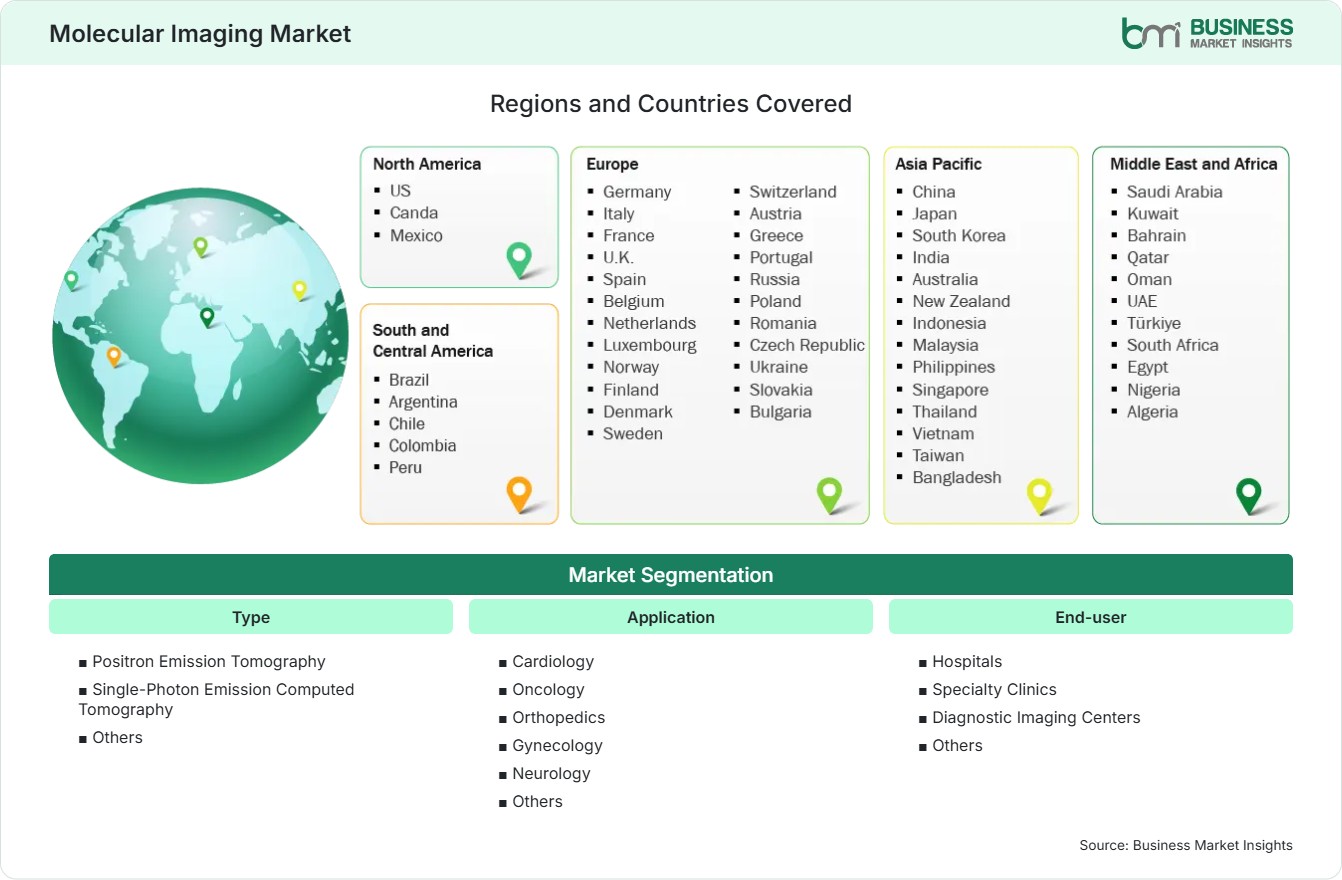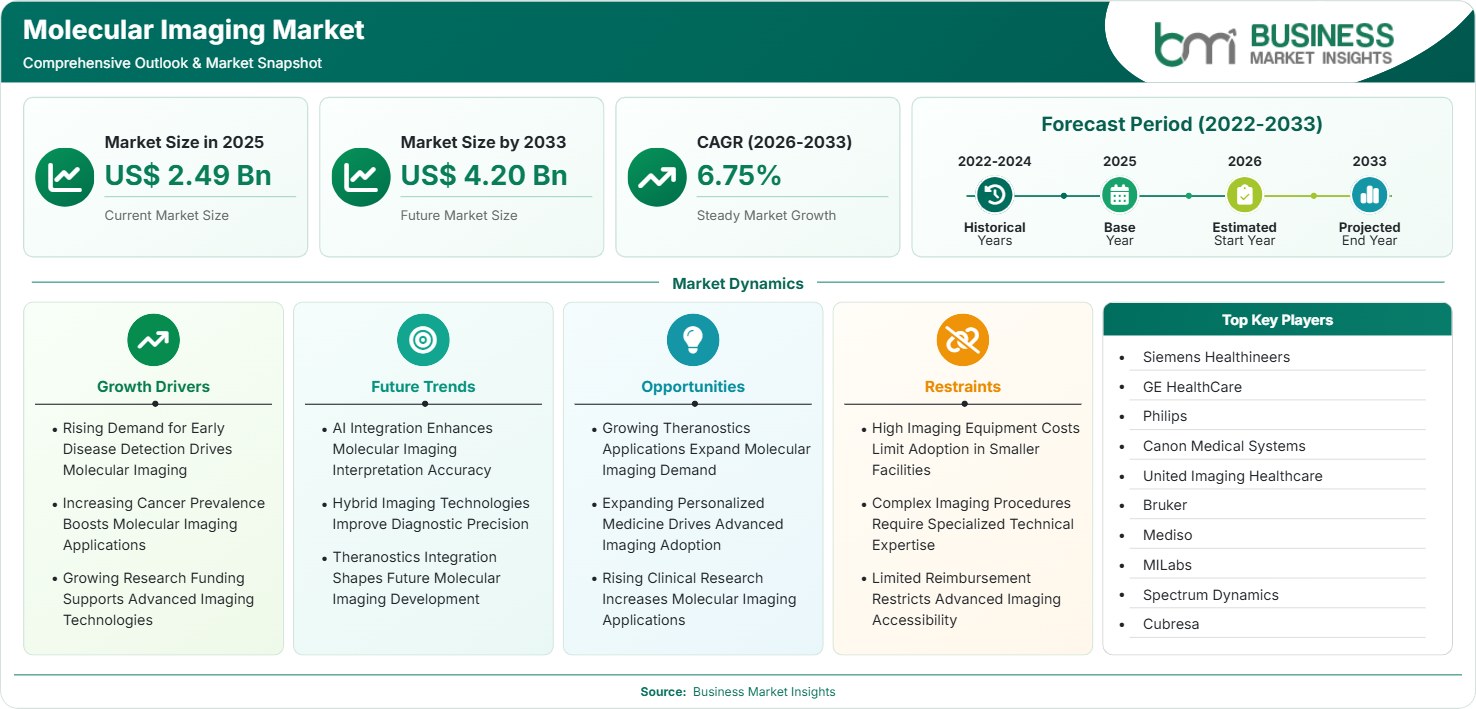
Molecular Imaging Market Regional Highlights
North America Molecular Imaging Market
North America holds a 34%–39% share in 2025 and is projected to expand at a 5.8%–6.8% CAGR during 2026–2033. The region benefits from established hospitals, advanced diagnostic infrastructure, clinical research capabilities, and access to PET and SPECT technologies. The United States represents the dominant regional market, supported by oncology demand and precision medicine investment. Molecular Imaging Market share is strengthened by reimbursement capabilities and technology adoption.
- The US remains the principal regional market because large healthcare systems operate advanced imaging networks and support high-volume oncology, cardiology, and neurology imaging programs.
- Canada offers opportunities through academic medical centers and specialized hospitals investing in advanced diagnostic imaging, clinical research, and precision medicine applications.
- Oncology represents a major regional demand driver as providers increasingly use PET imaging for staging, recurrence assessment, treatment planning, and monitoring therapeutic response.
- Research institutions continue to support molecular imaging innovation through radiotracer development, biomarker research, and clinical trials evaluating new diagnostic and therapeutic approaches.
US Molecular Imaging Market
The US represents a 29%–34% share of North America's 2025 market and is projected to grow at a 5.9%–6.9% CAGR through 2033. Its position reflects extensive hospital infrastructure, established PET and SPECT utilization, oncology demand, and strong biomedical research. Molecular Imaging Market opportunities are expanding as healthcare providers adopt quantitative imaging, artificial intelligence, and targeted radiopharmaceutical approaches. Academic centers and pharmaceutical companies are also increasing demand for molecular imaging in clinical research and drug development.
- Cancer diagnosis and treatment monitoring remain major applications, with PET-based imaging supporting disease characterization, staging, and evaluation of treatment effectiveness across multiple cancer types.
- Neurology research is expanding as imaging biomarkers are investigated for neurodegenerative diseases, supporting demand for advanced scanners, specialized radiotracers, and quantitative analysis software.
- Pharmaceutical companies increasingly use molecular imaging in clinical development to assess target engagement, biological response, and disease progression, creating opportunities beyond conventional hospital diagnostics.
Europe Molecular Imaging Market
Europe accounts for a 25%–30% share in 2025 and is forecast to expand at a 5.7%–6.7% CAGR during 2026–2033. Germany, the United Kingdom, and France represent leading markets, while Italy, Spain, and the Netherlands provide additional growth opportunities. Germany is projected to grow at 5.8%–6.8%, while the Netherlands could reach 6.8%–7.8% CAGR as advanced imaging research and precision medicine adoption expand. Molecular Imaging Market development benefits from academic research networks and specialized clinical centers.
- Germany has strong potential due to established healthcare infrastructure, university hospitals, oncology services, and research capabilities supporting PET, SPECT, and hybrid imaging.
- The UK benefits from a strong academic research ecosystem, with molecular imaging contributing to oncology, neuroscience, radiopharmaceutical development, and clinical research programs.
- France offers opportunities through advanced hospital networks and research institutions focused on nuclear medicine, oncology, cardiovascular disease, and neurological applications.
- The Netherlands represents a high-growth market because of its strong medical research ecosystem and increasing focus on precision medicine, imaging biomarkers, and translational research.
Asia Pacific Molecular Imaging Market
Asia Pacific represents a 24%–29% share in 2025 and is projected to register a 7.8%–8.8% CAGR during 2026–2033, making it the fastest-growing region. China leads regional expansion potential, while Japan and South Korea offer established healthcare systems and advanced imaging capabilities. India provides significant long-term opportunity as diagnostic infrastructure expands. China is estimated to grow at 8.2%–9.2%, while India could reach 8.5%–9.5% CAGR as healthcare investment and oncology demand increase.
- China combines a large patient population, expanding hospital infrastructure, domestic imaging manufacturing, and increasing demand for oncology and advanced diagnostic technologies.
- Japan has a mature healthcare system and strong research capabilities supporting molecular imaging applications in oncology, cardiology, neurology, and pharmaceutical development.
- South Korea benefits from advanced hospitals, technology-focused healthcare investment, and increasing interest in precision medicine and advanced diagnostic imaging.
- India offers substantial long-term potential as cancer incidence rises, healthcare infrastructure expands, and more hospitals invest in PET, SPECT, and hybrid imaging capabilities.
Rest of World Molecular Imaging Market
South and Central America account for a 7%–11% share in 2025 and are projected to grow at a 6.5%–7.5% CAGR, supported by expanding private healthcare and diagnostic infrastructure. Brazil leads regional opportunities. The Middle East and Africa represent a 5%–9% share and are expected to expand at a 6.0%–7.0% CAGR, supported by healthcare modernization, specialized hospitals, and increasing oncology demand.
- Brazil offers the largest opportunity in South America because of its population size, private healthcare infrastructure, and increasing demand for advanced oncology and diagnostic imaging services.
- Mexico provides growth potential as private hospitals and diagnostic networks expand access to advanced imaging equipment and specialized clinical services.
- Saudi Arabia and the UAE are investing in advanced healthcare infrastructure, creating opportunities for high-end molecular imaging systems within specialized hospitals and medical cities.
- Other Middle Eastern markets can benefit from centralized healthcare investment, although equipment costs, radiotracer logistics, and specialist availability may influence adoption rates.