
Mobile Imaging Services Market Outlook: Size, Share, Trends, Growth Analysis, Competitive Landscape & Forecast, 2026–2033

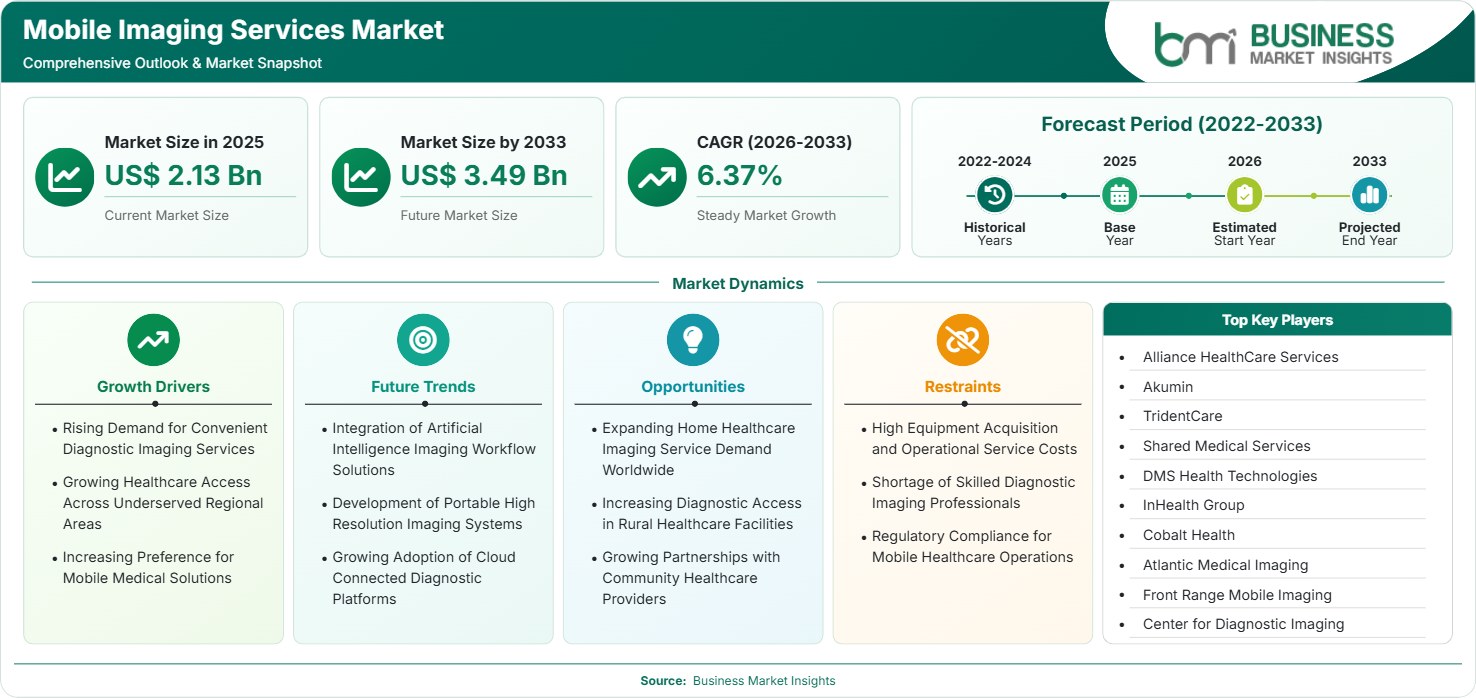
The Mobile Imaging Services Market size was valued at US$ 2.13 billion in 2025 and is projected to reach US$ 3.49 billion by 2033, growing at a CAGR of 6.37% during 2026–2033. Increasing demand for accessible diagnostic solutions, expanding healthcare coverage, rising preference for decentralized medical services, and growing adoption of portable imaging technologies are supporting market opportunities.

Report Coverage
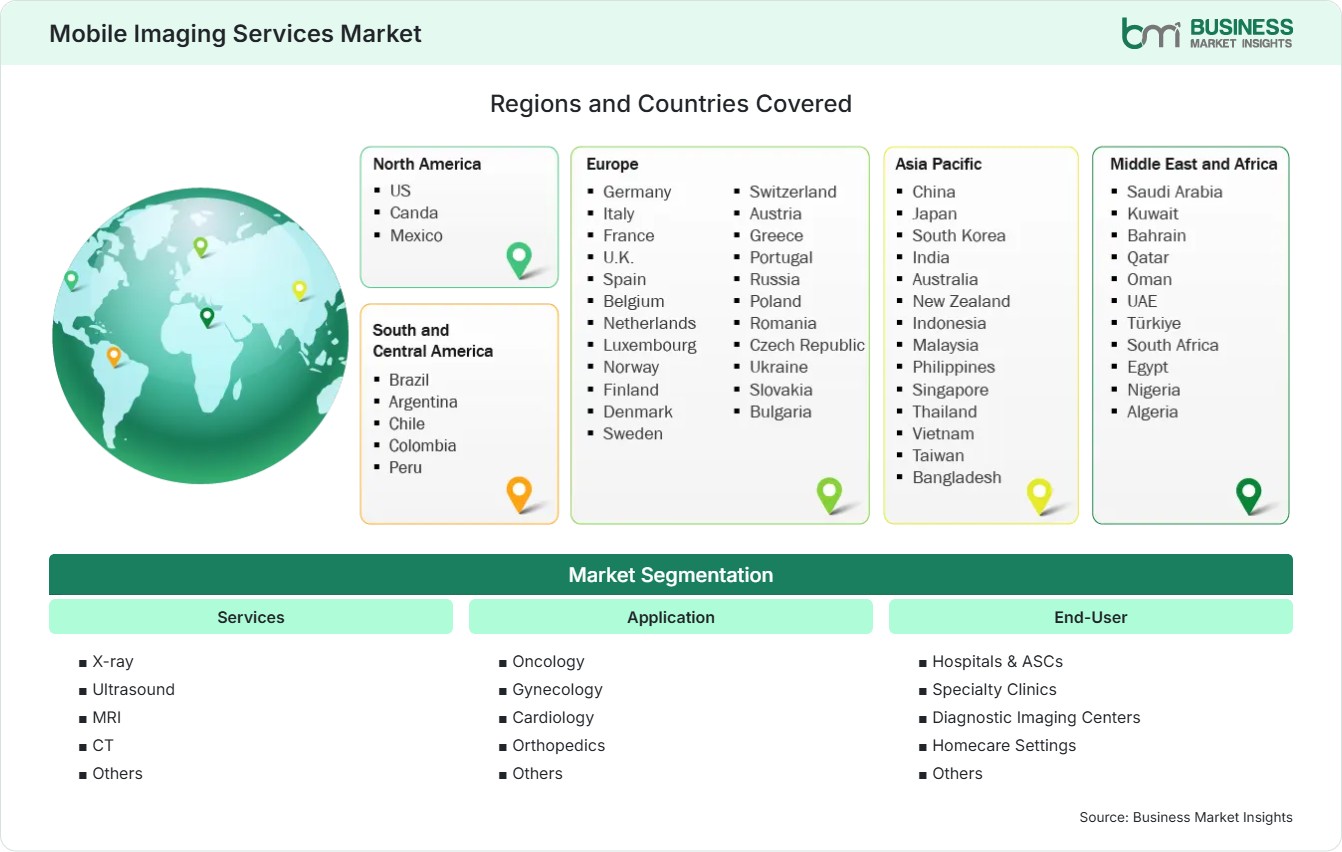
  • Services: X-ray, Ultrasound, MRI, CT, Others
  • Application: Oncology, Gynecology, Cardiology, Orthopedics, Others
  • End-User: Hospitals & ASCs, Specialty Clinics, Diagnostic Imaging Centers, Homecare Settings, Others
US$ 2.13 Bn Market size in 2025
US$ 3.49 Bn Market Size by 2033
6.37% CAGR, 2026 - 2033
2026-2033 Forecast Period

01 AI Overview

Mobile Imaging Services Market Summary

  • North America Region: North America holds a market share of 38%–41% in 2025 and is expected to grow at a CAGR of 6.0%–6.5% during 2026–2033. Growth is supported by advanced healthcare infrastructure, increasing diagnostic demand, hospital outsourcing models, and expanding mobile healthcare networks. The United States represents a major contributor due to rising demand for convenient imaging access and healthcare service flexibility, growing at a CAGR of 6.1%–6.6%.
  • Fastest Growing Region: Asia Pacific accounts for 24%–27% market share in 2025 and is projected to expand at a CAGR of 7.0%–7.5% through 2033. Increasing healthcare investments, rural diagnostic access programs, expanding medical infrastructure, and growing adoption of mobile healthcare solutions are driving regional growth.
  • Leading Segment: X-ray services represent 35%–39% market share in 2025 and are expected to grow at a CAGR of 6.2%–6.7% during 2026–2033. Their portability, cost efficiency, and broad clinical applications support adoption across hospitals, clinics, and underserved healthcare locations.
  • High Growth Segment: MRI services are projected to grow at a CAGR of 7.1%–7.6% during 2026–2033, driven by increasing demand for advanced diagnostic capabilities, reduced patient travel requirements, and expanding specialty healthcare applications.
  • Key Market Opportunity: Expansion of home healthcare imaging, rural diagnostic programs, community healthcare partnerships, and decentralized medical services is creating opportunities for mobile imaging providers.
  • Major Market Players: Alliance HealthCare Services, Akumin, TridentCare, Shared Medical Services, DMS Health Technologies, InHealth Group, Cobalt Health, Atlantic Medical Imaging, Front Range Mobile Imaging, Center for Diagnostic Imaging.
02 Strategic Insights

Mobile Imaging Services Market: Strategic Insights

Mobile Imaging Services Market Strategic Framework
FREE PDF
Request your free sample
Request free sample
03 Stakeholder View

Key Takeaways

  • The ecosystem includes mobile imaging operators, equipment manufacturers, healthcare providers, diagnostic specialists, technology platforms, and service partners supporting decentralized diagnostic delivery.
  • Oncology, cardiology, orthopedics, and preventive diagnostics represent attractive application areas as healthcare systems increasingly require faster and more accessible imaging solutions.
  • Innovation is shifting toward compact imaging equipment, cloud-based image management, remote interpretation capabilities, and improved connectivity between mobile units and healthcare networks.
  • Asia Pacific presents strong investment potential due to healthcare expansion, rural service gaps, increasing medical infrastructure development, and growing demand for affordable diagnostic access.
  • Companies are strengthening positions through healthcare partnerships, service network expansion, equipment upgrades, and investments in specialized imaging capabilities.
  • Increasing adoption of home healthcare and community-based medical services is encouraging providers to develop flexible imaging delivery models beyond traditional facilities.
04 Geographic Outlook

Mobile Imaging Services Market Regional Highlights

North America Mobile Imaging Services Market

North America represents 38%–41% of global demand in 2025 and is projected to grow at a CAGR of 6.0%–6.5% through 2033. The region benefits from established healthcare systems, strong diagnostic infrastructure, and increasing utilization of outsourced imaging services. The United States remains the dominant contributor due to healthcare provider partnerships, advanced technology adoption, and demand for convenient diagnostic solutions.

  • Hospitals and healthcare networks are increasingly using mobile imaging providers to manage capacity constraints and improve diagnostic availability.
  • Rural healthcare initiatives are supporting adoption of mobile imaging solutions to address geographic limitations and patient access challenges.
  • Advanced imaging technologies are being integrated into mobile units to expand diagnostic capabilities across healthcare settings.
  • Healthcare providers are developing partnerships with specialized imaging operators to improve service efficiency.
  • Demand for flexible diagnostic models is increasing due to changing healthcare delivery preferences.

US Mobile Imaging Services Market

The United States represents a significant portion of the North American market due to extensive healthcare infrastructure, high diagnostic demand, and increasing adoption of outsourced imaging services. Healthcare organizations are utilizing mobile imaging solutions to improve operational flexibility, expand specialty diagnostic access, and support facilities facing equipment limitations. The country continues to develop advanced mobile healthcare delivery networks.

  • Hospitals and ambulatory surgical centers are adopting mobile imaging services to optimize resource utilization.
  • Increasing demand for diagnostic procedures is encouraging partnerships between healthcare systems and mobile imaging providers.
  • Rural healthcare programs are supporting deployment of imaging services in underserved communities.
  • Digital image transmission technologies are improving remote diagnostic capabilities.

Europe Mobile Imaging Services Market

Europe accounts for 27%–30% of global demand in 2025 and is expected to expand at a CAGR of 5.8%–6.3% through 2033. Germany, the United Kingdom, France, and other developed healthcare markets are supporting growth through healthcare accessibility programs and increasing diagnostic requirements. The region is focusing on improving medical service availability through flexible healthcare delivery models.

  • Healthcare systems are adopting mobile imaging solutions to improve diagnostic access in remote communities.
  • Aging populations are increasing demand for efficient and accessible diagnostic services.
  • Technology providers are enhancing mobile imaging capabilities through digital healthcare integration.
  • Public healthcare initiatives are encouraging decentralized diagnostic service models.
  • Specialty clinics are exploring mobile imaging partnerships to expand service offerings.

Asia Pacific Mobile Imaging Services Market

Asia Pacific holds 24%–27% of global demand in 2025 and is projected to grow at a CAGR of 7.0%–7.5% through 2033. China, India, Japan, and Southeast Asian countries are driving regional expansion due to healthcare infrastructure development, increasing medical access initiatives, and growing demand for affordable diagnostic solutions. Expanding healthcare networks are strengthening adoption opportunities.

  • Rural healthcare development programs are increasing demand for mobile diagnostic solutions.
  • Healthcare providers are investing in flexible imaging models to overcome infrastructure limitations.
  • Growing medical tourism and specialty healthcare services are supporting imaging service expansion.
  • Technology adoption is improving connectivity and operational efficiency of mobile imaging units.
  • Private healthcare investments are encouraging expansion of diagnostic service networks.

Rest of World Mobile Imaging Services Market

The Rest of World region represents 8%–11% of global demand in 2025 and is forecast to grow at a CAGR of 6.3%–6.8% through 2033. Latin America, Middle East, and Africa are gradually adopting mobile imaging services due to healthcare access challenges, infrastructure gaps, and increasing investments in medical technology. Mobile solutions are helping providers extend diagnostic capabilities beyond traditional facilities.

Latin American markets are focusing on improving healthcare availability in remote areas through flexible diagnostic models. Middle Eastern countries are investing in advanced healthcare infrastructure and specialized medical services to improve diagnostic efficiency.

  • Healthcare providers are using mobile imaging units to reach underserved populations.
  • Infrastructure development projects are creating opportunities for decentralized diagnostic services.
  • Partnerships between governments and healthcare organizations are supporting medical access initiatives.
  • Increasing awareness of preventive healthcare is supporting diagnostic service expansion.
Global Market Geography
FREE PDF
Request your free sample
Request free sample
05 Segment Analysis

Mobile Imaging Services Market Segmentation

Services

The services segment is expanding as healthcare providers increasingly adopt flexible diagnostic delivery models to improve access and reduce infrastructure limitations. X-ray services remain widely adopted due to portability, affordability, and broad clinical applications. The Mobile Imaging Services Market scope is expanding through advanced imaging technologies, remote diagnostic capabilities, and increasing partnerships between providers and healthcare organizations.

  • X-ray: Widely adopted due to portability, lower operational requirements, and extensive use across emergency care, routine diagnostics, and rural healthcare applications.
  • Ultrasound: Increasingly utilized for flexible diagnostic procedures, especially in obstetrics, emergency care, and locations requiring portable imaging capabilities.
  • MRI: Growing adoption is supported by demand for advanced diagnostic imaging, specialty healthcare applications, and improved access to high-value imaging services.
  • CT: Used for advanced diagnostic assessment, trauma evaluation, and specialized healthcare applications requiring detailed imaging capabilities.

Application

The application segment is driven by increasing diagnostic requirements across multiple medical specialties and growing preference for accessible imaging solutions. Oncology and cardiology represent important application areas due to rising disease prevalence and the need for timely diagnostic evaluation. The Mobile Imaging Services Market trend reflects increasing adoption across specialty healthcare areas requiring flexible and efficient imaging delivery.

  • Oncology: Mobile imaging services support cancer diagnosis, monitoring, and screening programs by improving access to advanced diagnostic procedures.
  • Gynecology: Adoption is increasing through portable ultrasound and diagnostic solutions supporting reproductive healthcare and maternal health services.
  • Cardiology: Mobile imaging supports cardiovascular assessment through accessible diagnostic services, especially in community healthcare and specialized care environments.
  • Orthopedics: Growing use is driven by demand for musculoskeletal imaging, injury assessment, and improved diagnostic access for patients.

End-User

The end-user segment is influenced by increasing healthcare decentralization, capacity management requirements, and demand for convenient diagnostic services. Hospitals and ambulatory surgical centers represent a major adoption area due to their need for flexible imaging capacity. The Mobile Imaging Services Market growth is supported by increasing collaboration between healthcare providers and specialized imaging operators.

  • Hospitals & ASCs: Increasingly utilize mobile imaging services to manage patient volumes, reduce equipment constraints, and improve operational flexibility.
  • Specialty Clinics: Adopt mobile imaging solutions to expand diagnostic capabilities without significant investments in permanent imaging infrastructure.
  • Diagnostic Imaging Centers: Use mobile services to extend geographic reach, improve service availability, and support additional diagnostic demand.
  • Homecare Settings: Emerging adoption is driven by demand for patient-centered healthcare models and imaging access for individuals with mobility limitations.
06 Market Forces

Mobile Imaging Services Market Dynamics

Key Market Drivers

Rising Demand for Convenient Diagnostic Imaging Services

The growing trend toward convenience in healthcare is driving the rise of mobile imaging services that help patients avoid unnecessary travel time and expand access to diagnostics. Healthcare institutions are utilizing mobile services to achieve fast diagnosis, increased reach, and work around the drawbacks of traditional imaging facilities. Such services are becoming increasingly useful in areas where access to advanced diagnostics is limited. The Mobile Imaging Services Market growth can be attributed to the increasing decentralization of healthcare, rising numbers of diagnostic procedures, and increased need for patient-centric care models. Providers of such services are developing their capabilities in mobile services, connectivity, and remote interpretations.

Growing Healthcare Access Across Underserved Regional Areas

There has been an increase in problems related to healthcare accessibility in rural and underserved areas, prompting the use of mobile imaging solutions that provide diagnostic services closer to patients. Many healthcare systems have started adopting mobile solutions to overcome geographic barriers and infrastructure limitations and to support early disease diagnosis. Such services help cater to people who do not have access to imaging centers or for whom they would be expensive to set up. Other factors driving growth in the Mobile Imaging Services Market include government health care programs and investments in decentralized health services.

Increasing Preference for Mobile Medical Solutions

Healthcare companies are opting for mobile medical services owing to their high adaptability, scalability, and ability to meet the needs of the evolving healthcare industry. Mobile imaging services will enable providers to enhance their diagnostic capabilities without investing heavily in fixed assets. Such services are being used by hospitals and clinics amid equipment shortages, periods of high demand, and expansion efforts. The Mobile Imaging Services Market analysis states that operational adaptability and greater patient convenience are among the key drivers of adoption. Technical innovations are enabling mobile units to deliver high-end imaging solutions comparable to those offered by fixed facilities.

Key Market Opportunities

Expanding Home Healthcare Imaging Service Demand Worldwide

More people will demand home health care, increasing demand for mobile imaging services that offer patient-focused diagnostics. The aging population, chronic disease management, and the demand for home care will push healthcare institutions to seek imaging services outside conventional settings. Mobile imaging services can assist people who find it difficult to attend institutions or those who require diagnostic services near them. The Mobile Imaging Services Market forecast indicates an increased market opportunity for healthcare institutions seeking imaging services from outside conventional institutions. The emergence of dedicated home care imaging services will create opportunities for firms engaged in such practices, driven by increased demand for flexible medical services.

Increasing Diagnostic Access in Rural Healthcare Facilities

Rural healthcare settings may be seen as an interesting opportunity market, as there is a search for cost-efficient means to expand diagnostic capacity. With the help of mobile imaging technology, smaller healthcare facilities would be able to have advanced imaging at their disposal without making huge investments in fixed imaging equipment. The innovations would enable the earlier detection, prevention programs, and better healthcare of patients in underdeveloped regions. Healthcare companies are forming strategic partnerships with mobile imaging technology companies to provide the same across various geographic locations.

Growing Partnerships with Community Healthcare Providers

The collaboration between mobile imaging companies and community health care organizations is providing ways to extend diagnostic service networks. The community hospitals, clinics, and health care organizations are partnering with imaging firms in order to enhance their services and make sure that there are no difficulties during operation. This allows health care organizations to improve diagnostic capabilities without increasing costs. The firms are offering flexible services that can be adapted to different healthcare ecosystems and patient demographics. More collaboration within the healthcare ecosystems is resulting in increased use of mobile diagnostic services.

Market Restraints and Challenges

High Equipment Acquisition and Operational Service Costs

Factor: There is a high level of expenditure associated with mobile imaging services, as they involve sophisticated imaging equipment, specialized vehicles, maintenance, and other infrastructure. Impact: The cost of mobile imaging limits expansion because many organizations have limited budgets. It is difficult to control the costs of such operations because they involve expenditures for equipment upgrades, transportation, and regulatory compliance. Efforts are underway to minimize these costs by leasing equipment and forming strategic partnerships. However, it remains difficult to minimize costs while retaining sophisticated imaging equipment.

Shortage of Skilled Diagnostic Imaging Professionals

Factor: Mobile imaging services require trained radiologic technologists, imaging specialists, and healthcare professionals capable of operating advanced diagnostic equipment in varied environments. Impact: Shortages of skilled personnel can restrict service expansion, increase operational complexity, and affect availability in underserved regions. Healthcare providers are investing in workforce training, remote support technologies, and improved operational processes to address staffing challenges. However, competition for qualified professionals remains a significant issue as diagnostic imaging demand continues increasing. Companies that develop effective workforce strategies and leverage digital support systems can improve service reliability. Addressing skill shortages will remain important for expanding mobile imaging services and meeting growing healthcare access requirements.

07 Company Analysis

Competitive Landscape

The competitive landscape is influenced by service network expansion, advanced imaging technology adoption, healthcare partnerships, equipment capabilities, and operational efficiency. The Mobile Imaging Services Market analysis indicates that companies are focusing on expanding diagnostic coverage, improving mobile unit capabilities, strengthening healthcare collaborations, and integrating digital technologies to support flexible imaging delivery models across hospitals, clinics, and community healthcare environments.

Company Name

Overview

Products and Services relevant to this market

Alliance HealthCare Services

Healthcare services provider specializing in diagnostic imaging and technology-enabled healthcare solutions.

Mobile imaging services, MRI, CT, PET/CT solutions, imaging center operations, and diagnostic technology management services.

Akumin

Diagnostic imaging company providing outpatient imaging services across healthcare networks.

Mobile imaging solutions, MRI, CT, ultrasound services, diagnostic imaging operations, and healthcare facility partnerships.

TridentCare

Mobile diagnostic services provider focused on delivering imaging and healthcare solutions at patient locations.

Mobile X-ray, ultrasound, vascular services, diagnostic testing, and imaging support for healthcare facilities.

Shared Medical Services

Diagnostic imaging company offering mobile and fixed-site imaging solutions for healthcare providers.

Mobile MRI, CT, PET/CT services, equipment management, imaging technology solutions, and healthcare partnerships.

DMS Health Technologies

Healthcare technology services company supporting diagnostic imaging operations.

Mobile imaging solutions, equipment services, technology support, imaging system management, and healthcare infrastructure services.

InHealth Group

UK-based healthcare provider delivering diagnostic imaging and clinical services.

Mobile MRI, CT, ultrasound services, diagnostic imaging solutions, and specialized healthcare delivery models.

Cobalt Health

Medical imaging organization providing diagnostic and screening services.

Mobile imaging units, MRI services, CT solutions, diagnostic screening programs, and healthcare imaging support.

Atlantic Medical Imaging

Diagnostic imaging provider delivering medical imaging services across healthcare locations.

Imaging services, mobile diagnostic solutions, radiology support, MRI, CT, and ultrasound capabilities.

Front Range Mobile Imaging

Mobile imaging service provider supporting healthcare facilities with diagnostic capabilities.

Mobile MRI, CT imaging services, diagnostic equipment deployment, and flexible healthcare imaging solutions.

Center for Diagnostic Imaging

Diagnostic imaging organization providing advanced imaging services and healthcare solutions.

MRI, CT, diagnostic imaging services, mobile imaging support, and outpatient imaging solutions.

10 Trust & Transparency

Research Methodology

The market analysis combines proprietary research with secondary data from government agencies, company disclosures, regulatory filings, industry databases and expert interviews. Market estimates are validated through data triangulation, cross-market benchmarking and analyst review.

View Full Research Methodology

11 Questions Answered

Frequently Asked Questions

What does the Mobile Imaging Services Market report indicate about future competition?

The report indicates that future competition will focus on service expansion, technology integration, healthcare partnerships, operational efficiency, and advanced imaging capabilities. Companies strengthening regional networks and developing flexible diagnostic delivery models are expected to improve their competitive positioning.

Why are rural healthcare programs creating new opportunities for mobile imaging solutions?

Rural healthcare programs are creating opportunities because mobile imaging services address geographic barriers and provide diagnostic access where permanent facilities may be unavailable. These solutions help communities receive timely imaging services while reducing patient travel requirements and supporting healthcare accessibility initiatives.

How are digital healthcare technologies influencing mobile imaging services adoption?

Digital healthcare technologies are improving adoption through remote image transmission, cloud-based reporting, tele-radiology support, and connected healthcare platforms. These technologies enable faster diagnosis, improve workflow efficiency, and allow mobile imaging providers to support healthcare facilities across wider geographic areas.

Which applications present the strongest opportunity in the market?

Oncology, cardiology, orthopedics, preventive screening, and home healthcare represent strong opportunities. These applications require timely diagnostic access and benefit from mobile imaging solutions that support flexible service delivery, especially in areas with limited access to permanent imaging infrastructure.

What factors are improving Mobile Imaging Services Market return on investment?

Increasing demand for accessible healthcare, rising diagnostic procedure volumes, healthcare outsourcing models, and improved portable imaging technologies are improving return on investment. Mobile imaging services help providers reduce infrastructure limitations, improve equipment utilization, expand geographic coverage, and deliver diagnostic solutions efficiently across multiple healthcare environments.

Access the Full Mobile Imaging Services Market Report

Get segment-level forecasts, regional estimates, competitive benchmarking, company profiles and downloadable Excel datasets.

Access the full Mobile Imaging Services Market Report
350 pages PDF & Excel | 2026-08-21