
Breast Imaging Market Outlook: Size, Share, Trends, Growth Analysis, Competitive Landscape & Forecast, 2026-2033

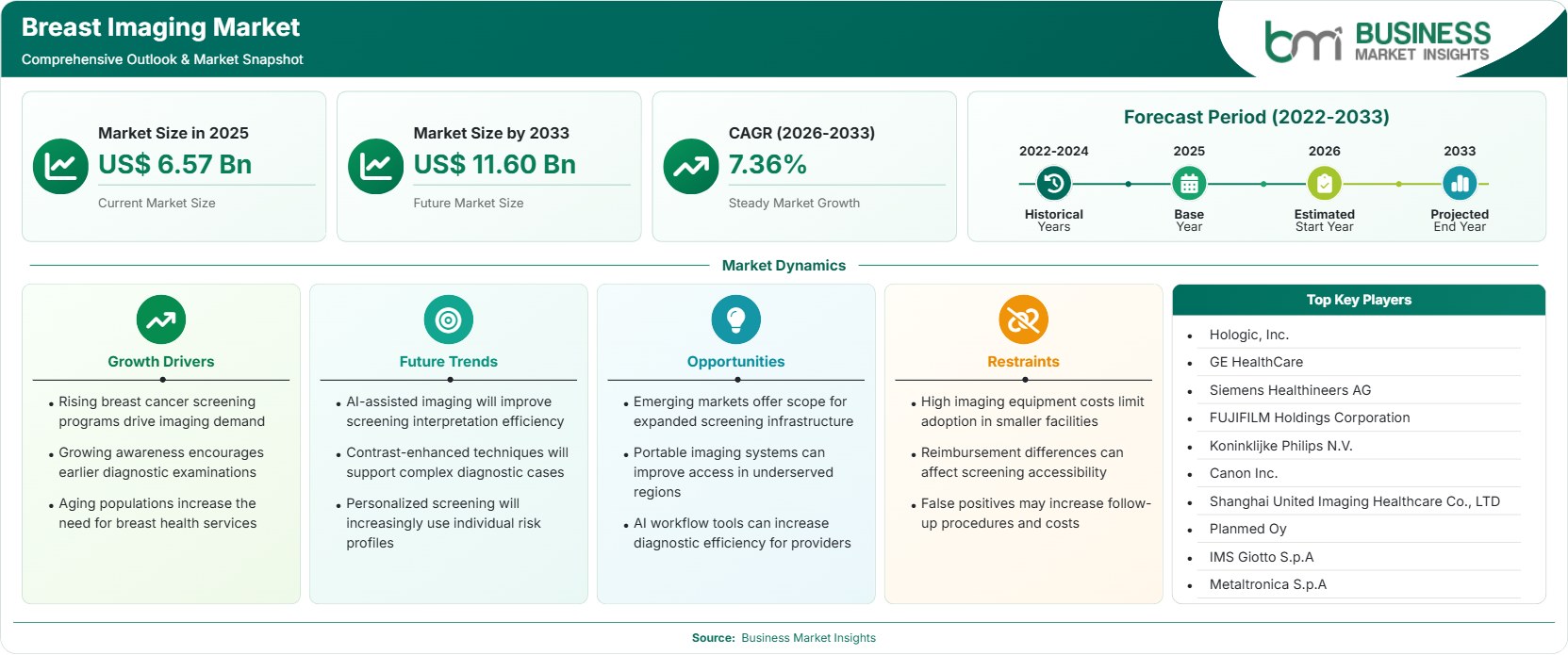
The Breast Imaging Market size was valued at USD 6.57 Billion in 2025 and is projected to reach USD 11.60 Billion by 2033, growing at a CAGR of 7.36% during 2026–2033. Rising breast cancer screening programs, increasing awareness regarding early disease detection, technological advancements in imaging systems, and expanding healthcare infrastructure are driving adoption. Opportunities are emerging from AI-assisted diagnostics, portable imaging platforms, and growing screening access in developing regions.

Report Coverage
  • Imaging Modality: 2D Mammography, Digital Breast Tomosynthesis, Breast Ultrasound, Breast MRI, Nuclear Breast Imaging, Galactography/Ductography
  • Technology: Ionizing Breast Imaging, Non-ionizing Breast Imaging
  • End-user: Hospitals, Specialty Clinics, Diagnostic Imaging Centers
US$ 6.57 Bn Market size in 2025
US$ 11.60 Bn Market Size by 2033
7.36% CAGR, 2026 - 2033
2026-2033 Forecast Period

01 AI Overview

Breast Imaging Market Summary

  • North America Region: North America holds 36%–40% share in 2025, growing with a CAGR of 6.8%–7.5% during 2026–2033. High screening penetration, strong reimbursement frameworks, widespread deployment of advanced mammography systems, and increasing adoption of AI-enabled diagnostics support growth. The U.S. remains the dominant regional market, expanding at 6.9%–7.7% CAGR through investments in screening infrastructure and digital imaging technologies.
  • Fastest Growing Region: Asia Pacific holds 22%–26% share in 2025, growing with a CAGR of 8.4%–9.2% during 2026–2033. Expanding healthcare infrastructure, rising awareness programs, growing patient populations, and increasing adoption of advanced imaging technologies continue accelerating market demand.
  • Leading Segment: Digital Breast Tomosynthesis accounts for 32%–36% share in 2025 and is expected to grow at 8.0%–8.8% CAGR. Improved lesion visualization, greater diagnostic accuracy, and increasing replacement of conventional systems support segment leadership.
  • High Growth Segment: Diagnostic Imaging Centers represent 26%–30% share in 2025 while expanding at 8.6%–9.4% CAGR. Increasing outpatient screening volumes, specialized diagnostic services, and investment in advanced imaging equipment continue driving adoption.
  • Key Market Opportunity: Integration of artificial intelligence, cloud-based image analysis, and workflow automation can improve diagnostic confidence, reduce interpretation time, and expand access to high-quality screening services globally.
  • Major Market Players: Hologic, Inc., GE HealthCare Technologies Inc., Siemens Healthineers AG, FUJIFILM Holdings Corporation, Koninklijke Philips N.V., Canon Inc., Shanghai United Imaging Healthcare Co., Ltd., Planmed Oy, IMS Giotto S.p.A., Metaltronica S.p.A.
02 Strategic Insights

Breast Imaging Market: Strategic Insights

Breast Imaging Market Strategic Framework
FREE PDF
Request your free sample
Request free sample
03 Stakeholder View

Key Takeaways

  • The industry ecosystem increasingly integrates imaging equipment manufacturers, healthcare providers, software developers, diagnostic centers, and screening program administrators focused on improving early detection outcomes.
  • Digital breast tomosynthesis and AI-assisted diagnostic applications offer the strongest commercial opportunities due to their ability to enhance diagnostic performance and workflow efficiency.
  • Innovation efforts are increasingly directed toward cloud-enabled diagnostics, automated lesion detection, advanced visualization software, and portable imaging technologies.
  • Asia Pacific offers the most compelling long-term investment opportunity due to healthcare infrastructure expansion, growing awareness, and rising diagnostic procedure volumes.
  • Strategic collaborations between imaging manufacturers and AI technology providers are accelerating development of intelligent diagnostic platforms.
  • Outpatient diagnostic imaging centers are becoming increasingly influential end users because of growing patient preference for specialized and accessible screening services.
04 Geographic Outlook

Breast Imaging Market Regional Highlights

North America Breast Imaging Market

North America accounted for 36%–40% Breast Imaging Market share in 2025 and is projected to grow at 6.8%–7.5% CAGR through 2033. The region benefits from well-developed healthcare infrastructure, extensive screening participation, advanced imaging technology adoption, and favorable reimbursement policies. Continued investments in digital breast tomosynthesis and AI-powered diagnostic tools are strengthening diagnostic capabilities. Strong healthcare spending and increasing emphasis on preventive screening continue supporting regional leadership in breast imaging technologies.

  • National screening programs continue driving high utilization rates of mammography and advanced imaging systems across healthcare facilities.
  • Diagnostic providers increasingly deploy AI-assisted workflow platforms to improve clinical efficiency and reduce interpretation variability.
  • Rising demand for personalized diagnostics encourages adoption of advanced multimodality imaging technologies.
  • Healthcare systems continue investing in imaging modernization projects to improve screening capacity and patient outcomes.
  • Growing awareness of early detection benefits supports consistent demand for routine screening procedures.

US Breast Imaging Market

The United States represents 82%–86% of North American demand and is anticipated to expand at 6.9%–7.7% CAGR through the forecast period. Strong screening participation, extensive imaging infrastructure, and technological innovation remain key adoption drivers.

  • Healthcare providers increasingly replace legacy mammography systems with advanced tomosynthesis platforms.
  • AI-assisted image analysis is gaining traction across both hospital and outpatient diagnostic settings.
  • Breast cancer awareness initiatives support continued patient participation in preventive screening programs.
  • The presence of leading imaging technology companies accelerates commercialization of advanced diagnostic solutions.

Europe Breast Imaging Market

Europe held 28%–32% share in 2025 and is projected to expand at 7.0%–7.8% CAGR through 2033. Strong public healthcare systems, organized screening programs, and widespread adoption of digital imaging solutions continue supporting growth. Germany remains the leading market, while Poland demonstrates notable expansion potential.

  • Germany leads regional demand through advanced healthcare infrastructure and extensive deployment of digital breast imaging systems.
  • Poland is projected to achieve 8.0%–8.8% CAGR supported by healthcare modernization and increased screening program investments.
  • AI integration within radiology workflows continues improving diagnostic productivity across healthcare institutions.
  • Government-supported preventive healthcare programs are increasing imaging procedure volumes.
  • Healthcare providers continue investing in high-resolution diagnostic technologies to improve early detection rates.

Asia Pacific Breast Imaging Market

Asia Pacific accounted for 22%–26% share in 2025 and is projected to advance at 8.4%–9.2% CAGR, making it the fastest-growing regional market. Rising healthcare expenditures, increasing awareness regarding breast cancer screening, and expansion of diagnostic infrastructure continue supporting growth. The strongest Breast Imaging Market growth momentum is observed in countries investing heavily in healthcare access and advanced diagnostic technologies. A growing patient population and improving insurance coverage continue accelerating imaging utilization.

  • China remains the largest regional market due to extensive healthcare investments and rising diagnostic procedure volumes.
  • India is projected to achieve 9.0%–9.8% CAGR driven by increasing awareness campaigns and healthcare infrastructure development.
  • Private healthcare providers are expanding access to advanced imaging technologies across urban centers.
  • Government initiatives focused on women's health continue supporting screening participation growth.
  • Technological modernization programs encourage wider adoption of digital breast imaging solutions.

Rest of World Breast Imaging Market

Rest of World accounted for 6%–10% share in 2025 and is expected to grow at 7.4%–8.2% CAGR through 2033. Growth is supported by healthcare investment programs, rising cancer awareness, and improving diagnostic service accessibility across Latin America, the Middle East, and Africa. Increasing public health initiatives continue strengthening long-term market fundamentals.

  • Brazil remains the leading Latin American market supported by growing investments in diagnostic healthcare services.
  • Saudi Arabia continues expanding medical infrastructure and preventive screening capabilities.
  • Rising awareness regarding early cancer detection is encouraging greater utilization of imaging services.
  • Private healthcare networks are increasing investments in advanced diagnostic equipment deployment.
  • International healthcare partnerships continue improving access to modern imaging technologies.
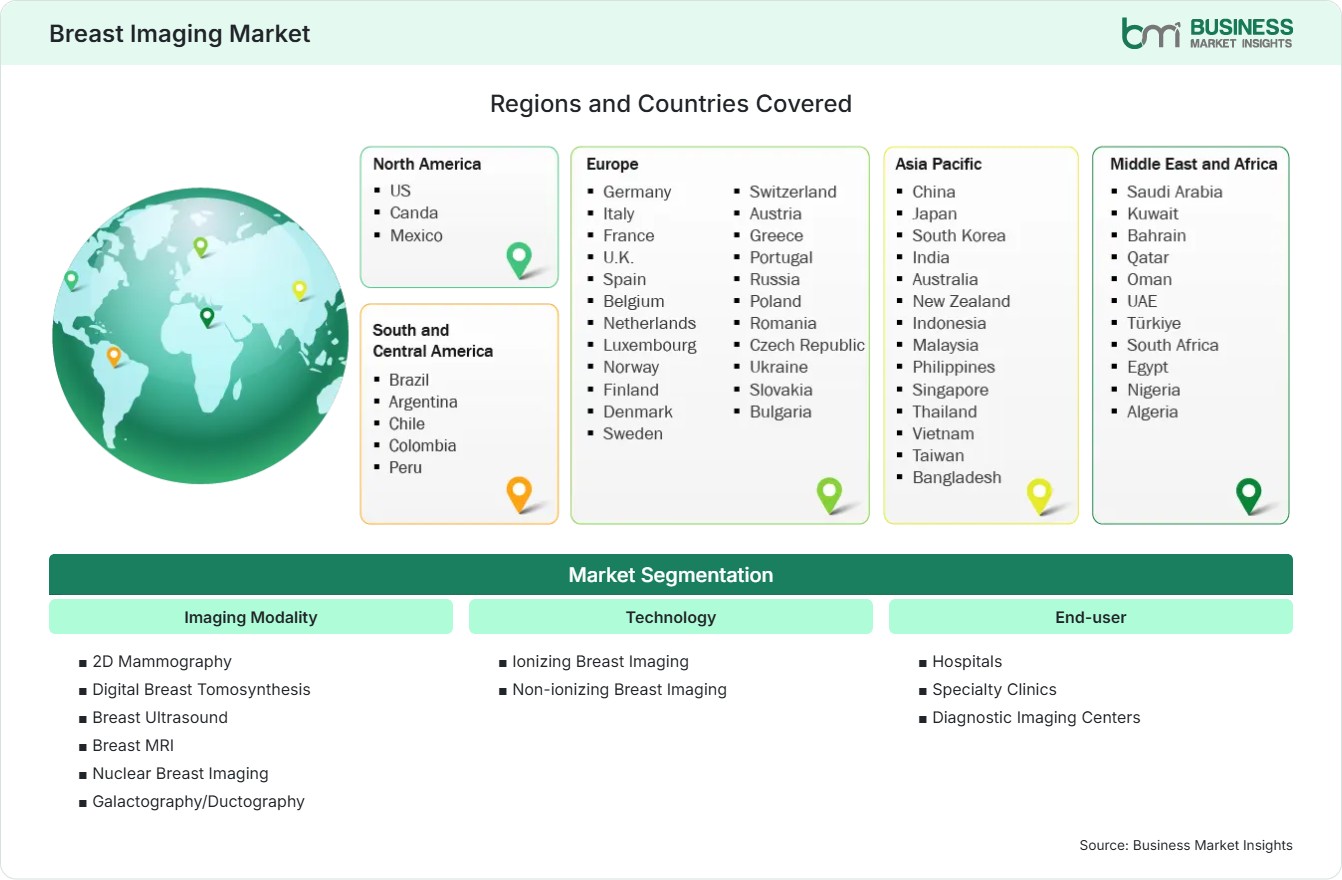
Global Market Geography
FREE PDF
Request your free sample
Request free sample
05 Segment Analysis

Breast Imaging Market Segmentation

Imaging Modality

The imaging modality segment represents the core technological foundation of breast cancer screening and diagnostic workflows. Digital Breast Tomosynthesis accounted for 32%–36% share in 2025 and is projected to expand at 8.0%–8.8% CAGR through 2034. The Breast Imaging Market scope continues expanding as healthcare providers seek greater lesion detection accuracy, reduced recall rates, enhanced image visualization, and improved patient outcomes through advanced imaging technologies.

  • 2D Mammography: Remains widely utilized in routine screening programs due to established clinical acceptance, broad availability, cost-effectiveness, and compatibility with population-based breast cancer detection initiatives.
  • Digital Breast Tomosynthesis: Provides three-dimensional visualization capabilities that improve lesion detection, reduce tissue overlap challenges, and enhance diagnostic confidence among radiologists.
  • Breast Ultrasound: Frequently used as a supplemental imaging modality for dense breast tissue assessment and characterization of suspicious abnormalities.
  • Breast MRI: Offers high sensitivity for risk assessment, pre-surgical planning, treatment monitoring, and complex diagnostic evaluations requiring advanced imaging detail.
  • Nuclear Breast Imaging: Supports functional assessment of breast tissue by identifying metabolic activity associated with suspicious lesions and cancer detection.
  • Galactography/Ductography: Utilized in specialized diagnostic situations to evaluate duct-related abnormalities and investigate nipple discharge conditions.

Technology

Technology selection continues evolving as healthcare facilities adopt advanced diagnostic capabilities and expand access to screening services. Ionizing Breast Imaging accounted for 64%–68% share in 2025 and is anticipated to grow at 7.2%–8.0% CAGR through the forecast period. Increasing deployment of digital mammography and tomosynthesis systems continues supporting market demand.

  • Ionizing Breast Imaging: Includes mammography, tomosynthesis, and nuclear imaging technologies that provide highly detailed visualization capabilities for cancer screening and diagnostic assessments.
  • Non-ionizing Breast Imaging: Encompasses ultrasound and MRI technologies that support supplemental screening, dense breast evaluation, and advanced diagnostic investigations without ionizing radiation exposure.

End-user 

End-user adoption reflects healthcare infrastructure development, patient access trends, and technological investment patterns. Hospitals accounted for 48%–52% share in 2025 and are projected to expand at 7.1%–7.8% CAGR through 2034. Increasing investments in comprehensive cancer care and diagnostic imaging facilities continue supporting segment leadership. Emerging Breast Imaging Market trends indicate rising adoption of advanced imaging systems across multiple healthcare settings.

  • Hospitals: Serve as primary providers of breast imaging services through integrated oncology, radiology, and diagnostic care networks supporting large patient populations.
  • Specialty Clinics: Focus on women's health, preventive screening, and specialized diagnostic evaluations utilizing dedicated breast imaging expertise and technology platforms.
  • Diagnostic Imaging Centers: Deliver accessible outpatient services, advanced imaging capabilities, and efficient diagnostic workflows supporting increasing screening procedure volumes.
06 Market Forces

Breast Imaging Market Dynamics

Key Market Drivers

Rising breast cancer screening programs drive imaging demand

Global initiatives for national screening programs continue to grow due to the prioritization of early cancer diagnosis and improved patient outcomes in healthcare institutions. Screening programs are designed to promote regular mammograms among eligible individuals, leading to an increase in the number of imaging procedures performed. The infrastructure for more sophisticated screening programs is now receiving more funding to improve detection rates and reduce cancer mortality. The Breast Imaging Market growth outlook remains strongly associated with continuing expansion of population-based screening initiatives, healthcare investments, and growing emphasis on preventive oncology services worldwide.

Growing awareness encourages earlier diagnostic examinations

Public awareness campaigns, advocacy initiatives, and educational programs continue encouraging women to seek preventive screening and diagnostic services at earlier stages. Increased awareness with respect to the risk factors and the outcomes of treatment for breast cancer is leading to an increase in the number of individuals seeking medical attention through screening programs. There is a growing trend within the healthcare sector that focuses on the importance of being proactive in carrying out diagnosis tests to facilitate early identification and treatment. Early diagnosis is probably lead to better treatment outcomes and lower costs.

Aging populations increase the need for breast health services

Demographic trends are expanding the number of individuals within age groups associated with elevated breast cancer risk. In developed and developing economies, with growing elderly population, there will be an increasing need for the healthcare system to develop better diagnostic capabilities to meet this increased demand. In the case of breast imaging services, they play an important role in the screening process, follow-up exams, and in the planning of treatments. Longer life expectancies and better access to healthcare also mean higher rates of use. This means that demographics will continue to drive investment.

Key Market Opportunities

Emerging markets offer scope for expanded screening infrastructure

Developing economies present substantial opportunities for diagnostic equipment providers and healthcare investors seeking to expand breast imaging access. Healthcare infrastructure is being upgraded with an increasing emphasis on preventive efforts related to cancer diagnosis in many regions. The development of screening and diagnostic systems creates good prospects for the market players. The growing spending in the area and increasing awareness provide additional factors in favor of using the technology. Companies able to provide affordable imaging systems and solutions will be able to reap great rewards.

Portable imaging systems can improve access in underserved regions

Portable and mobile diagnostic technologies create opportunities to address limitations associated with geographic accessibility and healthcare infrastructure gaps. Mobile screening programs can serve rural communities, remote populations, and regions with limited access to specialized diagnostic facilities. Improved portability enables healthcare providers to expand screening coverage while improving service reach. Technological advancements continue enhancing image quality, operational efficiency, and deployment flexibility. Market participants investing in innovative portable solutions may strengthen their ability to address unmet healthcare needs while supporting broader screening adoption globally.

AI workflow tools can increase diagnostic efficiency for providers

Artificial intelligence technologies represent a significant opportunity for improving imaging interpretation efficiency, workflow automation, and diagnostic accuracy. Healthcare organizations increasingly evaluate AI-enabled platforms capable of supporting radiologists through prioritization, image analysis, and decision support functions. Breast Imaging Market Forecasts indicate growing adoption of intelligent workflow solutions as healthcare providers seek improved productivity and enhanced clinical performance. AI integration may help address workforce constraints while reducing interpretation variability and supporting more consistent diagnostic outcomes. Technology developers focusing on clinically validated AI solutions can access substantial long-term growth opportunities.

Market Restraints and Challenges

High imaging equipment costs limit adoption in smaller facilities

Factor: Advanced mammography systems, tomosynthesis platforms, MRI equipment, and supporting software require substantial capital investment, installation expenses, and ongoing maintenance commitments. Impact: Smaller healthcare facilities, rural hospitals, and independent diagnostic centers may face financial barriers that delay technology adoption. Budget limitations can restrict access to advanced diagnostic capabilities and reduce modernization rates. Healthcare providers often require external funding or phased investment strategies to support procurement decisions. Consequently, equipment affordability remains an important consideration influencing adoption patterns and healthcare technology distribution.

Reimbursement differences can affect screening accessibility

Factor: Reimbursement policies, insurance coverage levels, and payment structures vary significantly across regions, healthcare systems, and diagnostic procedures. Impact: Variations in reimbursement support can influence patient access, provider investment decisions, and utilization rates for advanced imaging technologies. Inadequate reimbursement may discourage adoption of newer systems despite clinical benefits. Healthcare organizations frequently evaluate reimbursement stability when planning technology investments. These factors can create disparities in access to diagnostic services and influence long-term market development across different geographic and healthcare environments.

07 Company Analysis

Competitive Landscape

The Breast Imaging Market analysis reflects a competitive environment characterized by innovation in digital breast tomosynthesis, artificial intelligence-assisted diagnostics, advanced ultrasound systems, MRI technologies, and workflow automation platforms. Leading manufacturers continue investing in imaging accuracy, patient comfort, reduced radiation exposure, and cloud-enabled diagnostic capabilities to strengthen their market positions.

Company Name

Overview

Products and Services Relevant to This Market

Hologic, Inc.

Global leader in women's health diagnostics with strong expertise in breast screening and imaging technologies.

Mammography systems, digital breast tomosynthesis platforms, biopsy solutions, breast health software.

GE HealthCare Technologies Inc.

Healthcare technology provider focused on imaging, diagnostics, and precision care solutions.

Mammography equipment, breast ultrasound systems, AI-enabled imaging workflows, diagnostic technologies.

Siemens Healthineers AG

Medical technology company delivering advanced imaging and diagnostic systems worldwide.

Breast MRI, mammography systems, AI-powered imaging software, diagnostic workflow solutions.

FUJIFILM Holdings Corporation

Global imaging company with a broad portfolio of digital radiography and breast health technologies.

Digital mammography systems, tomosynthesis solutions, healthcare IT platforms, imaging software.

Koninklijke Philips N.V.

Healthcare technology provider emphasizing precision diagnosis and integrated clinical workflows.

Breast ultrasound, MRI systems, diagnostic imaging platforms, clinical informatics solutions.

Canon Inc.

Imaging technology company offering advanced medical diagnostic equipment and solutions.

Digital mammography systems, breast imaging equipment, advanced visualization technologies.

Shanghai United Imaging Healthcare Co., Ltd.

Medical imaging manufacturer expanding global presence through advanced diagnostic technologies.

MRI systems, molecular imaging solutions, breast imaging platforms, diagnostic software.

Planmed Oy

Specialized medical imaging company focused on breast imaging and orthopedic solutions.

Mammography systems, tomosynthesis technologies, breast diagnostic imaging equipment.

IMS Giotto S.p.A.

Breast imaging specialist recognized for dedicated mammography and tomosynthesis solutions.

Mammography units, breast screening systems, tomosynthesis platforms, diagnostic technologies.

Metaltronica S.p.A.

Manufacturer focused on dedicated breast imaging equipment and radiology applications.

Mammography systems, breast imaging devices, digital diagnostic solutions.

10 Trust & Transparency

Research Methodology

The market analysis combines proprietary research with secondary data from government agencies, company disclosures, regulatory filings, industry databases and expert interviews. Market estimates are validated through data triangulation, cross-market benchmarking and analyst review.

View Full Research Methodology

11 Questions Answered

Frequently Asked Questions

What does a Breast Imaging Market Report include?

A Market Report typically includes market sizing, technology assessment, competitive benchmarking, regional analysis, segmentation insights, growth opportunities, healthcare trends, and strategic developments.

How is artificial intelligence influencing breast imaging?

Artificial intelligence supports radiologists by improving image interpretation efficiency, prioritizing suspicious findings, reducing workflow burden, and enhancing diagnostic consistency.

Which end-user segment dominates the market?

Hospitals dominate the market because they provide comprehensive oncology services, advanced imaging infrastructure, multidisciplinary expertise, and high patient volumes.

Why is digital breast tomosynthesis gaining popularity?

Digital breast tomosynthesis improves lesion visualization, reduces tissue overlap, lowers recall rates, and enhances diagnostic confidence compared with conventional mammography techniques.

What is breast imaging used for?

Breast imaging is used to screen, detect, diagnose, and monitor breast abnormalities, including breast cancer, through technologies such as mammography, ultrasound, MRI, and tomosynthesis.

Access the Full Breast Imaging Market Report

Get segment-level forecasts, regional estimates, competitive benchmarking, company profiles and downloadable Excel datasets.

Access the full Breast Imaging Market Report
350 pages PDF & Excel | 2026-08-19