Market Summary
Executive Summary and Market Analysis
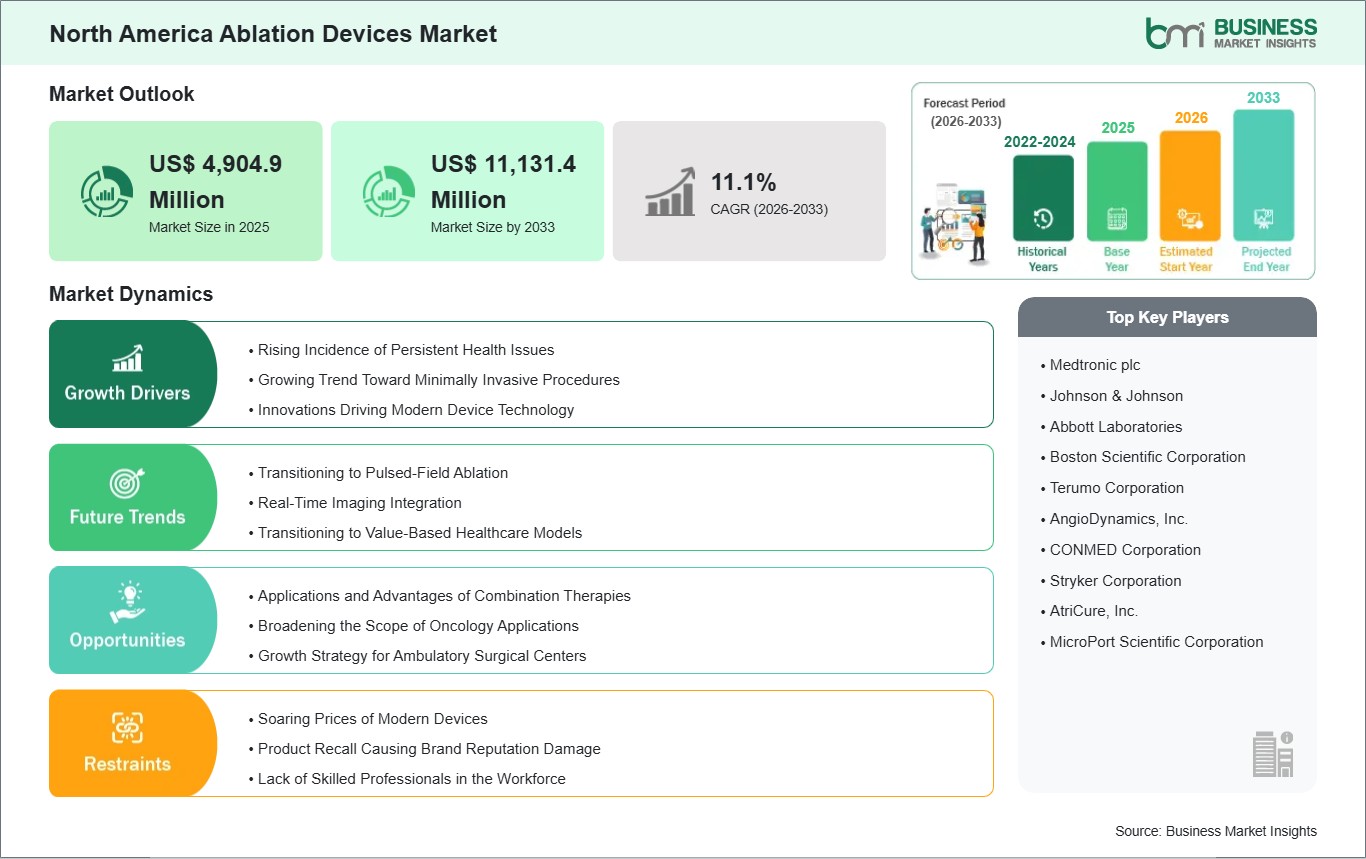
Hospitals and specialty clinics are integrating ablation technologies into cardiac, oncologic, and other specialty treatment pathways. Factors such as growing patient awareness of less invasive therapies, the demand for reduced hospital stays, and the preference for procedures with lower procedural risks are key drivers of adoption. The market benefits from a robust ecosystem of medical device innovation, supported by collaborations between healthcare providers, academic institutions, and manufacturers. Well-structured reimbursement frameworks and regulatory processes provide a clear path for the introduction of new ablation devices. However, the high cost of advanced ablation systems can limit adoption in smaller or rural hospitals. The increasing complexity of procedures, which requires highly trained specialists, creates potential workforce limitations. North America remains a leading region for ablation device adoption, with strong investments in technology and clinical expertise driving growth in minimally invasive interventions.
Segment Analysis
North America Ablation Devices Market Segmentation
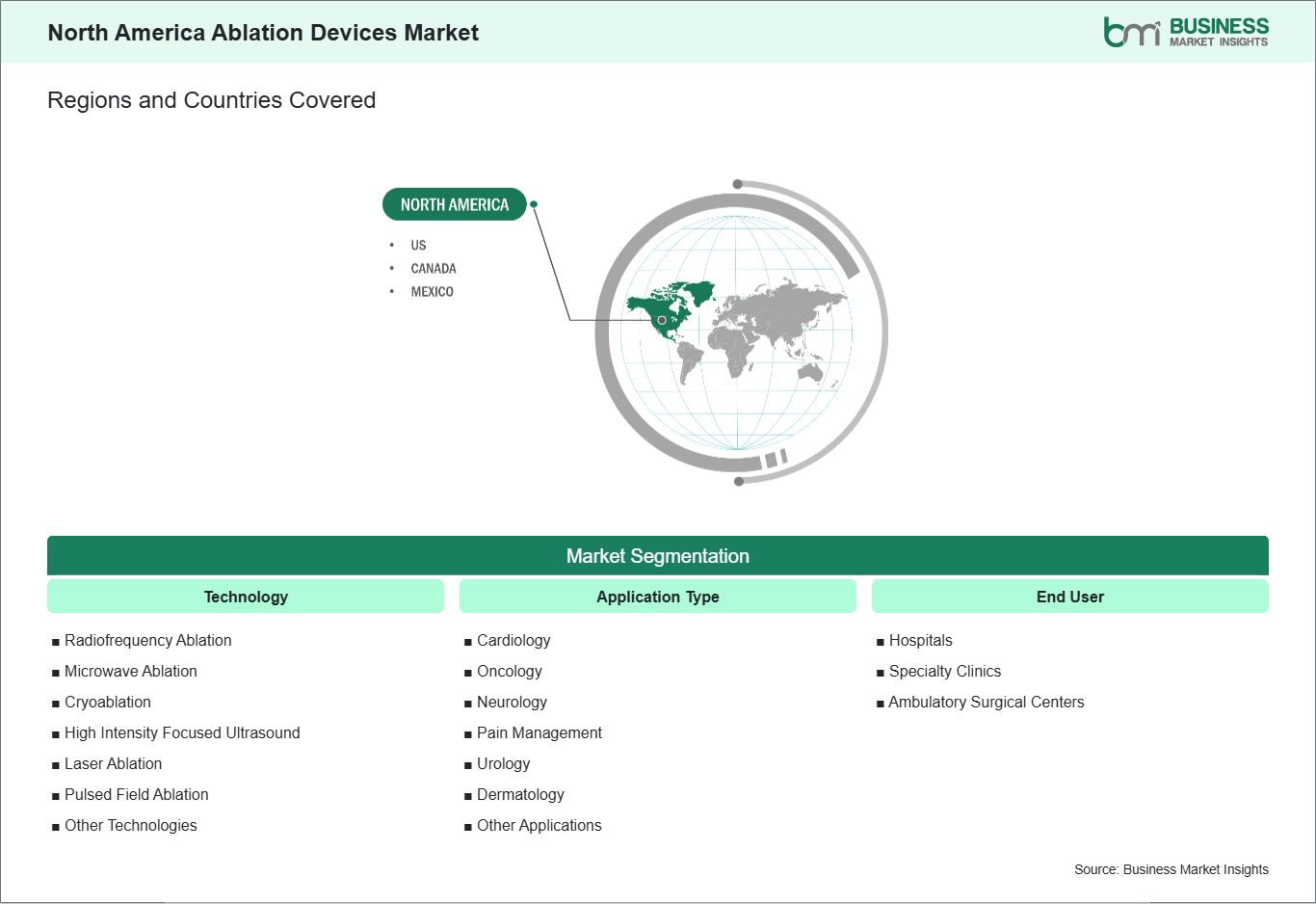
Key segments that contributed to the derivation of the North America Ablation Devices market analysis are technology type, application, and end user.
- By technology type, the ablation devices market is segmented into radiofrequency ablation, microwave ablation, cryoablation, high-intensity focused ultrasound, laser ablation, pulsed field ablation, and others. The radiofrequency ablation segment dominated the market in 2025.
- Based on application, the ablation devices market is classified into cardiology, oncology, neurology, pain management, urology, dermatology, and others. The cardiology segment dominated the market in 2025.
- In terms of end user, the ablation devices market is categorized into hospitals, specialty clinics, and ambulatory surgical centers. The hospitals segment dominated the market in 2025.
Market Forces
North America Ablation Devices Market Drivers and Opportunities
Rising Incidence of Persistent Health Issues
Lifestyle factors, aging populations, and broader access to advanced healthcare services have contributed to more individuals living with long-term illnesses that require intervention. Ablation technologies are becoming important as minimally invasive solutions that offer targeted treatment with shorter recovery times, helping healthcare providers manage the growing burden of chronic disease effectively.
Hospitals and specialized heart centers are integrating catheter-based ablation procedures into routine care for patients with chronic cardiac conditions. These procedures provide direct intervention at the source of abnormal electrical activity, reducing reliance on long-term medication and improving patient quality of life, which aligns with the emphasis on advanced cardiac care.
Thermal ablation techniques are used to treat localized tumors when surgery may be riskier or less feasible. Similarly, nerve and tissue ablation are gaining popularity for managing chronic pain and musculoskeletal conditions, providing patients with minimally invasive alternatives to traditional treatments.
Applications and Advantages of Combination Therapies
In cardiology, ablation is combined with pharmacological treatments and advanced diagnostic technologies, such as three-dimensional mapping and imaging systems. These integrated approaches allow clinicians to optimize procedural accuracy, reduce recurrence rates, and create tailored care plans that address complex cardiac conditions.
In oncology, combination strategies are used to improve tumor control while minimizing side effects. Ablation is paired with chemotherapy, targeted therapies, or image-guided interventions, enabling more precise management of localized cancers. This multimodal approach ensures that ablation is part of a coordinated treatment plan, improving patient recovery times and reducing overall procedural risk.
Pain management and endocrine care are benefiting from combination therapy approaches. Nerve and tissue ablation procedures are integrated with rehabilitation programs, physiotherapy, and tailored medications to provide sustained relief and optimize functional outcomes. The healthcare landscape emphasizes multidisciplinary treatment pathways, positioning ablation devices as essential tools within comprehensive care models that improve long-term quality of life for patients across multiple clinical areas.
Size and Share Analysis
North America Ablation Devices Market Size and Share Analysis
The North America Ablation Devices market demonstrates steady growth, with size and share analysis highlighting evolving trends and competitive dynamics among key players. The report evaluates important subsegments categorized within technology type, application, and end user, highlighting their respective contributions to overall market performance.
By technology type, the radiofrequency ablation subsegment dominated the market in 2025. Its adoption is driven by its proven clinical efficacy, precise tissue targeting capabilities, consistent procedural outcomes, and strong safety profile across multiple therapeutic areas, making it a cornerstone technology in minimally invasive treatment approaches.
In terms of application, the cardiology subsegment dominated the market in 2025. This leadership is attributed to the rising prevalence of cardiac arrhythmias in the adult population, increasing awareness of catheter-based rhythm management procedures, and greater accessibility of advanced ablation therapies for patients requiring long-term cardiac care.
Based on end user, the hospitals subsegment dominated the market in 2025. Hospitals remain the primary distribution channel due to their comprehensive cardiac care facilities, access to trained electrophysiologists and specialized technicians, advanced imaging and mapping infrastructure, and ability to provide immediate, life-saving interventional procedures.
Report Coverage
North America Ablation Devices Market Report Coverage and Deliverables
The "North America Ablation Devices Market Size and Forecast (2022–2033)" report provides a detailed analysis of the market covering below areas:
- North America Ablation Devices market size and forecast at regional and country levels for all market segments covered under the scope
- North America Ablation Devices market trends, as well as drivers, restraints, and opportunities
- North America Ablation Devices market analysis covering key trends, regional framework, major players, regulations, and recent developments
- Industry landscape and competition analysis covering market concentration, heat map analysis, prominent players, and recent developments for the North America Ablation Devices market
- Detailed company profiles, including SWOT analysis
Geographic Insights
North America Ablation Devices Market Geographic Insights
The geographical scope of the North America Ablation Devices market report is divided into: The US, Canada, and Mexico. The US held the largest share in 2025.
Major urban centers such as Boston, New York, and Los Angeles serve as hubs for sophisticated cardiac and oncologic ablation procedures, supported by hospitals equipped with state-of-the-art procedural suites and multidisciplinary teams. The country has prioritized minimally invasive treatments that enhance patient outcomes and reduce hospital stays, fueling demand for catheter-based and energy-based ablation technologies. Extensive clinical research programs, partnerships between healthcare institutions and medical device manufacturers, and early adoption of new technologies ensure that hospitals are the first to implement next-generation ablation solutions. Challenges remain in ensuring access to advanced procedures across rural areas and in maintaining a workforce of specialists trained to handle complex interventions. The high acquisition and operational costs of advanced ablation devices can limit smaller hospital adoption. Strong infrastructure, technological innovation, and patient-centric healthcare delivery firmly establish the US as the leading contributor to the North America ablation devices market, setting regional benchmarks for procedural standards and device adoption.
Industry Activity
Recent Developments
The North America Ablation Devices market is evaluated by gathering qualitative and quantitative data post primary and secondary research, which includes important corporate publications, association data, and databases. A few of the key developments in the North America Ablation Devices market are:
- In December 2025, Abbott Laboratories announced that its Volt Pulsed Field Ablation System had received FDA approval to treat patients with atrial fibrillation, supporting its commercial rollout in the US and strengthening its electrophysiology product lineup in North America.
- In October 2024, Medtronic plc announced that it had received FDA approval for its Affera Mapping and Ablation System and Sphere‑9 Catheter, an all‑in‑one high‑density mapping plus pulsed field and radiofrequency ablation platform, creating a new integrated solution for treating atrial fibrillation and expanding its cardiac ablation portfolio in North America.
- In January 2024, Boston Scientific Corporation announced that it had received U.S. Food and Drug Administration (FDA) approval for its FARAPULSE Pulsed Field Ablation (PFA) System, a catheter‑based ablation platform indicated for pulmonary vein isolation to treat drug‑refractory, recurrent, symptomatic paroxysmal atrial fibrillation, enabling the commercial launch of the technology in the nation.
Trust & Transparency
Research Methodology
The market analysis combines proprietary research with secondary data from government agencies, company disclosures, regulatory filings, industry databases and expert interviews. Market estimates are validated through data triangulation, cross-market benchmarking and analyst
review.
View Full Research Methodology
Key Sources Referred:
The World Bank
World Health Organization (WHO)
Center for Disease Control and Prevention (CDC)
Food and Drug Administration (FDA)
European Database on Medical Devices (EUDAMED)
European Society of Cardiology (ESC)
American College of Cardiology (ACC)
American Heart Association (AHA)
Company Websites
Company Annual Reports
Company Investor Presentations