Market Summary
Executive Summary and Market Analysis
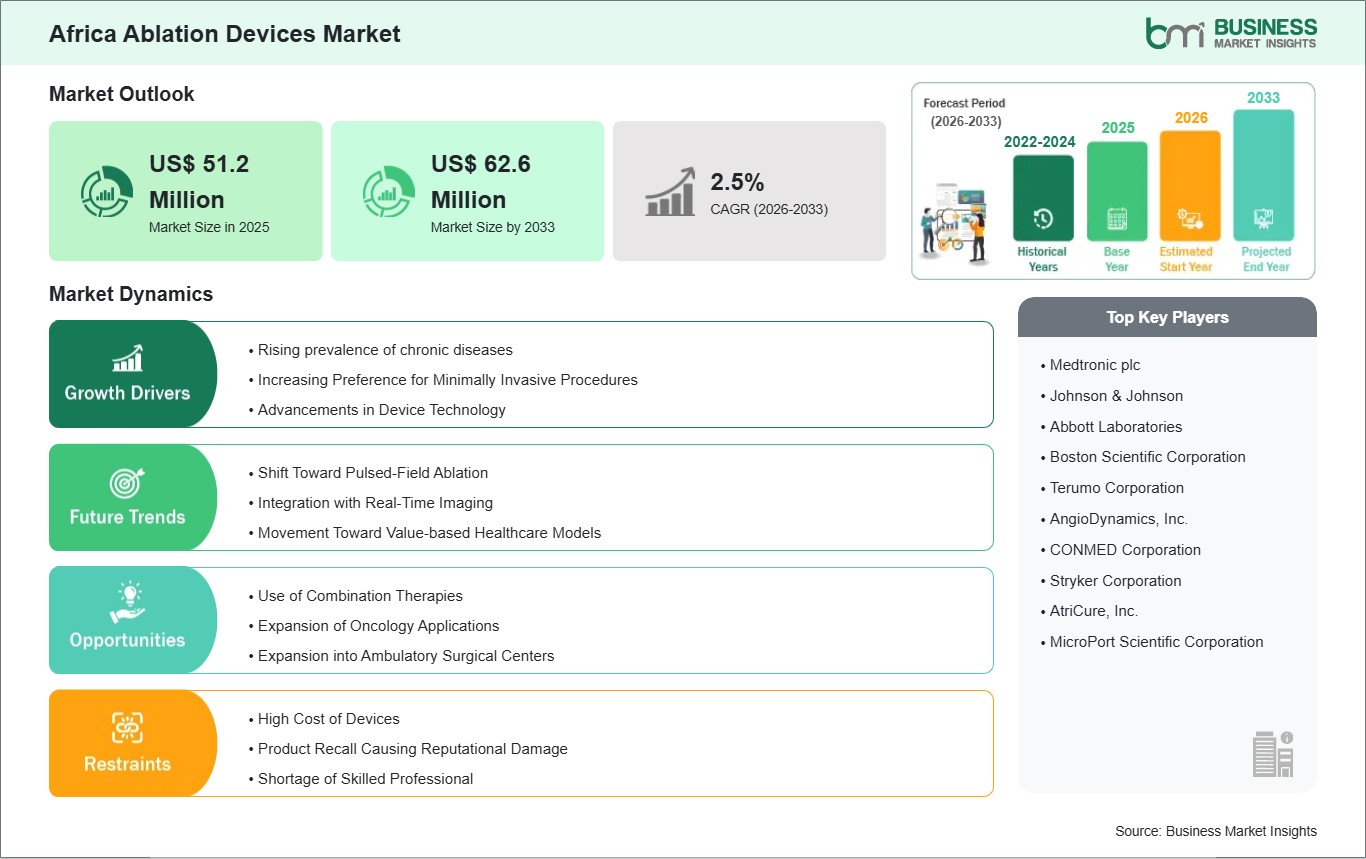
In the region, investment in healthcare infrastructure and gradual expansion of private healthcare facilities have supported increased adoption of ablation technologies, particularly radiofrequency and microwave ablation systems. Clinicians across healthcare centers are adopting ablation procedures due to their reduced recovery times, fewer complications compared to open surgery, and increasing patient preference for less invasive treatments.
However, limited healthcare funding in several sub-Saharan nations constrains the procurement of advanced ablation devices. Reimbursement frameworks are underdeveloped, impacting large-scale adoption. A shortage of trained interventional specialists slows dissemination beyond major urban centers. The high upfront costs of ablation equipment and maintenance requirements make it difficult for smaller hospitals to invest in these technologies, leaving larger tertiary care centers as the main adopters. Despite these restraints, ongoing government initiatives to strengthen clinical capacities and partnerships with global device manufacturers are fostering more robust uptake, positioning the market for expansion through increased procedural volumes and broader geographic penetration.
Segment Analysis
Africa Ablation Devices Market Segmentation
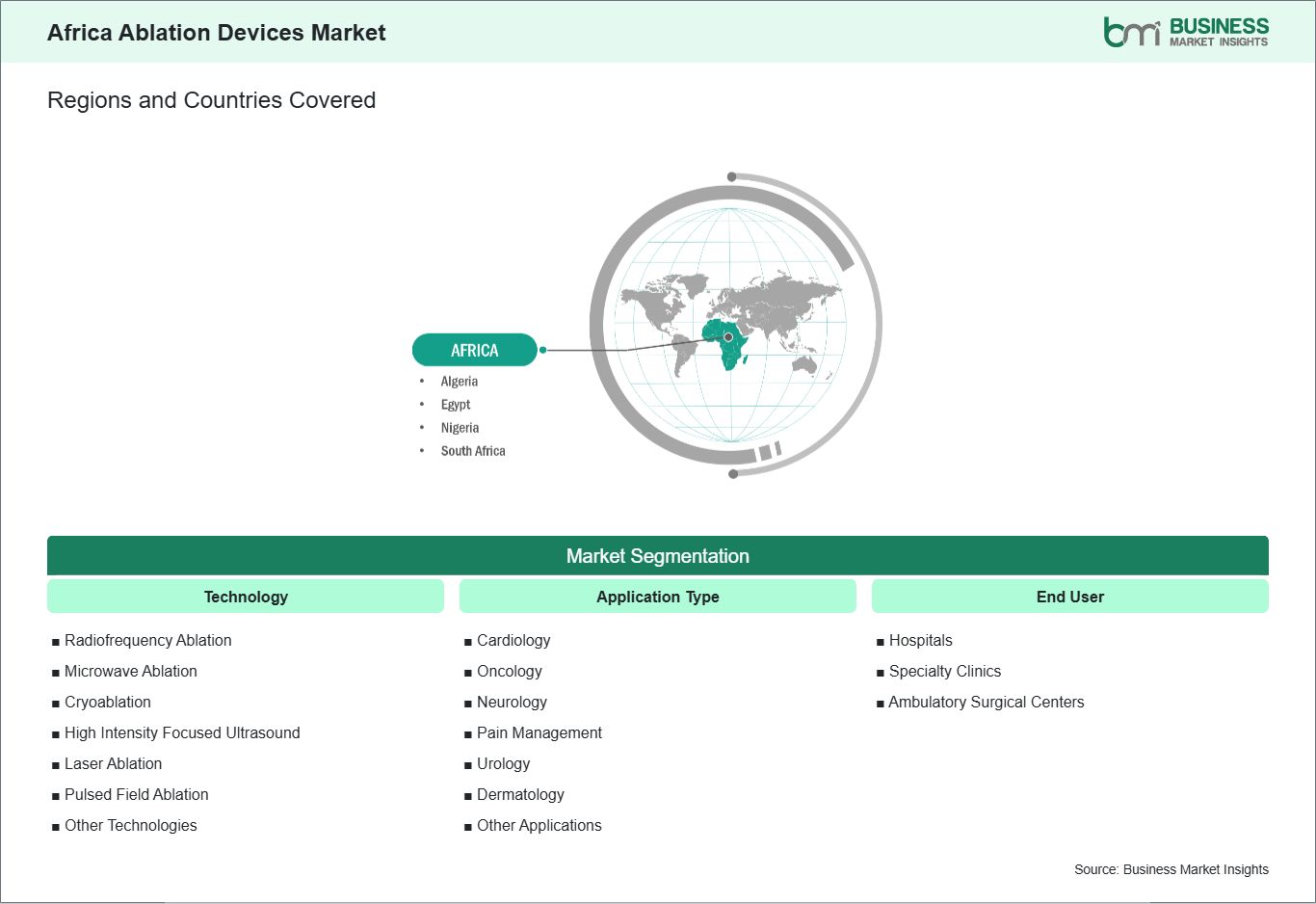
Key segments that contributed to the derivation of the Africa Ablation Devices market analysis are technology type, application, and end user.
- By technology type, the ablation devices market is segmented into radiofrequency ablation, microwave ablation, cryoablation, high-intensity focused ultrasound, laser ablation, pulsed field ablation, and others. The radiofrequency ablation segment dominated the market in 2025.
- Based on application, the ablation devices market is classified into cardiology, oncology, neurology, pain management, urology, dermatology, and others. The cardiology segment dominated the market in 2025.
- In terms of end user, the ablation devices market is categorized into hospitals, specialty clinics, and ambulatory surgical centers. The hospitals segment dominated the market in 2025.
Market Forces
Africa Ablation Devices Market Drivers and Opportunities
Rising Prevalence of Chronic Diseases
Africa is witnessing a steady increase in chronic diseases, particularly cancer and cardiovascular conditions, placing growing demands on healthcare systems. This trend is driving interest in minimally invasive treatments such as ablation devices, which offer alternatives to traditional surgery for tumor removal and cardiac rhythm management. Hospitals and specialized clinics in urban centers are beginning to incorporate these devices to address the increasing patient load.
The expanding awareness among physicians about the benefits of ablation procedures is contributing to their adoption. Oncologists and cardiologists in Africa are recommending ablation therapies as a first‑line or adjunct treatment to reduce complications and recovery time. Patients are showing more willingness to consider these procedures due to their less invasive nature, shorter hospital stays, and lower risk compared with conventional surgery.
While larger hospitals in South Africa, Egypt, and Nigeria are equipped with advanced devices, smaller clinics in other regions lack the necessary infrastructure and trained personnel. This disparity creates an opportunity for expanding device availability and training programs across the continent.
Use of Combination Therapies
Combination therapies are becoming common in healthcare settings, particularly for cancer and cardiac carealongside chemotherapy, targeted therapy, or medication management for arrhythmias to improve treatment outcomes. This integrated approach allows physicians to tailor interventions to patient needs while maximizing efficacy and minimizing invasiveness.
Cardiovascular specialists are adopting combination approaches that pair catheter ablation with pharmacological treatment or implantable devices to manage complex heart rhythm disorders. This strategy provides patients with a higher chance of long-term success, reducing the need for repeat interventions. As more hospitals are developing specialized cardiology and oncology departments, these combination therapies are gaining traction as standard practice.
However, limited specialist availability, training gaps, and the costs associated with multi-modality treatments can slow adoption. Nevertheless, leading hospitals in major urban areas are setting benchmarks, demonstrating how combination strategies with ablation devices can improve patient outcomes and influence regional adoption over time.
Size and Share Analysis
Africa Ablation Devices Market Size and Share Analysis
The Africa Ablation Devices market is experiencing steady growth, with market size and share analysis reflecting evolving treatment preferences and competitive dynamics among key players. The report evaluates important subsegments categorized within technology type, application, and end user, highlighting their respective contributions to overall market performance.
By technology type, the radiofrequency ablation subsegment dominated the market in 2025. Its adoption is driven by its proven clinical efficacy, precise tissue targeting capabilities, consistent procedural outcomes, and strong safety profile across multiple therapeutic areas, making it a cornerstone technology in minimally invasive treatment approaches.
In terms of application, the cardiology subsegment dominated the market in 2025. This leadership is attributed to the rising prevalence of cardiac arrhythmias in the adult population, increasing awareness of catheter-based rhythm management procedures, and greater accessibility of advanced ablation therapies for patients requiring long-term cardiac care.
Based on end user, the hospitals subsegment dominated the market in 2025. Hospitals remain the primary distribution channel due to their comprehensive cardiac care facilities, access to trained electrophysiologists and specialized technicians, advanced imaging and mapping infrastructure, and ability to provide immediate, life-saving interventional procedures.
Report Coverage
Africa Ablation Devices Market Report Coverage and Deliverables
The "Africa Ablation Devices Market Size and Forecast (2022–2033)" report provides a detailed analysis of the market covering below areas:
- Africa Ablation Devices market size and forecast at regional and country levels for all market segments covered under the scope
- Africa Ablation Devices market trends, as well as drivers, restraints, and opportunities
- Africa Ablation Devices market analysis covering key trends, regional framework, major players, regulations, and recent developments
- Industry landscape and competition analysis covering market concentration, heat map analysis, prominent players, and recent developments for the Africa Ablation Devices market
- Detailed company profiles, including SWOT analysis
Geographic Insights
Africa Ablation Devices Market Geographic Insights
The geographical scope of the Africa Ablation Devices market report is divided into: Nigeria, Egypt, South Africa, and Algeria. South Africa held the largest share in 2025.
Compared to the region, South African hospitals are more likely to have dedicated cardiac electrophysiology labs and multidisciplinary tumor boards, which facilitate the use of ablation techniques for cardiac arrhythmias and select tumor types. Clinical expertise in private and public healthcare sectors has supported familiarity with a range of ablation modalities, fostering physician confidence in recommending these procedures and enhancing patient access.
South Africa benefits from stronger reimbursement practices and structured training programs for cardiologists and interventional radiologists, which contrasts with other African countries, where such support systems are still developing. Partnerships between South African medical associations and global ablation device manufacturers have resulted in knowledge-sharing initiatives and clinical workshops, supporting technology adoption. Despite these advantages, cost remains a challenge for broader penetration across all socioeconomic segments, with high-end ablation services concentrated in metropolitan areas. Accessibility in rural provinces remains limited, underscoring the need for ongoing investment in training, technology diffusion, and outreach to smaller healthcare facilities to bridge regional disparities within the country.
Industry Activity
Recent Developments
The Africa Ablation Devices market is evaluated by gathering qualitative and quantitative data post primary and secondary research, which includes important corporate publications, association data, and databases. A few of the key developments in the Africa Ablation Devices market are:
- In May 2024, Stereotaxis announced that it had been invited by the Africa Heart Rhythm Association to present its robotic cardiac ablation solution aimed at expanding high-quality cardiac ablation therapy access in underserved regions of Africa, including a model for mobile robotic EP labs to support arrhythmia care.
- In February 2023, Abbott announced that its TactiFlex Ablation Catheter, Sensor Enabled, received regulatory approvals and is available for use in Africa (as part of its CE Mark launch) along with Europe, Japan, and Australia, marking an important availability milestone of this advanced ablation device in Africa.
Trust & Transparency
Research Methodology
The market analysis combines proprietary research with secondary data from government agencies, company disclosures, regulatory filings, industry databases and expert interviews. Market estimates are validated through data triangulation, cross-market benchmarking and analyst
review.
View Full Research Methodology
Key Sources Referred:
The World BankWorld Health Organization (WHO)Center for Disease Control and Prevention (CDC)Food and Drug Administration (FDA)European Database on Medical Devices (EUDAMED)European Society of Cardiology (ESC)American College of Cardiology (ACC)American Heart Association (AHA)Company WebsitesCompany Annual ReportsCompany Investor Presentations